

Introduction
The rapid expansion of streaming platforms has created a growing demand for structured, reliable, and frequently updated entertainment data. An HBO Max Dataset can help businesses, analysts, researchers, media companies, and content strategists understand titles, genres, ratings, release dates, availability, cast information, and other attributes across an evolving OTT catalog.
An HBO Max dataset for OTT content analytics can transform scattered streaming information into organized records suitable for market research, competitive analysis, recommendation systems, and content performance studies. With systematic collection methods, businesses can monitor how catalogs change and identify patterns across genres, languages, formats, and release periods.
Organizations can also Scrape HBO Max movies and TV shows data to build structured datasets containing title names, content types, genres, descriptions, release information, runtime, cast, creators, ratings, and availability attributes. Depending on the permitted data sources and collection requirements, datasets can be delivered in formats such as CSV, JSON, Excel, or database-ready structures.
Why HBO Max Data Matters for OTT Analytics?
Streaming catalogs are constantly changing. New movies and shows are added, existing titles may become unavailable, and metadata can be updated. Manually tracking these changes across a large catalog can become time-consuming and difficult to scale.
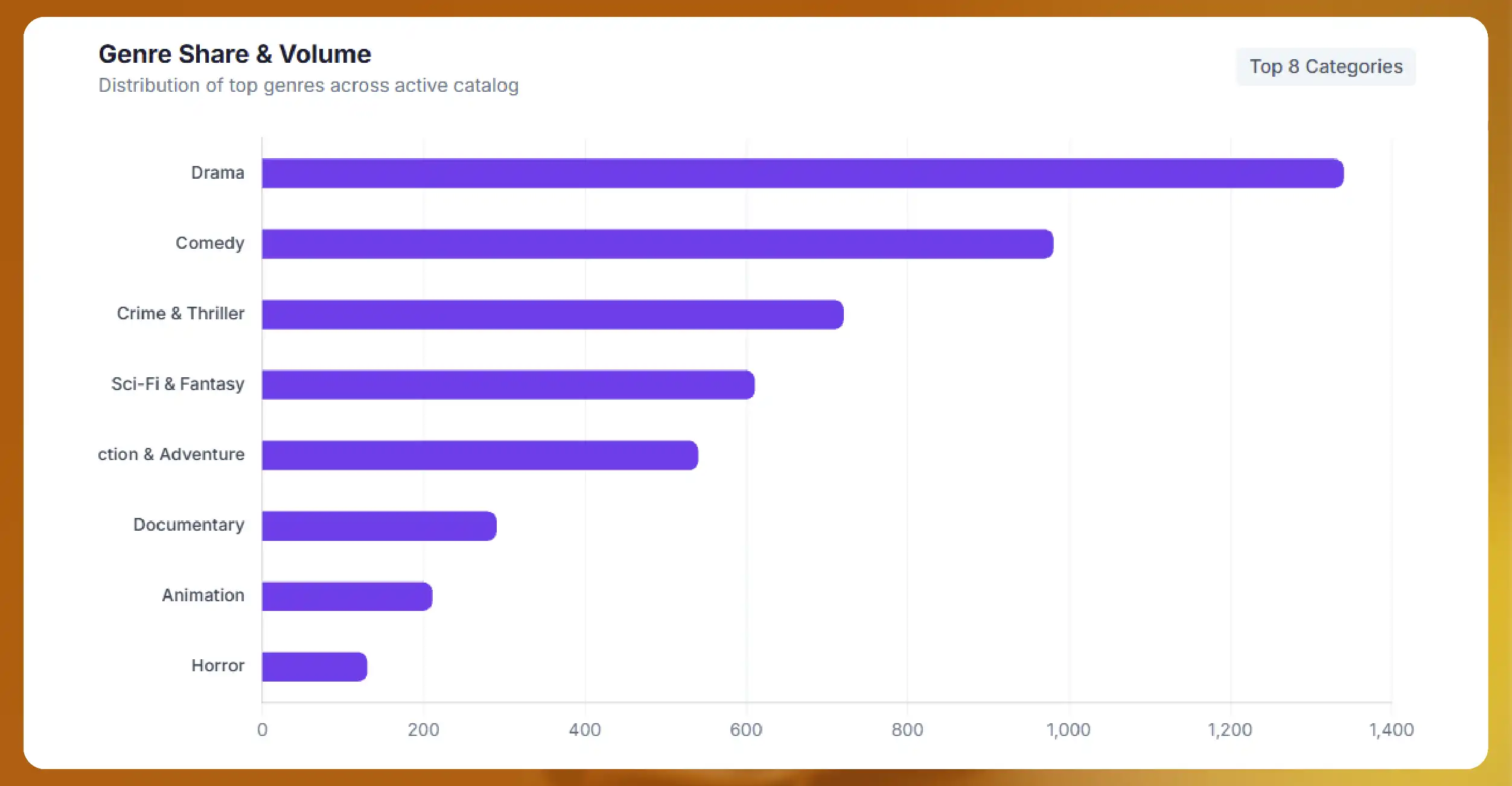
Structured streaming data provides a foundation for monitoring these changes systematically. Analysts can compare content volumes, genre distributions, release patterns, ratings, and catalog composition over time.
For example, an OTT analyst could examine:
- Number of movies versus TV shows
- Genre distribution
- Content release years
- Runtime patterns
- Ratings and review information
- Popularity indicators
- Cast and creator relationships
- Content availability by market
- Changes in catalog size
- New title additions and removals
These datasets can subsequently support dashboards, research reports, machine-learning pipelines, recommendation engines, and competitive intelligence platforms.
Key Fields in an HBO Max Dataset
A well-structured dataset can contain multiple layers of metadata. The exact fields depend on the collection scope, source availability, geography, and business requirements.
| Data Category | Example Dataset Fields |
|---|---|
| Title Information | Title, content type, description, original title |
| Genre | Primary genre, secondary genre, category |
| Release | Release date, release year, season |
| Duration | Runtime, episode duration |
| Cast | Actors, directors, creators |
| Ratings | Rating value, rating count, review indicators |
| Availability | Market, availability status, collection date |
| TV Metadata | Seasons, episodes, episode titles |
| Platform Metadata | Platform category, content classification |
| Tracking | First seen, last seen, update timestamp |
Combining these fields enables businesses to create comprehensive entertainment intelligence datasets rather than relying on isolated title lists.
HBO Max Content Data Extraction for Market Research
HBO Max Content Data Extraction can support detailed market research by turning streaming catalog information into standardized records. Researchers can analyze the platform's content mix and compare it with other streaming services using consistent data structures.
A content dataset can help answer questions such as:
- Which genres occupy the largest share of the catalog?
- How frequently are new titles introduced?
- Which release years appear most frequently?
- What types of content receive stronger ratings?
- How does movie availability compare with television programming?
- Which creators or actors appear across multiple titles?
Historical snapshots are particularly useful. Rather than examining only today's catalog, analysts can maintain periodic datasets to identify additions, removals, metadata changes, and evolving content strategies.
Building an HBO Max Ratings and Reviews Dataset

Audience feedback provides another valuable layer of entertainment intelligence. An HBO Max ratings and reviews dataset can organize available rating and review-related information alongside title-level metadata.
When combined with genres, release dates, runtime, cast, and content types, rating information can support broader analysis. Businesses can identify relationships between audience response and content characteristics.
For example, analysts can segment titles according to:
- Rating ranges
- Review volume
- Genre
- Release period
- Movie versus series format
- Runtime
- Cast or creator
- Market availability
Such datasets can also support sentiment-oriented research when review text is legally and technically available for collection and its use complies with applicable terms and policies.
Applications of HBO Max OTT Data
An HBO Max OTT data for content intelligence strategy can serve multiple business functions.
Competitive Intelligence
Media companies can compare catalog depth, genre
concentration, release activity, and content availability across competing streaming services.
Content Strategy
Studios and production companies can examine catalog trends to
understand which genres, formats, and themes receive significant platform representation.
Recommendation Systems
Structured metadata can become an input for recommendation
engines that organize content according to genres, cast, creators, release periods, and other
attributes.
Market Research
Research teams can use historical catalog datasets to study the
evolution of streaming services and identify changes in content strategies.
Investment Analysis
Investors and media analysts can combine content datasets
with other market indicators to develop broader research models around streaming businesses.
Dashboard Development
Organizations can transform structured records into
interactive dashboards showing content counts, genre distributions, release trends, ratings, and
catalog changes.
Automating HBO Max Streaming Data Collection
Manual collection becomes increasingly difficult when datasets contain thousands of records and require regular updates. Automated workflows can reduce repetitive data gathering and standardize the resulting records.
An HBO Max Streaming Data Scraping API can provide a programmatic approach for integrating collected information into business applications, analytical systems, and data pipelines.
A typical workflow can involve:
- Identifying permitted data sources and collection requirements.
- Defining the required fields.
- Collecting publicly accessible information where permitted.
- Extracting relevant metadata.
- Standardizing inconsistent values.
- Removing duplicates.
- Validating records.
- Adding timestamps.
- Exporting structured datasets.
- Delivering data through APIs, files, or databases.
This approach can support recurring collection schedules and reduce the need for manual catalog maintenance.
Data Quality and Standardization
A useful OTT dataset requires more than simply collecting large quantities of records. Data quality determines whether the resulting information can be reliably analyzed.
Common data-quality processes include normalization of title names, standardized genre classifications, consistent date formats, duplicate detection, missing-field checks, and validation of rating values.
For historical monitoring, timestamps are particularly important. They allow analysts to distinguish between current records and earlier catalog snapshots.
Geographic metadata can also be important because streaming availability may differ across markets. A dataset designed for international analysis should therefore preserve relevant market-level information rather than combining records indiscriminately.
OTT and Media Data Scraping for Business Intelligence
The broader OTT and media data scraping ecosystem extends beyond a single streaming platform. Businesses can build multi-platform datasets covering movies, television shows, sports, documentaries, genres, ratings, release dates, and availability.
Cross-platform datasets make it possible to conduct comparative analysis. For example, researchers can examine how frequently specific genres appear across services or compare the composition of catalogs in different markets.
When collection is performed at regular intervals, organizations can also build historical databases that show how streaming catalogs evolve.
Benefits of a Structured Dataset
A structured HBO Max dataset offers several advantages over manually maintained spreadsheets.
- Scalability: Automated workflows can handle large numbers of records.
- Consistency: Standardized fields make different records easier to compare.
- Freshness: Scheduled collection can keep datasets updated.
- Historical Tracking: Periodic snapshots can reveal catalog changes.
- Integration: Structured files can feed dashboards, databases, and analytical systems.
- Customization: Businesses can define fields according to their specific research objectives.
How iWeb Data Scraping Can Help You?
Customized Dataset Development
iWeb Data Scraping can design structured entertainment datasets around your required fields, markets, content categories, metadata attributes, ratings, availability, and historical tracking requirements.
Automated Data Collection
Its automated workflows can support recurring collection schedules, helping businesses maintain updated OTT records without relying on repetitive manual research and spreadsheet maintenance.
Data Cleaning and Standardization
Collected records can be normalized, deduplicated, validated, and organized into consistent schemas, making them easier to integrate with analytics platforms, dashboards, databases, and research workflows.
API and Dashboard Integration
Structured streaming datasets can be prepared for API-based delivery, business intelligence dashboards, internal applications, research platforms, and analytical pipelines requiring regularly refreshed entertainment information.
Scalable Data Solutions
iWeb Data Scraping can support expanding requirements across platforms, regions, categories, and datasets, enabling organizations to build broader OTT intelligence systems as their analytical needs grow.
Conclusion
An HBO Max dataset can provide a valuable foundation for understanding streaming catalogs, content composition, audience signals, release patterns, and platform-level changes. When structured and refreshed systematically, it can support content research, competitive intelligence, recommendation systems, dashboards, and market analysis.
Businesses can combine scraping API, Managed web scraping, and Mobile app scraping capabilities with structured data processing to develop scalable OTT intelligence workflows. With appropriate source permissions, data-quality controls, and regular updates, streaming datasets can become a reliable component of broader media analytics strategies.
FAQs
An HBO Max dataset is a structured collection of streaming-related information such as titles, genres, release dates, runtime, cast, ratings, and availability attributes.
It can support OTT market research, catalog analysis, competitive intelligence, recommendation systems, content strategy, dashboards, and entertainment analytics.
Automated collection can be implemented for permitted and publicly accessible data sources, subject to applicable website terms, technical restrictions, copyright, and privacy requirements.
Depending on the project, structured datasets can be delivered in formats such as CSV, JSON, Excel, database tables, or API-ready structures.
Update frequency depends on the analytical requirement. Daily, weekly, or scheduled collection can be used when ongoing catalog monitoring is required.