Introduction
The grocery retail industry is becoming increasingly data-centric as businesses strive to respond quickly to changing customer preferences, dynamic pricing strategies, supply chain disruptions, and evolving market competition. Modern retailers no longer depend solely on historical reports for decision-making. Instead, they leverage live inventory updates, automated pricing intelligence, and structured product datasets to improve operational efficiency and maximize profitability. Advanced retail analytics allow organizations to monitor thousands of products across multiple store locations while identifying pricing opportunities and inventory fluctuations in real time.
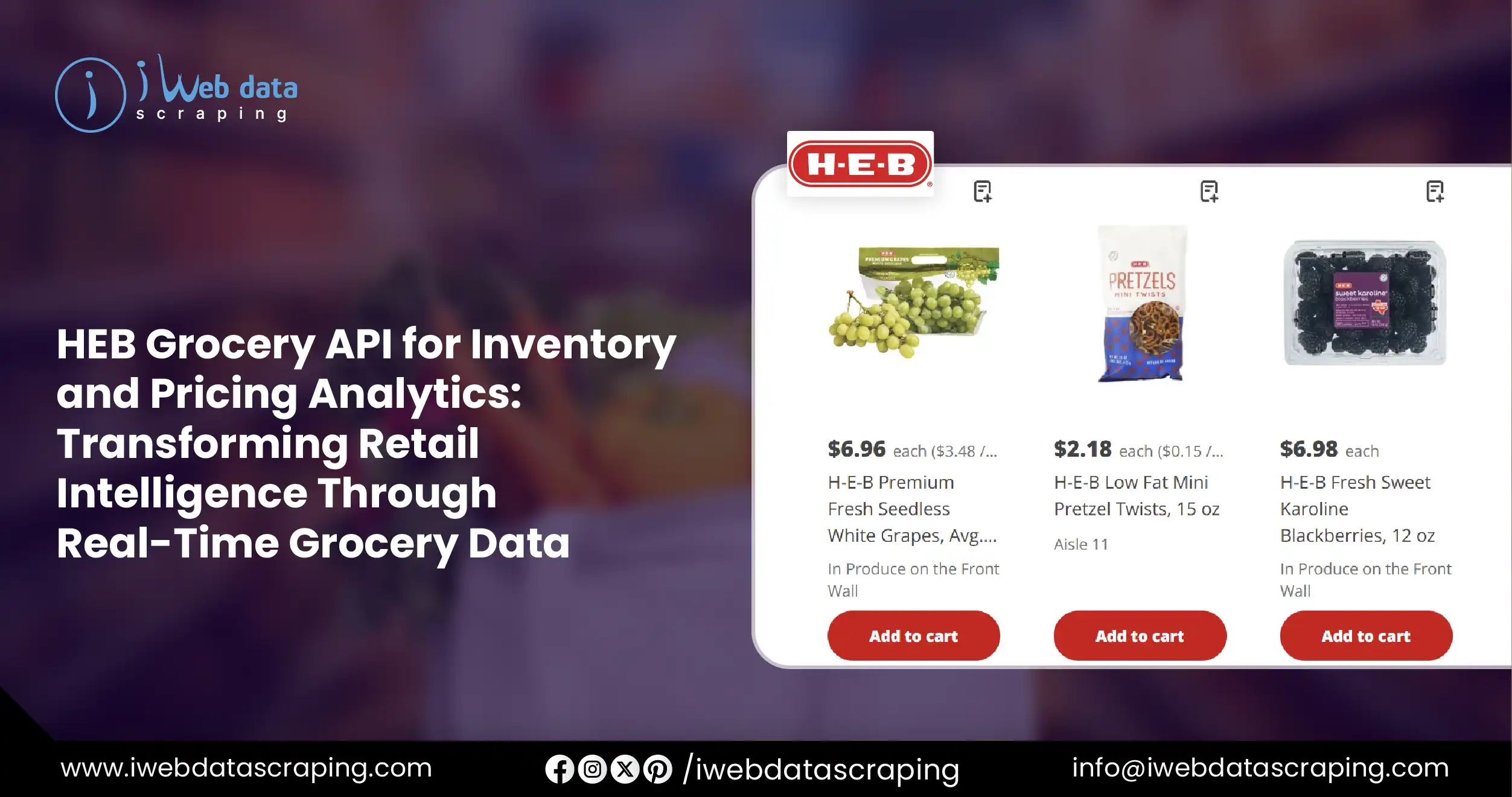
Organizations implementing HEB Grocery API for inventory and pricing analytics gain continuous access to structured product information that supports pricing optimization, category benchmarking, inventory forecasting, and promotional analysis. In parallel, HEB grocery data extraction enables enterprises to collect detailed information including product descriptions, categories, nutritional attributes, package sizes, availability, pricing, and promotional offers. The growing adoption of Real-time HEB Grocery price monitoring further empowers retailers, suppliers, and manufacturers to respond instantly to changing market conditions while maintaining a competitive position.
The Growing Role of Grocery Data Intelligence
Retail grocery businesses generate enormous volumes of operational data every hour. Product prices change because of supplier negotiations, seasonal demand, promotional campaigns, transportation costs, and competitive market activity. Similarly, inventory levels fluctuate continuously as products move through distribution centers, warehouses, and retail stores.
Modern grocery intelligence platforms consolidate this information into structured datasets that provide valuable insights for retailers, consumer packaged goods manufacturers, distributors, wholesalers, and market research organizations. Instead of manually tracking individual products, businesses now automate data collection using APIs and intelligent extraction systems that deliver reliable information around the clock.
Access to structured grocery intelligence improves forecasting accuracy, enhances merchandising decisions, supports procurement planning, and enables businesses to identify emerging retail trends before they significantly impact sales performance.
Building Comprehensive Inventory Intelligence
Effective inventory management depends on timely visibility into stock availability across thousands of products. Grocery retailers manage highly dynamic inventories consisting of fresh produce, dairy products, frozen foods, beverages, packaged goods, bakery items, household supplies, personal care products, and seasonal merchandise.
Businesses that Extract HEB grocery inventory API information can continuously monitor inventory changes across multiple stores and regions. Real-time visibility into inventory availability helps procurement teams improve replenishment schedules, optimize warehouse utilization, minimize stock shortages, and reduce excess inventory carrying costs.
Accurate inventory intelligence also supports demand forecasting models by identifying recurring purchasing patterns, seasonal demand spikes, and supply chain disruptions before they affect customer satisfaction.
Comprehensive Grocery Pricing Dataset
| Dairy |
Whole Milk |
1 Gallon |
4.89 |
4.49 |
8.2 |
In Stock |
95 |
4.72 |
Stable |
| Dairy |
Greek Yogurt |
32 oz |
5.99 |
5.39 |
10.0 |
In Stock |
81 |
5.69 |
Rising |
| Bakery |
Whole Wheat Bread |
20 oz |
3.19 |
2.79 |
12.5 |
In Stock |
88 |
2.95 |
Stable |
| Pantry |
Long Grain Rice |
5 lb |
7.49 |
6.79 |
9.3 |
In Stock |
84 |
7.02 |
Rising |
| Pantry |
Pasta |
16 oz |
2.09 |
1.79 |
14.4 |
In Stock |
79 |
1.89 |
Stable |
| Beverages |
Orange Juice |
52 oz |
5.69 |
4.99 |
12.3 |
Low Stock |
76 |
5.31 |
Declining |
| Beverages |
Ground Coffee |
12 oz |
10.49 |
9.49 |
9.5 |
In Stock |
82 |
9.88 |
Rising |
| Frozen Foods |
Family Pizza |
Each |
8.49 |
7.49 |
11.8 |
In Stock |
86 |
7.95 |
Stable |
| Household |
Laundry Detergent |
100 oz |
15.49 |
13.99 |
9.7 |
In Stock |
70 |
14.42 |
Rising |
| Household |
Dish Soap |
24 oz |
4.29 |
3.79 |
11.7 |
In Stock |
68 |
3.95 |
Stable |
| Snacks |
Potato Chips |
8 oz |
4.79 |
3.99 |
16.7 |
Low Stock |
90 |
4.28 |
Rising |
| Breakfast |
Corn Flakes |
18 oz |
5.89 |
5.09 |
13.6 |
In Stock |
73 |
5.45 |
Stable |
Pricing Intelligence for Competitive Retail Strategy
Pricing intelligence has become one of the most influential factors in grocery retail performance. Customers frequently compare prices across physical stores and online grocery platforms before making purchasing decisions. Even small pricing differences can significantly affect sales volume, customer loyalty, and market share.
Continuous monitoring enables retailers to detect promotional activities, temporary discounts, bundle pricing strategies, and seasonal price adjustments across thousands of products. These insights allow organizations to refine pricing models while balancing profitability and customer expectations.
Retailers also evaluate pricing elasticity by measuring consumer response to price changes, enabling data-driven pricing decisions that maximize both revenue and inventory turnover.
Inventory Analytics Supporting Supply Chain Optimization
Inventory analytics extends far beyond identifying whether products are available on store shelves. Businesses increasingly analyze inventory velocity, replenishment frequency, stock turnover ratios, supplier lead times, warehouse capacity, and regional demand patterns.
Through HEB Grocery inventory Data Scraping, organizations receive continuously updated information that improves procurement planning and distribution efficiency. Supply chain managers can anticipate inventory shortages, identify slow-moving products, optimize warehouse allocations, and improve supplier collaboration using accurate operational data.
Such intelligence minimizes stockouts while reducing unnecessary inventory accumulation, helping retailers achieve healthier inventory turnover rates and improved customer satisfaction.
Understanding Consumer Demand Through Historical Analytics
Historical grocery datasets reveal long-term purchasing behavior that supports strategic planning across multiple business functions. Retailers examine product performance over weeks, months, and seasonal cycles to understand demand fluctuations caused by holidays, weather changes, inflation, and promotional events.
Historical analysis also identifies recurring purchasing trends within specific product categories, allowing businesses to improve assortment planning and inventory allocation. Consumer packaged goods manufacturers benefit from these insights by aligning production schedules with anticipated retail demand.
Historical pricing intelligence further enables businesses to distinguish temporary market fluctuations from long-term pricing trends, supporting more accurate forecasting models.
Regional Pricing and Inventory Intelligence
Regional grocery markets often display significant differences in pricing, product assortment, and inventory availability. Transportation costs, demographic characteristics, supplier networks, local competition, and seasonal demand contribute to these regional variations.
Organizations performing HEB grocery competitor price comparison can evaluate pricing consistency across multiple locations while identifying opportunities to strengthen regional competitiveness. Understanding local pricing dynamics allows retailers to develop customized pricing strategies that better reflect consumer purchasing behavior within each geographic market.
Regional inventory analytics also improve distribution planning by ensuring products are allocated according to localized demand rather than broad national averages.
Enterprise Grocery Analytics Dataset
| Dairy |
1,260 |
5 |
48 |
14 |
10.4 |
96.2 |
185 |
4.6 |
95 |
| Fresh Produce |
2,340 |
7 |
101 |
20 |
8.2 |
93.8 |
190 |
4.5 |
93 |
| Bakery |
910 |
4 |
37 |
12 |
9.1 |
95.4 |
182 |
4.4 |
91 |
| Frozen Foods |
1,610 |
5 |
43 |
18 |
13.8 |
97.1 |
188 |
4.6 |
94 |
| Beverages |
2,480 |
6 |
54 |
24 |
12.5 |
96.8 |
191 |
4.5 |
96 |
| Snacks |
2,920 |
6 |
49 |
22 |
14.6 |
95.7 |
186 |
4.4 |
95 |
| Household Essentials |
1,470 |
3 |
28 |
11 |
11.4 |
97.5 |
179 |
4.5 |
92 |
| Personal Care |
1,020 |
3 |
23 |
9 |
10.8 |
98.1 |
176 |
4.6 |
93 |
| Meat & Seafood |
1,210 |
7 |
76 |
15 |
7.9 |
92.6 |
184 |
4.7 |
90 |
| Pantry Staples |
2,840 |
5 |
53 |
18 |
9.5 |
97.3 |
189 |
4.5 |
94 |
| Baby Care |
650 |
2 |
19 |
6 |
8.7 |
98.5 |
171 |
4.8 |
95 |
| Pet Supplies |
980 |
3 |
22 |
8 |
9.8 |
97.8 |
174 |
4.6 |
93 |
Competitive Benchmarking Through Grocery Intelligence
Retail organizations increasingly depend on competitive benchmarking to evaluate pricing strategies, promotional effectiveness, and assortment positioning. Comparing product prices across retailers provides actionable insights into market competitiveness while revealing opportunities to improve customer value propositions.
Businesses that Extract grocery price trends from HEB can analyze pricing behavior over extended periods, identifying seasonal patterns, inflationary impacts, promotional frequency, and long-term category performance. These datasets enable pricing teams to build predictive models that anticipate future market conditions rather than merely reacting to them.
Long-term competitive intelligence also strengthens supplier negotiations by providing evidence-based pricing benchmarks across comparable grocery categories.
Business Applications Across the Grocery Ecosystem
Structured grocery intelligence supports a wide range of organizations throughout the retail value chain. Retail grocery companies use detailed datasets to improve pricing strategies, optimize inventory allocation, and strengthen merchandising decisions. Consumer packaged goods manufacturers analyze retail performance to evaluate brand visibility and promotional effectiveness. Market research firms utilize comprehensive grocery data to measure category growth, consumer demand, and competitive positioning.
Investment firms increasingly rely on grocery analytics to evaluate retail performance indicators, while supply chain providers leverage inventory intelligence to improve logistics planning. Technology companies also integrate structured grocery datasets into advanced business intelligence platforms that deliver predictive analytics, automated reporting, and machine learning applications.
Organizations implementing H-e-b Grocery and Supermarket Data Extraction Services gain scalable access to structured product, pricing, inventory, and promotional data that supports informed decision-making across every stage of retail operations. Comprehensive Grocery Dataset from H-e-b solutions further enable businesses to build sophisticated forecasting models, evaluate assortment performance, and monitor market dynamics with greater precision. These insights become even more valuable when combined with enterprise-grade Grocery and Supermarket Store Datasets, providing a unified view of product performance across multiple locations and categories.
Conclusion
The evolution of grocery retail continues to be driven by data accuracy, automation, and real-time decision-making. Organizations that invest in structured pricing and inventory intelligence gain a measurable advantage through faster response times, improved operational efficiency, and stronger competitive positioning. As pricing becomes increasingly dynamic and inventory conditions change throughout the day, continuous access to reliable grocery data becomes an essential component of modern retail strategy.
Enterprise-grade Grocery & Supermarket Data Extraction Services enable retailers, manufacturers, distributors, and analytics firms to transform raw product information into actionable business intelligence. Supported by advanced Web Scraping Services and scalable Web Scraping API Services, organizations can continuously monitor pricing movements, inventory availability, promotional activities, and market trends, empowering data-driven decisions that enhance profitability, customer satisfaction, and long-term growth.
Experience top-notch web scraping service and mobile app scraping solutions with iWeb Data Scraping. Our skilled team excels in extracting various data sets, including retail store locations and beyond. Connect with us today to learn how our customized services can address your unique project needs, delivering the highest efficiency and dependability for all your data requirements.