
86.4K+
HISTORICAL HOTEL RATE RECORDS PROCESSED

Historical Hotel Rate Data Scraping for Smarter Pricing Insights, Competitive Benchmarking, Seasonal Analysis, and Revenue Optimization Across Hotel Groups.
This case study explores how a multi-property hotel group transformed fragmented accommodation pricing information into structured revenue intelligence through automated data extraction, historical rate tracking, and advanced hospitality analytics. The organization operated hotels across multiple cities, destinations, and customer segments, making it increasingly difficult to understand pricing movements, evaluate competitor strategies, and maintain consistent revenue management practices.
It is particularly relevant for:
The client's primary objective was to establish a centralized pricing intelligence framework capable of tracking historical room rates, identifying market-wide pricing patterns, and supporting informed commercial decisions. The organization wanted to move beyond isolated pricing checks and develop a reliable understanding of how hotel rates changed across different seasons, weekdays, destinations, room categories, and distribution channels.
The hotel group partnered with iWeb Data Intelligence to establish an automated hospitality data intelligence framework that captured, organized, and analyzed accommodation pricing information across multiple properties and booking platforms.
The project focused on developing a centralized hotel rate history dataset containing historical room prices, property information, occupancy-related indicators, booking conditions, and rate variations across different travel periods.
Using automated data collection pipelines, the system gathered publicly accessible hotel pricing information across selected online travel agencies and hotel booking channels. Data was standardized according to property identifiers, room categories, occupancy configurations, check-in dates, stay durations, cancellation policies, and currency values.
The resulting hotel revenue management data provided a consistent foundation for comparing historical pricing movements and identifying commercial opportunities.
The analytical framework examined weekday and weekend pricing differences, seasonal demand patterns, advance booking windows, promotional discounts, and competitor rate positioning. It also enabled hotel managers to understand how room prices evolved during holidays, local events, peak travel periods, and low-demand seasons.
The client operated a growing hotel portfolio across multiple destinations. Each property had different demand characteristics, customer segments, room categories, and competitive environments. Managing pricing decisions across this diverse portfolio required reliable historical information, which was not readily available through its existing systems.
Limited Historical Pricing Visibility
The organization primarily relied on current booking rates and internally maintained spreadsheets. Although these provided basic pricing information, they did not offer sufficient historical context to understand how competitor rates changed over several months. Revenue managers struggled to identify recurring seasonal patterns and distinguish temporary promotions from long-term pricing movements.
Fragmented Information Across Booking Channels
Hotel rates were distributed across direct booking websites and multiple online travel agencies. Differences in room descriptions, occupancy configurations, taxes, cancellation conditions, and promotional offers made comparisons difficult. The client lacked a unified dataset that could bring these observations together under consistent property and room identifiers.
Inconsistent Competitor Benchmarking
Competitor pricing was monitored manually and at irregular intervals. Consequently, the organization could not consistently evaluate whether its properties were competitively positioned during important booking periods. Limited historical comparisons also made it difficult to understand how competitors responded to seasonal demand and market changes.
Complex Seasonal Demand Patterns
Room rates fluctuated according to holidays, festivals, business travel, local events, and destination-specific tourism cycles. The client struggled to identify these movements accurately across its entire portfolio. Without sufficient historical evidence, pricing adjustments sometimes depended heavily on individual experience rather than measurable market patterns.
To address these challenges, the client required a scalable hospitality data collection solution that could continuously capture pricing observations, preserve historical records, and convert fragmented accommodation information into actionable intelligence.
The organization replaced fragmented manual monitoring with an automated data intelligence framework. This enabled systematic collection, standardization, and comparison of hotel pricing information across multiple properties and distribution channels.
| Dimension | Manual Monitoring | iWeb Data Scraping System |
|---|---|---|
| Data collection | Individual website checks | Automated multi-source collection |
| Historical coverage | Limited spreadsheet records | Centralized historical observations |
| Rate comparison | Manual property comparisons | Standardized competitor benchmarking |
| Seasonal analysis | Experience-based assessments | Data-backed seasonal comparisons |
| Room classification | Inconsistent room descriptions | Normalized room category mapping |
| Currency handling | Manual conversion | Standardized currency processing |
| Reporting | Periodic spreadsheet reports | Interactive analytical dashboards |
| Data scalability | Limited monitoring capacity | Expandable property and channel coverage |
| Trend identification | Reactive analysis | Historical pattern identification |
| Data quality | Manual validation | Automated cleaning and verification |
The structured approach improved consistency across the hotel group's pricing intelligence operations. Rather than depending on individual website checks, the organization could access historical observations through a centralized analytical environment.
The brand in focus is a multi-property hospitality group operating across business travel destinations, leisure markets, and popular tourist locations. Its portfolio includes different accommodation categories, ranging from business-oriented hotels to premium and leisure-focused properties.
The organization competes in an increasingly dynamic hospitality environment where room prices can change frequently according to demand, availability, booking lead times, competitor activity, and distribution channel strategies.
As its portfolio expanded, the organization encountered growing difficulties in maintaining consistent pricing intelligence across its properties. Different booking platforms displayed varying room configurations, promotional conditions, and rate structures. These differences made it challenging to establish accurate comparisons and identify the actual competitive position of individual properties.
The group recognized that effective revenue management required more than access to current room prices. It needed historical information that could explain how rates evolved, when competitors adjusted their pricing, and which market conditions influenced accommodation costs.
iWeb implemented an end-to-end hotel pricing intelligence solution designed to capture, process, and organize historical accommodation rates across selected booking sources.
The solution combined automated data extraction, property matching, data normalization, historical storage, and analytical dashboard development.
Multi-Source Hotel Rate Collection
The first stage involved identifying relevant hotel properties, booking channels, and competitor groups. Automated extraction pipelines collected publicly available accommodation information, including displayed room rates, property names, destinations, room categories, check-in dates, and booking conditions.
Collection schedules were configured according to source accessibility and monitoring requirements.
Historical Data Structuring
Raw pricing observations were converted into standardized records. Each observation was associated with a property identifier, room category, occupancy configuration, booking date, stay date, and source channel.
This structure enabled consistent comparisons across different properties and booking platforms.
Property and Room Matching
Hotel names and room descriptions frequently differed across distribution channels. The system implemented matching rules using property names, addresses, location details, room characteristics, and other available identifiers.
This reduced mismatches and improved the reliability of competitor comparisons.
Data Cleaning and Validation
Duplicate observations, incomplete records, inconsistent currencies, and incorrectly formatted values were identified through automated validation procedures.
Where available, tax information, cancellation conditions, meal inclusions, and promotional labels were retained as separate attributes to avoid misleading price comparisons.
Historical Analytics and Benchmarking
Processed records were analyzed to identify seasonal pricing movements, weekday-weekend differences, competitor rate gaps, promotional patterns, and advance booking variations.
The framework also supported property-level and destination-level comparisons.
Dashboard Integration
The final datasets were integrated into analytical dashboards that allowed commercial teams to explore historical rate movements, compare competitors, and evaluate pricing opportunities.
The solution established a repeatable intelligence pipeline that could accommodate additional properties, destinations, and booking sources as the hotel group's monitoring requirements expanded.
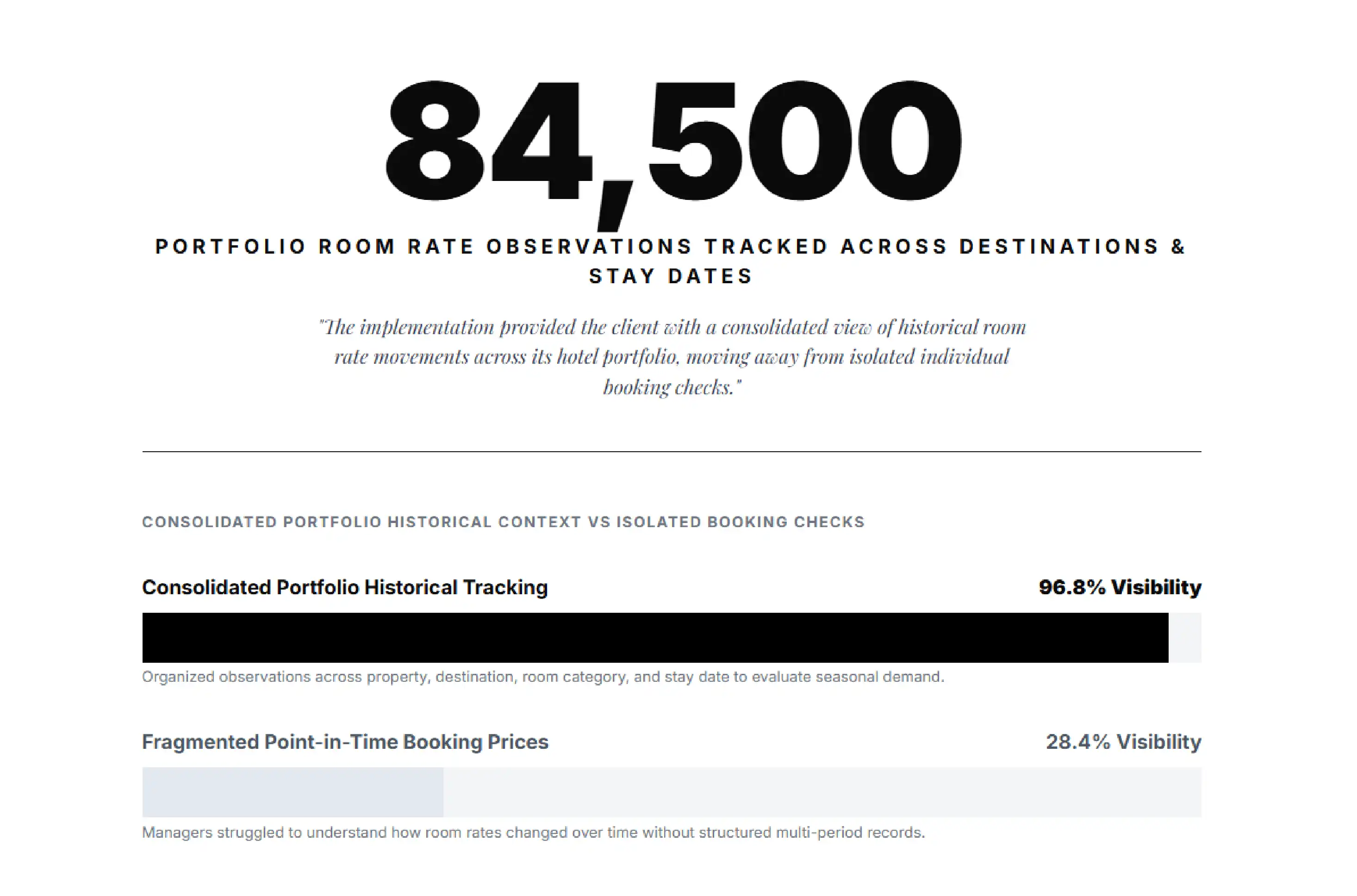
The implementation provided the client with a consolidated view of historical room rate movements across its hotel portfolio.
Previously, managers could access individual booking prices but struggled to understand how those prices changed over time. The new framework organized observations according to property, destination, room category, and stay date.
This allowed analysts to identify recurring pricing patterns, compare different booking periods, and understand the relationship between seasonal demand and displayed room rates.
The organization could distinguish between temporary promotional adjustments and broader pricing movements.
Historical comparisons also helped managers evaluate whether rate increases were consistent with competitor behavior or represented an opportunity to improve market positioning.
As a result, pricing decisions became more evidence-based and less dependent on isolated observations.
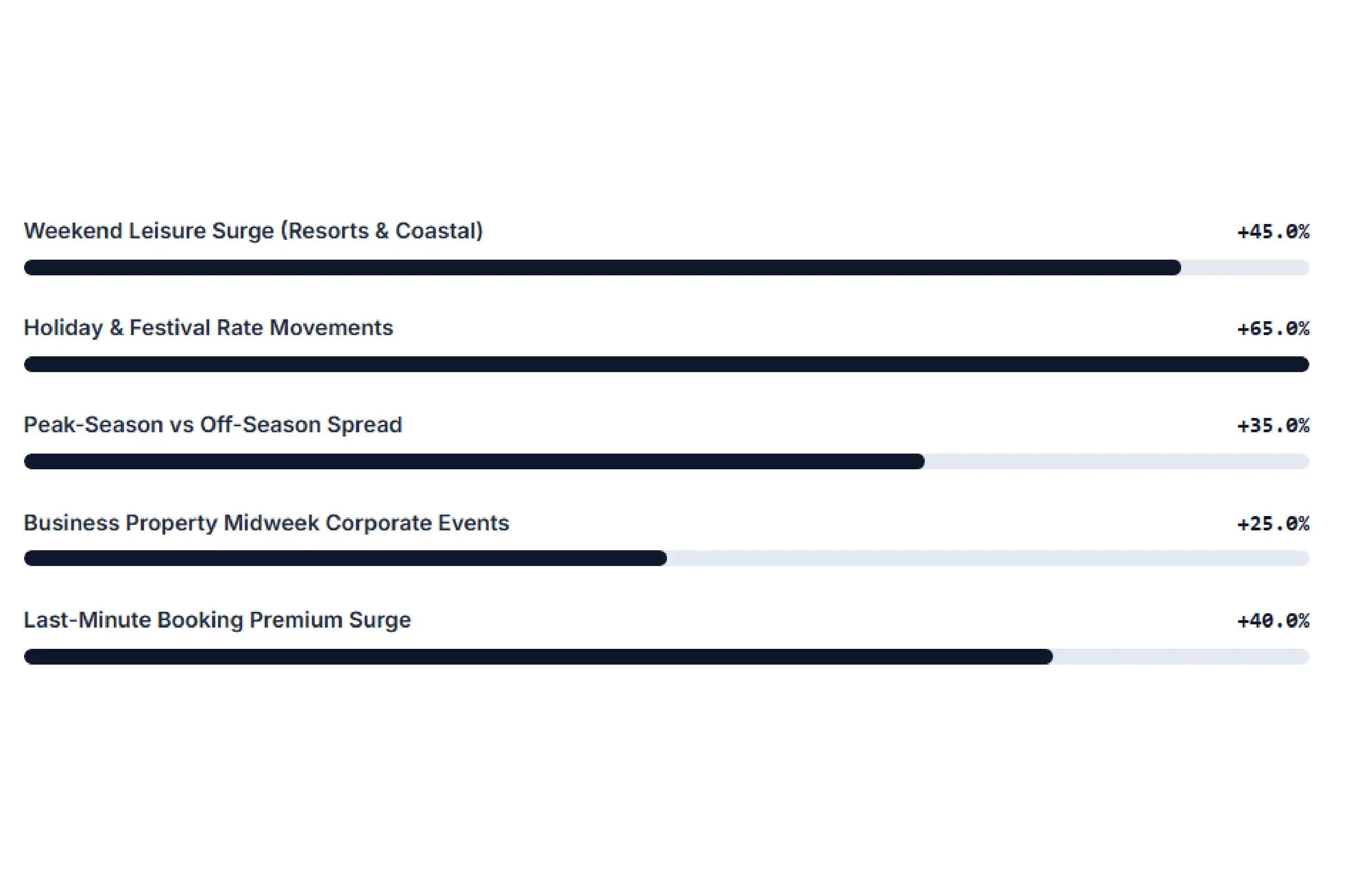
The analysis revealed that hotel pricing behavior differed considerably across travel periods.
Weekend accommodation rates often followed different patterns from weekday rates, particularly in leisure destinations. Business-oriented properties demonstrated different pricing characteristics during weekdays, corporate travel periods, and major industry events.
The system helped identify these differences through structured comparisons of historical observations.
Revenue managers could examine:
This information supported better planning for promotional campaigns and seasonal pricing adjustments.
The client gained a more consistent approach to evaluating its competitive position across different destinations.
The system compared similar properties using available location information, accommodation categories, room configurations, occupancy conditions, and booking policies.
This was important because comparing two displayed prices without considering their underlying conditions could produce misleading conclusions.
The analytical framework helped revenue managers understand whether a competitor's lower displayed rate reflected a genuine pricing advantage or differences in room inclusions, cancellation flexibility, and promotional conditions.
| Benchmarking Metric | Insight Captured | Business Application |
|---|---|---|
| Average room rate | Average displayed price | Property-level pricing comparison |
| Competitor rate gap | Difference between comparable rates | Competitive positioning |
| Seasonal rate movement | Changes across travel periods | Seasonal revenue planning |
| Weekend premium | Weekend versus weekday difference | Stay-date optimization |
| Promotional discount | Displayed promotional reduction | Campaign evaluation |
| Booking lead time | Difference across booking windows | Advance pricing strategy |
| Room category premium | Rate variation by room type | Room inventory positioning |
| Cancellation flexibility | Refundable versus non-refundable conditions | Rate comparability |
The resulting benchmarking framework helped management understand pricing opportunities across its portfolio.
The following illustrative dataset demonstrates how structured hotel pricing observations can be organized for competitive benchmarking and historical analysis.
Illustrative sample records; not verified live hotel prices.
| Hotel Name | Destination | Room Type | Stay Period | Historical Rate | OTA Source Name |
|---|---|---|---|---|---|
| Grand Palace | Delhi | Deluxe | January | $125 | Booking.com |
| City Comfort | Mumbai | Standard | January | $98 | Expedia |
| Royal Suites | Jaipur | Premium | February | $145 | Booking.com |
| Ocean View | Goa | Sea View | February | $185 | Agoda |
| Business Inn | Bengaluru | Executive | March | $112 | Expedia |
| Heritage Stay | Udaipur | Deluxe | March | $155 | Booking.com |
| Metro Residency | Hyderabad | Standard | April | $105 | Agoda |
| Mountain Retreat | Shimla | Premium | April | $172 | Expedia |
The sample illustrates how different properties and destinations can be compared using consistent pricing attributes.
A complete production dataset may include additional information such as:
Maintaining these attributes allows analysts to compare equivalent accommodation products rather than relying exclusively on headline prices.
The implementation of structured hotel pricing intelligence improved the organization's ability to evaluate market conditions, benchmark competitors, and develop more informed revenue management strategies.
The following illustrative project outcomes demonstrate the business value of the implemented framework.
iWeb Data Intelligence provides structured data collection and processing capabilities designed to help hospitality organizations transform fragmented online information into reliable analytical resources.
Unified Data Collection
Our approach consolidates hotel pricing information from multiple publicly accessible sources into a standardized structure. This reduces fragmentation and helps organizations establish consistent property-level and destination-level comparisons.
Historical Price Monitoring
Automated collection pipelines preserve pricing observations over time, helping revenue managers examine seasonal movements, competitor adjustments, promotional activity, and historical rate differences across multiple booking periods.
Data Accuracy and Standardization
Advanced cleaning, validation, and deduplication procedures improve consistency across property names, room descriptions, currencies, booking conditions, and pricing attributes.
Scalable Data Infrastructure
Our framework supports expanding property portfolios, additional destinations, and new distribution channels without requiring organizations to depend on repetitive manual collection processes.
Actionable Business Intelligence
Structured datasets and analytical dashboards help commercial teams understand pricing behavior, evaluate competitive positioning, improve reporting efficiency, and make informed revenue management decisions.
Flexible Delivery Formats
Processed information can be delivered through CSV, Excel, JSON, databases, APIs, and customized dashboard integrations according to business requirements.
"The historical hotel pricing intelligence solution has significantly improved how we monitor our portfolio and evaluate competitor rates. Earlier, our teams depended on manual research and disconnected spreadsheets, which made historical comparisons difficult and time-consuming. The centralized dataset and dashboards have provided better visibility into seasonal pricing patterns, booking channel differences, and competitor movements. We particularly appreciate the structured approach to data collection, validation, and reporting. The solution has strengthened our revenue management processes and helped our teams make more informed commercial decisions. It has also established a reliable foundation for future forecasting and hospitality analytics initiatives."
— Head of Revenue Management
The project delivered a centralized and scalable hotel pricing intelligence framework that transformed fragmented accommodation rate observations into structured historical business intelligence.
The hotel group gained improved visibility into pricing movements across its properties, destinations, room categories, and distribution channels. Automated collection and standardization reduced dependence on manual monitoring, while historical comparisons enabled revenue managers to understand seasonal fluctuations, competitor positioning, and promotional pricing strategies more effectively.
The implementation of OTA hotel price data collection capabilities also helped the organization examine displayed accommodation rates across selected online travel agencies and compare them with relevant booking channel information. By retaining important attributes such as room configuration, occupancy, booking conditions, and stay dates, the organization established a more consistent foundation for competitive benchmarking.
Furthermore, the structured historical database created opportunities to develop hotel rate forecasting data models by combining past pricing observations with occupancy trends, booking lead times, seasonality, local events, and other relevant demand indicators.
Historical hotel rate data refers to previously recorded accommodation prices across different properties, room categories, booking channels, and travel periods. It helps hospitality businesses understand pricing trends, seasonal fluctuations, competitor strategies, and historical market behavior.
Hotel groups can use historical pricing analysis to evaluate competitor rates, understand seasonal demand patterns, identify promotional opportunities, compare destinations, and improve revenue management decisions through structured historical information.
A hotel rate dataset can include property names, locations, room categories, displayed prices, currencies, check-in dates, check-out dates, booking channels, cancellation policies, meal inclusions, promotional offers, and observation timestamps.
Yes. iWeb can develop customized data collection pipelines to capture publicly accessible hotel pricing information from multiple selected booking sources, subject to source accessibility, technical limitations, and applicable terms and regulations.
Historical hotel pricing provides valuable information about previous rate movements and seasonal behavior. When combined with occupancy, booking pace, demand indicators, and market conditions, it can support predictive models and more informed revenue planning.
iWeb Data Intelligence helps hotel groups collect, structure, and analyze accommodation pricing information through customized data scraping solutions, historical datasets, APIs, and interactive dashboards. Build stronger competitor visibility, understand seasonal pricing movements, and establish a reliable foundation for smarter hospitality revenue management.
Start a projectFields marked * are required. Everything else just helps us scope faster — skip what you don't know yet.