

Introduction
The rapid expansion of online food delivery has made restaurant menu and pricing data an important source of competitive intelligence. iFood, one of Brazil's leading food delivery platforms, provides extensive information about restaurants, cuisines, dishes, prices, promotions, ratings, availability, delivery options, and locations. Businesses can use this information to understand local restaurant markets, benchmark competitors, and identify pricing opportunities.
Scrape iFood Restaurant Menus & Prices via API to collect structured restaurant information at scale instead of manually visiting individual restaurant pages. API-driven extraction can organize menu names, categories, prices, discounts, restaurant details, and availability into datasets suitable for analytics and automation.
iFood menu price API extraction can help businesses monitor how dishes are priced across restaurants, neighborhoods, cuisine categories, and time periods. Historical price observations can reveal price increases, discount patterns, premium positioning, and competitive gaps.
iFood restaurant pricing API intelligence can further transform raw menu information into actionable market intelligence. Restaurant aggregators, food-tech companies, market researchers, delivery businesses, and analytics platforms can compare prices and menus across large geographic areas while maintaining consistent datasets.
Understanding iFood Restaurant Menu Data
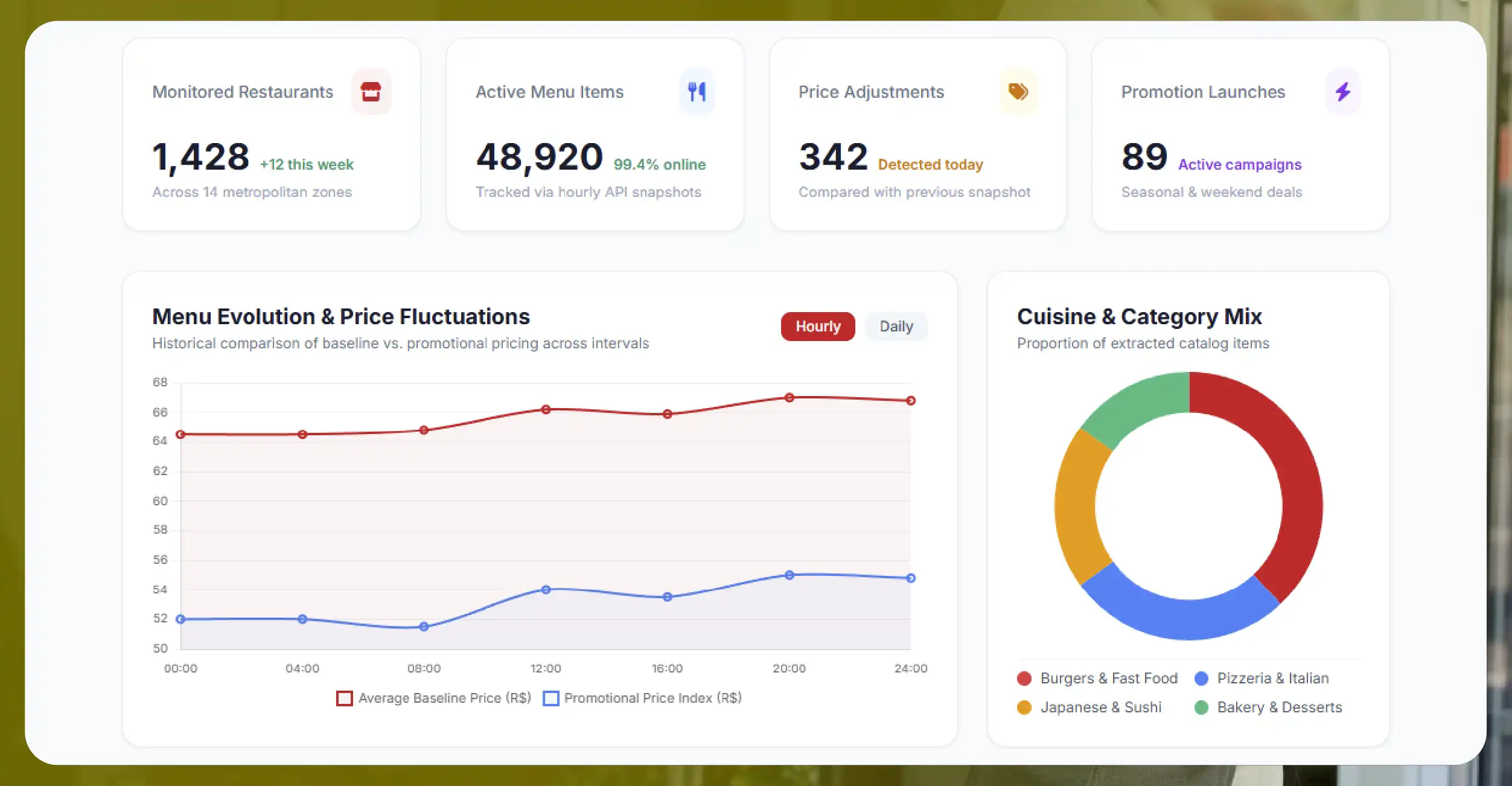
Restaurant menus contain considerably more information than dish names and prices. A comprehensive dataset can include restaurant name, restaurant identifier, cuisine type, menu categories, item names, descriptions, regular prices, promotional prices, portion information, add-ons, availability, ratings, delivery fees, estimated delivery time, and location.
API-based extraction is particularly useful because restaurant data changes frequently. Restaurants may modify prices, introduce seasonal products, discontinue dishes, launch promotions, or temporarily mark items unavailable. A scheduled extraction workflow can capture these changes repeatedly and build a historical database.
For example, a restaurant analytics company could collect menu observations every few hours or once per day. Comparing successive snapshots makes it possible to identify when prices changed and whether the adjustment was connected with a promotion or menu update.
The resulting dataset can support competitive benchmarking, market research, restaurant discovery, menu optimization, and pricing intelligence.
How API-Based iFood Data Extraction Works?
An API-oriented extraction architecture typically begins by identifying the required restaurant or geographic scope. Depending on the use case, the workflow may collect restaurants by city, neighborhood, cuisine, category, or delivery area.
The extraction layer retrieves relevant restaurant and menu information and converts the responses into standardized records. Data normalization is important because restaurants can structure their menus differently. One restaurant may organize products into starters, mains, desserts, and beverages, while another may use entirely different categories.
A standardized schema allows analysts to compare these restaurants consistently. Typical fields can include restaurant ID, restaurant name, cuisine, category, product name, description, regular price, promotional price, discount, availability, rating, delivery fee, estimated delivery time, latitude, longitude, and extraction timestamp.
The timestamp is especially valuable. Without historical timestamps, analysts only see the current menu state. With repeated collection, businesses can create a longitudinal dataset that shows how restaurant offerings and prices evolve.
iFood Restaurant Menu API Integration
iFood restaurant menu API integration can connect extracted restaurant information directly with internal analytics environments, applications, dashboards, or databases. Instead of treating scraped information as a one-time spreadsheet, businesses can create automated pipelines that continuously deliver structured data.
An integration can be designed around scheduled extraction jobs, data validation, transformation, storage, and downstream analytics. Restaurants can be uniquely identified to prevent duplicate records, while menu items can be mapped against persistent product identifiers whenever available.
Data can subsequently be stored in relational databases, cloud storage environments, data warehouses, or business intelligence systems. Organizations can also create APIs around their processed datasets to make restaurant information available to internal applications.
A well-designed integration should also account for changing restaurant availability, geographic variations, promotional pricing, and temporary menu changes. This makes the dataset more reliable for real-world decision-making.
Restaurant Menu & Pricing Intelligence with iFood Data
Restaurant Menu & Pricing Intelligence with iFood Data allows businesses to move beyond simple menu collection. The objective is to identify patterns within restaurant pricing, assortment, promotions, and competitive positioning.
A restaurant operating in a competitive neighborhood can compare its menu prices with similar restaurants. Analysts can calculate median prices for common dishes and identify restaurants positioned above or below local benchmarks.
For food delivery platforms, this intelligence can reveal which cuisine categories have high menu diversity and where particular dishes are heavily discounted. Investors and market researchers can study how restaurant concepts differ across Brazilian cities.
Menu intelligence can also help identify assortment gaps. If competitors frequently offer a particular dish category while a restaurant does not, that observation may provide an opportunity for menu expansion.
Building a Food Delivery Analytics Platform
A food delivery analytics platform powered by iFood data can combine restaurant, menu, pricing, promotion, availability, and geographic information into a single analytical environment.
Such a platform could provide dashboards showing average dish prices by cuisine, restaurants with the largest menus, price changes over time, promotional intensity, popular menu categories, and geographic differences in restaurant pricing.
For example, analysts could compare average burger prices between multiple neighborhoods or examine how Brazilian, Japanese, Italian, Mexican, and fast-food restaurants differ in pricing. These comparisons become more meaningful when they are based on thousands of standardized menu observations.
Historical data can also support trend analysis. A business might discover that menu prices consistently rise during particular periods or that restaurants increase discounts during competitive campaigns. These findings can inform pricing and promotional strategies.
iFood Restaurant Menu & Pricing Analytics
iFood Restaurant Menu & Pricing Analytics can be used for several commercial applications. Competitive intelligence is one of the most important. Businesses can monitor competitors' menu prices and identify significant changes without manually checking restaurant pages.
Another application is menu benchmarking. Restaurant groups operating across multiple locations can compare their pricing with similar restaurants in each market. This helps identify whether particular locations are priced too aggressively or too conservatively.
Market researchers can use the dataset to measure cuisine growth, menu diversity, price segmentation, and promotional behavior. Food-tech companies can use restaurant information to develop discovery, recommendation, comparison, or market-analysis products.
Pricing teams can additionally analyze regular versus promotional prices. Tracking these values over time makes it possible to distinguish genuine menu price changes from temporary discounts.
iFood Food Delivery Data Scraping at Scale
iFood Food Delivery Data Scraping becomes increasingly valuable when the research requirement covers thousands of restaurants. Manual collection is difficult to maintain because restaurants constantly modify their menus and prices.
An automated system can collect records according to predefined geographic or category requirements. Data processing can then remove duplicates, normalize fields, standardize currencies and prices, and validate missing values.
Large-scale extraction also makes historical monitoring possible. Instead of maintaining a static dataset, businesses can create daily or weekly snapshots and compare them programmatically.
Scalable infrastructure may include distributed processing, cloud storage, relational databases, or analytical warehouses depending on dataset volume. Data pipelines can additionally produce CSV, JSON, Excel, database, or API-ready outputs according to business requirements.
iFood Online Food Delivery App Scraping for Competitive Research
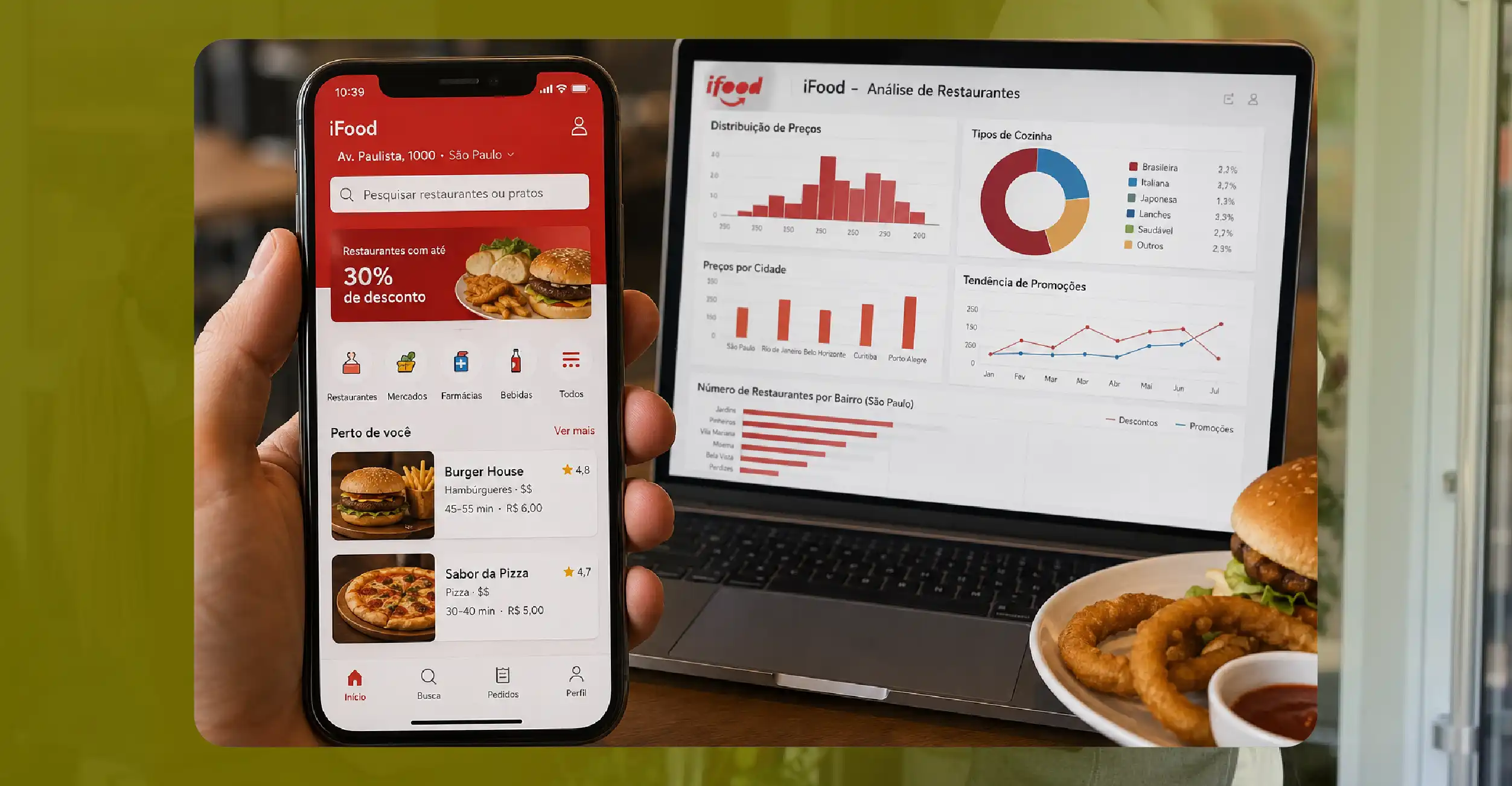
iFood Online Food Delivery App Scraping can provide a broader perspective on Brazil's food delivery ecosystem. Restaurant data can be analyzed according to city, neighborhood, cuisine, restaurant type, menu category, and pricing tier.
For competitive research, analysts can calculate price distributions for individual dishes and compare them across restaurants. They can also monitor restaurant assortment and determine whether competitors are expanding or reducing their menu selections.
Another valuable application is promotional monitoring. A restaurant may offer a temporary discount on selected products, bundle meals, or change promotional pricing. Capturing these observations over time creates a record of competitive promotional activity.
Geographic analysis can reveal differences between markets. A dish that commands a premium in one city may have substantially different pricing in another. Such insights can help restaurant groups and food-tech businesses develop location-specific strategies.
Data Quality and API Scraping Considerations
Reliable restaurant intelligence depends on consistent data collection and validation. Restaurant menus can contain missing descriptions, duplicated items, temporary availability changes, inconsistent categories, or promotional prices that require careful interpretation.
A robust pipeline should therefore include validation rules and standardized schemas. Restaurant identifiers should be maintained where possible, while timestamps should accompany every observation. Price fields should distinguish regular and discounted values rather than combining them into a single number.
Geographic information should also be normalized because restaurant names alone may not uniquely identify locations. Maintaining restaurant-location relationships helps prevent incorrect comparisons.
Businesses should also design extraction systems responsibly, respecting applicable laws, platform terms, access controls, and technical restrictions. API-based workflows should use authorized access where required and avoid disrupting platform infrastructure.
Business Benefits of iFood Data Extraction
The commercial value of restaurant menu data comes from converting frequently changing information into structured intelligence. Instead of looking at isolated restaurant pages, businesses can analyze thousands of records simultaneously.
Restaurant groups can benchmark pricing, researchers can analyze market structures, food-tech companies can improve data products, and investors can study restaurant-market trends.
The greatest advantage comes from historical collection. A single snapshot answers what a restaurant offers today. A continuously updated dataset can answer how its prices, assortment, and promotional behavior have changed over weeks or months.
This makes iFood data particularly useful for organizations that need recurring competitive intelligence rather than one-time research.
How iWeb Data Scraping Can Help You?
Scalable Extraction
iWeb Data Scraping can collect structured restaurant menus, prices, categories, availability, and metadata across large restaurant datasets efficiently.
Historical Monitoring
Automated recurring extraction can create timestamped datasets, enabling businesses to analyze price changes, promotions, assortment shifts, and competitive movements.
Data Standardization
Extracted records can be cleaned, normalized, deduplicated, and organized into consistent schemas suitable for databases, dashboards, and analytics workflows.
Custom Delivery
Restaurant datasets can be delivered in formats and structures aligned with existing business systems, research platforms, analytical environments, and reporting requirements.
Competitive Intelligence
Continuous restaurant monitoring can help businesses benchmark competitors, identify pricing gaps, understand menu trends, and support data-driven strategic decisions.
Conclusion
Scraping iFood restaurant menus and prices through API-oriented workflows can provide valuable intelligence for food-tech companies, restaurant groups, researchers, aggregators, and competitive analytics businesses. Structured restaurant data makes it easier to compare prices, monitor menus, analyze promotions, and understand market movements at scale.
By combining Online Restaurant Data Extraction with historical tracking, businesses can transform frequently changing restaurant information into a reliable analytical resource. Food Menu Data Extraction can support pricing studies, assortment analysis, competitive benchmarking, and restaurant market research.
Professional Web Scraping API Services can further automate collection, normalization, validation, storage, and delivery, helping organizations build scalable iFood datasets that support long-term food delivery intelligence.
FAQs
Restaurant name, cuisine, menu categories, dish names, descriptions, prices, promotional prices, availability, ratings, delivery information, location details, and timestamps can be collected depending on the accessible data.
API-oriented extraction can provide structured and automation-friendly data, making recurring collection and integration with databases, dashboards, and analytics systems easier.
Yes. Repeated data collection with timestamps can create historical observations that help identify price changes, promotions, assortment changes, and competitive pricing trends.
Restaurant groups, food delivery businesses, market researchers, food-tech companies, aggregators, pricing analysts, and competitive intelligence teams can use structured restaurant data for different analytical purposes.
Yes. Data collection workflows can be structured around required restaurants, locations, categories, fields, extraction frequency, output formats, and downstream analytics requirements, subject to applicable access permissions and platform terms.