
58.6K+
TOTAL RESTAURANT AND MENU RECORDS PROCESSED

iFood and Keeta Data Scraping for Brazil Market Intelligence Through Restaurant Menus, Pricing Analysis, and Competitive Food Delivery Benchmarking.
This case study explores a real-world enterprise scenario in which a food market intelligence and analytics organization wanted to understand Brazil's rapidly evolving online food delivery ecosystem. The project focused on iFood and Keeta Data Scraping to collect restaurant listings, menu information, product prices, promotional offers, delivery charges, and availability signals from iFood and Keeta through structured data extraction methods. By implementing iFood data scraping, the organization aimed to establish a reliable foundation for restaurant intelligence, competitive benchmarking, and food delivery market analysis.
It is designed for:
The project also addressed the growing importance of Keeta Brazil data in understanding the competitive food delivery landscape. As new platforms expand their restaurant networks and strengthen their market presence, businesses require consistent information about restaurant coverage, menu availability, pricing, and promotional strategies.
Brazil's online food delivery industry presents significant opportunities for restaurant operators, aggregators, and market intelligence organizations. However, understanding platform-level competition requires continuous monitoring of restaurant availability, menu changes, pricing differences, discounts, and regional coverage. The client wanted a unified solution to collect and analyze Brazil food delivery data across iFood and Keeta.
The initiative focused on developing an automated extraction pipeline capable of collecting restaurant profiles, cuisine categories, menu descriptions, product prices, ratings, delivery estimates, and promotional information. Through structured collection of iFood menu and price data, analysts could compare restaurant offerings and identify differences in product positioning across locations and platforms.
Another important objective was improving restaurant price comparison Brazil capabilities through standardized product matching and location-level benchmarking. Restaurant names, menu descriptions, portion sizes, and product variations were normalized to make comparisons more meaningful and reduce inconsistencies between platform listings.
The solution consolidated restaurant-level information into structured datasets that supported pricing analysis, competitor monitoring, promotional benchmarking, and market expansion research. It also enabled analysts to examine differences between platform coverage, restaurant availability, and menu diversity across selected Brazilian markets.
The client faced multiple difficulties in collecting and interpreting restaurant and menu information across Brazil's competitive food delivery environment. Although iFood offered extensive restaurant coverage, collecting consistent information across different cities, categories, and restaurant listings required significant manual effort.
Fragmented Restaurant Information Across Cities
The client needed comprehensive Porto Alegre restaurant data to understand restaurant distribution, cuisine availability, menu positioning, and competitor coverage. However, information was distributed across numerous listings, making city-level comparisons difficult. Different restaurant names, branches, and location identifiers also created inconsistencies during data consolidation.
Inconsistent Menu and Pricing Information
Restaurant menus frequently changed through price revisions, product additions, temporary unavailability, and promotional offers. Without automated monitoring, analysts struggled to identify these changes consistently. The absence of standardized menu records also affected product-level comparisons and historical pricing analysis.
Limited Competitive Visibility Across Platforms
The client needed to compare iFood and Keeta restaurant listings to understand platform coverage and competitive differences. However, differences in restaurant naming conventions, menu descriptions, category structures, and promotional presentation made direct comparisons challenging.
Manual Data Collection and Processing
Traditional collection methods involved opening individual restaurant listings, recording product information, and manually comparing prices. The client therefore required scalable food data scraping services to automate information collection, improve consistency, and reduce repetitive operational work.
Difficulty Building Reliable Analytical Datasets
The organization also lacked standardized food delivery datasets containing restaurant identifiers, product descriptions, prices, discounts, delivery information, and location attributes. This restricted its ability to perform historical analysis, develop dashboards, and generate reliable competitive intelligence.
To overcome these challenges, the client required an automated data extraction framework that could collect, validate, normalize, and organize information from both platforms while supporting continuous updates and scalable analytical requirements.
By adopting an automated iFood and Keeta data extraction methodology, the client replaced fragmented manual research with a centralized intelligence pipeline. The system collected restaurant listings, menu information, pricing details, and promotional signals, enabling consistent analysis across selected Brazilian markets.
| Dimension | Manual Restaurant Tracking | Client Data Scraping System |
|---|---|---|
| Restaurant discovery | Individual restaurant searches and browsing | Automated restaurant listing collection |
| Platform coverage | Separate manual research for each platform | Unified iFood and Keeta monitoring |
| Menu collection | Manual recording of menu items | Automated extraction of structured menu records |
| Price monitoring | Occasional spreadsheet updates | Scheduled price collection and comparison |
| Product matching | Manual identification of similar products | Normalized restaurant and product matching |
| Promotional tracking | Limited visibility into discounts | Structured collection of offers and promotional prices |
| Location intelligence | Inconsistent city-level records | Standardized city and restaurant location attributes |
| Data accuracy | Dependent on manual entry | Automated validation and duplicate detection |
| Reporting | Time-consuming spreadsheet preparation | Dashboard-ready datasets and analytical reports |
| Scalability | Difficult to expand across locations | Flexible monitoring across additional markets |
The centralized system provided a consistent analytical foundation for comparing restaurant and menu performance across platforms while reducing repetitive operational work.
The brand in focus is an emerging food market intelligence organization supporting businesses that operate within Brazil's expanding online food delivery ecosystem. Its primary objective is to help restaurant operators, food technology companies, and market research teams understand digital restaurant competition through reliable platform-level information.
The organization focuses on restaurant discovery, menu intelligence, product pricing, promotional monitoring, and competitive benchmarking. Its research requirements involve identifying restaurant availability across delivery applications, comparing similar menu items, evaluating cuisine distribution, and understanding how pricing strategies differ across geographical markets.
As its research operations expanded, the organization encountered increasing complexity in monitoring multiple food delivery platforms. Restaurant listings changed frequently, product descriptions varied between applications, and promotional prices created additional challenges for accurate comparison.
We implemented an end-to-end food delivery intelligence solution designed to collect, process, standardize, and analyze restaurant information from iFood and Keeta.
Source Identification and Coverage Planning
The initial stage involved identifying relevant restaurant categories, geographical coverage requirements, and data attributes necessary for competitive analysis. We established structured extraction workflows for publicly accessible platform information, subject to applicable platform terms, access permissions, and privacy requirements.
Restaurant and Menu Collection
The collection framework captured restaurant names, outlet identifiers, cuisine categories, addresses, menu categories, product descriptions, listed prices, promotional prices, availability indicators, ratings, and delivery-related information wherever available.
Restaurant Standardization and Matching
Restaurant information was standardized using common identifiers and location attributes. This reduced duplicate records and helped analysts identify the same restaurant across different platform listings.
Menu Normalization
Menu normalization was another important component. Similar products were grouped using product names, descriptions, category information, and portion details. This enabled more meaningful comparisons between restaurant offerings without treating every differently worded listing as an identical product.
Validation, Historical Storage and Dashboard Integration
The solution also incorporated automated validation, duplicate removal, missing-field checks, and historical record management. Scheduled collection cycles helped capture menu revisions, pricing changes, and promotional updates. Finally, the processed information was integrated into analytical dashboards and structured datasets, allowing business users to examine restaurant distribution, product pricing, platform coverage, and competitive positioning.
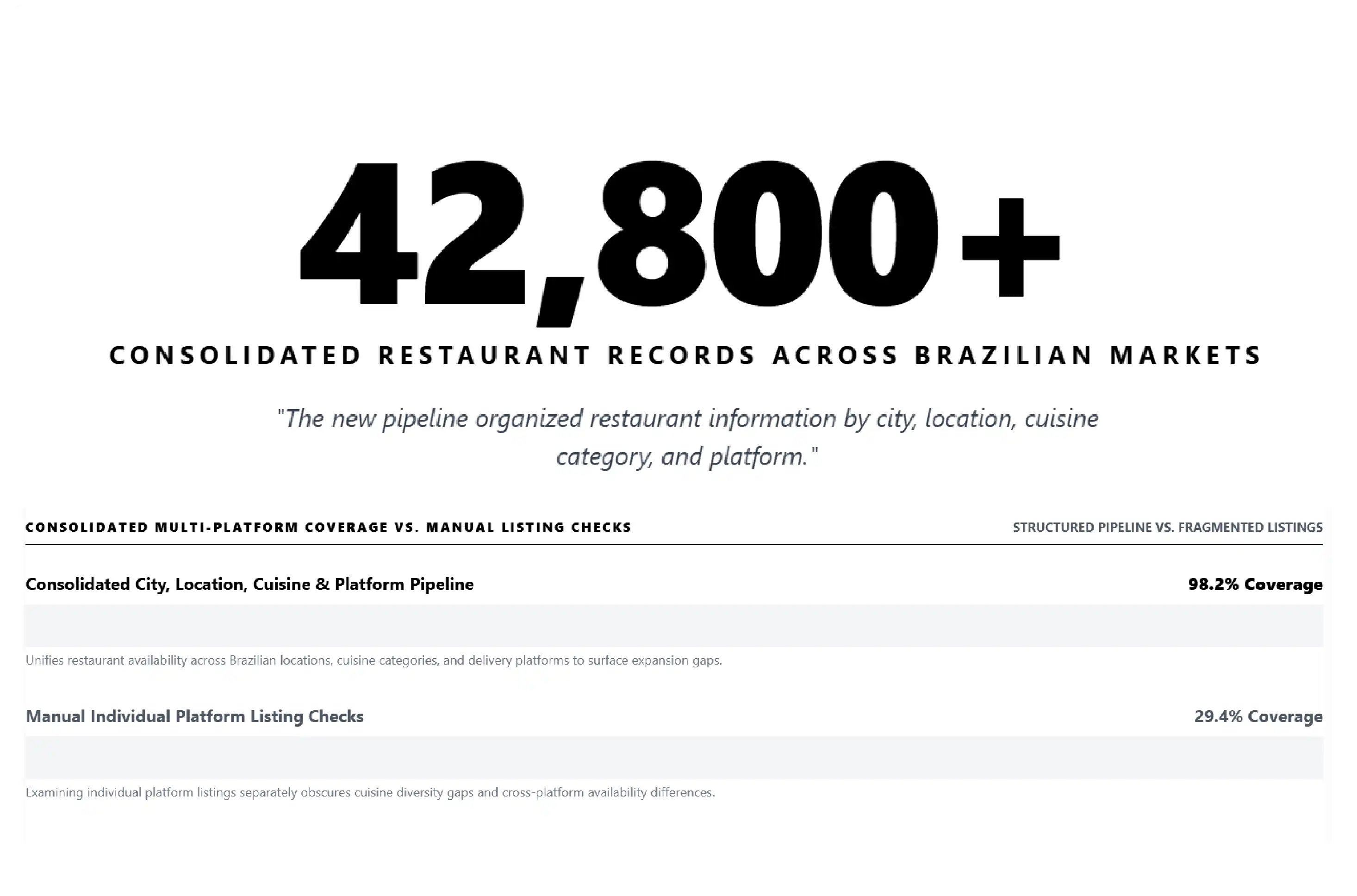
The implementation of automated restaurant data collection provided the client with a consolidated view of restaurant availability across selected Brazilian locations.
Previously, analysts had to examine individual platform listings to understand restaurant distribution and cuisine availability. The new pipeline organized restaurant information by city, location, cuisine category, and platform.
This enabled the organization to identify areas with strong restaurant coverage, locations with limited cuisine diversity, and differences in platform-level restaurant availability. The consolidated information also helped identify potential expansion opportunities for restaurant partnerships and food delivery businesses.
The structured extraction of restaurant menus enabled analysts to examine product prices across iFood and Keeta.
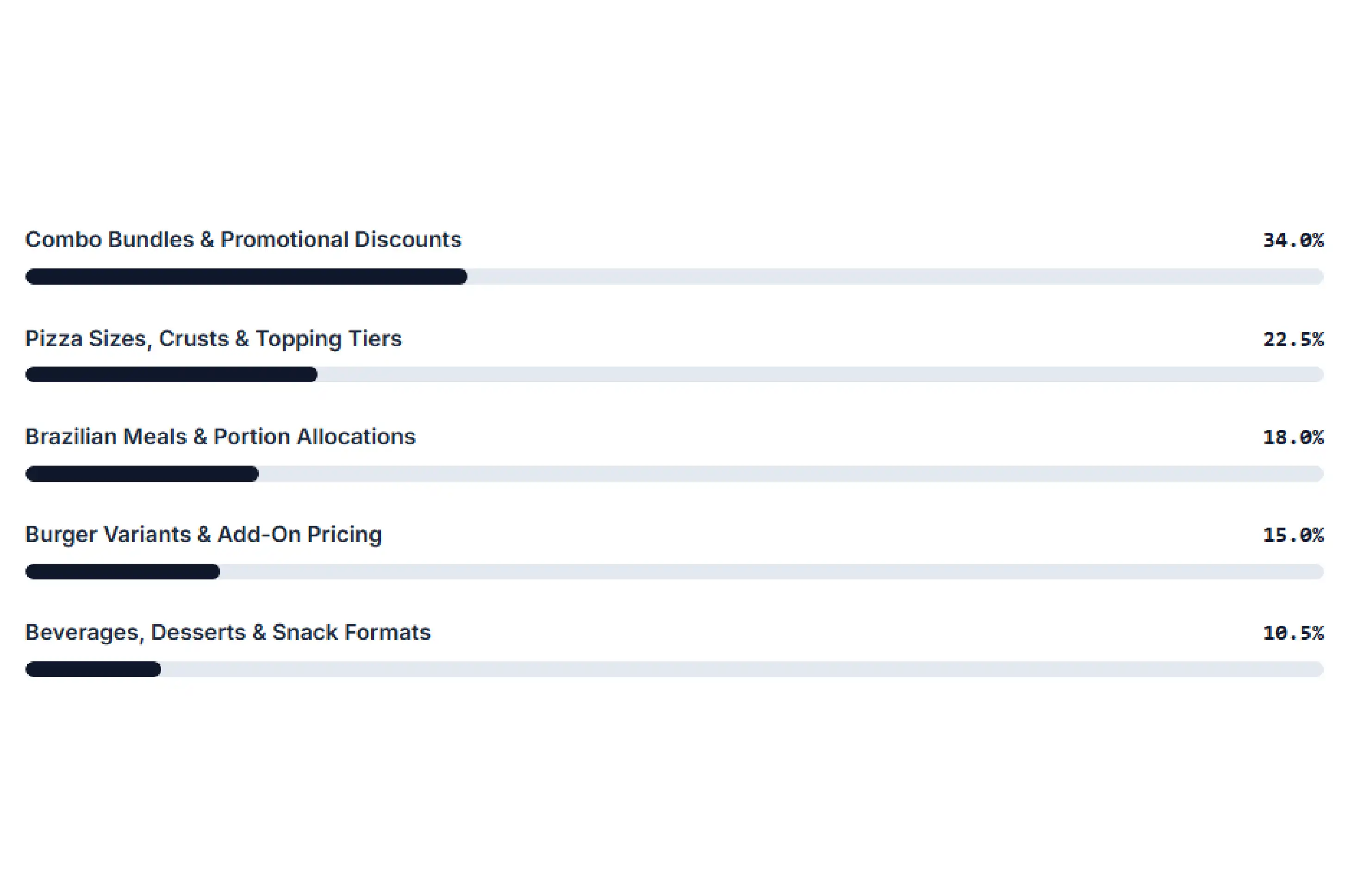
Instead of comparing restaurant-level averages alone, the organization could evaluate individual menu items, product categories, portion sizes, and promotional prices.
This provided a deeper understanding of pricing differences between similar restaurant offerings. Analysts could identify products with higher price variations, evaluate discount strategies, and monitor changes in menu positioning. Menu categories such as burgers, pizza, Brazilian meals, beverages, desserts, combos, and snacks supported competitive menu benchmarking and product-level price comparison.
One of the most important findings was the ability to compare restaurant listings across iFood and Keeta using standardized data attributes.
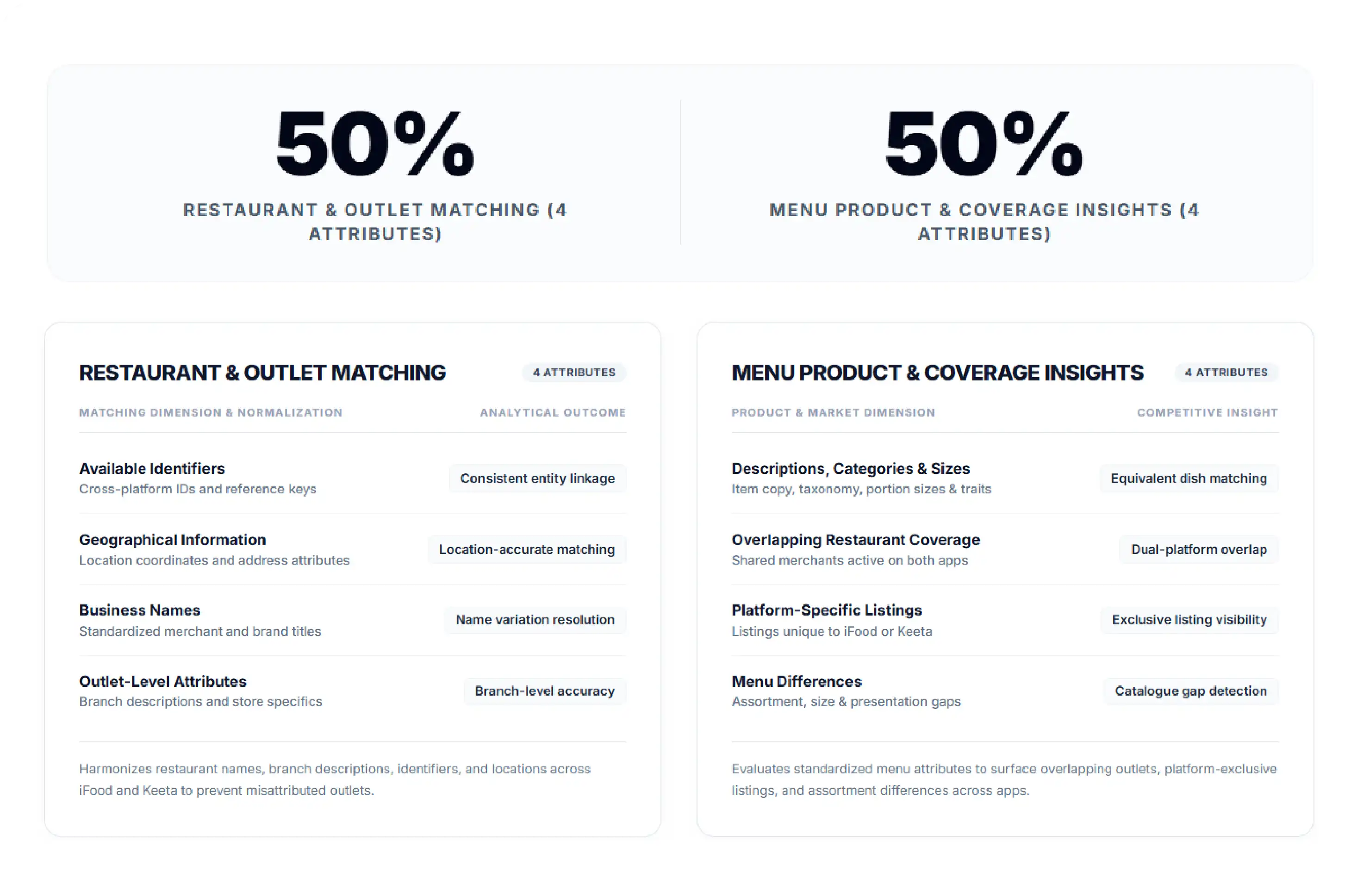
The client previously struggled with variations in restaurant names, branch descriptions, menu terminology, and product presentation. The implemented normalization framework improved matching consistency.
Restaurant records were compared using available identifiers, geographical information, business names, and outlet-level attributes. Menu products were evaluated using descriptions, categories, sizes, and relevant product characteristics. This enabled the client to identify overlapping restaurant coverage, platform-specific listings, and menu differences across competing applications.
The solution provided structured visibility into listed prices, promotional prices, and available discount information.
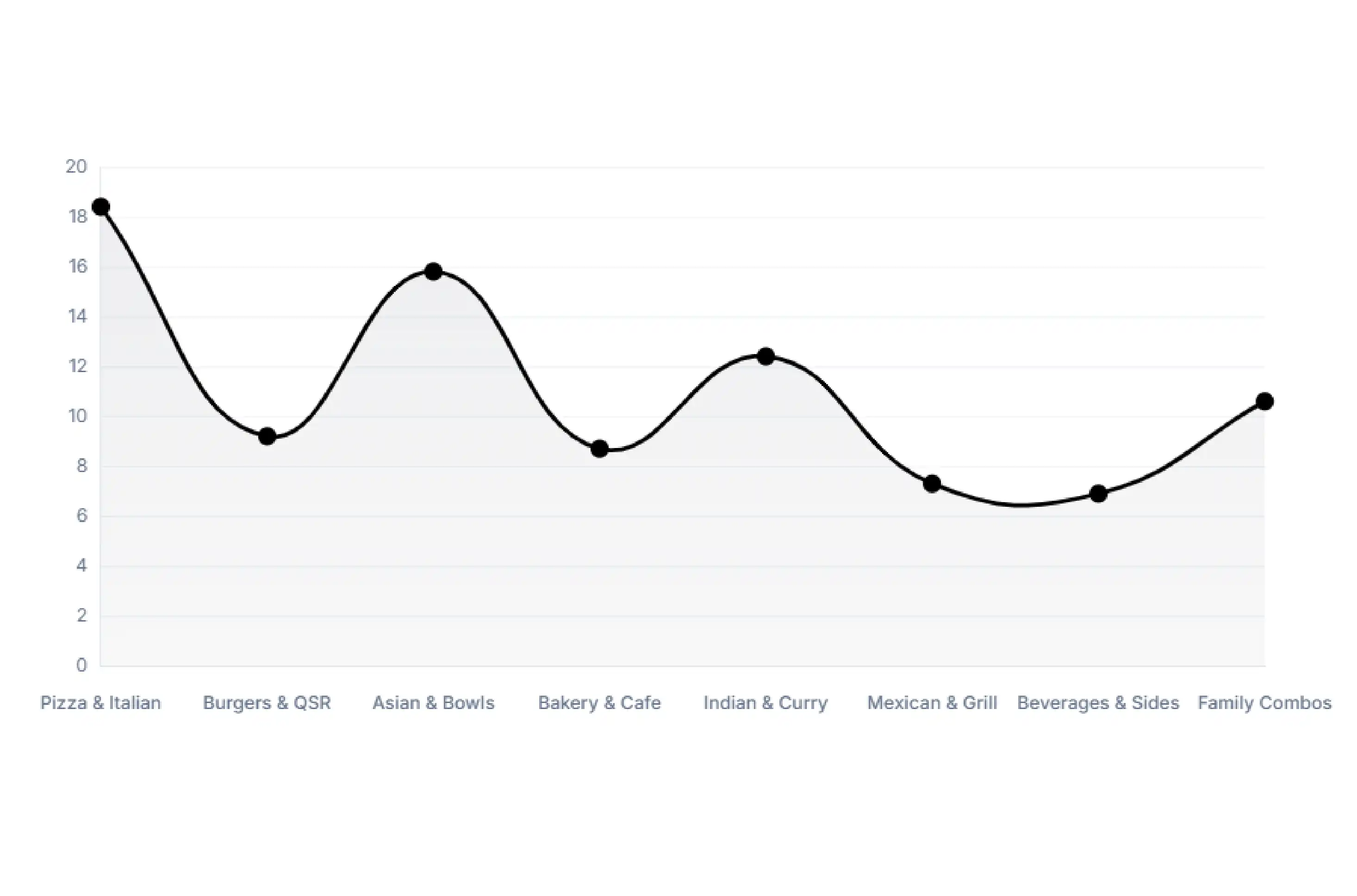
By tracking these attributes across collection periods, analysts could distinguish regular menu prices from temporary promotional offers wherever the platform displayed these details.
This supported the evaluation of restaurant discount strategies and platform-level promotional activity. Businesses could identify frequently discounted categories, compare promotional positioning, and understand how offers influenced displayed menu prices. It also helped restaurant operators examine whether their pricing and promotional strategies remained competitive within their respective cuisine categories.
The following illustrative dataset demonstrates how restaurant and menu information from iFood and Keeta can be organized for competitive intelligence. It includes platform names, restaurant categories, sample menu items, listed prices, promotional prices, and location attributes.
The sample records are representative examples created to demonstrate the dataset structure and should not be interpreted as verified live platform listings or current market prices.
| Platform | City | Restaurant Name | Cuisine | Menu Item | Listed Price (BRL) | Promotional Price (BRL) |
|---|---|---|---|---|---|---|
| iFood | São Paulo | Urban Burger | Burgers | Classic Burger | 32.90 | 27.90 |
| Keeta | São Paulo | Burger House | Burgers | Cheese Burger | 29.90 | 25.90 |
| iFood | Rio de Janeiro | Pizza Central | Pizza | Margherita Pizza | 45.90 | 39.90 |
| Keeta | Rio de Janeiro | Italian Corner | Pizza | Pepperoni Pizza | 49.90 | 44.90 |
| iFood | Porto Alegre | Grill Express | Brazilian | Grilled Chicken Meal | 34.90 | 31.90 |
| Keeta | Porto Alegre | Sabor Kitchen | Brazilian | Rice and Beef Meal | 36.90 | 32.90 |
| iFood | Curitiba | Fresh Bowl | Healthy | Chicken Salad Bowl | 28.90 | 25.90 |
| Keeta | Curitiba | Green Plate | Healthy | Vegetable Bowl | 26.90 | 23.90 |
| iFood | Belo Horizonte | Sweet Spot | Desserts | Chocolate Brownie | 16.90 | 14.90 |
| Keeta | Belo Horizonte | Dessert Lab | Desserts | Chocolate Cake | 19.90 | 17.90 |
Note: Sample figures are illustrative and do not represent verified live platform listings or current market prices.
The structured dataset enables analysts to compare platforms, cities, restaurant names, cuisines, menu items, listed prices, and promotional prices across monitored Brazilian markets.
After implementing the structured iFood and Keeta data intelligence framework, the client improved restaurant discovery, menu-level benchmarking, and competitive visibility across selected Brazilian markets.
The following illustrative project outcomes demonstrate the potential operational impact of the solution:
iWeb Data Intelligence provides structured data extraction solutions that help businesses transform fragmented online information into reliable business intelligence. For the Brazil food delivery ecosystem, the approach combines automated restaurant discovery, menu extraction, product-level pricing analysis, and platform benchmarking.
Centralized Restaurant Intelligence
Our methodology consolidates restaurant information from multiple delivery platforms into a standardized dataset. Businesses can examine restaurant names, locations, cuisines, menus, and availability through a unified structure, improving research consistency and reducing fragmented information.
Automated Menu and Price Monitoring
The solution supports recurring collection of restaurant menus, listed prices, promotional prices, and product availability. This enables businesses to identify pricing changes, evaluate competitive positioning, and understand how restaurant offerings evolve over time.
Accurate Data Cleaning and Standardization
Our processing workflows incorporate duplicate detection, field validation, product normalization, and structured formatting. These processes improve dataset consistency and help ensure that information is suitable for analytical dashboards, reporting systems, and business intelligence applications.
Scalable Multi-Platform Coverage
The architecture supports flexible data collection across multiple food delivery platforms and geographical markets. Organizations can expand monitoring requirements by adding restaurant categories, locations, and additional platform-level attributes as their research needs evolve.
Actionable Business Intelligence
Beyond collecting raw information, we organize extracted records into meaningful analytical datasets. Businesses can use these datasets for restaurant benchmarking, menu optimization, pricing intelligence, promotional evaluation, market research, and strategic expansion planning.
"The data intelligence solution delivered by the team significantly improved our understanding of Brazil's online food delivery market. Earlier, collecting restaurant information and comparing menus across different platforms required considerable manual effort. The automated solution helped us consolidate restaurant listings, menu information, pricing details, and promotional data into a structured intelligence framework. We particularly appreciated the quality of data organization, restaurant matching capabilities, and flexibility of the extraction pipeline. Our research teams can now evaluate restaurant coverage, identify pricing differences, and monitor competitive activity with greater efficiency. The solution has strengthened our analytical capabilities and provided a reliable foundation for future food delivery market research and expansion initiatives."
— Head of Food Market Intelligence
The final outcome of the project was a centralized and scalable food delivery intelligence system designed to transform restaurant listings, menus, prices, and promotional information from iFood and Keeta into structured business datasets.
The client gained improved visibility into restaurant coverage, menu diversity, product pricing, and competitive positioning across selected Brazilian markets. Automated collection reduced repetitive manual research activities while standardized processing improved the consistency of restaurant and product-level records.
The implementation of menu and catalog intelligence capabilities enabled businesses to evaluate restaurant menus, compare similar products, identify pricing differences, and monitor promotional positioning across multiple food delivery platforms.
The framework also supported mobile app scraping workflows for collecting permitted, publicly accessible information presented through supported application interfaces. This extended the organization's ability to structure platform-level information while maintaining consistent data processing and validation procedures.
The resulting datasets supported restaurant benchmarking, price comparison, geographical market analysis, and promotional intelligence. Dashboards provided stakeholders with a more accessible view of restaurant and menu performance, helping them identify opportunities and respond to competitive changes.
Overall, the project established a strong foundation for data-driven food delivery intelligence in Brazil. The scalable framework can support additional cities, restaurant categories, menu attributes, and platform coverage as business requirements expand.
The solution can collect permitted restaurant listing information, business names, cuisine categories, menu items, product descriptions, listed prices, promotional prices, ratings, availability indicators, and displayed delivery information. Available fields depend on platform access and applicable restrictions.
Yes. Restaurant and menu records can be standardized to support cross-platform price comparison. Product names, portion sizes, descriptions, and categories are considered to improve matching accuracy and ensure meaningful comparisons between similar offerings.
Yes. Restaurant information can be organized by city, location, cuisine, platform, and outlet. This allows businesses to evaluate restaurant coverage, category distribution, and competitive differences across selected Brazilian markets.
Collection frequency can be configured according to project requirements, permitted platform access, and technical feasibility. Scheduled extraction workflows can capture changes in menu items, prices, promotional offers, and availability over selected monitoring periods.
Businesses can use these datasets for competitor price benchmarking, restaurant discovery, menu optimization, promotional analysis, geographical expansion research, restaurant segmentation, and market intelligence. Structured information can also be integrated into dashboards and internal analytical systems.
iWeb Data Intelligence helps businesses collect, structure, and analyze restaurant listings, menu catalogs, product prices, and promotional information through scalable data scraping solutions. Transform fragmented food delivery information into actionable intelligence for smarter pricing strategies, competitive benchmarking, and market expansion decisions.
Start a projectFields marked * are required. Everything else just helps us scope faster — skip what you don't know yet.