

Introduction
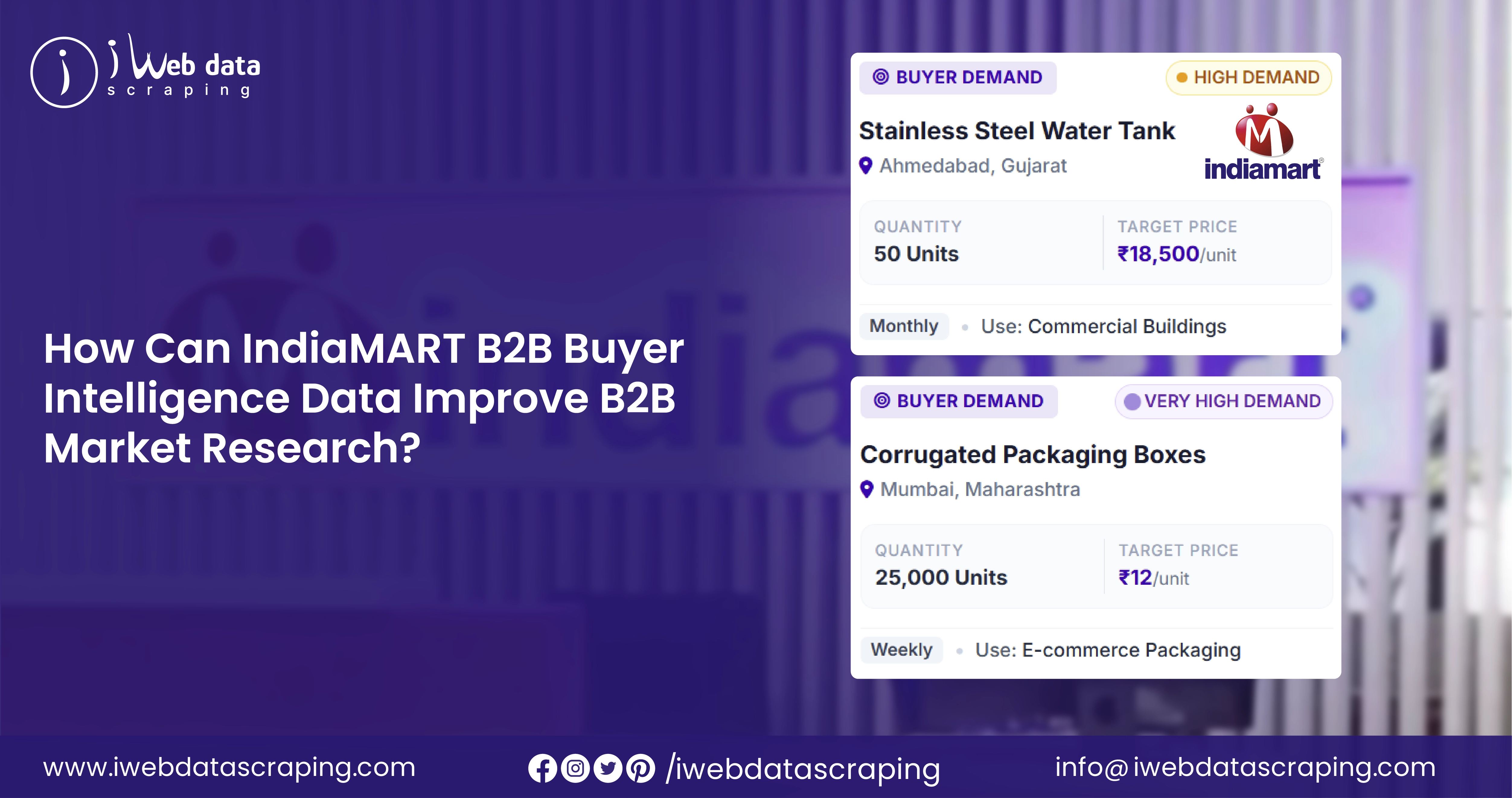
B2B marketplaces generate valuable signals about buyer requirements, supplier offerings, product categories, locations, and purchasing activity. IndiaMART B2B Buyer Intelligence Data can help businesses understand these signals and organize them into structured datasets for market research, sales planning, and competitive analysis.
With IndiaMART B2B buyer data Scraping for lead generation, organizations can collect relevant buyer requirements, product interests, business categories, locations, and supplier information to create more targeted prospecting strategies.
Businesses can also Scrape IndiaMART buyer and supplier data to develop structured intelligence covering buyer demand, supplier profiles, product information, category trends, and geographic opportunities. When collected responsibly from publicly accessible information and handled according to applicable terms and laws, this data can support a scalable B2B intelligence workflow.
What Is IndiaMART B2B Buyer Intelligence Data?
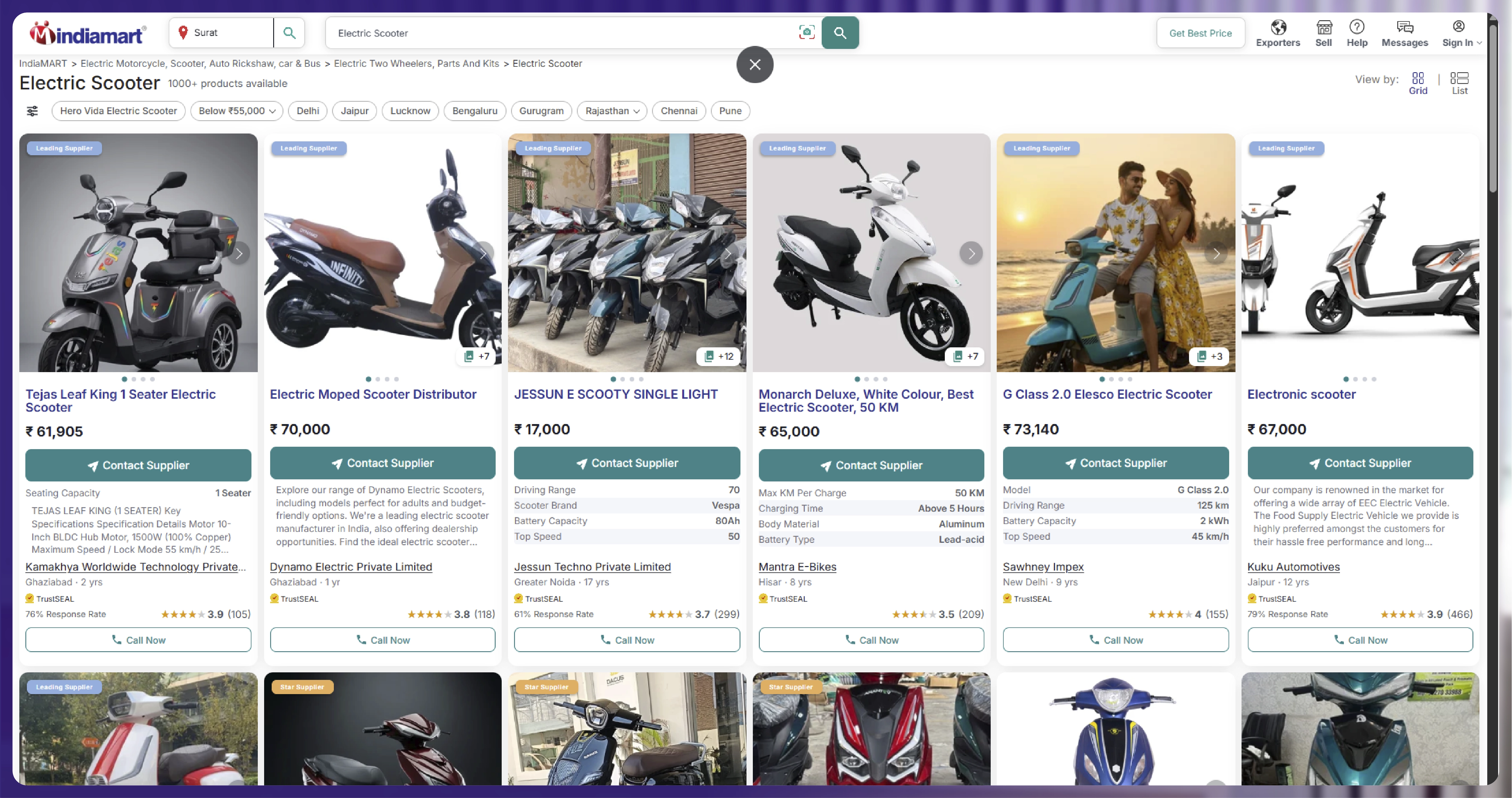
IndiaMART connects buyers and suppliers across numerous industries and product categories. Every buyer requirement and supplier listing can provide useful market signals when analyzed at scale.
Buyer intelligence data may include:
- Buyer requirement or inquiry
- Product or service requested
- Category and subcategory
- Buyer location
- Requirement quantity, where publicly displayed
- Business type
- Inquiry date or freshness indicators
- Supplier information
- Product specifications
- Price ranges, where available
- Listing attributes
- Seller location
- Business category
The objective is not simply to collect records. The greater value comes from transforming fragmented marketplace information into normalized datasets that can be searched, segmented, compared, and analyzed.
Why B2B Buyer Intelligence Matters?
Traditional B2B prospecting often depends on manually finding companies, researching their requirements, and determining whether their interests match available products or services. This approach can become slow when organizations operate across multiple categories and regions.
Structured buyer intelligence can provide a broader market view.
For example, a manufacturer selling industrial equipment could analyze buyer requirements by city, product category, business type, and demand frequency. A distributor could identify regions where specific product requirements appear more frequently. A market researcher could compare demand patterns between industries.
This makes marketplace data useful for several functions, including sales intelligence, category research, market sizing, competitor monitoring, and territory planning.
Key Elements of IndiaMART Buyer Data Extraction
IndiaMART buyer data extraction involves identifying relevant publicly accessible marketplace information and converting it into structured records.
A practical dataset can contain fields such as:
| Data Field | Intelligence Value |
|---|---|
| Buyer Requirement | Identifies requested products or services |
| Product Category | Enables category segmentation |
| Location | Supports geographic analysis |
| Quantity | Indicates potential requirement scale |
| Business Type | Helps classify prospects |
| Requirement Date | Supports freshness analysis |
| Supplier Name | Enables supplier discovery |
| Supplier Category | Supports competitive research |
| Product Details | Enables product-level comparisons |
| Price Information | Supports market benchmarking |
The exact fields available depend on the source pages, visibility of information, collection methodology, and applicable access restrictions.
Industry-Wise Buyer Intelligence
Different industries demonstrate different purchasing patterns. Therefore, organizing marketplace information according to industry can make the resulting dataset considerably more useful.
IndiaMART industry-wise buyer data extraction can help researchers categorize requirements into sectors such as manufacturing, construction, healthcare, agriculture, textiles, electronics, chemicals, food processing, packaging, hospitality, and professional services.
For example, an industrial machinery company may want to isolate requirements associated with manufacturing businesses. A packaging supplier may analyze buyer demand for cartons, containers, labels, and packaging equipment.
Industry segmentation allows teams to move from a large marketplace dataset toward focused market intelligence.
Understanding Industry Leaders and Established Businesses
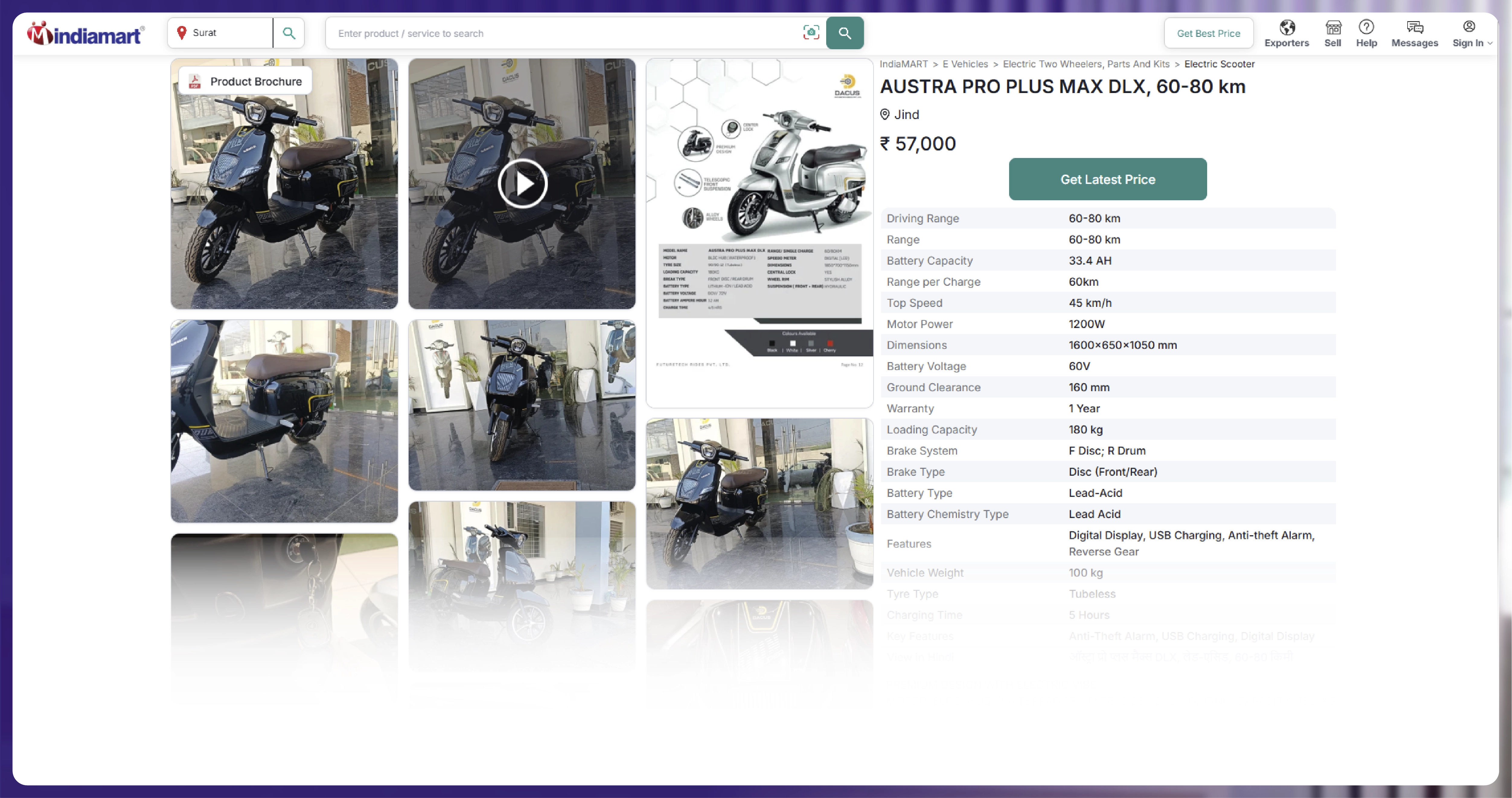
B2B marketplaces contain information about businesses operating across different market segments. Identifying established companies, prominent suppliers, and industry participants can support competitive research and market mapping.
IndiaMART Industry Leader Data Scraping can be used to organize publicly visible business information into structured profiles, where permitted.
Potential attributes can include:
- Company or supplier name
- Industry category
- Product specialization
- Business location
- Years in business, where displayed
- Product portfolio
- Business description
- Supplier classification
- Marketplace activity indicators
- Publicly displayed contact or business information
The resulting dataset can help analysts study supplier concentration, product specialization, geographic distribution, and competitive positioning without relying exclusively on manual research.
IndiaMART Supplier Intelligence
Buyer intelligence becomes more powerful when examined alongside supplier information. A combined dataset can reveal relationships between product demand and supplier availability.
IndiaMart Supplier Real Time Data Scraping can support workflows that monitor publicly available supplier listing changes, product availability indicators, category movements, and other visible marketplace attributes.
For instance, researchers can periodically capture supplier listings and compare successive snapshots. Changes in product descriptions, prices, categories, ratings, or availability indicators can then be analyzed to understand marketplace movement.
Real-time or near-real-time collection should always be designed around the source's technical limitations, access rules, and permitted usage rather than assuming unrestricted continuous extraction.
Building a B2B Lead Intelligence Dataset
A well-designed dataset can transform marketplace information into a repeatable sales intelligence resource.
A typical workflow may include:
Source discovery: Identify relevant public marketplace pages and target categories.
Data collection: Gather permitted buyer, supplier, product, and category information.
Cleaning: Remove duplicate records, normalize names, standardize locations, and resolve inconsistent category labels.
Enrichment: Add useful analytical fields derived from the collected information.
Segmentation: Group records by industry, location, product category, or business type.
Validation: Check records for completeness, consistency, and freshness.
Delivery: Provide structured datasets through CSV, JSON, databases, dashboards, or APIs, depending on requirements.
This pipeline creates a reusable foundation for B2B market intelligence rather than a one-time spreadsheet.
Applications Across B2B Markets
IndiaMART marketplace intelligence can support multiple business functions.
Sales Prospecting
Sales teams can segment publicly available business and
requirement information by product category, region, and industry to identify relevant prospects for
further qualification.
Market Research
Researchers can analyze product demand, supplier distribution,
regional concentration, and category activity to develop a clearer view of specific B2B markets.
Competitive Intelligence
Supplier datasets can help businesses monitor product
portfolios, listing attributes, positioning, and marketplace presence.
Territory Planning
Geographic segmentation can reveal where certain product
categories or buyer requirements are concentrated, helping businesses organize sales territories and
research priorities.
Product Strategy
Repeated buyer requirements can highlight product
specifications, emerging categories, and areas where businesses may consider adjusting their product
portfolios.
Data Quality and Normalization
Large-scale marketplace datasets can contain duplicate businesses, inconsistent spelling, incomplete fields, changing product information, and variations in location names.
Data quality therefore requires dedicated processing.
Common normalization activities include:
- Standardizing company names
- Normalizing city and state names
- Removing duplicate listings
- Standardizing category labels
- Validating product fields
- Identifying missing values
- Recording collection timestamps
- Maintaining historical snapshots
- Separating source fields from derived fields
A timestamp is particularly useful because B2B marketplace information can change frequently. Historical snapshots allow analysts to distinguish temporary changes from longer-term trends.
Combining Buyer and Supplier Intelligence
The strongest intelligence systems often combine several data layers.
A buyer dataset can show what businesses are looking for, while supplier data can indicate who is offering relevant products. Product-level information can then provide additional context around specifications, pricing, ratings, and availability.
For example:
Buyer Layer → Requirement, category, location, quantity
Supplier Layer → Supplier, specialization,
location, business type
Product Layer → Product, specifications, price, ratings
Analytics
Layer → Demand trends, category distribution, supplier concentration, regional opportunities
This layered architecture makes it easier for analysts to create dashboards and searchable intelligence platforms.
Challenges in B2B Marketplace Data Collection
B2B marketplace scraping requires more than simply extracting page content.
Common challenges include dynamic pages, changing layouts, pagination, duplicate records, incomplete fields, location normalization, request limitations, and changing availability.
A robust system should therefore include monitoring, validation, retry handling, structured extraction rules, duplicate detection, and data-quality checks.
Organizations should also respect website terms, robots directives where applicable, privacy requirements, intellectual-property restrictions, and relevant laws when collecting and using marketplace information.
How iWeb Data Scraping Can Help You?
Structured Buyer Intelligence
iWeb Data Scraping can organize publicly available buyer requirements into structured datasets, making category, location, product, and business segmentation easier for research and sales teams.
Supplier Monitoring
Automated collection workflows can track permitted supplier information and organize product listings, categories, locations, and marketplace attributes into consistent datasets for competitive intelligence and analysis.
Industry Segmentation
iWeb can categorize collected marketplace records by industry, product category, geography, and business attributes, helping teams analyze specific B2B segments without manually sorting large datasets.
Data Cleaning and Validation
Collected records can be normalized, deduplicated, standardized, and validated before delivery, improving dataset consistency and making downstream analytics, dashboards, and business intelligence workflows more reliable.
Flexible Data Delivery
iWeb can support customized datasets and recurring collection workflows, allowing businesses to receive structured marketplace intelligence in formats suited to analytics, databases, dashboards, or internal applications.
Conclusion
IndiaMART marketplace data can provide a valuable foundation for B2B market research when publicly available information is collected responsibly, structured accurately, and analyzed in context. Combining buyer requirements with supplier, product, category, and geographic information can create a broader view of marketplace activity.
An IndiaMART Scraper can support automated collection workflows designed around permitted public information, while E-commerce Data Extraction Services can help organizations integrate marketplace intelligence with broader commercial datasets.
Businesses can also combine marketplace records with an Ecommerce Product Ratings and Review Dataset to develop richer product and supplier intelligence, subject to applicable source terms and data-use requirements.
FAQs
It is structured information derived from publicly accessible B2B marketplace signals, such as buyer requirements, product categories, locations, business attributes, and related supplier information.
Depending on public availability and permitted access, datasets may include buyer requirements, categories, locations, supplier information, product details, pricing indicators, and other visible listing attributes.
Structured marketplace data can help businesses segment relevant requirements and prospects by product, industry, geography, and other available attributes before conducting their own sales qualification.
Periodic collection can be designed to capture changes in permitted publicly accessible information, creating historical datasets for monitoring marketplace activity and trends.
Depending on project requirements, structured data can be delivered through formats such as CSV, JSON, databases, APIs, or customized analytical datasets.