

Introduction
India's e-commerce market is expanding rapidly, with retailers and marketplaces constantly changing product prices, availability, discounts, ratings, reviews, sellers, and promotional offers. For brands, retailers, distributors, and market research companies, manually collecting these changes is increasingly difficult. Indian retailer product data scraping provides a structured approach to collecting large volumes of marketplace information and converting it into actionable retail intelligence.
Modern businesses can Scrape daily Amazon, Flipkart, Meesho product data to understand assortment changes, product availability, seller activity, pricing movements, and customer sentiment. Continuous data collection helps businesses move beyond occasional competitive checks and establish a reliable view of the Indian digital retail landscape.
Price intelligence is another major application. With Amazon, Flipkart, Meesho price monitoring, businesses can compare listed prices, promotional discounts, seller offers, and changes across product categories. This information can support pricing decisions, assortment planning, marketplace strategy, and competitive benchmarking.
Why Indian Retail Product Data Matters?
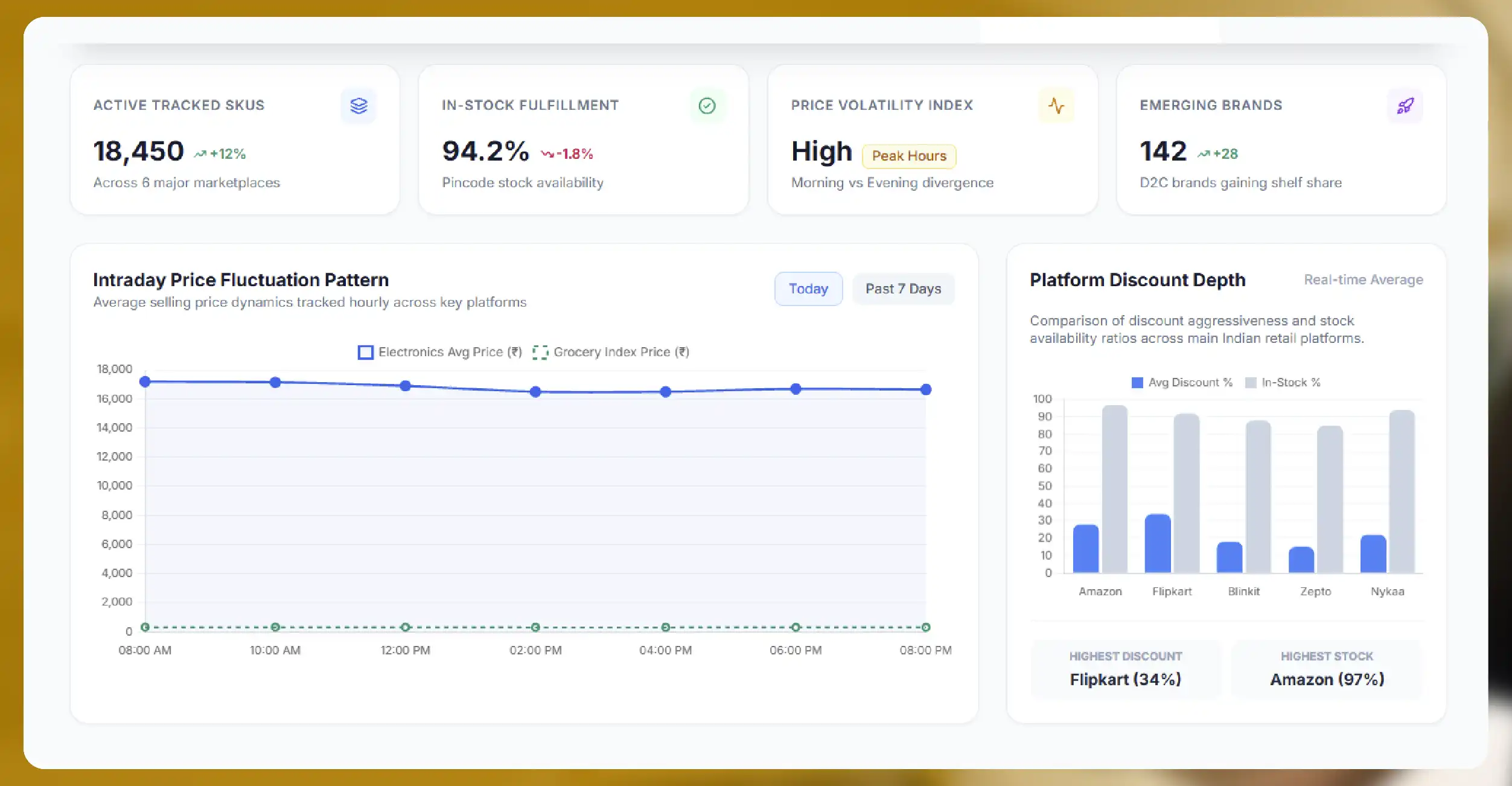
Indian online retail is highly dynamic. A product that appears at one price in the morning may be discounted later in the day, while stock availability can change according to location, seller inventory, or demand. Retailers therefore need continuously refreshed information rather than static datasets.
Product data scraping can capture information such as product names, descriptions, brands, categories, SKUs, ASINs, seller information, prices, MRP, discounts, ratings, review counts, availability, specifications, images, and promotional details.
The resulting datasets can be standardized and organized according to business requirements. Companies can use historical snapshots to identify pricing patterns, assortment expansion, disappearing products, emerging brands, and marketplace-specific differences.
Building Scalable Marketplace Product Intelligence
One of the biggest advantages of automated collection is scalability. Instead of tracking a few hundred products manually, businesses can monitor thousands or millions of product listings across multiple categories and marketplaces.
An Extract Indian marketplace product data API solution can make collected information accessible to internal applications, dashboards, analytics platforms, recommendation engines, and pricing systems. API-based delivery can also help organizations integrate marketplace intelligence directly into existing workflows.
For example, an e-commerce company could receive refreshed product information at predefined intervals and automatically compare it with its own catalog. A consumer brand could monitor competitor products and detect price changes. A research company could build category-level datasets for analyzing market movements.
Automated Retailer Data Collection
Retail environments generate enormous amounts of product information every day. Manually copying product details into spreadsheets is time-consuming and can introduce inconsistencies. Automation allows businesses to establish repeatable collection processes.
With Automated retailer product data extraction, companies can define the product fields they require and collect them according to specific schedules. Depending on the project, data may be delivered in CSV, Excel, JSON, database, or API-ready formats.
Automation also supports historical tracking. Instead of looking only at the current product page, businesses can maintain periodic snapshots and analyze how listings evolve over weeks or months.
This creates opportunities for trend analysis, competitor benchmarking, promotional intelligence, assortment research, and retail market forecasting.
Indian E-commerce Category Intelligence
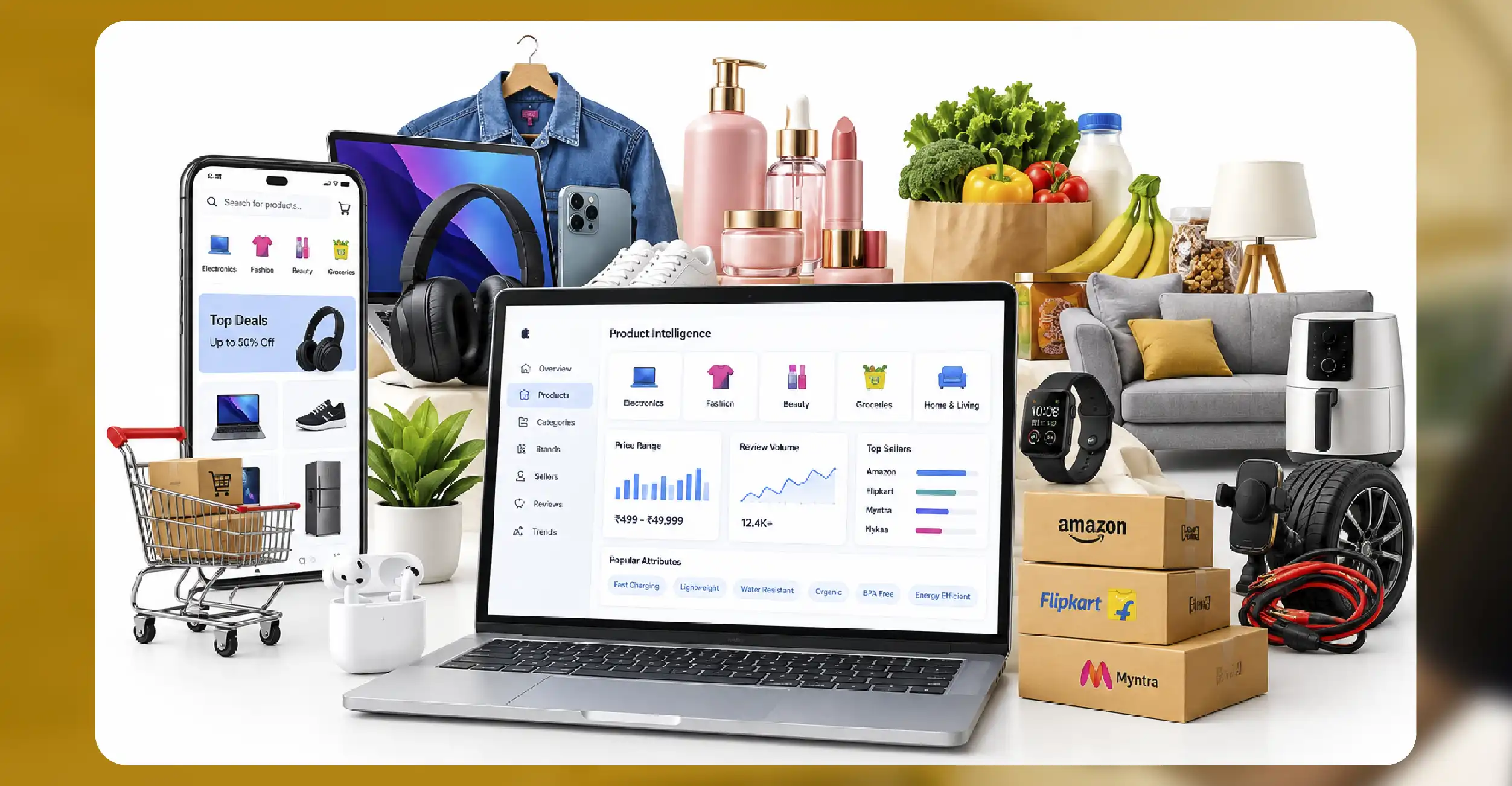
The Indian marketplace ecosystem covers electronics, fashion, beauty, groceries, home products, appliances, personal care, sports products, automotive accessories, and thousands of other categories.
Indian ecommerce product data scraping can help businesses analyze these categories at scale. A brand launching a new product, for instance, can study competing products, price ranges, review volumes, seller activity, and promotional patterns before developing its marketplace strategy.
Category managers can also identify gaps in product assortment. If certain product attributes are increasingly common among high-visibility listings, retailers can investigate whether those attributes should be incorporated into their own catalog strategy.
Product datasets can further support market research teams studying brand presence and marketplace penetration.
Flipkart Product Intelligence
Flipkart represents an important source of Indian marketplace intelligence, particularly for brands and sellers seeking to understand competitive positioning in India.
Through Flipkart data scraping, businesses can collect structured information about product listings, categories, prices, discounts, ratings, reviews, sellers, specifications, and availability, subject to applicable website terms and data-access requirements.
Historical Flipkart datasets can help organizations examine how product prices move during promotional campaigns, identify frequently changing listings, and compare competing products within the same category.
For sellers, this intelligence can support marketplace optimization. For brands, it can provide visibility into competitor assortment and pricing. For analysts, it can contribute to broader Indian e-commerce research.
Amazon Product Data Intelligence
Amazon product listings contain extensive information that can be useful for competitive and market intelligence. Brands can study product positioning, price movements, seller participation, ratings, review volumes, product specifications, and promotional activity.
Amazon data scraping can help create structured product datasets for monitoring large catalogs. Rather than relying on isolated manual checks, organizations can establish recurring collection workflows that provide consistent information over time.
This can be particularly valuable for businesses operating across multiple product categories. Historical datasets can reveal changes in competitive pricing, new product launches, listing activity, and category-level movements.
Meesho and Social-Commerce Intelligence
Meesho has created a distinctive marketplace environment where sellers and product categories can evolve rapidly. Fashion, lifestyle, home products, beauty, accessories, and other consumer categories can experience frequent assortment changes.
Businesses interested in this segment can analyze product titles, prices, ratings, reviews, seller information, categories, and other publicly available listing attributes to understand marketplace behavior.
Combining Meesho intelligence with information from other marketplaces can reveal differences in pricing, assortment, product positioning, and seller activity. Such cross-platform analysis is useful for brands targeting different consumer segments across India.
Cross-Platform Competitive Monitoring
A major benefit of retailer product scraping is the ability to move from single-platform analysis to cross-platform intelligence.
Suppose a brand sells the same product through several marketplaces. Its analysts may want to determine where the product is listed, how prices differ, which sellers are active, and where promotional activity is strongest.
A centralized dataset can normalize product names, identifiers, brands, categories, prices, discounts, ratings, and availability across sources. This makes comparison easier and supports dashboards that provide a consolidated view of marketplace performance.
Such monitoring can also help identify unauthorized sellers, unusual price differences, inactive listings, and changes in competitive positioning.
Product Data for Pricing and Promotion Analysis
Pricing is one of the most frequently changing elements in online retail. Discounts, coupons, seller offers, seasonal campaigns, and marketplace promotions can create substantial price variation.
A historical scraping system can preserve price observations and enable businesses to study changes over time. Analysts can identify products with frequent discounts, categories experiencing pricing pressure, and periods when competitors increase promotional activity.
The same information can support pricing teams in developing marketplace strategies. Rather than relying exclusively on occasional competitor checks, teams can use continuously refreshed datasets to understand broader market movements.
Supporting Retail Analytics With Structured Data
Raw scraped information becomes considerably more valuable when it is cleaned, standardized, and organized. Duplicate products can be identified, product attributes can be normalized, and marketplace-specific fields can be mapped into common schemas.
For example, different marketplaces may describe the same product using slightly different titles or category structures. Data processing can help identify comparable listings and create a unified product intelligence layer.
This structured information can then feed business intelligence dashboards, analytics systems, pricing engines, recommendation tools, and research databases.
How iWeb Data Scraping Can help You?
Multi-Marketplace Product Tracking
iWeb Data Scraping can collect product information across selected Indian marketplaces, helping businesses monitor prices, availability, ratings, sellers, discounts, categories, and product attributes through recurring data collection.
Automated Data Delivery
Businesses can receive structured datasets through formats and delivery methods aligned with their workflows. Automated pipelines reduce repetitive manual collection and make regularly refreshed marketplace information easier to consume.
Competitive Price Intelligence
iWeb Data Scraping can help organizations monitor competitor pricing and promotional changes across selected products. Historical records can support benchmarking, pricing analysis, discount tracking, and identification of changing market patterns.
Customized Product Datasets
Every business requires different product attributes. iWeb can structure datasets around selected categories, brands, products, sellers, marketplaces, locations, pricing fields, ratings, reviews, and availability requirements.
Scalable Retail Intelligence
As catalogs expand, automated scraping infrastructure can support larger product volumes and recurring collection schedules. This enables brands, retailers, researchers, and analysts to develop continuously refreshed datasets for e-commerce intelligence.
Conclusion
Indian marketplace data has become an important resource for understanding rapidly changing digital retail conditions. From product availability and competitor pricing to seller activity, ratings, reviews, and assortment changes, structured data can provide a deeper view of marketplace behavior.
Businesses can use Platform data scraping to consolidate information from multiple retail environments and develop broader competitive intelligence. A dedicated meesho product Data Scraper can support targeted collection for Meesho-focused research and marketplace monitoring.
Organizations can also build historical Meesho Product Datasets to analyze assortment changes, pricing patterns, seller activity, and category trends over time. When combined with Amazon and Flipkart intelligence, these datasets can create a more comprehensive foundation for Indian e-commerce analytics, pricing research, assortment planning, and competitive monitoring.
FAQs
It is the automated collection of publicly available product information from online retail and marketplace sources, including product names, prices, discounts, ratings, reviews, sellers, categories, and availability.
Depending on the source and project requirements, datasets can include product titles, brands, categories, prices, MRP, discounts, ratings, reviews, seller information, specifications, availability, product identifiers, and promotional information.
Collection frequency depends on business requirements and source conditions. Projects can be designed around periodic refreshes, such as daily, weekly, or other scheduled intervals, subject to applicable access and website terms.
Yes. Data from multiple marketplaces can be standardized into a common structure, allowing businesses to compare products, prices, sellers, ratings, availability, and assortment across selected platforms.
Retailer datasets can support competitive pricing, product research, assortment analysis, marketplace monitoring, seller intelligence, promotional tracking, category research, business intelligence dashboards, and broader e-commerce market analysis.