
50K+
BLINKIT SEARCH RESULTS PROCESSED

Keyword-Based Data Collection from Blinkit reveals product rankings, pricing, availability, assortment trends, and competitive grocery market intelligence.
This case study presents a real-world enterprise scenario where a grocery intelligence and analytics team uses automated search-result extraction to transform Blinkit keyword data into structured market intelligence. The objective was to understand product visibility, search rankings, assortment patterns, pricing signals, and category movements across a fast-changing quick-commerce environment.
It is designed for:
The client's primary challenge was that Blinkit search results change continuously based on keywords, product availability, location, pricing, promotions, and ranking signals. They needed a scalable framework to capture these changes systematically instead of relying on manual searches and isolated screenshots.
A leading grocery intelligence team wanted to understand how products appeared across Blinkit search results for strategically selected grocery keywords. The organization required continuous visibility into product rankings, assortment depth, pricing, availability, and competitor presence.
The solution introduced automated Blinkit keyword and product ranking tracking to monitor how products moved across search positions and categories over time. This created a consistent data layer for identifying ranking gains, losses, visibility gaps, and competitive movements.
The collected information also supported keyword-based grocery market analysis from Blinkit, allowing analysts to compare products appearing for the same search terms and evaluate category-level market dynamics.
Instead of manually checking individual keywords, the client established an automated workflow capable of collecting search-result records at scheduled intervals. The resulting datasets helped identify frequently appearing products, changing rankings, competitive assortment patterns, promotional visibility, and emerging grocery trends.
The initiative ultimately transformed Blinkit search pages into a structured source of market intelligence that could support digital shelf monitoring, assortment decisions, competitive research, and grocery category strategy.
The client operated in a highly dynamic quick-commerce environment where grocery search results could change frequently. Manual keyword searches provided only limited snapshots and made it difficult to understand how product visibility evolved over time.
A major challenge was the absence of structured Blinkit search trend and category analytics, which restricted the organization's ability to compare keyword performance and understand product movements across grocery categories.
The client also needed a reliable method to Extract Blinkit search results for market research without repeatedly depending on manual browsing. Analysts wanted standardized records that could be compared across keywords, products, categories, locations, and collection periods.
Additional challenges included:
The client therefore needed an automated data pipeline capable of continuously capturing search-result information and converting it into standardized grocery intelligence.
By replacing manual searches with an automated keyword intelligence pipeline, the client gained repeatable visibility into Blinkit search results and product movements.
| Dimension | Manual Keyword Tracking | Client Data Collection System |
|---|---|---|
| Keyword coverage | Limited number of searches | Automated tracking across large keyword sets |
| Search frequency | Occasional manual checks | Scheduled and repeatable collection |
| Ranking visibility | Individual snapshots | Historical product ranking records |
| Product discovery | Manually identified | Automatically captured from search results |
| Data structure | Screenshots and notes | Standardized product-level datasets |
| Competitive analysis | Time-consuming | Automated brand and product comparisons |
| Trend detection | Reactive | Historical and recurring trend analysis |
| Scalability | Limited | Designed for large keyword volumes |
The brand in focus is a grocery market intelligence organization operating in the rapidly expanding quick-commerce ecosystem. Its objective was to help grocery brands, retailers, and analysts understand product visibility and competitive movements across digital grocery marketplaces.
As the number of monitored keywords increased, manual collection became increasingly difficult. Different grocery terms produced changing product assortments, rankings, prices, and availability conditions, making isolated observations insufficient for strategic analysis.
The organization therefore required a structured data framework that could collect search-result information consistently and convert individual keyword observations into a historical intelligence layer.
With automated collection, the brand could move beyond asking which products appeared for a keyword at a particular moment and instead investigate broader questions: Which brands dominate specific searches? Which products are gaining visibility? Which categories are becoming more competitive? How frequently do rankings change?
We developed an automated collection workflow designed to capture structured search-result information from Blinkit across predefined grocery keywords, categories, and monitoring conditions.
The Blinkit data scraping pipeline collected relevant search-result attributes and organized them into standardized records. Depending on the monitoring requirement, fields could include keyword, product name, brand, category, price, discount, availability, ranking position, product URL, and collection timestamp.
The workflow was designed around repeatable keyword monitoring. Instead of collecting isolated results, the system maintained historical observations that allowed analysts to compare product visibility across different collection periods.
The resulting Blinkit Grocery Datasets provided a structured foundation for keyword-level market research, product ranking analysis, assortment monitoring, and competitive intelligence.
Data processing included cleaning duplicate records, standardizing product attributes, validating collected fields, and maintaining timestamps for historical comparison. The structured output could then be integrated into dashboards, analytical models, spreadsheets, databases, or downstream reporting workflows.
This approach also enabled analysts to group search results by keyword, brand, product, and category. By comparing these groups over time, the client could identify changes in search visibility and product positioning more efficiently.
The automated collection system made it possible to observe how products appeared across targeted grocery keywords. Rather than evaluating visibility through isolated manual searches, analysts could compare ranking positions across multiple collection periods.
This helped identify products that consistently appeared near the top of search results as well as products whose visibility fluctuated significantly.
Ranking history also provided a stronger foundation for evaluating competitive positioning. Brands could determine whether their products maintained stable visibility or experienced changes that warranted further investigation.
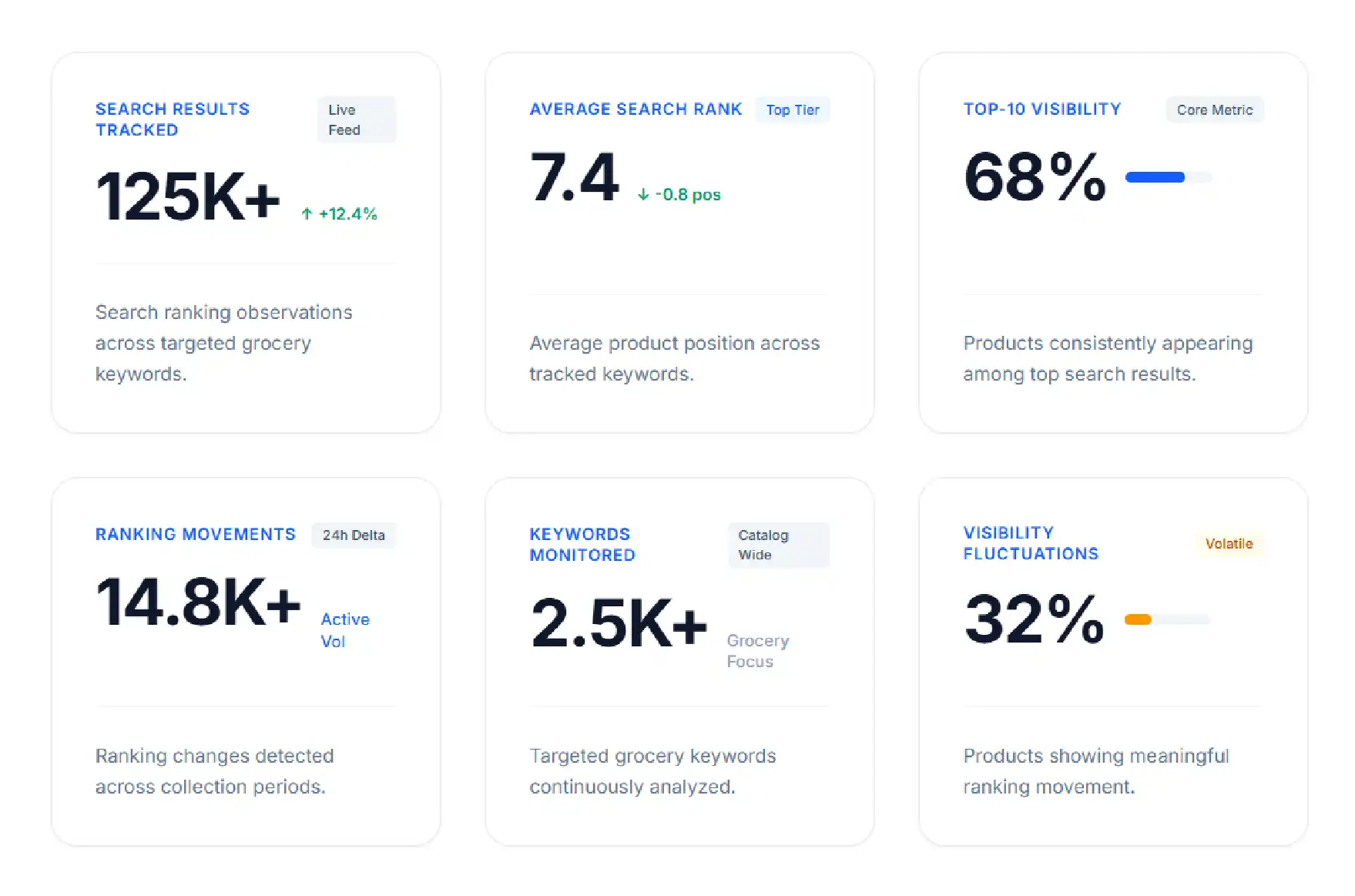
Different grocery keywords generated different combinations of brands and products. By collecting results across a large keyword set, the client could identify which competitors appeared repeatedly across high-value searches.
This revealed competitive assortment patterns that were difficult to observe through manual monitoring.
For example, one brand might dominate broad category keywords while another could achieve stronger visibility for specific product-oriented searches. These distinctions provided useful signals for assortment planning and digital shelf optimization.
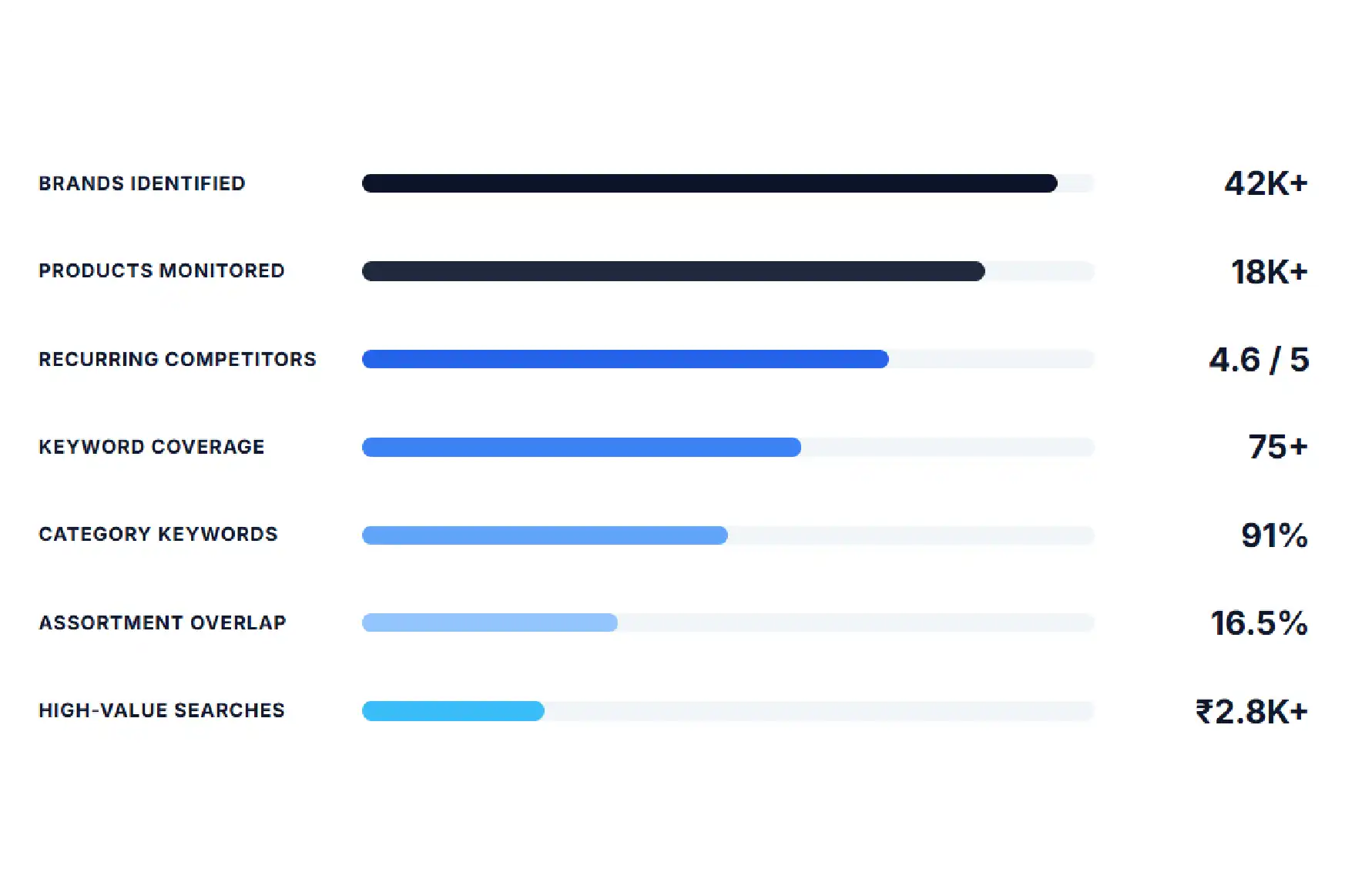
The structured dataset allowed the client to compare search results over time rather than treating each search as an isolated event.
| Metric | Insight Captured | Business Impact |
|---|---|---|
| Search Ranking | Position of each product for targeted keywords | Visibility and ranking analysis |
| Brand Frequency | Number of appearances across keyword results | Competitive presence measurement |
| Product Availability | In-stock or unavailable status | Assortment and availability monitoring |
| Price | Listed product price | Competitive pricing analysis |
| Discount | Promotional price signals | Promotion monitoring |
| Keyword Coverage | Products appearing across multiple searches | Search visibility analysis |
| Category Presence | Product distribution by category | Assortment intelligence |
Historical comparisons helped identify recurring patterns, new product appearances, disappearing products, and changes in category competition.
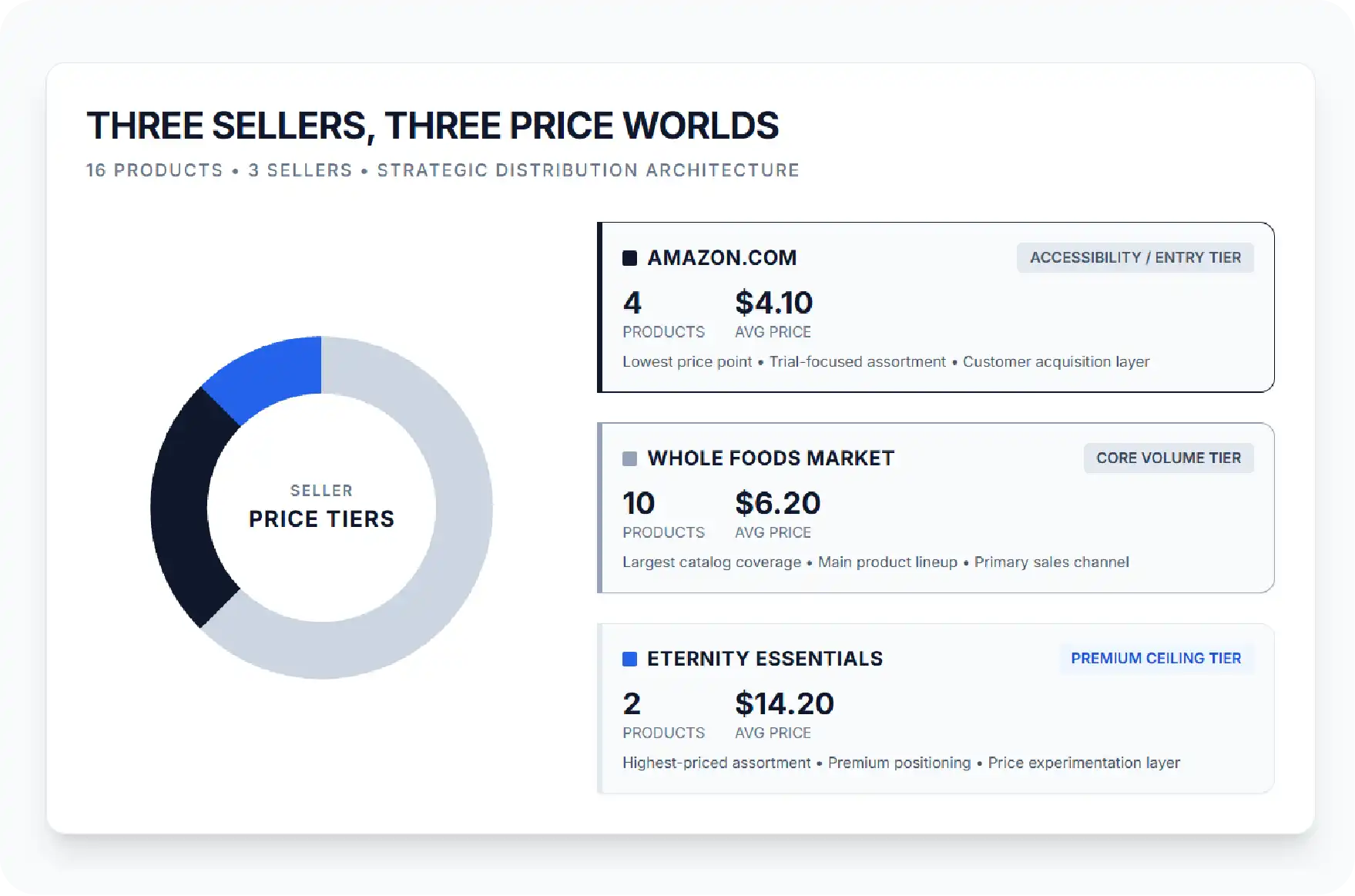
Previously, analysts needed to perform individual searches and manually organize observations. The automated workflow converted these repeated activities into a structured collection process.
This reduced repetitive research work and allowed analysts to spend more time interpreting the data rather than gathering it.
The dataset also made it easier to compare multiple keywords simultaneously, helping teams recognize relationships between product visibility, brand presence, category competition, and search behavior.
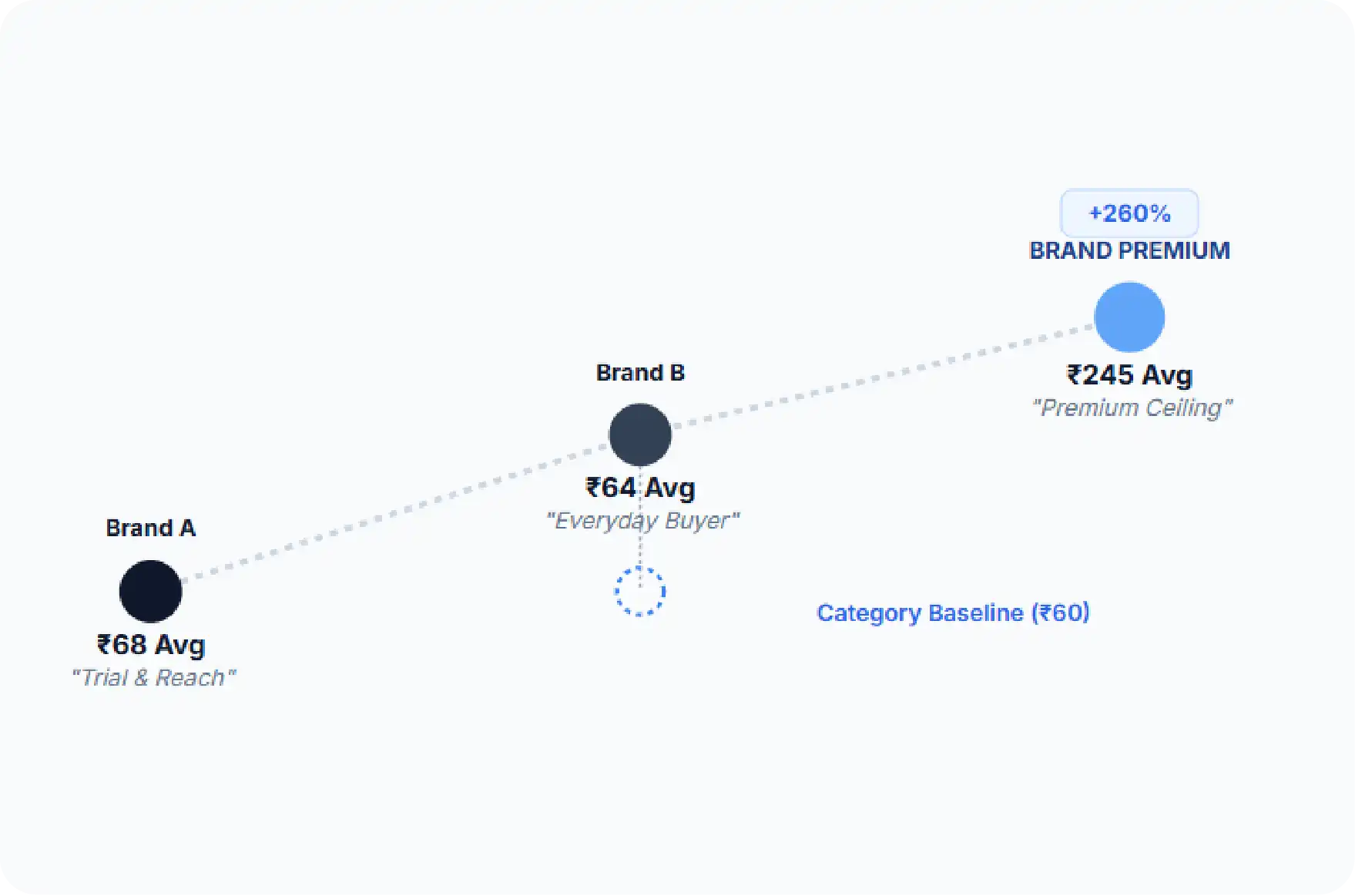
A representative dataset snapshot demonstrates how keyword-based Blinkit intelligence can be structured for analysis.
| Keyword | Rank | Product | Brand | Category | Price | Availability |
|---|---|---|---|---|---|---|
| milk | 1 | Full Cream Milk | Brand A | Dairy | ₹68 | In Stock |
| milk | 2 | Toned Milk | Brand B | Dairy | ₹64 | In Stock |
| atta | 1 | Whole Wheat Atta | Brand C | Staples | ₹245 | In Stock |
| atta | 2 | Chakki Atta | Brand D | Staples | ₹228 | In Stock |
| biscuits | 1 | Digestive Biscuits | Brand E | Snacks | ₹110 | In Stock |
| cooking oil | 1 | Sunflower Oil | Brand F | Cooking Essentials | ₹155 | In Stock |
The sample illustrates how search-result records can be converted into structured observations that support ranking, pricing, availability, brand, and category analysis.
After implementing automated keyword-based data collection, the client gained a repeatable intelligence framework for monitoring grocery search visibility.
Our approach combines automated data collection, structured processing, validation, and scalable delivery to transform complex online grocery information into usable intelligence.
The solution is designed to support recurring monitoring across large keyword lists while maintaining standardized fields and consistent historical records.
By automating collection and normalization, businesses can reduce repetitive research tasks and improve the consistency of their market intelligence workflows.
The resulting datasets can support competitive analysis, product visibility monitoring, pricing intelligence, assortment research, category analytics, and digital shelf strategy.
"We needed a reliable way to understand how products and brands appeared across important grocery searches. The structured data solution gave our analysts historical visibility that manual tracking simply could not provide. We can now monitor rankings, assortment, pricing, and availability more efficiently and use those insights to support faster market decisions."
— Head of Grocery Market Intelligence
The final outcome was a scalable search intelligence framework that transformed Blinkit keyword results into structured business intelligence.
The client gained improved visibility into product rankings, brand presence, category assortment, pricing, and availability across monitored grocery searches.
The implementation of Grocery data scraping enabled continuous collection and organization of search-result information, reducing dependence on manual research and creating a repeatable intelligence workflow.
The resulting Grocery datasets provided historical records that could be analyzed across keywords, products, brands, categories, and collection periods. This helped the organization identify competitive movements and changing grocery market patterns more efficiently.
Through Managed web scraping, the client gained an operational framework capable of supporting recurring collection, data processing, quality checks, and structured delivery as monitoring requirements expanded.
Overall, the project established a strong foundation for keyword-based grocery intelligence, supporting market research, digital shelf monitoring, competitive analysis, assortment planning, and data-driven decision-making.
Depending on the project requirements, datasets can include keywords, product names, brands, rankings, categories, prices, discounts, availability, product URLs, and collection timestamps.
It allows researchers to compare products and brands appearing for targeted grocery searches, identify assortment patterns, monitor ranking movements, and develop historical market intelligence.
Yes. Scheduled collection can create timestamped records that allow businesses to compare product ranking positions across different monitoring periods and identify visibility changes.
Yes. Search-result information can be cleaned, normalized, deduplicated, and delivered as structured datasets suitable for analytics, dashboards, databases, spreadsheets, or machine learning workflows.
Grocery brands, retailers, market researchers, digital shelf teams, e-commerce analysts, competitive intelligence teams, and data science organizations can use keyword-based search intelligence for strategic analysis.
Our data scraping and analytics solutions help transform keyword-level grocery search results into structured datasets for ranking analysis, competitive intelligence, assortment monitoring, and faster market research.
Start a projectFields marked * are required. Everything else just helps us scope faster — skip what you don't know yet.