

Introduction
Lazada is one of Southeast Asia's leading e-commerce marketplaces, offering millions of products across electronics, fashion, beauty, home appliances, groceries, and other categories. For brands, retailers, sellers, market researchers, and e-commerce analytics companies, continuously collecting marketplace data can provide valuable insights into prices, products, promotions, seller activity, and assortment changes.
Lazada API scraping enables businesses to systematically collect structured marketplace information for analytics, monitoring, and competitive intelligence. Instead of manually checking thousands of product pages, automated extraction can gather relevant data at scale and transform it into usable datasets.
A Lazada product data extraction API can provide structured product information such as product names, categories, prices, discounts, ratings, reviews, seller details, availability, specifications, images, and product URLs. This information can support applications that require regularly refreshed marketplace intelligence.
Similarly, a Lazada competitor price tracking API can help brands and retailers compare their pricing against competing sellers and products. Automated data collection makes it possible to identify price movements, promotional changes, discount patterns, and assortment differences across large product catalogs.
The growing importance of marketplace intelligence has made automated Lazada data collection particularly useful for businesses operating in competitive Southeast Asian e-commerce markets.
Understanding Lazada API Scraping
Lazada API scraping refers to the automated process of collecting marketplace information through available API endpoints, structured requests, or other technically appropriate data extraction mechanisms. Depending on the implementation and permitted access methods, businesses can retrieve specific product and marketplace attributes in structured formats.
An automated workflow can be designed to collect product-level information according to predefined categories, sellers, brands, keywords, or geographic marketplaces. Instead of receiving unstructured webpage content, the resulting information can be normalized into JSON, CSV, Excel, database tables, or cloud-based storage systems.
The key advantage is scalability. A company tracking a few hundred products manually may be able to maintain the information temporarily, but monitoring tens of thousands of products requires automation. API-oriented extraction can make scheduled collection more efficient and easier to integrate with analytical systems.
Businesses should also ensure that their data collection methods comply with applicable laws, contractual restrictions, platform terms, and technical access requirements.
What Data Can Be Extracted from Lazada?
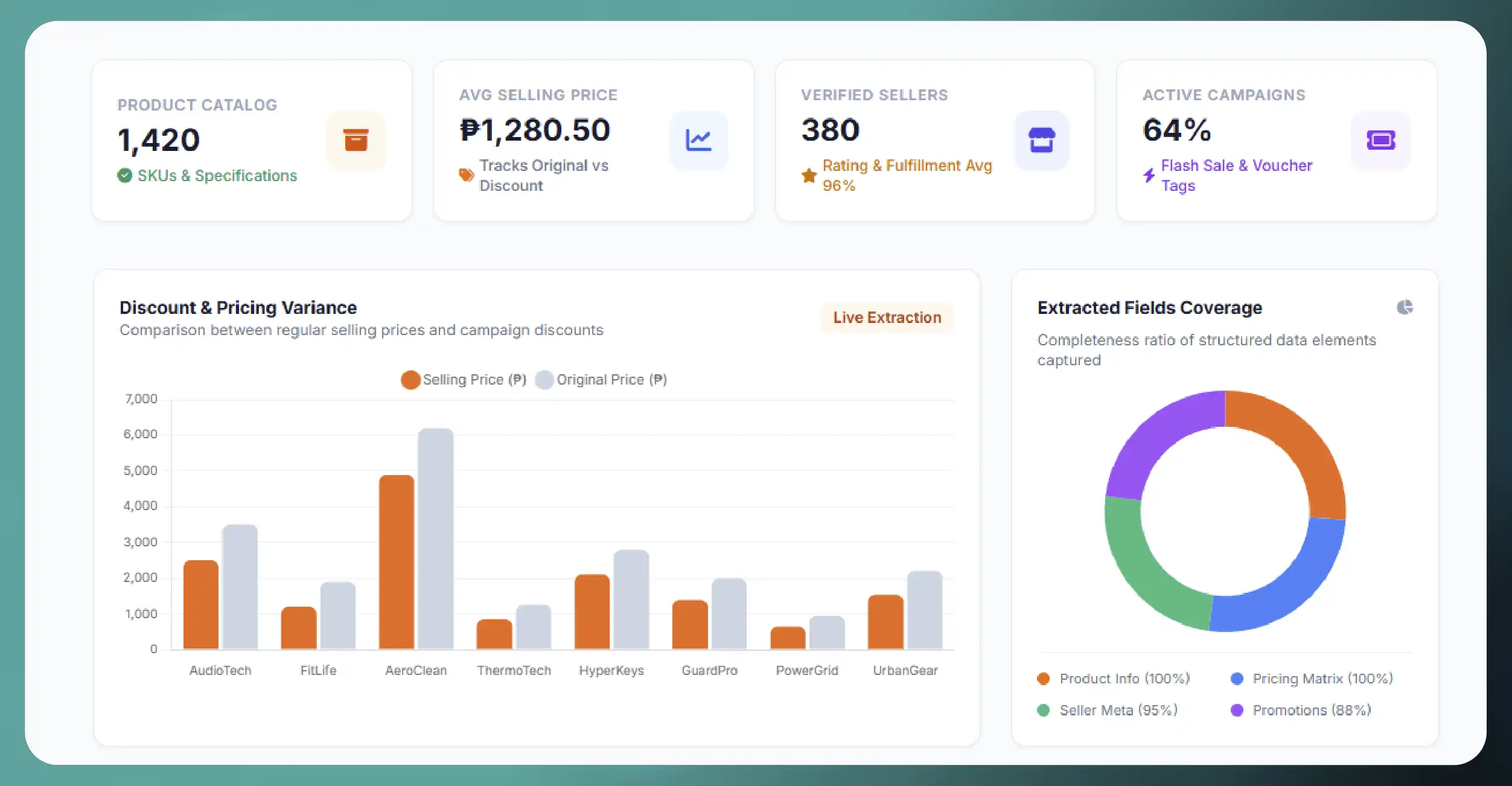
A comprehensive Lazada data extraction workflow can capture numerous attributes depending on the project's requirements and the availability of the information.
Product information may include product title, SKU, product ID, brand, category, subcategory, description, specifications, images, product URL, and variations. Pricing fields can include original price, current selling price, discounted price, discount percentage, currency, and promotional pricing.
Seller-level information can include seller name, seller identifier, seller rating, fulfillment information, location, and other publicly available attributes. Availability information can capture stock status, variations available for purchase, and changes in product availability.
Marketplace datasets can also incorporate customer-facing metrics such as ratings and review counts. Promotional information may include vouchers, flash-sale indicators, campaign prices, bundle offers, and other visible promotional attributes.
The resulting dataset can therefore combine product, pricing, seller, promotional, and availability information into a unified structure.
Lazada API Price Monitoring
Price intelligence is one of the strongest applications of automated marketplace data collection. Lazada API price monitoring allows businesses to periodically capture product prices and compare them with historical records.
Suppose a retailer monitors 50,000 products across multiple categories. A scheduled extraction process can capture the current price at defined intervals and store each observation with a timestamp. Historical records can then reveal whether a product is becoming more expensive, receiving frequent discounts, or experiencing unusual price fluctuations.
Price monitoring can also support minimum advertised price analysis, competitor benchmarking, promotional measurement, and dynamic pricing research. Retailers can identify products where competitors consistently undercut their prices, while brands can determine which products are repeatedly discounted.
Historical pricing data becomes even more valuable when combined with promotions, availability, seller information, and category-level trends.
Lazada Marketplace Data Scraping for Competitive Analysis
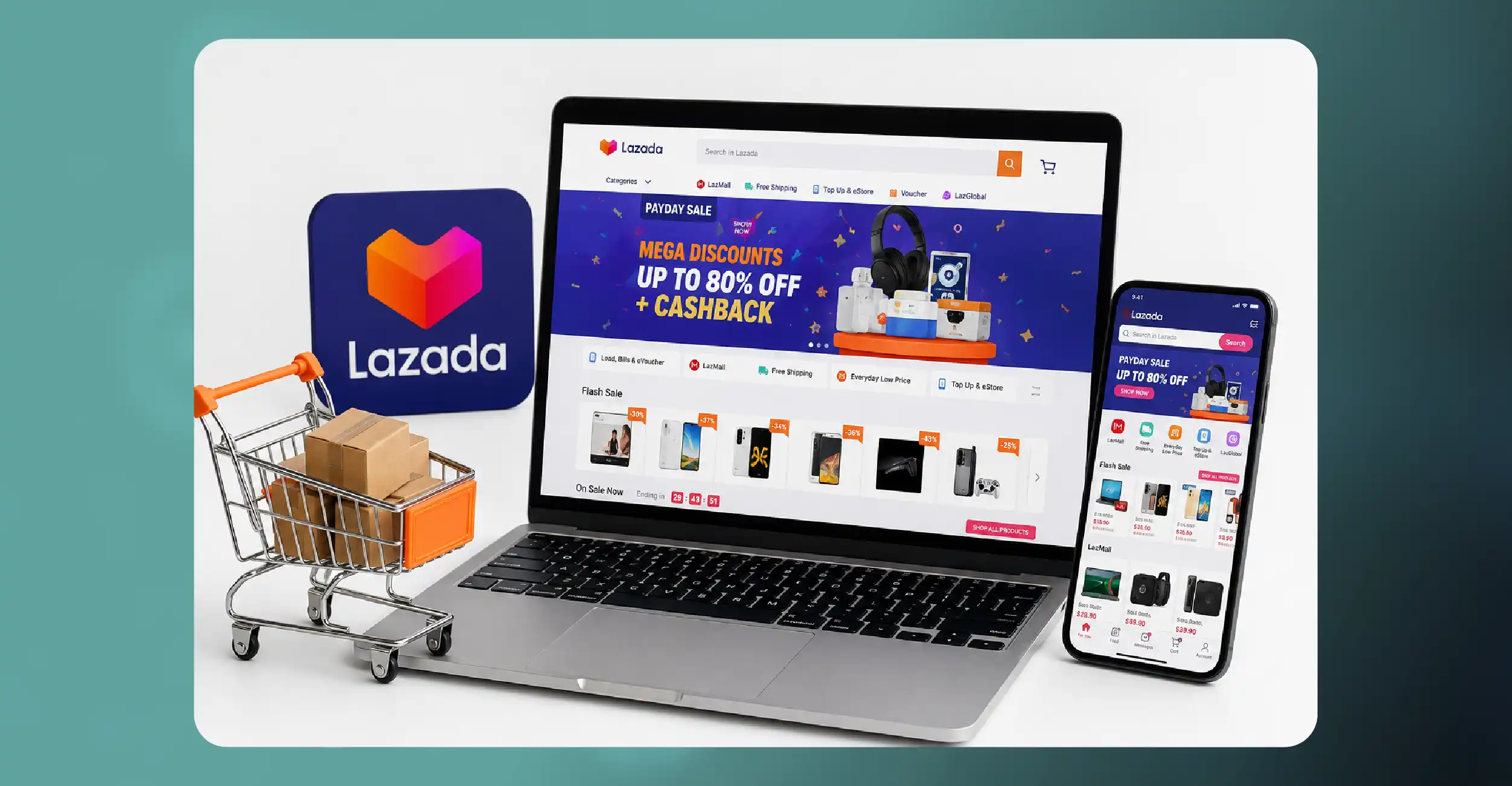
Lazada marketplace data scraping enables organizations to build a broader view of marketplace activity rather than focusing exclusively on individual products.
A competitive intelligence system can monitor several sellers offering similar products and compare their pricing, discounts, ratings, availability, and assortment. This helps businesses understand competitive positioning and identify market changes.
For example, a consumer electronics brand could monitor competing smartphones across different sellers. The dataset could record product models, storage variants, prices, discounts, seller ratings, promotional campaigns, and review volumes.
Over time, this information can reveal which products are aggressively discounted, which sellers maintain consistent pricing, and which product categories experience rapid competitive movement.
Building Lazada Retail Intelligence
Lazada retail intelligence transforms raw marketplace records into business insights. Raw product data alone has limited value unless it can be organized, analyzed, and interpreted.
A retail intelligence pipeline can combine historical prices, seller information, availability, ratings, reviews, promotions, and product attributes. Analytical models can then identify pricing trends, assortment gaps, promotional intensity, and competitive movements.
Brands can use this intelligence to evaluate marketplace performance, while retailers can identify emerging categories and products. Market research companies can use historical datasets to understand market evolution and competitive positioning.
The same information can also support dashboards where users filter products by category, brand, seller, price range, discount level, or marketplace.
Creating a Lazada Product Pricing Dataset
A structured Lazada product pricing dataset can become a valuable historical resource for pricing analytics.
A dataset might contain fields such as product ID, product name, brand, category, seller, original price, current price, discount, rating, review count, availability, product URL, marketplace, and extraction timestamp.
The timestamp is particularly important because marketplace prices are dynamic. Without historical timestamps, businesses can see only the current state rather than how pricing evolved.
Historical pricing records can support statistical analysis, price-change detection, competitor benchmarking, promotional analysis, and forecasting. Organizations can also combine Lazada records with internal sales data to evaluate how external marketplace pricing relates to their own commercial performance.
Using a Lazada Product Data Scraper
A Lazada product data scraper can automate the collection and transformation of marketplace information into structured datasets.
A typical workflow begins by defining the products, categories, sellers, brands, or search terms that need to be monitored. The extraction system then collects relevant fields, validates the returned information, removes duplicates, normalizes values, and stores the final records.
Data quality is an important part of the process. Product names may change, prices may fluctuate, products may become unavailable, and sellers may modify their listings. Therefore, automated validation and historical record management should be incorporated into the pipeline.
Organizations can schedule extraction according to their business requirements. Some businesses may need daily updates, while pricing-sensitive operations may require more frequent collection.
Scrape Product Data for E-Commerce Analytics
Businesses increasingly Scrape Product Data to understand marketplace competition, consumer-facing assortment, and pricing behavior.
Lazada data can be integrated with internal product catalogs to identify matching products across marketplaces. Product matching can use product IDs, SKUs, brand names, model numbers, specifications, or other attributes.
Once matching is completed, businesses can compare equivalent products across sellers and marketplaces. This creates a foundation for price intelligence, digital shelf analysis, assortment optimization, and competitive monitoring.
Product data can also be enriched with additional business attributes. For example, a retailer may combine marketplace information with internal product categories, profitability metrics, inventory levels, or sales performance.
Business Applications of Lazada Data
Lazada marketplace datasets can support numerous commercial applications. Brands can monitor competitors and identify pricing changes. Retailers can benchmark marketplace prices against their own catalogs. Sellers can analyze category competition and identify products with attractive market opportunities.
Market research organizations can use historical marketplace records to evaluate category growth, seller concentration, promotional behavior, and product assortment.
E-commerce analytics companies can integrate the data into dashboards, recommendation systems, price comparison platforms, and market intelligence products.
Another important application is promotion analysis. Businesses can compare standard prices with promotional prices and measure how often products enter discounts. Over time, this can help identify recurring campaigns and seasonal pricing behavior.
Data Processing and Integration
Collecting data is only one stage of an effective marketplace intelligence system. The information must be processed into a consistent structure before it becomes useful.
Data pipelines can normalize currencies, standardize category names, clean seller information, remove duplicate records, validate prices, and identify missing values. Historical snapshots can be stored in databases or cloud environments for analytical processing.
For large datasets, businesses can use databases and distributed processing technologies to handle high volumes of historical records. APIs can also deliver structured results directly to downstream applications, dashboards, and internal analytics systems.
A well-designed pipeline can therefore connect marketplace extraction with business intelligence tools rather than keeping the data isolated in spreadsheets.
How iWeb Data Scraping Can Help You?
Customized Extraction
iWeb Data Scraping can develop customized Lazada extraction workflows around products, categories, sellers, pricing, promotions, availability, ratings, and other required marketplace attributes.
Scalable Collection
Its scalable data collection infrastructure can support large product catalogs, recurring extraction schedules, historical snapshots, and continuously expanding marketplace datasets efficiently.
Structured Datasets
Collected marketplace information can be cleaned, standardized, deduplicated, and delivered through structured formats suitable for databases, analytics platforms, dashboards, and business applications.
Competitive Intelligence
Historical marketplace data can help businesses identify competitor pricing changes, promotional activity, assortment movements, seller behavior, availability trends, and emerging category opportunities.
API Integration
We can provide structured delivery workflows that integrate extracted marketplace information into internal systems, analytical applications, dashboards, and automated intelligence platforms.
Conclusion
Lazada provides a substantial source of marketplace intelligence for organizations seeking deeper visibility into product assortment, pricing, sellers, promotions, and availability across Southeast Asian e-commerce markets. Automated extraction makes it possible to transform continuously changing marketplace information into structured, historical, and analytically useful records.
Businesses can use Lazada Product Datasets to conduct competitor analysis, price benchmarking, assortment research, promotional intelligence, and retail performance analysis. When supported by reliable Web Scraping API Services, these datasets can be integrated into dashboards, applications, databases, and automated analytical workflows.
The value can be further increased through Product Data Enrichment, where marketplace information is combined with internal catalogs, business attributes, historical records, and other commercial datasets. With an appropriately designed extraction and processing architecture, Lazada data can become a dependable foundation for modern e-commerce intelligence and competitive decision-making.
FAQs
Lazada API scraping is an automated approach for collecting structured marketplace information such as products, prices, sellers, ratings, availability, and promotions for analysis.
Depending on the permitted data-access method, datasets can include product names, SKUs, prices, discounts, brands, categories, sellers, ratings, reviews, images, availability, and product specifications.
Historical pricing information helps businesses monitor competitors, identify price changes, evaluate promotions, benchmark products, and understand marketplace pricing behavior.
Yes. Structured extracted data can be designed for API-based delivery, depending on the project architecture, required fields, access method, and integration requirements.
Brands, retailers, sellers, market researchers, e-commerce analytics companies, pricing teams, and competitive intelligence professionals can use Lazada marketplace data for research and decision-making.