

Introduction
In today's competitive e-commerce environment, maintaining consistent product pricing across online marketplaces is a major challenge for brands, manufacturers, distributors, and authorized retailers. Products can appear on multiple platforms with different prices, promotional offers, seller identities, and availability conditions. Without continuous visibility, even a carefully designed pricing strategy can become difficult to enforce, potentially affecting profitability, retailer relationships, and customer trust.
Marketplace price compliance monitoring helps brands observe product listings across digital marketplaces, compare advertised prices against established pricing policies, and identify potential discrepancies before they create significant commercial problems. By collecting structured information about product prices, seller names, discounts, product identifiers, and listing URLs, businesses can understand where their pricing policies are being followed and where further investigation may be necessary.
An essential part of this process is MAP violation tracking, which helps businesses identify advertised prices that fall below their Minimum Advertised Price (MAP) thresholds, where applicable. Alongside pricing discrepancies, unauthorized seller monitoring helps brands identify unfamiliar merchants, suspicious listings, and potentially unauthorized distribution channels that may require verification.
Combining marketplace data collection with automated analysis enables businesses to move beyond occasional manual checks. Instead of reviewing hundreds of listings individually, companies can develop a repeatable monitoring process that highlights emerging risks, measures compliance trends, and supports evidence-based decisions.
What Is Marketplace Price Compliance Monitoring?
Marketplace price compliance monitoring is the systematic process of collecting and analyzing publicly available marketplace listing information to evaluate whether advertised prices and seller activities align with a brand's applicable policies, distribution agreements, and pricing guidelines.
Brands often distribute products through authorized retailers, independent resellers, distributors, and large e-commerce platforms. Although these channels expand product reach, they also create pricing complexity. A single product might appear at its recommended advertised price on one marketplace, at a substantial discount on another, and through an unfamiliar seller on a third.
Monitoring helps businesses identify these differences and prioritize listings that require attention.
Typical monitoring activities include:
- Comparing advertised prices against configured MAP thresholds.
- Identifying discounts, coupons, and promotional price changes.
- Tracking seller names and storefront identifiers.
- Matching products using SKUs, GTINs, UPCs, or model numbers.
- Monitoring listing availability and product page changes.
- Recording timestamps and URLs for further investigation.
- Tracking repeated discrepancies across sellers and marketplaces.
It is important to distinguish an observed price discrepancy from a confirmed policy violation. MAP policies vary by brand, jurisdiction, product category, and agreement. A listing may reflect a permitted promotion, a pricing exception, or a policy that does not apply to that seller. Monitoring identifies potential issues; appropriate review determines whether a violation actually occurred.
Why MAP Compliance Matters for E-Commerce Brands?

Minimum Advertised Price policies can help eligible brands establish consistent advertised-price expectations within their distribution strategies. When implemented lawfully and appropriately, these policies can support channel relationships and reduce concerns about public discounting.
However, online pricing changes rapidly. Sellers may update prices multiple times throughout a day, apply coupon codes, introduce limited-time promotions, or adjust prices in response to competitors. Manual monitoring often struggles to capture these changes consistently.
Protecting Margins and Pricing Strategy
Frequent discounting can create pressure on other retailers to lower their prices. If one seller repeatedly advertises products below a brand's established threshold, authorized retailers may feel compelled to respond, potentially reducing margins across the distribution network.
Structured monitoring allows brands to identify price movements and evaluate whether intervention is warranted. Businesses can distinguish isolated fluctuations from persistent patterns and prioritize the listings with the greatest potential commercial impact.
Maintaining Authorized Retailer Relationships
Retail partners invest in product promotion, inventory, customer service, and advertising. Unexplained pricing differences can create tension when some sellers appear to operate under different commercial conditions.
Consistent monitoring gives brands clearer visibility into marketplace pricing and helps them investigate discrepancies using comparable product and seller information.
Preserving Brand Positioning
Premium brands may rely on a carefully managed pricing strategy to communicate product quality and value. Persistent discounting can influence customer expectations, making regular prices appear less attractive over time.
Monitoring advertised prices helps businesses understand how their products are presented across marketplaces and evaluate whether pricing patterns align with their intended positioning.
Common MAP Violations and Pricing Irregularities
Not every discount is a violation, but several patterns deserve attention.
- Below-threshold advertised prices: A product is displayed below the applicable MAP threshold, subject to the policy's terms and permitted exceptions.
- Coupon-driven price differences: A listing displays a compliant headline price but offers a coupon that may affect the advertised-price assessment under the applicable policy.
- Repeated short-term discounts: A seller frequently changes advertised prices around promotional periods, making persistent discrepancies difficult to identify through occasional checks.
- Inconsistent product matching: Similar models, bundles, or product variations are mistakenly compared, creating false alerts that waste investigation time.
- Cross-marketplace pricing differences: A product appears at substantially different prices across marketplaces or regions. Such differences may be legitimate, but they can reveal patterns requiring closer review.
- Unclear promotional conditions: Discounts, rebates, shipping charges, and membership offers may affect the final customer price differently from the displayed advertised price.
A reliable monitoring framework records the relevant pricing components separately instead of treating every visible difference as proof of noncompliance.
Identifying Unauthorized Sellers Across Marketplaces
Unauthorized sellers present a different challenge from advertised-price discrepancies. A merchant may list a product at an acceptable price while operating outside a brand's authorized distribution network. Conversely, a legitimate reseller may offer a discounted product without violating any applicable policy.
Effective monitoring therefore evaluates seller information alongside pricing data.
Important seller attributes include storefront names, seller IDs, marketplace URLs, product assortments, listing history, and available business information. Brands can compare these attributes with internal authorized-seller lists and distributor records.
Detecting Unfamiliar Seller Activity
Automated data collection can reveal sellers that suddenly begin offering multiple branded products, appear across several marketplaces, or repeatedly list products that are difficult to trace through existing distribution channels.
These patterns can help investigation teams decide which sellers require further verification.
Tracking Seller and Listing Changes
Seller names, listing URLs, and product offers may change over time. Historical records help businesses understand when a seller first appeared, which products were listed, and how the listing evolved.
However, marketplace seller information does not always establish the origin or authenticity of inventory. Brands should verify suspicious cases through appropriate internal records, marketplace processes, and authorized distribution partners before taking action.
How Marketplace Data Scraping Supports Price Compliance
Manual checks become increasingly inefficient when brands manage hundreds of products across numerous marketplaces. Data scraping automates the collection of accessible listing information and converts it into structured datasets suitable for analysis.
A well-designed marketplace price monitoring solution can collect product names, identifiers, displayed prices, discounts, seller details, availability, and listing URLs at defined intervals.
The resulting data can be normalized into a consistent format, allowing analysts to compare equivalent products across different websites.
For example, a manufacturer selling 500 products through five marketplaces may need to evaluate thousands of individual listings. Automated collection can reduce repetitive manual work and make it easier to identify listings that have changed since the previous monitoring cycle.
A typical workflow includes:
1. Product identification: Establish a master catalog containing SKUs, GTINs, model numbers, and approved product names.
2. Data collection: Gather accessible listing and seller information from selected marketplaces.
3. Data normalization: Standardize currencies, product identifiers, price fields, seller names, and timestamps.
4. Compliance comparison: Compare observed advertised prices with the relevant configured policy thresholds.
5. Alert generation: Flag potential discrepancies according to severity, recurrence, and business importance.
6. Evidence retention: Preserve listing URLs, timestamps, and relevant snapshots where permitted.
7. Investigation and reporting: Review alerts, document findings, and determine appropriate next steps.
Collection frequency should reflect product volatility, marketplace access conditions, and operational requirements. High-priority products may need more frequent checks than stable, low-volume items.
Essential Data Fields for Marketplace Compliance Analysis
The usefulness of compliance monitoring depends on the quality and consistency of collected information.
| Data Field | Business Purpose |
|---|---|
| Product name and SKU | Identifies the item being monitored |
| GTIN, UPC, or model number | Improves product matching across platforms |
| Advertised price | Supports comparisons against configured thresholds |
| Original or reference price | Provides context for displayed discounts |
| Coupon or promotion details | Helps assess promotional conditions |
| Seller name and seller ID | Supports seller verification and tracking |
| Marketplace name | Identifies the source of the listing |
| Product URL | Enables investigators to revisit the listing |
| Availability status | Indicates whether the offer is currently visible or available |
| Collection timestamp | Establishes when the information was observed |
| Applicable MAP threshold | Provides the policy benchmark for comparison |
| Alert status | Records whether a discrepancy is pending, reviewed, or resolved |
These fields form the foundation of brand price compliance data, enabling businesses to connect pricing observations with seller intelligence, product catalogs, and compliance workflows.
Data quality checks are equally important. Missing prices, currency differences, duplicate listings, incorrect product matches, and outdated pages can distort compliance reports. Automated validation should identify these issues before alerts reach investigation teams.
Building a Scalable Multi-Marketplace Monitoring Strategy
Brands rarely operate through a single digital sales channel. Products may appear on Amazon, Flipkart, Walmart Marketplace, eBay, regional platforms, specialist retailers, and independent e-commerce websites.
Effective multi-marketplace price tracking brings these sources into a common monitoring framework while preserving the differences between their listing structures and seller policies.
Start by prioritizing marketplaces according to revenue contribution, product visibility, historical pricing volatility, and exposure to unauthorized distribution. Then define monitoring rules for each relevant product category and marketplace.
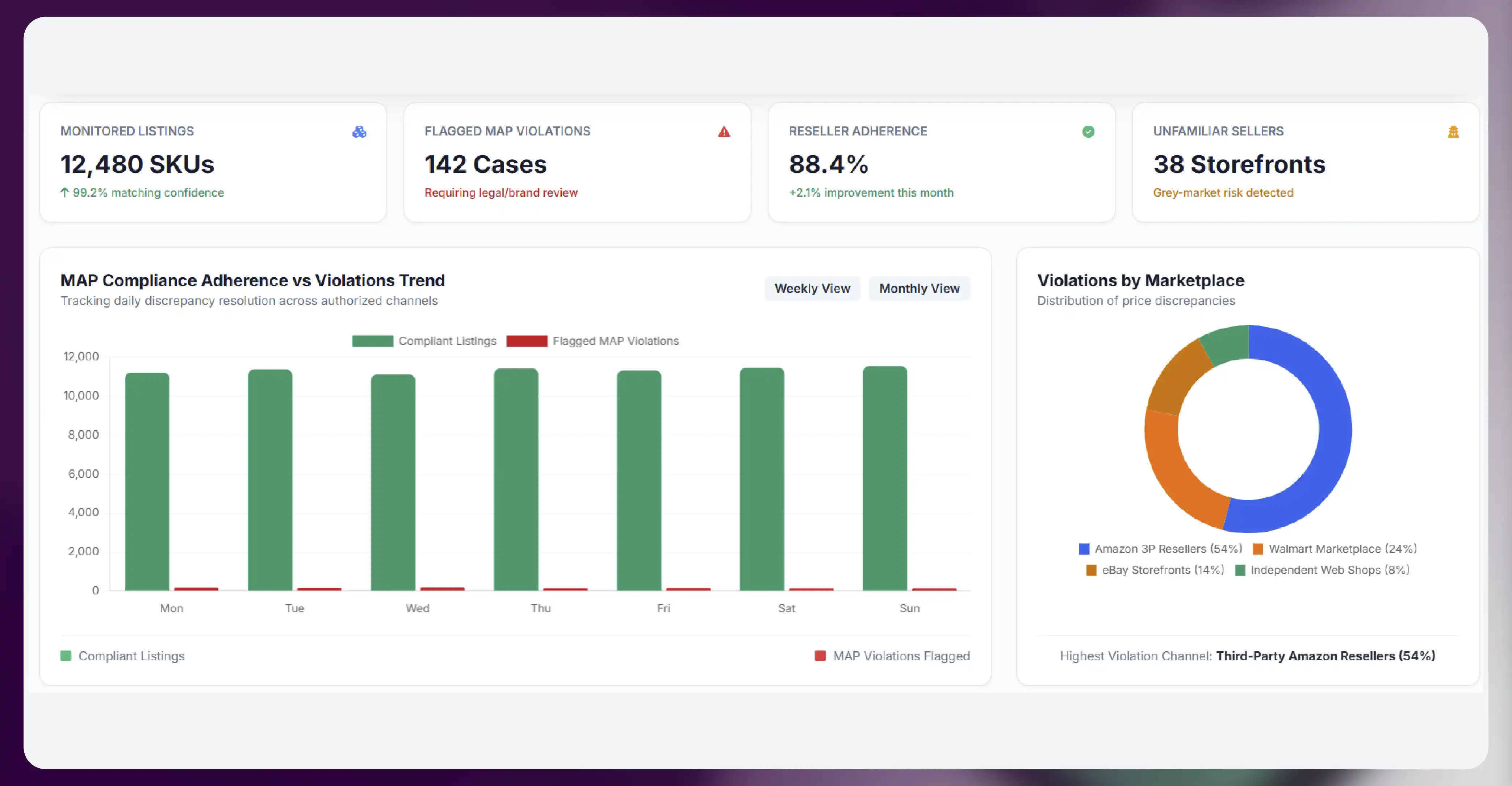
A centralized dashboard can display:
- The number of listings reviewed.
- Potential below-threshold price observations.
- Sellers requiring authorization checks.
- Products with repeated pricing discrepancies.
- Average and minimum observed advertised prices.
- Marketplace-specific compliance trends.
- Open investigations and resolution times.
Brands should also establish clear escalation procedures. For example, a single unusual price observation may trigger verification, while repeated discrepancies across multiple products may warrant a more detailed investigation.
When selecting MAP monitoring services, businesses should evaluate product-matching accuracy, collection frequency, marketplace coverage, historical data retention, alert customization, and reporting flexibility.
Legal review is essential when establishing or enforcing MAP policies. In particular, businesses should distinguish advertised-price policies from restrictions on actual resale prices, which can raise different competition-law concerns depending on the jurisdiction.
Turning Compliance Data into Actionable Insights
Collecting marketplace data is only the first step. The real value comes from translating observations into decisions that improve oversight.
Historical price records can reveal whether certain products experience frequent discounting, whether specific sellers repeatedly trigger alerts, and whether discrepancies cluster around major shopping events.
Trend analysis also helps brands measure whether corrective actions are associated with improved advertised-price consistency. Teams can compare compliance indicators before and after interventions without assuming that every price change was caused by a particular action.
Seller-level analysis can highlight recurring patterns, while product-level analysis identifies items that require closer monitoring. Combining both views helps businesses allocate investigation resources more effectively.
A useful dashboard should separate confirmed findings from unverified alerts, document the evidence supporting each case, and make it easy to revisit the original listing. This approach reduces false positives and helps teams maintain a defensible audit trail.
Automation should support human judgment rather than replace it. Pricing context, seller authorization, contractual terms, and applicable laws all influence the appropriate response to a potential discrepancy.
How iWeb Data Scraping Can Help You?
1. Automated Price Collection
iWeb Data Scraping can collect accessible marketplace prices, discounts, and product details at scheduled intervals, helping brands reduce manual checks and identify relevant pricing changes across selected digital sales channels.
2. MAP Threshold Comparison
Structured datasets can be compared with configured MAP thresholds to flag potential below-threshold advertised prices, helping compliance teams prioritize unusual listings and review exceptions before determining whether a violation occurred.
3. Seller Intelligence
Seller names, marketplace identifiers, product listings, and historical observations can be organized to support authorization checks, identify unfamiliar merchants, and investigate potentially unauthorized distribution activity using internal records.
4. Cross-Marketplace Benchmarking
Consolidated marketplace datasets enable businesses to compare equivalent products across platforms, monitor pricing differences, evaluate discount patterns, and understand how marketplace-specific changes affect their wider retail distribution strategy.
5. Compliance Reporting
Customized dashboards and historical datasets help teams review recurring alerts, monitor resolution progress, document observed discrepancies, and communicate pricing trends to sales, channel management, and compliance stakeholders.
Conclusion
Marketplace price compliance monitoring is an important capability for brands seeking greater visibility into advertised prices, seller activity, and digital distribution channels. By combining automated data collection, accurate product matching, policy-based comparisons, and structured investigation workflows, businesses can identify potential discrepancies more efficiently and make better-informed decisions.
An effective strategy connects pricing observations with seller verification, historical analysis, and clear escalation procedures. This approach strengthens brand protection by helping businesses investigate suspicious listings, understand discounting patterns, and maintain better oversight of their online presence.
Integrating Amazon seller data into the monitoring process can improve visibility into merchant activity and advertised prices on Amazon, while Flipkart data scraping can support comparable analysis across Flipkart listings and sellers. When these datasets are combined with other relevant marketplace sources, brands gain a broader understanding of their pricing environment.
Ultimately, successful monitoring depends on reliable data, well-defined policies, and proportionate responses. Treating automated alerts as investigation signals—not automatic proof of wrongdoing—helps brands build a more accurate, scalable, and commercially effective compliance program.
Frequently Asked Questions (FAQs)
Marketplace price compliance monitoring involves collecting and analyzing product listing prices across online marketplaces to identify potential discrepancies with applicable MAP policies, advertised-price guidelines, and internal pricing requirements.
MAP violation tracking compares observed advertised prices with configured thresholds, records relevant listing details, and flags potential discrepancies for review. Businesses must consider policy terms, promotional exceptions, and applicable laws before confirming a violation.
Brands can compare marketplace seller names and IDs against authorized-seller records, examine listing histories, and investigate unfamiliar merchants. Additional verification may be needed to establish distribution status, inventory origin, or product authenticity.
Yes. A suitably designed data collection workflow can gather accessible product and seller information from multiple marketplaces, standardize the results, and consolidate them into a central dataset or dashboard, subject to platform access restrictions.
Businesses should evaluate marketplace coverage, collection frequency, product-matching accuracy, seller identification, historical records, customizable alerts, dashboard capabilities, data quality controls, and the ability to integrate results with existing compliance and reporting workflows.