
42.8K+
AUTOMOBILE PRICE AND OFFER RECORDS PROCESSED

Maruti Suzuki Data Scraping Enabled City-Wise Price Tracking and Offer Intelligence for a Multi-City Automobile Dealer Network.
This case study explores how an automobile dealer network transformed fragmented vehicle pricing information into structured market intelligence through automated Maruti Suzuki automobile data scraping. The initiative focused on monitoring variant-level prices, dealership offers, ex-showroom rates, and city-specific pricing differences to improve competitive visibility and support informed sales decisions.
It is designed for:
The network required reliable access to Maruti Suzuki car price data across multiple cities, dealerships, and vehicle configurations. Its objective was to understand how prices differed between locations, identify changing promotional patterns, and establish a unified pricing intelligence system.
The case study examines how an automobile dealer network implemented an automated data intelligence framework to monitor vehicle pricing across India's competitive passenger automobile market. The initiative focused on collecting car variant price data India through structured extraction pipelines covering manufacturer websites, publicly accessible dealership listings, and other relevant digital sources.
The primary requirement was to establish consistent visibility into Maruti Suzuki vehicle prices across different geographical markets. The client wanted to compare ex-showroom prices, estimated on-road costs, variant specifications, and promotional incentives without depending on individual dealership reports.
The implementation also incorporated automobile dealer offers data to identify discounts, exchange bonuses, corporate benefits, finance-related promotions, and other publicly advertised incentives. These records helped distinguish manufacturer-level pricing from location-specific dealership offers.
The solution covered popular Maruti Suzuki vehicle categories, including hatchbacks, sedans, compact SUVs, SUVs, and multi-purpose vehicles. It captured relevant variant information and mapped pricing records to their respective cities, dealerships, and collection dates.
Automated extraction pipelines continuously gathered available information, standardized inconsistent product descriptions, and identified changes between successive price observations. The resulting dataset enabled analysts to evaluate regional pricing differences, understand promotional intensity, and identify opportunities for improved customer engagement.
The client operated an expanding automobile dealer network with dealerships serving customers across multiple Indian cities. Although Maruti Suzuki vehicles were available through several locations, maintaining an accurate and consistent understanding of their prices proved challenging.
One of the biggest difficulties involved tracking India car on-road price data across different geographical markets. On-road prices include several components beyond the ex-showroom amount, such as registration charges, insurance, applicable taxes, and optional accessories. These components vary by location and customer requirements, making direct comparisons difficult.
The client also needed a dependable framework for automotive data scraping India to collect information from multiple public digital sources and transform it into a consistent analytical dataset.
Fragmented Pricing Information
Vehicle prices were published across manufacturer pages and individual dealership websites. Information appeared in different formats, making consolidated analysis difficult. Teams frequently spent considerable time collecting and organizing records manually.
City-Wise Price Variations
Identical vehicle variants could have different estimated on-road prices across cities because of regional taxes, insurance calculations, registration expenses, and dealership-level promotional adjustments. The client lacked a centralized mechanism to compare these differences systematically.
Variant-Level Identification Problems
Vehicle listings contained different descriptions, fuel options, transmission configurations, and feature packages. Without standardized identification, comparing equivalent variants across dealerships created inaccurate conclusions.
Limited Promotional Visibility
Dealerships frequently advertised seasonal discounts, exchange bonuses, corporate benefits, and finance-related offers. However, these promotions were not consistently documented, making it difficult to understand the actual customer acquisition opportunity in each market.
The implementation replaced disconnected manual research activities with an automated automobile intelligence framework. Instead of relying on individual dealership visits and spreadsheet updates, the network gained a centralized system for collecting and comparing vehicle pricing information.
| Dimension | Manual Price Tracking | Automated Data Scraping System |
|---|---|---|
| Data collection | Individual website visits and dealership enquiries | Automated collection from selected public sources |
| Price monitoring | Periodic manual updates | Scheduled and continuous price observations |
| Variant identification | Inconsistent vehicle descriptions | Standardized model and variant mapping |
| City coverage | Limited dealership coverage | Multi-city pricing intelligence |
| Offer tracking | Scattered promotional records | Structured discounts and incentive information |
| Historical analysis | Limited spreadsheet records | Date-stamped historical datasets |
| Price comparison | Manual calculations | Automated city-wise comparisons |
| Reporting | Separate dealership reports | Centralized dashboards |
| Data validation | Human-dependent verification | Automated validation and exception checks |
| Scalability | Increasing manual workload | Expandable extraction infrastructure |
The structured approach improved consistency across the network by ensuring that pricing observations were associated with identifiable models, variants, locations, and collection timestamps.
The brand in focus is Maruti Suzuki, one of India's prominent passenger vehicle manufacturers, with a broad portfolio covering different customer requirements and price segments.
Its product portfolio includes popular models such as Alto K10, S-Presso, Celerio, WagonR, Swift, Dzire, Baleno, Fronx, Brezza, Grand Vitara, Ertiga, XL6, and Invicto. Different models are available in multiple configurations, including petrol, CNG, manual, and automatic options, depending on the vehicle.
For an automobile dealer network, this extensive portfolio creates an important requirement for accurate variant-level price monitoring. Customers frequently compare different configurations, features, and ownership costs before selecting a vehicle.
Pricing intelligence becomes particularly valuable when dealerships operate across cities with different registration charges, insurance requirements, and promotional conditions.
The project therefore focused on creating a standardized information framework that could organize vehicle records according to model, variant, fuel type, transmission, city, dealership, and observation date.
The objective was not simply to collect advertised prices. It was to understand the complete pricing environment surrounding each vehicle and provide dealership management with information that could support competitive positioning, customer discussions, and regional sales planning.
iWeb Data Intelligence implemented an end-to-end automobile data extraction and processing framework designed to collect, standardize, and analyze vehicle pricing information across selected Indian markets.
The methodology combined automated source monitoring, structured extraction, data normalization, validation, historical storage, and dashboard development.
Source Identification and Data Collection
The initial stage involved identifying relevant public information sources, including manufacturer websites, authorized dealership websites, and publicly accessible automotive listing platforms.
Extraction workflows were configured to capture vehicle details, advertised prices, specifications, available offers, and geographical information. Collection schedules were established according to source update frequency and business requirements.
Model and Variant Standardization
Different websites sometimes displayed vehicle names and configurations using inconsistent descriptions. The solution introduced standardized model and variant identifiers to ensure that equivalent vehicles could be compared accurately.
Records were organized using attributes such as model name, variant, fuel type, transmission, engine configuration, and available features.
City-Wise Price Extraction
The pipeline captured available city-specific pricing information and associated every observation with its geographical location.
This enabled the client to compare identical variants across different markets while separating manufacturer-listed prices from location-dependent costs and dealership promotions.
Offer and Discount Monitoring
Publicly advertised promotional information was extracted and categorized into exchange bonuses, consumer discounts, corporate benefits, finance-related promotions, and other applicable incentives.
Each record included the available offer description, source, associated vehicle, location, and observation date. Conditions were retained wherever available to avoid misleading comparisons.
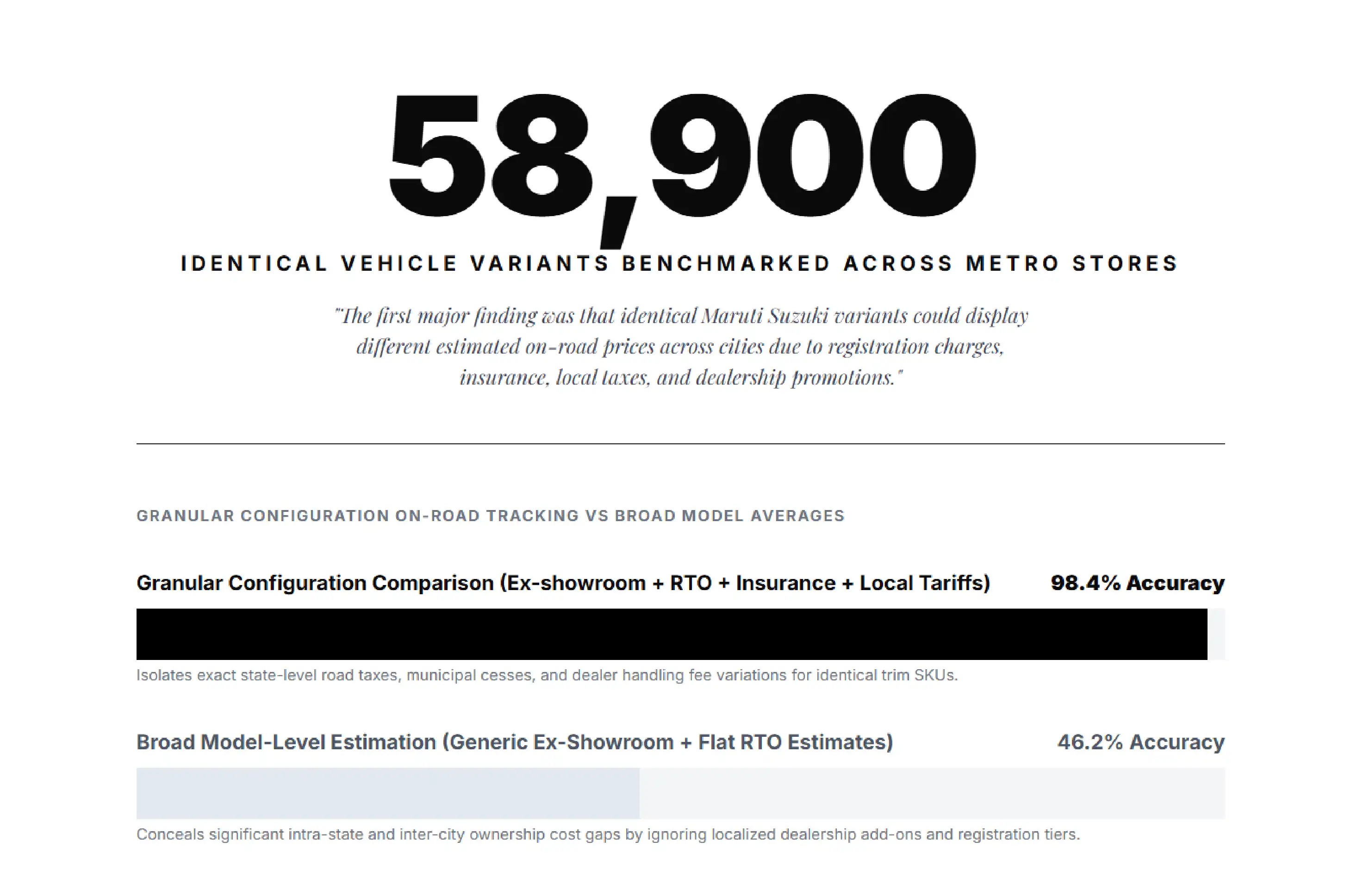
The first major finding was that identical Maruti Suzuki variants could display different estimated on-road prices across cities.
These variations were influenced by registration charges, insurance calculations, applicable local taxes, accessories, and dealership-level promotions.
The centralized dataset allowed the client to compare equivalent configurations across locations rather than relying on broad model-level comparisons.
This improved the identification of markets where vehicle ownership costs were comparatively higher or lower. It also helped dealership teams explain price differences more accurately during customer discussions.
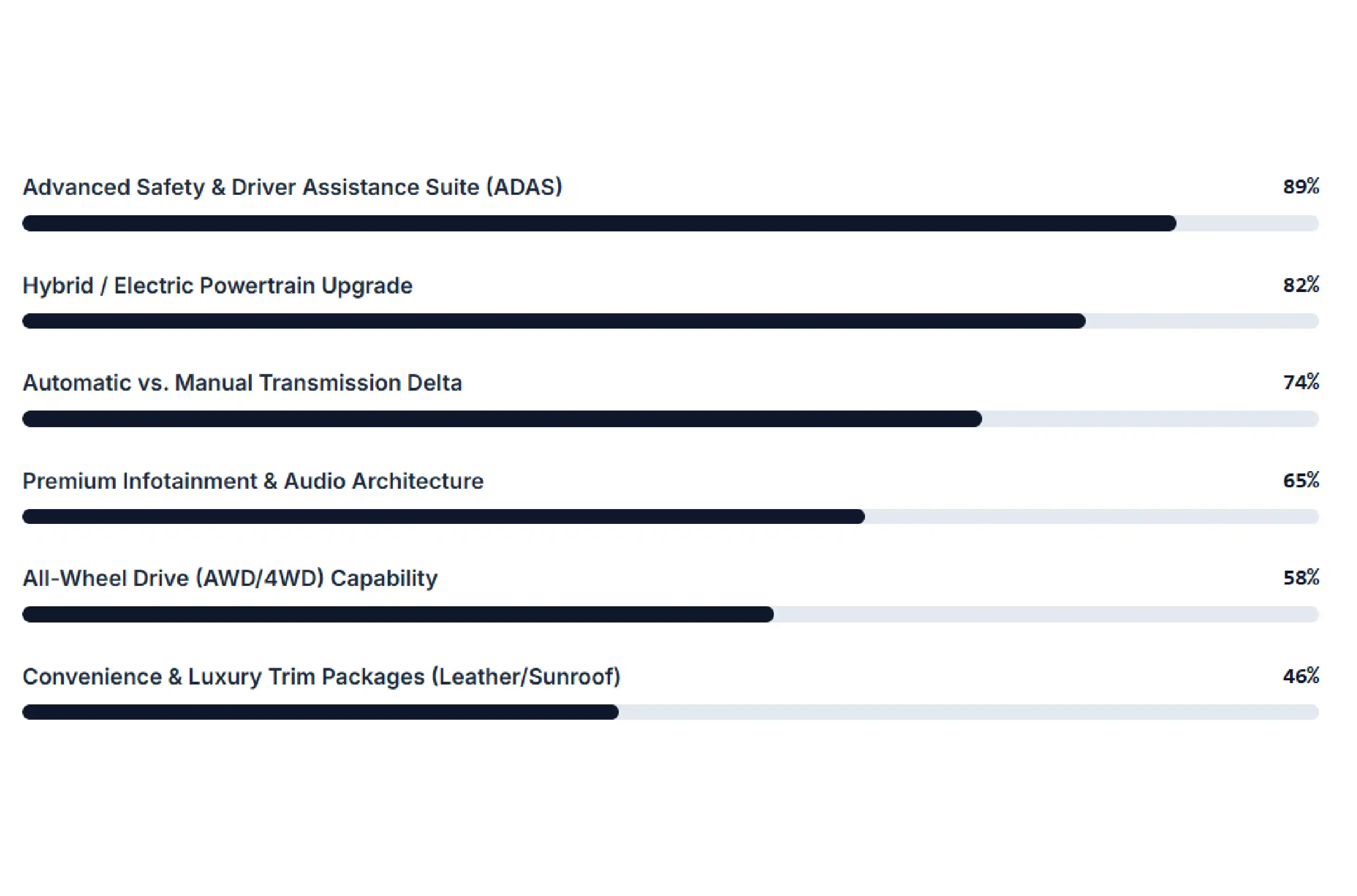
The second finding highlighted the importance of comparing individual variants instead of relying exclusively on base model prices.
A single model may offer multiple configurations with differences in safety features, infotainment systems, transmission, fuel options, and convenience features.
The standardized dataset enabled the network to identify these configurations and compare their advertised prices across dealerships.
This created a more accurate understanding of product positioning and helped sales teams recommend alternatives based on customer budgets and feature requirements.
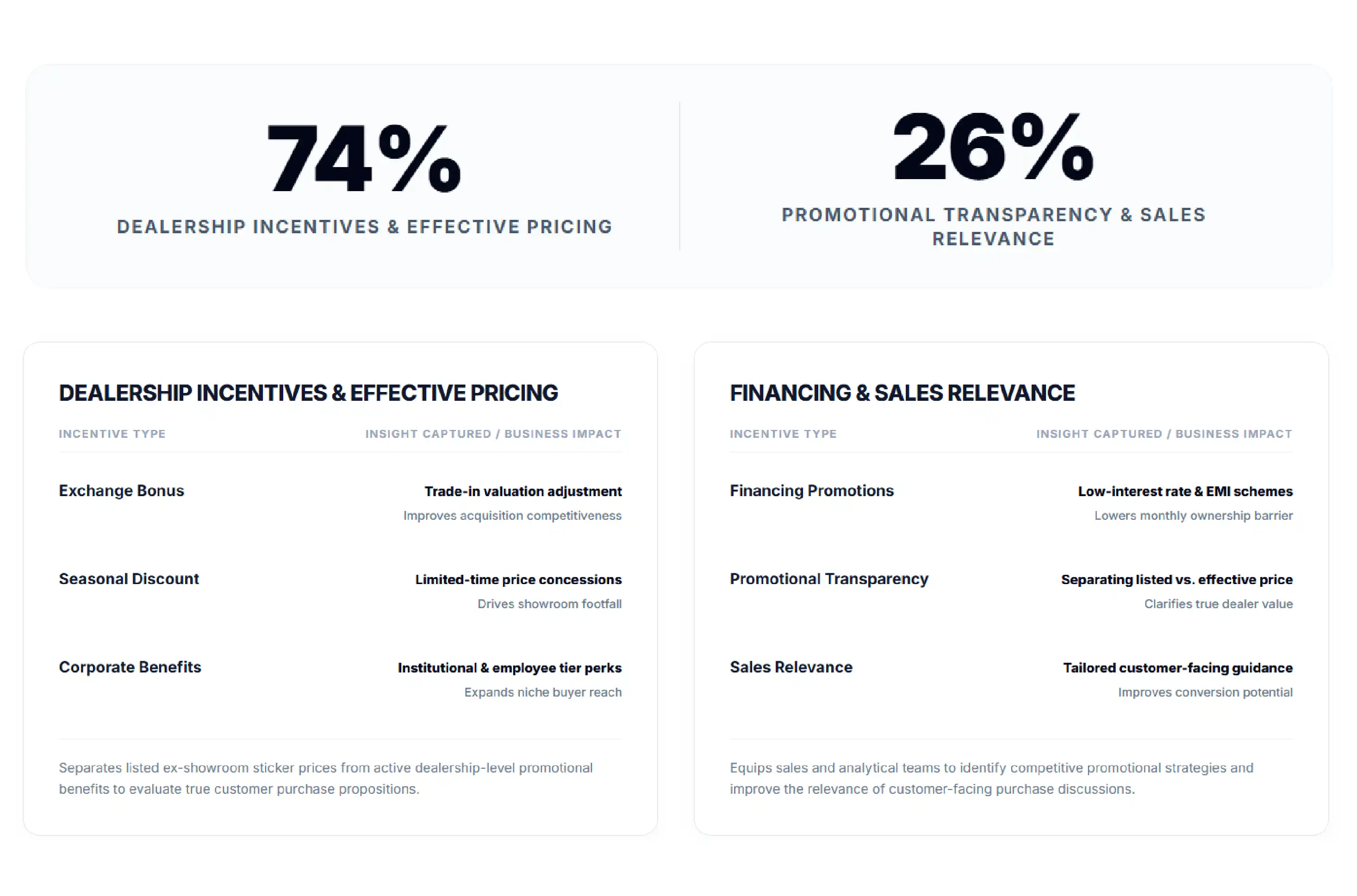
The third finding concerned the influence of dealership-level incentives on advertised vehicle pricing.
Exchange bonuses, seasonal discounts, corporate benefits, and financing promotions could change the effective customer purchase proposition without necessarily changing the official ex-showroom price.
The extracted information allowed analysts to separate listed prices from promotional benefits and evaluate which dealerships were communicating stronger offers.
This helped the client identify competitive promotional strategies and improve the relevance of customer-facing sales discussions.
The following illustrative dataset demonstrates how vehicle pricing information can be structured for comparative analysis. The values are hypothetical examples created to explain the reporting methodology and should not be interpreted as verified current quotations.
| City | Model | Variant | Ex-Showroom Price | Estimated On-Road Price |
|---|---|---|---|---|
| Delhi | Swift | VXi Petrol | ₹6.49 Lakh | ₹7.35 Lakh |
| Mumbai | Swift | VXi Petrol | ₹6.49 Lakh | ₹7.68 Lakh |
| Bengaluru | Swift | VXi Petrol | ₹6.49 Lakh | ₹7.72 Lakh |
| Hyderabad | Baleno | Delta Petrol | ₹6.80 Lakh | ₹8.02 Lakh |
| Pune | Baleno | Delta Petrol | ₹6.80 Lakh | ₹7.96 Lakh |
| Delhi | Brezza | VXi Petrol | ₹8.26 Lakh | ₹9.35 Lakh |
| Jaipur | Brezza | VXi Petrol | ₹8.26 Lakh | ₹9.27 Lakh |
| Chennai | WagonR | LXI Petrol | ₹5.79 Lakh | ₹6.55 Lakh |
| Kolkata | WagonR | LXI Petrol | ₹5.79 Lakh | ₹6.63 Lakh |
| Ahmedabad | Fronx | Sigma Petrol | ₹6.85 Lakh | ₹7.72 Lakh |
The dataset illustrates how the same variant can retain an identical ex-showroom price while estimated on-road costs differ across locations.
Following the implementation of the structured automobile intelligence framework, the dealer network achieved measurable operational improvements across data collection, pricing comparisons, and reporting activities.
The following figures represent illustrative project outcomes for this case study.
These improvements strengthened the network's ability to use automobile pricing information as a practical decision-support resource rather than treating it as scattered operational data.
iWeb Data Intelligence provides structured data extraction and analytics solutions that help businesses convert fragmented online information into reliable business intelligence.
Unified Data Collection
Our automated pipelines consolidate information from selected public digital sources into standardized datasets. This reduces fragmentation and makes it easier for teams to compare pricing information across different locations and platforms.
Real-Time Market Monitoring
Scheduled extraction workflows help businesses monitor available pricing updates, promotional changes, and vehicle listing information. This improves awareness of evolving market conditions and supports timely business decisions.
Advanced Data Accuracy
Data cleaning, duplicate detection, validation rules, and standardized identifiers help maintain reliable records. These processes reduce inconsistencies and improve the usefulness of collected information for analytical applications.
Scalable Data Infrastructure
Our solutions can accommodate additional cities, dealerships, vehicle models, and information sources as business requirements expand. Flexible extraction schedules and processing workflows support growing information requirements.
"The automobile pricing intelligence solution delivered by the iWeb Data Intelligence team has significantly improved our ability to monitor vehicle prices across multiple cities. Earlier, our teams depended on manual research and individual dealership updates, which made comparisons difficult and time-consuming. The automated system brought vehicle variants, pricing information, and promotional offers together within a structured reporting environment. We now have better visibility into regional pricing differences and can identify important market developments much faster. The data consistency, reporting capabilities, and flexibility of the solution have improved our internal research processes. It has also helped our dealership teams prepare more informed customer discussions and evaluate competitive positioning across different locations. We appreciate the team's approach, technical capabilities, and commitment to delivering a scalable data intelligence solution."
— Head of Dealer Network Operations
The project successfully established a centralized automobile pricing intelligence framework that transformed fragmented vehicle information into structured, city-wise, and variant-level business intelligence.
Through Maruti Suzuki automobile data scraping, the client gained a systematic approach to monitoring advertised vehicle prices, dealership promotions, and regional pricing differences across selected Indian markets.
The automated extraction infrastructure reduced dependence on manual research while improving consistency across multiple information sources. Standardized model identifiers and variant mapping made it easier to compare equivalent vehicle configurations across different cities.
The solution also strengthened promotional visibility by organizing publicly available dealership incentives into structured categories. Management could evaluate discounts, exchange bonuses, corporate benefits, and other promotional activities alongside standard vehicle pricing information.
Historical data storage introduced an additional analytical advantage. By maintaining date-stamped observations, the network established a foundation for evaluating price movements, monitoring promotional changes, and identifying emerging market patterns.
The centralized dashboard improved reporting efficiency by providing a consolidated view of vehicle prices, city-wise variations, and dealership-level information. Sales and management teams could access relevant records without depending on disconnected spreadsheets and repeated manual enquiries.
The implementation of Web Scraping API Services supported automated information collection and integration with the client's analytical environment. Additional Web Scraping Services enabled the infrastructure to accommodate expanding data requirements across vehicle categories and geographical markets.
Automobile data scraping involves collecting publicly available vehicle information from selected digital sources and converting it into structured datasets. For Maruti Suzuki pricing, this can include model names, variants, ex-showroom prices, estimated on-road prices, specifications, dealership offers, and location-specific information. Businesses can use these records for market research, competitive benchmarking, and dealership pricing analysis.
Yes. An automated data extraction framework can collect available vehicle pricing information across selected Indian cities. Each observation can be associated with its location, model, variant, source, and collection date. This enables businesses to compare identical vehicle configurations and understand differences in estimated ownership costs across regional markets.
Depending on source availability, the dataset can include model names, variant descriptions, fuel types, transmission options, ex-showroom prices, estimated on-road prices, specifications, publicly advertised discounts, exchange bonuses, and promotional information. Additional fields can be customized according to the dealer network's reporting and analytical requirements.
City-wise tracking helps dealers understand regional pricing differences, evaluate competitive positioning, and identify promotional opportunities. It also supports more informed customer discussions by providing structured comparisons between equivalent vehicle variants. Historical observations can further help management evaluate pricing movements and changing promotional patterns.
Yes. iWeb Data Intelligence can develop customized extraction and reporting frameworks based on the required vehicle categories, geographical coverage, information fields, update frequency, and delivery formats. Solutions can include structured datasets, API-based integration, historical records, and customized dashboards to support automotive market intelligence.
iWeb Data Intelligence helps automobile dealer networks transform fragmented vehicle listings, variant prices, and dealership promotions into structured market intelligence. Our automotive data extraction solutions support city-wise price comparisons, historical tracking, competitive benchmarking, and informed dealership decisions through scalable data pipelines and customized reporting systems.
Start a projectFields marked * are required. Everything else just helps us scope faster — skip what you don't know yet.