

Introduction
The Swedish online grocery market generates a wealth of valuable information through product catalogs, pricing, promotions, availability, categories, brands, and delivery options. Businesses that systematically collect and analyze this information can gain deeper insights into market trends, competitor positioning, product assortment, and customer demand.
Mathem API scraping enables businesses to gather relevant grocery information from the platform in a structured and automated manner. By collecting data at regular intervals, companies can build historical records that support pricing research, assortment analysis, and competitive benchmarking.
With Mathem product data API extraction, organizations can capture detailed product-level information, including product names, categories, brands, package sizes, prices, promotional offers, and availability. This structured information can be integrated into databases, dashboards, and analytical systems.
Meanwhile, Mathem grocery API scraping can support broader grocery intelligence initiatives by helping businesses monitor market changes, compare product positioning, and develop continuously refreshed datasets for retail research and strategic decision-making.
Understanding Mathem API Scraping
Mathem is a major online grocery platform in Sweden, offering consumers access to groceries, household products, fresh foods, beverages, personal-care products, and other everyday essentials. Its extensive digital catalog creates an important source of market intelligence for retailers, brands, analysts, researchers, and technology companies.
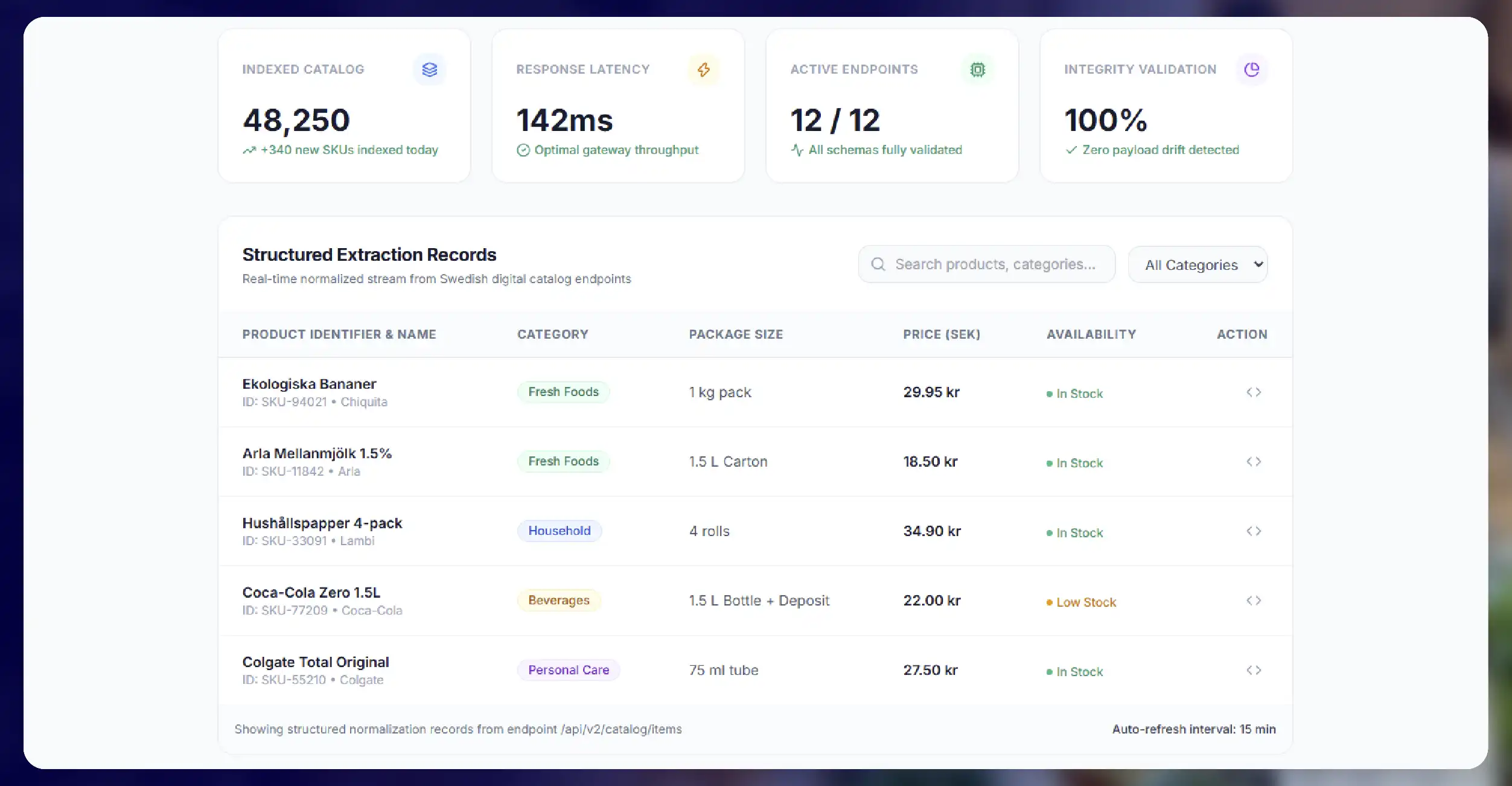
API-oriented extraction can provide structured access to information that would otherwise require extensive manual collection. Depending on the available data endpoints and permitted access methods, businesses can collect product identifiers, names, descriptions, categories, brands, prices, promotional prices, package sizes, availability, images, nutritional information, and other attributes.
The primary advantage is consistency. Instead of collecting isolated product pages manually, an automated pipeline can repeatedly retrieve structured records, normalize them, validate changes, and transfer the resulting information into databases or analytical systems.
What Data Can Be Extracted?
A well-designed Mathem extraction project can capture multiple dimensions of grocery information. The exact fields depend on the accessible data structure and project requirements, but common datasets can include:
- Product name and unique identifier
- Brand and manufacturer
- Product category and subcategory
- Regular and promotional prices
- Unit prices and package sizes
- Product descriptions
- Availability status
- Product images and URLs
- Nutritional or ingredient information
- Product ratings and reviews where available
- Promotions and discount information
- Store or fulfillment information
- Timestamp of collection
A structured Mathem grocery product dataset can then become the foundation for dashboards, price comparison systems, market research models, assortment analysis, and competitive intelligence applications.
Building a Reliable Extraction Pipeline
Successful API scraping requires more than sending repeated requests. The process should be designed around data quality, scalability, monitoring, and long-term maintainability.
The first stage is endpoint discovery and schema analysis. Analysts identify the relevant product, category, search, pricing, availability, or promotional data structures. The next stage establishes request logic, pagination handling, authentication requirements where applicable, and response validation.
Once extraction begins, raw responses can be transformed into standardized records. Product names can be cleaned, categories mapped into consistent taxonomies, prices converted into numerical formats, and duplicate records removed.
A scheduling layer can then run extraction at predetermined intervals. Daily collection may be appropriate for broad assortment research, while more frequent collection can support fast-moving pricing or availability applications.
Price Monitoring and Competitive Intelligence

Online grocery prices change because of promotions, supplier costs, seasonal demand, competition, inventory conditions, and commercial strategy. Tracking these changes over time can reveal patterns that are difficult to identify from occasional observations.
Mathem price monitoring enables businesses to maintain historical records of product prices and identify when products become cheaper or more expensive. With sufficient historical depth, analysts can measure price volatility, promotional frequency, average selling prices, and category-level inflation.
For brands and retailers, Mathem price API tracking can support competitor benchmarking. A company can compare its own pricing against comparable products, evaluate promotional positioning, identify persistent price gaps, and understand how competitors respond to market conditions.
Sweden Supermarket Pricing Intelligence
Sweden's grocery market includes established supermarkets, discount retailers, online grocery platforms, and specialized food businesses. Digital pricing data makes it possible to examine how products are positioned across channels and categories.
Sweden supermarket pricing intelligence can combine Mathem data with other legally accessible sources to create broader market benchmarks. Analysts can examine category averages, brand-level pricing, unit-price differences, promotional activity, and changes across geographical or product segments.
This information can be especially valuable for consumer brands entering Sweden. Instead of relying entirely on surveys or periodic market reports, businesses can use continuously refreshed digital datasets to understand how products are positioned in the market.
Product Assortment and Category Analysis
Price is only one dimension of grocery intelligence. Product assortment can reveal retailer priorities, category depth, brand diversity, and changes in consumer demand.
API-based extraction makes it possible to compare the number of products within categories, monitor new product introductions, detect discontinued items, and identify brands gaining or losing shelf presence.
For example, an analyst could track dairy, snacks, beverages, frozen foods, fresh produce, household supplies, or personal-care categories independently. Historical snapshots can show whether assortment is expanding, contracting, or shifting toward particular brands and product types.
This type of analysis can also help suppliers identify assortment gaps. If a category has strong demand but limited representation of a particular product type, the data may highlight a potential commercial opportunity.
Promotion and Discount Tracking
Promotional activity is another important area for grocery analytics. Discounts can significantly influence customer purchasing decisions and competitor positioning.
Automated extraction can capture regular prices alongside promotional prices whenever the source provides those fields. Historical records can then be used to calculate discount percentages, promotional duration, frequency, and category-level promotional intensity.
Businesses can analyze whether promotions are concentrated around weekends, holidays, seasonal events, or particular product categories. Brands can also assess whether competing products are repeatedly discounted and determine how their own promotional strategies compare.
The resulting intelligence can support campaign planning, revenue analysis, pricing decisions, and retail negotiations.
Data Cleaning and Standardization
Raw API responses are rarely ready for direct business analysis. Different products may have inconsistent names, units, category labels, or formatting. Data cleaning therefore plays a central role in the extraction workflow.
A robust pipeline can standardize product names, normalize package quantities, convert prices into consistent numerical fields, identify duplicate products, and map categories into a common hierarchy.
Product identifiers are particularly useful for maintaining historical continuity. When the same product appears in multiple extraction cycles, its records can be linked so analysts can observe price, availability, and promotional changes over time.
Validation rules can also detect missing prices, unexpected values, malformed records, discontinued products, or sudden structural changes in responses.
Creating Grocery and Supermarket Datasets
Collected data can be delivered in formats suited to different business environments. Smaller research projects may use CSV or Excel, while larger analytical systems may require JSON, PostgreSQL, cloud storage, data warehouses, or APIs.
Online Grocery & Supermarket Data Extraction can support projects involving price comparison, assortment intelligence, market research, demand forecasting, and competitive monitoring.
Likewise, Grocery and Supermarket Store Datasets can be integrated with internal sales, inventory, customer, and promotional information. Combining external market observations with first-party business data creates a more comprehensive analytical environment.
For example, a retailer could compare competitor pricing against internal pricing and sales performance. A consumer goods company could connect competitor assortment changes with its own product distribution. An investment research team could use historical grocery data to evaluate category dynamics.
Scaling Mathem Data Collection
Large catalogs create technical challenges when extraction is performed frequently. A scalable architecture should handle pagination, request failures, duplicate records, schema changes, temporary unavailability, and increasing product volumes.
Incremental extraction can reduce unnecessary processing by focusing on records that have changed since the previous collection. Caching can also minimize repeated requests where appropriate.
Monitoring systems should track successful requests, failed requests, response structures, record counts, and unusual data changes. Alerts can notify technical teams when extraction behavior deviates from established patterns.
Scalability also means designing the pipeline so additional retailers or grocery platforms can be added later without rebuilding the entire system.
How iWeb Data Scraping Can Help You?
Automated Collection
Our team can design automated workflows to collect grocery information at scheduled intervals, reducing manual research while creating consistent datasets for ongoing market and pricing analysis.
Structured Data Delivery
We can transform raw responses into organized datasets containing standardized product, category, price, availability, promotion, and brand fields that are easier for analysts and business teams to consume.
Historical Tracking
Our solutions can maintain historical snapshots so businesses can examine pricing changes, promotional movements, assortment shifts, availability patterns, and competitor behavior across defined periods.
Scalable Pipelines
We can build scalable extraction architectures capable of handling expanding product catalogs, recurring collection schedules, data validation, deduplication, monitoring, and downstream delivery into databases or cloud environments.
Business Intelligence
We can prepare datasets for dashboards, competitive benchmarking, pricing analytics, market research, assortment optimization, and strategic decision-making, helping organizations convert continuously collected grocery information into actionable intelligence.
Conclusion
Mathem API scraping can transform publicly accessible grocery information into structured intelligence for pricing analysis, assortment monitoring, competitive research, and market evaluation. By combining automated collection, historical tracking, data normalization, and analytical processing, organizations can move beyond isolated product observations toward continuously updated market intelligence.
Businesses looking to build reliable grocery datasets can use professional Grocery Data Scraping Services to manage collection, transformation, validation, and delivery requirements. Grocery API Data Scraping can further support structured workflows where API-accessible information is available and permitted for collection.
For organizations managing multiple data sources, Web Scraping API Services can provide a scalable way to integrate external datasets into existing analytics systems. With the right architecture, Mathem data can become a valuable component of broader Swedish grocery intelligence and international retail analytics initiatives.
FAQs
Mathem API scraping involves programmatically collecting structured grocery information from accessible Mathem data interfaces, subject to applicable technical restrictions, terms, and permissions.
Depending on available data structures, projects may collect product names, identifiers, categories, brands, prices, promotions, availability, package information, images, and other product attributes.
Historical extraction can help businesses compare prices over time, identify promotional changes, calculate price differences, and evaluate competitor positioning across grocery categories.
Yes. Structured datasets can be delivered in formats such as CSV, JSON, Excel, databases, cloud storage, or APIs, depending on project requirements.
Automation reduces repetitive manual collection and enables businesses to maintain larger, more consistent, and regularly refreshed datasets for pricing, assortment, competitive, and market intelligence.