
60,000+
PROPERTY SELLER PHONE NUMBERS COLLECTED

Mexico Property Seller Data Collection for Scalable Real Estate Lead Intelligence Across Major Cities, Listings, Sellers, and Property Markets
This case study presents a real-world enterprise scenario involving a Mexico-focused real estate platform that wanted to build a large, structured database of property sellers, listing information, and seller contact details. The organization operated in a highly fragmented property market where seller information was distributed across real estate portals, classified platforms, brokerage websites, independent property pages, and other publicly accessible digital sources.
The platform's objective was to create a scalable intelligence system capable of discovering property listings, identifying seller information, standardizing contact records, and creating a reliable prospecting database for its real estate operations.
This case study is particularly relevant to:
The client required Mexico Property Seller Data Collection to transform scattered property information into a centralized intelligence layer that could support lead generation, market research, and business development.
The organization also wanted to Collect Mexico real estate seller phone numbers from publicly accessible listing information where such contact details were available, while maintaining structured records connecting each seller contact with the relevant property, location, listing category, and source.
The project was therefore designed around scalable data collection, normalization, validation, deduplication, and structured delivery rather than simple contact-list creation.
Mexico's real estate ecosystem contains a large and continuously changing volume of property listings. Sellers, owners, agents, developers, and brokers publish property information across multiple digital channels, creating valuable market intelligence but also making systematic analysis difficult.
The client wanted to create a centralized property seller database covering residential and commercial listings across important Mexican markets. Existing manual processes required employees to visit multiple websites, identify new listings, copy seller details, record phone numbers, and associate contacts with property information.
This process was slow and inconsistent.
To solve the problem, the client implemented Mexico real estate data scraping pipelines designed to identify relevant listings and capture structured property attributes from publicly accessible sources.
The system was designed to Extract property seller contact data alongside property-level information such as listing title, property type, location, price, bedroom count, area, seller category, listing date, and available contact information.
The resulting database created a centralized view of property supply and seller activity. Automated processing reduced repetitive research work while enabling the platform to identify new listings and seller records more systematically.
The project covered multiple property categories, including apartments, houses, villas, commercial properties, land, offices, and other real estate segments. Geographic coverage was expanded across major urban markets and selected surrounding areas.
The client was a growing Mexico-focused real estate technology platform attempting to expand its property acquisition and seller outreach operations. Its existing research process depended heavily on manual browsing and spreadsheet-based data entry.
The first challenge was fragmentation. Property listings were distributed across numerous digital sources, and each source presented seller information differently. Some listings contained phone numbers, while others provided names, agency information, or other contact fields.
The client needed Mexico real estate data scraping for lead generation because its sales and acquisition teams required a continuous flow of new property opportunities rather than occasional manually collected leads.
The second challenge involved scale. Employees could collect only a limited number of listings each day. As the property market changed, new listings appeared while older listings were modified, removed, or replaced.
The organization therefore needed automated monitoring capable of processing large volumes of listings without requiring employees to manually inspect every page.
A further problem was connecting seller information with property information. A phone number alone had limited business value if the platform could not identify the associated property, location, asking price, property type, or listing source.
The project consequently required property listing and seller data extraction in Mexico that could maintain the relationship between contact records and property-level attributes.
Data duplication was another major issue. The same seller could advertise several properties or publish the same property across multiple sources. Without deduplication, the platform risked creating multiple records for the same opportunity.
The client also needed a Real Estate Property data Scraper capable of handling different page layouts, property categories, geographic areas, and source structures while maintaining consistent output fields.
Before implementation, the client's property research process relied substantially on manual browsing, copy-pasting, spreadsheet maintenance, and periodic verification.
The new system transformed this process into an automated data intelligence pipeline.
| Dimension | Manual Property Research | Automated Intelligence Pipeline |
|---|---|---|
| Listing discovery | Employees manually browse websites | Automated source monitoring |
| Seller identification | Manual inspection of listing pages | Structured seller-field extraction |
| Phone collection | Copy-paste into spreadsheets | Automated capture where publicly available |
| Property details | Manually recorded | Standardized property fields |
| Geographic coverage | Limited by researcher capacity | Expanded across multiple markets |
| Duplicate handling | Manual comparison | Automated deduplication rules |
| Data validation | Periodic manual checking | Automated validation and formatting |
| Update monitoring | Irregular | Scheduled collection and refresh cycles |
| Lead creation | Spreadsheet-based | Structured lead-ready datasets |
| Reporting | Manual aggregation | Automated dashboards and exports |
| Scalability | Dependent on workforce | Designed for growing record volumes |
| Historical tracking | Difficult to maintain | Versioned and time-stamped records |
The transition allowed the client to move from isolated listing research toward a continuously refreshed real estate intelligence environment.
The client was a Mexico-focused real estate technology platform serving property discovery, seller acquisition, and real estate lead-generation requirements.
Its business model depended on maintaining a broad understanding of available property inventory. The more effectively the platform could identify new properties and associated seller information, the more efficiently its commercial teams could discover potential opportunities.
Initially, the organization relied on employees to search property websites, identify relevant listings, collect seller information, and organize records manually. As the number of sources increased, this approach became increasingly difficult to maintain.
The company needed a centralized database capable of connecting three important layers of information:
The project therefore focused on building a structured data environment rather than merely collecting phone numbers.
The final database connected available seller contact information with property attributes and source information. This gave the client a broader view of the market while creating a scalable foundation for future real estate intelligence initiatives.
Our approach began with source discovery and schema design. We first identified the property attributes required by the client and created a standardized structure capable of accommodating listings from different source formats.
The solution incorporated Real estate data scraping workflows designed to capture property listings, seller information, location details, pricing fields, property characteristics, and other publicly available attributes relevant to the client's business requirements.
The collection architecture was organized into several stages.
1. Source Discovery and Page Identification
Relevant public property sources were mapped according to geography, property category, listing type, and information availability.
The system identified pages containing property information and relevant seller details, allowing the collection process to focus on records with useful business attributes.
2. Listing-Level Extraction
Each listing was processed into a standardized structure containing fields such as:
3. Contact Data Processing
Available phone numbers were extracted from the relevant public listing fields and normalized into a consistent database format.
The system applied formatting and validation rules to identify incomplete, malformed, or duplicate records.
Where multiple contact fields were available, the system maintained their relationship with the corresponding listing rather than creating disconnected contact entries.
The client could therefore use the same underlying dataset across multiple business functions.
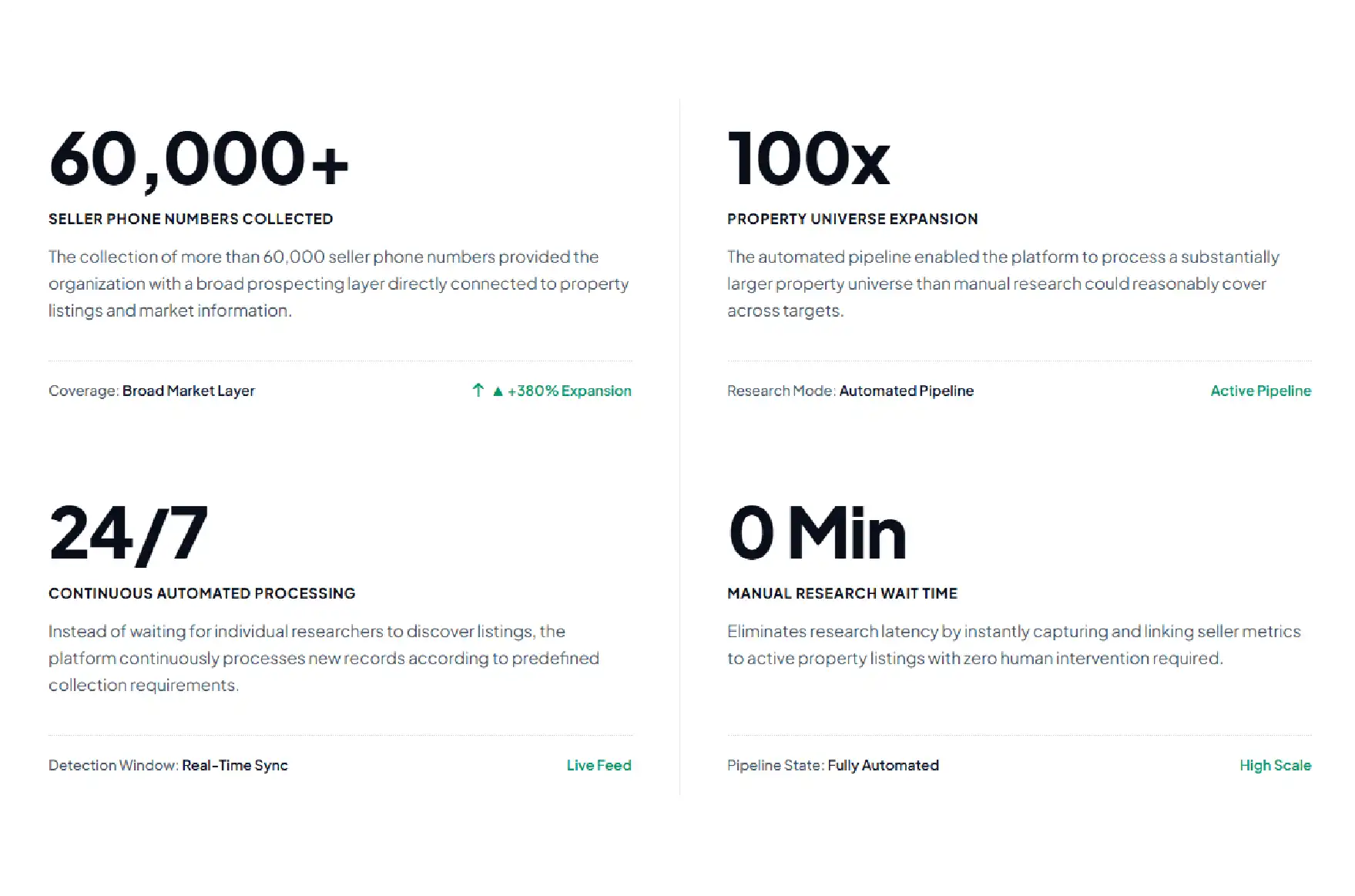
The automated pipeline enabled the platform to process a substantially larger property universe than manual research could reasonably cover.
The collection of more than 60,000 seller phone numbers provided the organization with a broad prospecting layer connected to property listings and market information.
Instead of waiting for individual researchers to discover listings, the platform could continuously process new records according to predefined collection requirements.
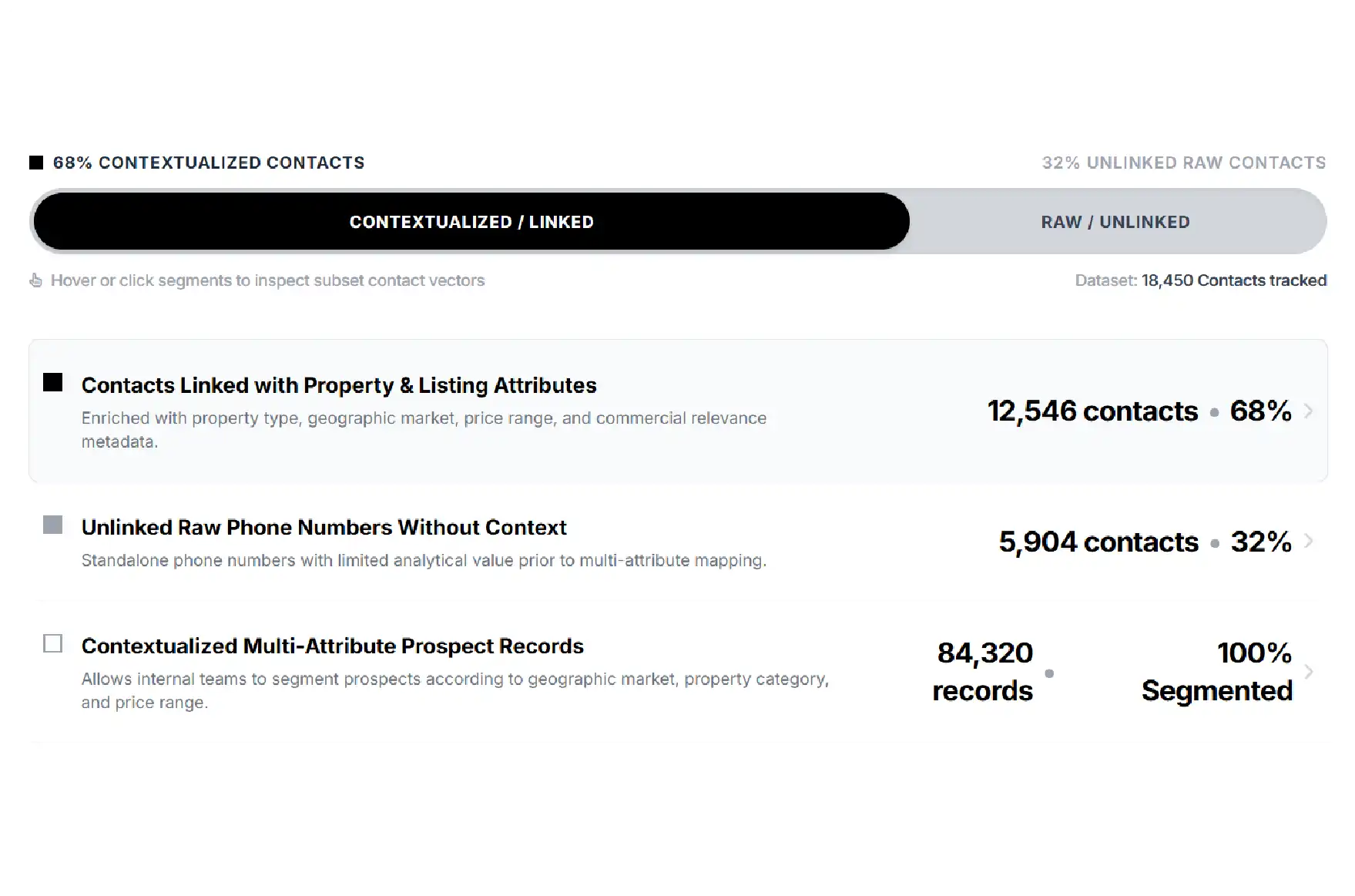
A major improvement came from connecting contact information with listing attributes.
A phone number without context provided limited analytical value. By connecting it with property type, location, price, and listing information, the platform could better understand the commercial relevance of each contact.
This allowed internal teams to segment prospects according to geographic market, property category, price range, and other available attributes.
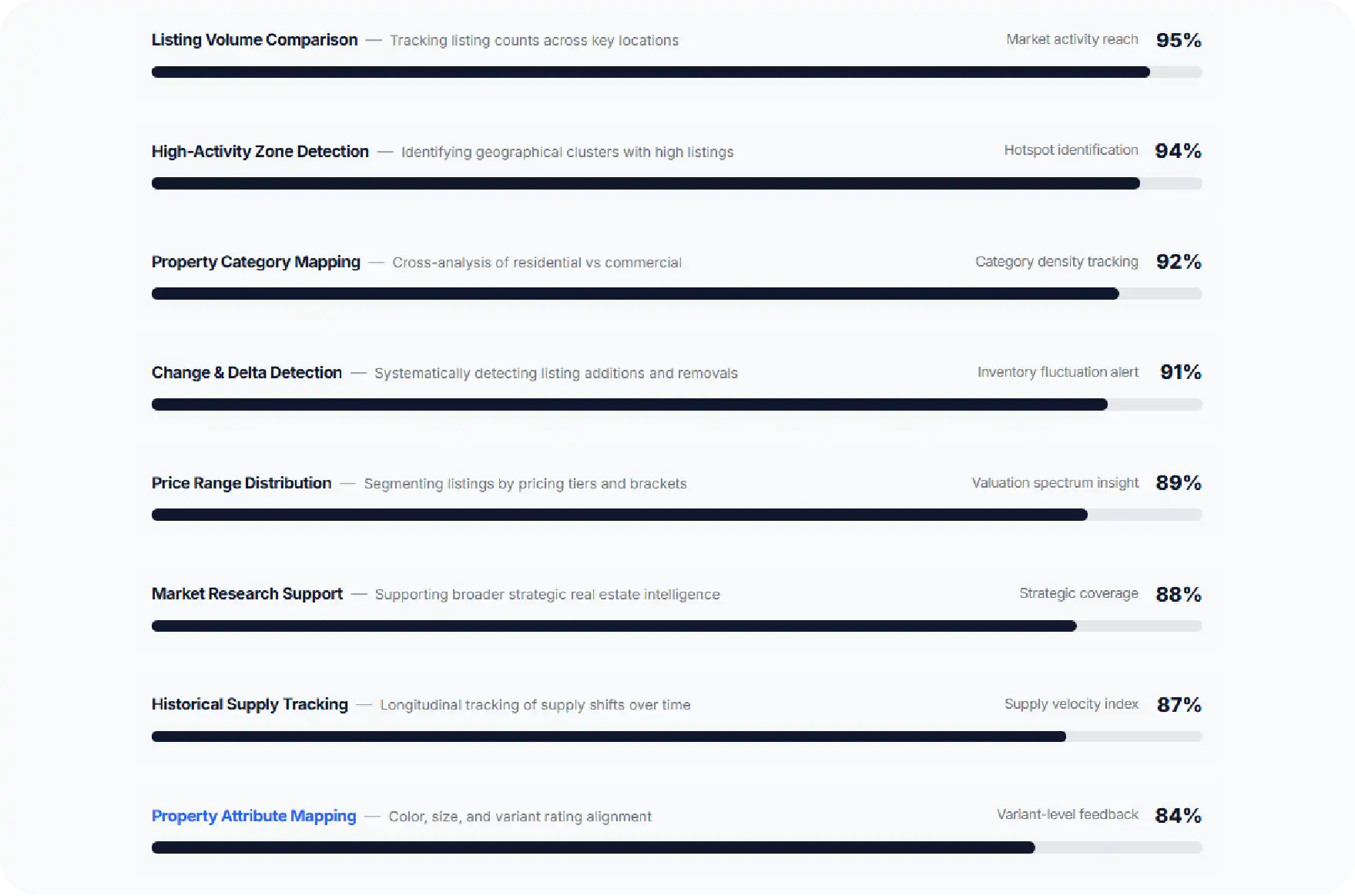
The dataset also provided a structured view of property supply.
Analysts could compare the number of listings across locations, property categories, and price ranges. This supported broader market research and helped the organization identify areas with higher listing activity.
The same infrastructure could subsequently support historical tracking and change detection.
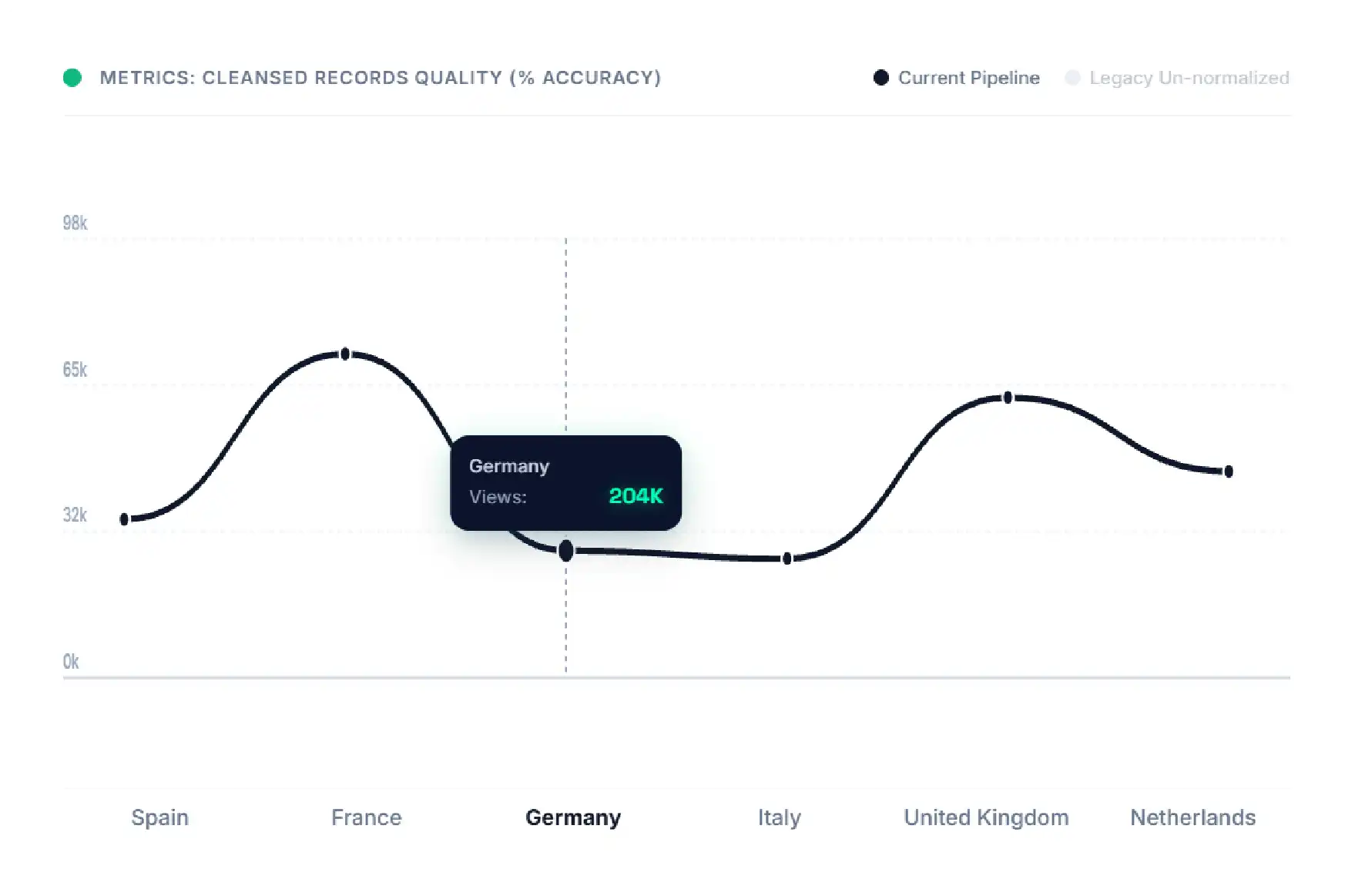
Different sources frequently used different formats for prices, locations, seller names, and phone numbers.
Normalization created a common structure across records.
This made downstream analysis easier because analysts no longer needed to manually reconcile every dataset before using it.
The final database gave business teams a structured source for discovering seller opportunities.
Instead of manually searching individual property pages, teams could filter records according to location, property type, price range, seller category, and other available attributes.
This transformed property research from a page-by-page activity into a searchable intelligence workflow.
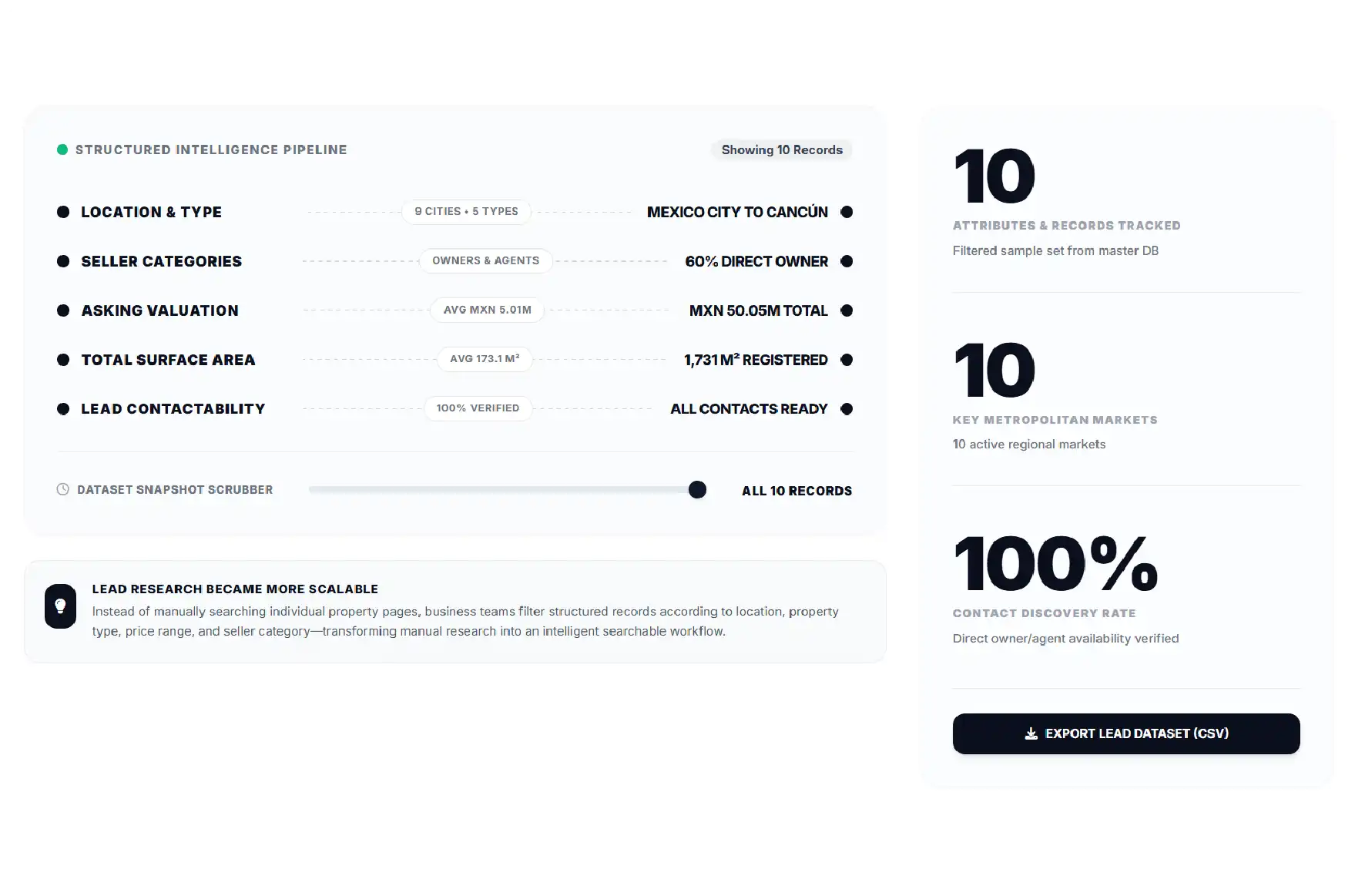
The following illustrative dataset structure demonstrates how property and seller information could be organized for analytical and lead-generation applications.
| Property ID | City | Property Type | Asking Price | Seller Type | Seller Contact | Bedrooms | Area | Listing Status |
|---|---|---|---|---|---|---|---|---|
| MX-RE-10021 | Mexico City | Apartment | MXN 4.85M | Owner | Available Contact | 2 | 94 m² | Active |
| MX-RE-10087 | Guadalajara | House | MXN 6.20M | Owner | Available Contact | 3 | 168 m² | Active |
| MX-RE-10142 | Monterrey | Apartment | MXN 3.75M | Agent | Available Contact | 2 | 82 m² | Active |
| MX-RE-10216 | Querétaro | House | MXN 5.40M | Owner | Available Contact | 3 | 145 m² | Active |
| MX-RE-10308 | Puebla | Land | MXN 2.90M | Seller | Available Contact | — | 410 m² | Active |
| MX-RE-10422 | Mérida | Villa | MXN 7.85M | Owner | Available Contact | 4 | 220 m² | Active |
| MX-RE-10519 | Tijuana | Commercial | MXN 8.60M | Agent | Available Contact | — | 315 m² | Active |
| MX-RE-10603 | Cancún | Apartment | MXN 4.10M | Developer | Available Contact | 2 | 89 m² | Active |
| MX-RE-10741 | León | House | MXN 3.65M | Owner | Available Contact | 3 | 132 m² | Active |
| MX-RE-10852 | Toluca | Apartment | MXN 2.75M | Agent | Available Contact | 2 | 76 m² | Active |
The table illustrates the structure and type of information delivered in the intelligence dataset; individual contact details are represented generically.
The project produced a significant operational shift for the client.
The project demonstrated the value of combining automated collection with structured data engineering.
The first advantage was scale. A manual team can only inspect a limited number of pages within a working day. Automated pipelines can process significantly larger volumes while maintaining standardized extraction rules.
The second advantage was consistency. Every record could pass through the same normalization and validation process, reducing differences caused by individual researchers.
The third advantage was flexibility. New sources, property categories, geographic areas, and fields could be incorporated into the architecture as the client's requirements expanded.
Another important advantage was data relationship management. The system did not treat seller contacts, properties, and locations as unrelated datasets. Instead, it connected the available information into a unified property intelligence structure.
The architecture also supported scheduled updates, enabling the client to maintain a more current view of changing property inventory.
Finally, structured delivery allowed the resulting data to be consumed by analysts, dashboards, databases, sales systems, and other business applications without repeatedly rebuilding the dataset.
"We needed a scalable way to understand property listings and identify seller opportunities across the Mexican market. The solution gave us a structured database that connected seller information with property and location attributes. It significantly reduced manual research and helped our teams work with a much broader property universe. The data organization, processing consistency, and scalable architecture have created a strong foundation for our ongoing real estate intelligence initiatives."
— Director of Real Estate Intelligence
The final outcome was a scalable real estate intelligence infrastructure capable of processing large volumes of Mexican property listings and organizing publicly available seller information into a structured database.
The platform successfully established a database containing more than 60,000 seller phone numbers associated with relevant property records.
The solution transformed fragmented property information into a centralized intelligence resource covering seller information, property characteristics, locations, pricing, listing status, and source metadata.
The implementation also created a repeatable process for discovering new listings and maintaining structured records as the property market changed.
Integration capabilities allowed the client to move beyond static spreadsheets and connect the dataset with analytics environments, internal databases, reporting workflows, and lead-management processes.
The platform also gained the ability to segment seller opportunities based on property characteristics and geography, creating a more organized approach to prospect discovery.
Implementation of scraping API infrastructure in the final architecture provided a scalable mechanism for integrating continuously collected property information into downstream systems.
The project therefore delivered more than a contact database. It established a reusable real estate data foundation that could support future applications such as property market intelligence, listing monitoring, seller segmentation, geographic expansion analysis, pricing research, and automated lead prioritization.
Overall, the project demonstrated how large-scale property information can be transformed from fragmented digital listings into structured, searchable, and business-ready real estate intelligence.
Depending on source availability and project requirements, datasets can include property titles, property types, prices, locations, seller or agency information, available phone fields, bedrooms, bathrooms, area, listing status, source references, and timestamps.
Yes. The data architecture can associate available seller information with the corresponding property listing, location, price, category, and source metadata. This creates contextual records instead of disconnected contact entries.
Automated collection reduces repetitive browsing and manual data-entry requirements. It also allows organizations to process larger listing volumes, apply consistent extraction rules, normalize records, and create structured datasets for analytics.
Yes. The architecture can be configured for multiple geographic markets, subject to source availability, project requirements, and applicable access and data-use conditions.
Deduplication rules can compare combinations of available property identifiers, normalized contact information, listing attributes, source references, and other signals to reduce repeated records.
We can collect and structure property listings, seller contacts, and market data for your business.
Start a projectFields marked * are required. Everything else just helps us scope faster — skip what you don't know yet.