

Introduction
Modern e-commerce businesses operate across multiple marketplaces, making inventory visibility increasingly complex. A Multi-Channel Marketplace Inventory Scraping API enables brands, retailers, aggregators, and analytics companies to collect structured inventory information across different online marketplaces from a unified data pipeline.
With marketplaces constantly changing prices, availability, sellers, product variants, and fulfillment statuses, businesses need timely information to understand what is available, where it is available, and how stock conditions are changing. A reliable inventory scraping solution can transform scattered marketplace information into actionable intelligence.
Businesses can Scrape Amazon, Flipkart, Meesho, & Myntra inventory data to monitor product availability, SKU-level stock signals, sellers, pricing, ratings, and marketplace positioning across multiple channels.
A method to Extract Real-time marketplace inventory data API can further help organizations integrate marketplace inventory intelligence into dashboards, internal systems, pricing engines, analytics platforms, and e-commerce applications.
Why Multi-Channel Inventory Intelligence Matters?
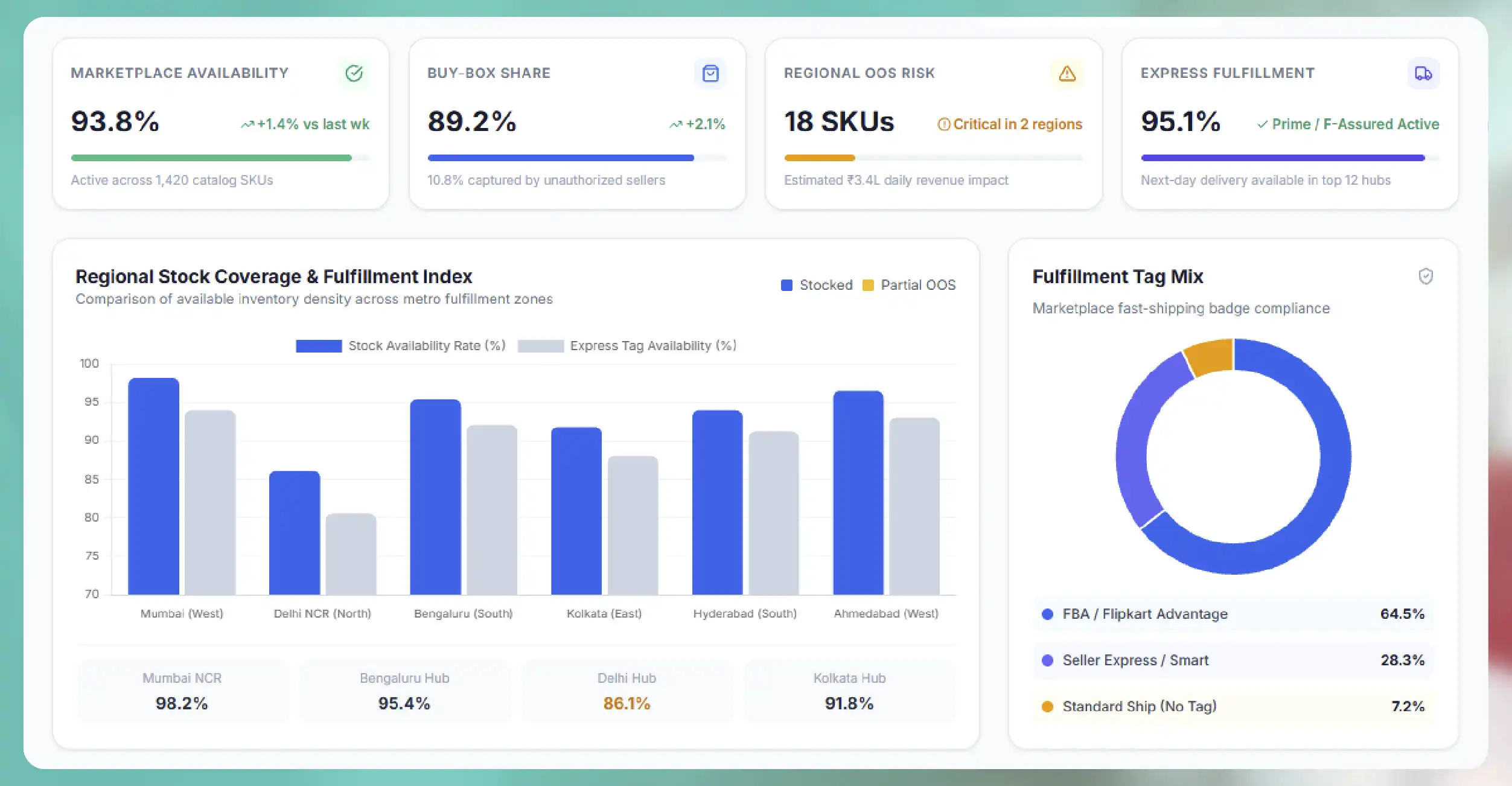
Marketplace inventory is no longer a simple question of whether a product is listed or unavailable. A product may be available in one city, temporarily unavailable in another, sold by multiple sellers, available in selected sizes or colors, or offered through different fulfillment options.
For brands operating across Amazon, Flipkart, Meesho, and Myntra, monitoring these changes manually can become extremely difficult.
Inventory intelligence helps businesses identify:
- Product availability
- Stock-status changes
- SKU-level availability
- Variant availability
- Seller-level inventory signals
- Marketplace assortment
- Product pricing
- Promotional changes
- Delivery and fulfillment indicators
- Regional availability
- Out-of-stock patterns
When this information is collected consistently, businesses can build a broader understanding of marketplace performance rather than relying on isolated observations.
Understanding Marketplace Inventory Scraping
Marketplace inventory scraping involves collecting publicly accessible product and availability information from online marketplaces and converting it into structured datasets.
Depending on the business requirement, collected fields can include product name, SKU, product ID, category, brand, seller, price, discount, availability, ratings, reviews, variant information, and other relevant attributes.
The collected information can then be normalized across marketplaces.
For example, one marketplace may identify a product using an ASIN, while another uses a marketplace-specific product ID or SKU. A standardized data model can map these identifiers to a common product structure.
This makes cross-marketplace analysis much easier.
Building a Unified Inventory Data Pipeline
The primary advantage of an API-driven approach is automation.
Instead of repeatedly collecting information manually, an API can deliver structured marketplace data into existing business systems.
A typical workflow includes:
- Marketplace identification – Define the marketplaces and product categories to monitor.
- Product discovery – Identify relevant products, SKUs, brands, and categories.
- Data collection – Gather available marketplace information at scheduled intervals.
- Data normalization – Standardize product fields across different marketplaces.
- Validation – Check data completeness, consistency, and duplication.
- API delivery – Deliver structured information in formats suitable for applications and analytics.
- Monitoring – Compare historical snapshots to identify inventory changes.
This approach can support both periodic datasets and recurring monitoring programs.
Ecommerce Inventory Data Scraping API for Marketplace Monitoring
An Ecommerce inventory Data Scraping API can serve as the technical foundation for organizations that need marketplace information at scale.
Instead of creating separate data collection processes for every marketplace, businesses can establish a centralized pipeline capable of handling multiple sources.
The API layer can support applications such as:
- Inventory monitoring dashboards
- Competitive intelligence platforms
- Marketplace analytics
- Brand monitoring systems
- Product research tools
- Pricing intelligence platforms
- Retail analytics applications
- Assortment management systems
- Demand planning workflows
The structure of the API can also be customized according to the business's required fields and collection frequency.
Amazon, Flipkart, Meesho, & Myntra Stock Monitoring

For brands selling across multiple Indian marketplaces, Amazon, Flipkart, Meesho, & Myntra stock monitoring can reveal important differences in marketplace availability.
A product may remain available on one platform while becoming unavailable on another. Monitoring these differences can help businesses investigate marketplace-specific inventory conditions.
For instance, a brand may monitor:
- Number of active product listings
- Available variants
- Stock-status changes
- Seller availability
- Price changes
- Discount changes
- Product visibility
- Category placement
- Marketplace-specific assortment
Historical monitoring can also reveal recurring patterns, such as frequent stockouts, seasonal availability, or marketplace-specific product gaps.
SKU-Level Inventory Data Extraction
At the operational level, SKU information is particularly valuable.
SKU-level inventory data extraction allows businesses to move beyond general product-level monitoring and examine individual variants.
A single product may contain multiple:
- Sizes
- Colors
- Pack quantities
- Models
- Specifications
- Configurations
A product could appear available overall while a high-demand variant is unavailable.
SKU-level monitoring can therefore provide a more detailed picture of marketplace availability.
For fashion businesses, for example, monitoring individual sizes and colors can reveal which variants frequently disappear from listings. For electronics, SKU-level tracking can help identify availability differences between storage capacities, colors, or configurations.
Tracking Marketplace Inventory Changes Over Time
One-time inventory collection provides a snapshot. Continuous scraping creates a timeline.
Historical datasets can be compared to determine how product availability changes throughout the day, week, month, or season.
Businesses can use these historical records to examine:
- Stockout frequency
- Availability duration
- Product replenishment patterns
- Seasonal demand
- Marketplace differences
- Promotional periods
- Product lifecycle changes
This information becomes especially useful when combined with pricing and product-performance data.
For example, businesses can examine whether products become unavailable following major discounts or whether certain SKUs experience repeated stockouts during promotional periods.
Flipkart Data Scraping for Product Availability
Flipkart data scraping can support marketplace intelligence initiatives focused on product discovery, availability, pricing, seller information, and SKU monitoring.
Brands can collect relevant product information and organize it into standardized datasets for comparison with other marketplaces.
When combined with historical records, this information can help businesses identify changing product availability and marketplace assortment.
Amazon Data Scraping for Inventory Intelligence
Amazon data scraping can provide structured marketplace information that supports product monitoring and competitive analysis.
Depending on the project scope, businesses may monitor product identifiers, titles, brands, categories, prices, ratings, reviews, seller information, availability indicators, and other publicly visible attributes.
When Amazon information is combined with data from other marketplaces, businesses gain a broader view of marketplace positioning.
E-Commerce Data Scraping at Scale
E-commerce data scraping becomes increasingly valuable when organizations monitor thousands or millions of products.
Large-scale collection requires more than simply extracting webpage information. It involves data normalization, scheduling, validation, deduplication, monitoring, and structured delivery.
A scalable system can help businesses organize information according to:
- Marketplace
- Brand
- Category
- Product
- SKU
- Seller
- Geography
- Availability
- Date and time
This structured architecture makes the resulting datasets easier to analyze and integrate.
Inventory Intelligence for Brands and Retailers
Brands can use marketplace inventory data to understand how their products are represented across digital channels.
Retailers can use it to compare assortment and availability.
Market research companies can use it to develop marketplace intelligence datasets.
E-commerce technology companies can integrate the information into their own applications.
The same underlying inventory dataset can therefore support multiple business functions.
Identifying Stockout Opportunities
Identifying Stockout Opportunities
Repeated stockouts can indicate potential
sales opportunities or supply constraints. Monitoring these changes helps businesses understand when
products disappear from marketplace listings.
Comparing Marketplace Availability
Cross-marketplace comparisons can reveal
whether the same product is consistently available across channels or whether availability varies
significantly.
Monitoring Product Variants
Variant-level information provides greater detail
than simply tracking the parent product.
Supporting Competitive Intelligence
Inventory information can be combined with
price, reviews, ratings, and seller data to create broader marketplace intelligence.
Creating Historical Datasets
Repeated collection creates a historical inventory
database that can support trend analysis and reporting.
How iWeb Data Scraping Can Help You?
Multi-Marketplace Data Collection
iWeb Data Scraping can collect structured product and inventory information from multiple marketplaces, helping businesses consolidate fragmented marketplace intelligence into a unified, analysis-ready data environment.
Automated Inventory Monitoring
Automated collection can track marketplace availability at scheduled intervals, helping organizations identify stock-status changes without depending on repetitive manual marketplace checks.
Customized SKU-Level Datasets
iWeb Data Scraping can structure datasets around SKUs, variants, products, brands, sellers, and categories according to specific business intelligence and monitoring requirements.
Scalable API Data Delivery
Businesses can receive structured marketplace information through customized data pipelines and API-ready formats designed for dashboards, analytics platforms, internal systems, and applications.
Historical Marketplace Intelligence
Continuous collection can create historical datasets that help businesses examine inventory patterns, availability changes, marketplace differences, product trends, and recurring stockout conditions.
Conclusion
A multi-channel inventory strategy requires more than monitoring individual marketplace listings. Businesses need structured, recurring, and comparable information that can reveal how products and SKUs behave across digital commerce channels.
A well-designed scraping infrastructure can bring marketplace inventory information into a centralized analytical environment, supporting product monitoring, competitive intelligence, assortment analysis, and marketplace strategy.
For organizations building specialized marketplace datasets, a meesho product Data Scraper can support structured collection of relevant Meesho product information.
Similarly, Meesho Product Datasets can provide historical and current marketplace information for analytics, research, and business intelligence applications.
For fashion-focused marketplace monitoring, a Myntra Product Data Scraping API Service can help businesses collect and structure relevant product and marketplace information at scale.
Ultimately, the value of marketplace scraping comes from transforming constantly changing e-commerce information into organized data that businesses can analyze, compare, and integrate into their existing workflows.
FAQs
It is an API-driven data collection solution designed to gather and deliver structured inventory and product information from multiple online marketplaces.
Depending on marketplace availability and project requirements, datasets may include product IDs, SKUs, availability, variants, prices, sellers, ratings, reviews, categories, and product attributes.
SKU-level monitoring provides more granular visibility into individual product variants, helping businesses distinguish between overall product availability and the availability of specific sizes, colors, models, or configurations.
Yes. Data collection can be configured around scheduled monitoring requirements, allowing businesses to create recurring snapshots and historical datasets.
Businesses can use them for inventory intelligence, marketplace monitoring, competitive research, assortment analysis, product tracking, pricing intelligence, dashboards, and e-commerce analytics.