Introduction
Customer reviews have evolved from simple feedback into a strategic source of market
intelligence. In 2026, consumers routinely compare opinions across search engines, marketplaces,
social platforms, specialist review portals, travel sites, app stores, and community forums
before making purchasing decisions. Recent research shows the scale of this behavior: 77% of
Americans say online reviews are important to purchasing decisions, while 96% of consumers
surveyed by Clutch check reviews before making a first-time purchase.
The Multi-Platform Review Collection Report 2026 examines how brands can consolidate
customer feedback from 10 or more digital sources into a structured intelligence system. Instead
of analyzing Google, Amazon, Yelp, Trustpilot, TripAdvisor, G2, Capterra, app stores, Reddit,
and other channels independently, businesses can build a unified review dataset covering
ratings, review text, dates, locations, product attributes, customer concerns, and sentiment.
Multi-platform review data scraping for brands enables organizations to transform
fragmented customer commentary into comparable datasets.
Collect reviews from 10+ websites automatically to reduce repetitive monitoring
while creating a broader view of customer experience.
The business case is becoming stronger because consumers increasingly cross-check
multiple sources. ConsumerAffairs reports that 61.6% of surveyed Americans seek Google reviews
first, while 27.8% begin with forums and about 29% use YouTube or TikTok for reviews.
Why Multi-Platform Review Monitoring Matters in 2026?
A single review platform rarely represents the complete customer experience. A
restaurant may have thousands of Google reviews but relatively few TripAdvisor reviews. A SaaS
company may have substantial G2 feedback but little Google commentary. A consumer product can
receive detailed Amazon reviews while customers discuss durability and customer service on
Reddit.
This fragmentation creates a major analytical problem.
A brand looking only at one platform can mistake platform-specific behavior for
overall customer sentiment. For example, one marketplace might show a 4.6/5 average rating while
another shows 3.9/5 because its users have different expectations.
Automated customer review data collection addresses this problem by creating a
common framework for collecting and normalizing feedback.
A useful system can capture:
- Brand and product name
- Platform and review URL
- Review title
- Full review text
- Star rating
- Review date
- Reviewer location, where publicly available
- Product or service category
- Positive and negative attributes
- Sentiment classification
- Mentioned competitors
- Price-related complaints
- Customer-service issues
- Delivery or availability problems
- Feature requests
- Response status
The resulting dataset becomes much more valuable than a collection of isolated
reviews.
Ten-Platform Review Intelligence Framework
A mature monitoring program should not simply maximize the number of websites. It
should prioritize platforms that represent different customer journeys.
| Search/local |
Google Reviews |
12,500 |
4.2 |
Local experience |
10 |
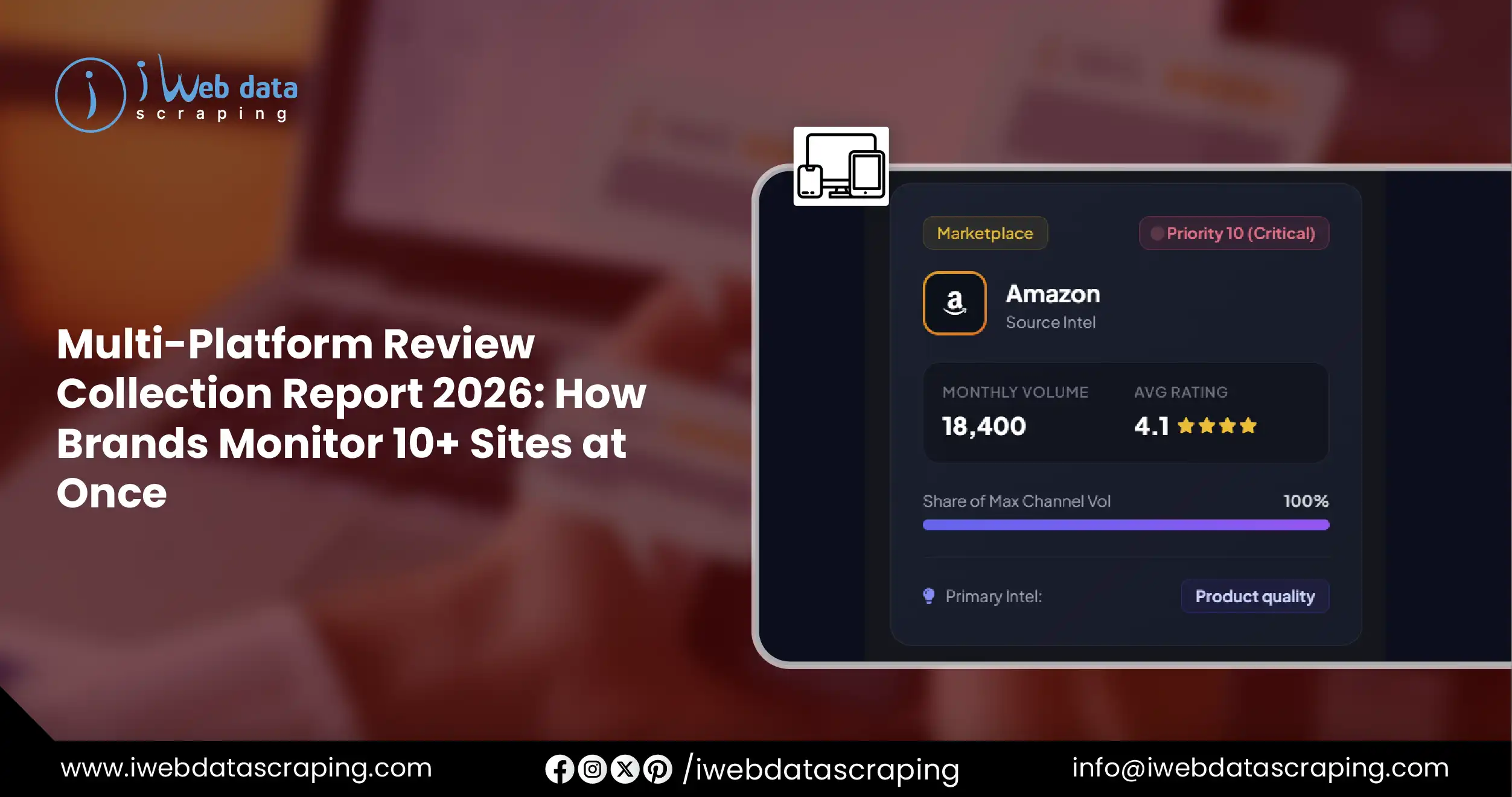
| Marketplace |
Amazon |
18,400 |
4.1 |
Product quality |
10 |
| Local discovery |
Yelp |
4,800 |
4.0 |
Service experience |
8 |
| Trust/reputation |
Trustpilot |
3,600 |
3.8 |
Brand trust |
9 |
| Travel |
TripAdvisor |
5,200 |
4.3 |
Hospitality experience |
8 |
| Software |
G2 |
2,150 |
4.4 |
Product usability |
9 |
| Software |
Capterra |
1,720 |
4.2 |
Purchase experience |
8 |
| Community |
Reddit |
3,100 |
3.9* |
Unfiltered discussion |
9 |
| Video/social |
YouTube/TikTok |
2,450 |
4.0* |
Visual/customer sentiment |
7 |
| Mobile apps |
App Store/Google Play |
6,750 |
4.1 |
App performance |
10 |
| Total |
10+ channels |
60,670 |
4.09 |
Cross-platform intelligence |
— |
*Illustrative 2026 benchmarking dataset created for this report; values are not
presented as a direct scrape of these platforms.
The important insight is not simply the total number of reviews. It is the variation
between platforms. A brand might discover that product quality receives positive ratings on
marketplaces while support complaints dominate Trustpilot and app-store reviews.
That gap can reveal operational problems that an overall star rating hides.
Scraping Ratings and Reviews from Multiple Websites
The method to Scrape ratings and reviews from multiple websites programs typically
involve four stages: discovery, extraction, normalization, and analysis.
First, the system identifies target business or product pages. Second, it collects
publicly available review attributes. Third, data is normalized into consistent fields. Finally,
analytical models transform raw text into usable insights.
A standardized structure might look like:
- Platform → Brand → Product → Rating → Review → Date → Location → Sentiment →
Topic → Competitor → Action
This structure allows businesses to compare otherwise incompatible review
ecosystems.
For example, "delivery took three days," "shipment arrived late," and "slow
dispatch" can be grouped under Delivery Delay. Similarly, "friendly staff," "helpful
representative," and "support team was excellent" can be categorized under Customer Service.
This is where review intelligence moves beyond simple monitoring.
Cross-Platform Review Sentiment Analysis
Cross-platform review sentiment analysis helps determine whether customer perception
is improving, deteriorating, or changing differently across channels.
A useful analytical model can classify reviews into:
- Positive
- Neutral
- Negative
- Highly positive
- Highly negative
But sentiment alone is not enough. Brands should combine sentiment with topic
extraction.
Consider a fictional electronics brand:
- Product quality: 82% positive
- Design: 88% positive
- Battery: 61% positive
- Delivery: 48% positive
- Customer support: 43% positive
- Price/value: 39% positive
The brand could have an overall rating above 4 stars while still experiencing
significant dissatisfaction around support and value.
This is why Reviews and ratings
intelligence should be viewed as multidimensional rather than as a single average score.
Illustrative 2026 Cross-Platform Benchmark
The following model demonstrates how a company could convert collected reviews into
measurable intelligence.
| Reviews analyzed |
12,500 |
18,400 |
3,600 |
4,800 |
2,150 |
5,200 |
3,100 |
6,750 |
56,500 |
| Average rating |
4.2 |
4.1 |
3.8 |
4.0 |
4.4 |
4.3 |
3.9 |
4.1 |
4.08 |
| Positive % |
76 |
72 |
64 |
69 |
82 |
79 |
61 |
73 |
72.3 |
| Neutral % |
12 |
15 |
17 |
14 |
9 |
11 |
16 |
13 |
13.2 |
| Negative % |
12 |
13 |
19 |
17 |
9 |
10 |
23 |
14 |
14.5 |
| Product complaints |
1,240 |
2,360 |
310 |
420 |
280 |
510 |
620 |
1,150 |
6,890 |
| Service complaints |
1,860 |
1,440 |
920 |
710 |
310 |
630 |
780 |
1,340 |
7,990 |
| Price complaints |
920 |
1,870 |
540 |
380 |
290 |
410 |
510 |
830 |
5,750 |
| Delivery complaints |
1,480 |
3,210 |
240 |
310 |
80 |
290 |
330 |
920 |
6,860 |
| Feature requests |
340 |
760 |
180 |
130 |
420 |
90 |
670 |
1,250 |
3,840 |
| Reviews with photos/media |
1,850 |
4,720 |
460 |
690 |
170 |
1,430 |
380 |
520 |
10,220 |
Illustrative analytical benchmark, not platform-reported data.
This type of table enables executives to ask better questions: Where are complaints
concentrated? Which topics are growing fastest? Which platforms contain the most actionable
feedback?
Detecting Market Trends and Demand Signals
Review datasets can reveal emerging demand before conventional sales reports do.
Market trend and demand intelligence can emerge
from repeated phrases, product requests, complaints, and changing review frequency.
For example, suppose mentions of "smaller size," "eco-friendly packaging," and
"subscription option" increase rapidly over six months. Individually, these may look like minor
comments. Collectively, they can indicate a developing market opportunity.
A review intelligence pipeline can calculate:
Topic growth rate = (Current mentions − Previous mentions) ÷ Previous mentions × 100
If "battery life" appeared 1,200 times in Q1 and 1,800 times in Q2:
Growth = (1,800 − 1,200) ÷ 1,200 × 100 = 50%
The business can then investigate whether this growth reflects increased customer
demand, worsening performance, or competitor activity.
Competitive Benchmarking
Multi-platform collection also enables brands to compare themselves against
competitors using a standardized framework.
Instead of asking only, "What is our average rating?" businesses can measure:
- Rating by platform
- Review velocity
- Positive sentiment share
- Negative sentiment share
- Complaint categories
- Response rates
- Response speed
- Product feature mentions
- Price/value perception
- Customer-service sentiment
- Geographic differences
This creates a competitive review scorecard.
For example, Brand A may have 4.4 stars while Brand B has 4.2, but Brand B could
have significantly faster review growth and stronger sentiment around customer service. That
distinction may matter more for future competitive positioning than the headline rating.
From Review Collection to Business Action
The ultimate purpose of review intelligence is not data accumulation.
It is decision-making.
A retail company can use review data to identify recurring product defects. A hotel
chain can detect location-specific service problems. A SaaS provider can discover missing
features. A restaurant group can identify menu items that consistently disappoint customers.
Research also indicates why this matters commercially: ConsumerAffairs found that
80.2% of surveyed Americans had been influenced not to purchase after reading reviews, while
many consumers become hesitant when ratings fall below approximately 4–4.5 stars.
Therefore, a multi-platform review system should connect directly to business
workflows.
- Alert → Investigate → Categorize → Assign → Resolve → Measure
For instance, if negative mentions of "checkout failure" suddenly increase across
app stores and Reddit, the issue can be escalated to product and engineering teams instead of
remaining buried inside individual reviews.
Key Benefits for Brands in 2026
A well-designed multi-platform review collection strategy provides five major
benefits.
1. Broader customer visibility: Brands see feedback beyond their primary review
channel.
2. Faster issue detection: Automated monitoring identifies sudden increases in
complaints.
3. Better competitive intelligence: Competitor reviews reveal weaknesses, strengths,
and unmet needs.
4. More accurate sentiment measurement: Cross-platform analysis reduces the risk of
relying on a biased sample.
5. Stronger strategic planning: Recurring review themes can influence product
development, pricing, marketing, customer support, and expansion.
Review management software increasingly follows this aggregation model, bringing
reviews from multiple platforms into centralized interfaces for monitoring and response.
The Future of Multi-Platform Review Intelligence
The next stage is moving from passive dashboards to predictive intelligence.
Instead of reporting that negative reviews increased 18%, systems will increasingly
identify why they increased, where the problem originated, and which customer segments are
affected.
AI-assisted classification can help summarize thousands of reviews, but human
validation remains important. ConsumerAffairs' 2026 research found that 87.7% of surveyed
Americans had seen AI-generated review summaries, yet 48.6% trusted such summaries less than, or
no more than, the underlying human reviews.
Consequently, the strongest architecture combines automation with source-level
traceability.
A future-ready pipeline should therefore include:
- Collection → Deduplication → Normalization → Sentiment → Topic Detection →
Trend Analysis → Competitive Benchmarking → Alerts → Executive Dashboard
Conclusion
The Multi-Platform Review Collection Report 2026 demonstrates why brands can no
longer treat customer reviews as isolated comments. With consumers consulting search engines,
marketplaces, specialist platforms, forums, social media, and app stores, the modern customer
voice is distributed across a fragmented digital ecosystem.
Organizations that centralize these signals can move from basic reputation
monitoring toward genuine customer and market intelligence. The combination of ratings, review
volume, sentiment, topic frequency, review velocity, and competitor benchmarking provides a much
richer picture of market conditions.
For companies operating at scale, Web Scraping API
Services can provide an adaptable infrastructure for collecting structured information
from multiple sources, subject to each platform's terms, access controls, and applicable laws.
Managed web scraping can further reduce the technical burden of maintaining
collection pipelines, handling source changes, scheduling extraction, validating data, and
maintaining consistent datasets.
Mobile app scraping is also increasingly relevant because app-store reviews provide
a direct stream of customer feedback about usability, crashes, performance, payments, updates,
and feature expectations.
Ultimately, the competitive advantage is not simply having more reviews. It is being
able to turn thousands of fragmented customer experiences into clear, comparable, timely, and
actionable intelligence. In 2026, brands that systematically listen across 10+ digital channels
will be better positioned to identify problems early, understand changing demand, benchmark
competitors, and build products and experiences around what customers actually say.
Experience top-notch web scraping service
and mobile app scraping solutions with iWeb Data
Scraping. Our skilled team excels in extracting various data sets, including retail store locations and beyond. Connect with us
today to learn how our customized services can address your unique project needs, delivering the
highest efficiency and dependability for all your data requirements.