

Introduction
India's fashion e-commerce industry is becoming increasingly competitive as consumers explore multiple online platforms to compare clothing, footwear, accessories, brands, and promotional offers. Myntra has established a strong position in this market by offering a broad assortment of fashion products, private labels, international brands, and seasonal collections. For retailers, manufacturers, fashion brands, and market research companies, understanding how this marketplace operates can reveal valuable commercial opportunities.
Myntra data scraping enables businesses to collect structured information about product listings, categories, prices, discounts, ratings, availability, and brand positioning. Instead of manually checking thousands of product pages, companies can use automated data extraction to monitor marketplace activity and identify changing consumer preferences.
Access to Myntra product data helps businesses understand product characteristics, including descriptions, sizes, colours, materials, images, brand names, and customer feedback. These attributes can support catalogue management, competitor research, product discovery, and assortment planning.
Similarly, Myntra price tracking provides visibility into listed prices, discounted prices, promotional campaigns, and changes in product pricing over time. This intelligence helps businesses evaluate their competitive position and make informed pricing decisions.
As India's fashion marketplace continues to evolve, structured marketplace intelligence is becoming an important resource for companies seeking better visibility into product performance, discount strategies, and brand competitiveness.
1. Understanding Myntra's Fashion E-Commerce Ecosystem

Myntra operates across several fashion categories, making it a valuable marketplace for analysing online retail competition. Its assortment includes men's clothing, women's apparel, children's fashion, footwear, handbags, watches, beauty products, jewellery, and lifestyle accessories.
The marketplace brings together established fashion companies, emerging designers, private labels, and international brands. This variety creates opportunities to study how different sellers position their products and compete for consumer attention.
Businesses can analyse several marketplace dimensions:
- Category distribution: Understand the number of products listed across different fashion categories.
- Brand positioning: Identify leading brands and their representation within individual categories.
- Product variety: Examine differences in colours, sizes, materials, styles, and designs.
- Pricing structures: Compare regular prices, selling prices, and promotional discounts.
- Customer engagement: Evaluate ratings, reviews, and available product feedback.
- Product availability: Monitor size-level and colour-level stock information where publicly displayed.
Collecting these attributes in a structured format allows businesses to transform marketplace listings into organised datasets for commercial analysis.
2. Tracking Fashion Prices Across Product Categories
Pricing plays a significant role in online fashion purchasing decisions. Consumers frequently compare similar products across brands before choosing clothing, footwear, or accessories.
For retailers, understanding these pricing differences is essential for maintaining competitive positioning. A product priced significantly above comparable alternatives may require better differentiation through quality, design, materials, or brand reputation.
Myntra pricing intelligence can capture:
- Original or maximum retail prices.
- Current displayed selling prices.
- Discount percentages.
- Product-specific promotional offers.
- Price variations across categories.
- Changes in displayed prices over time.
- Brand-wise and product-wise pricing differences.
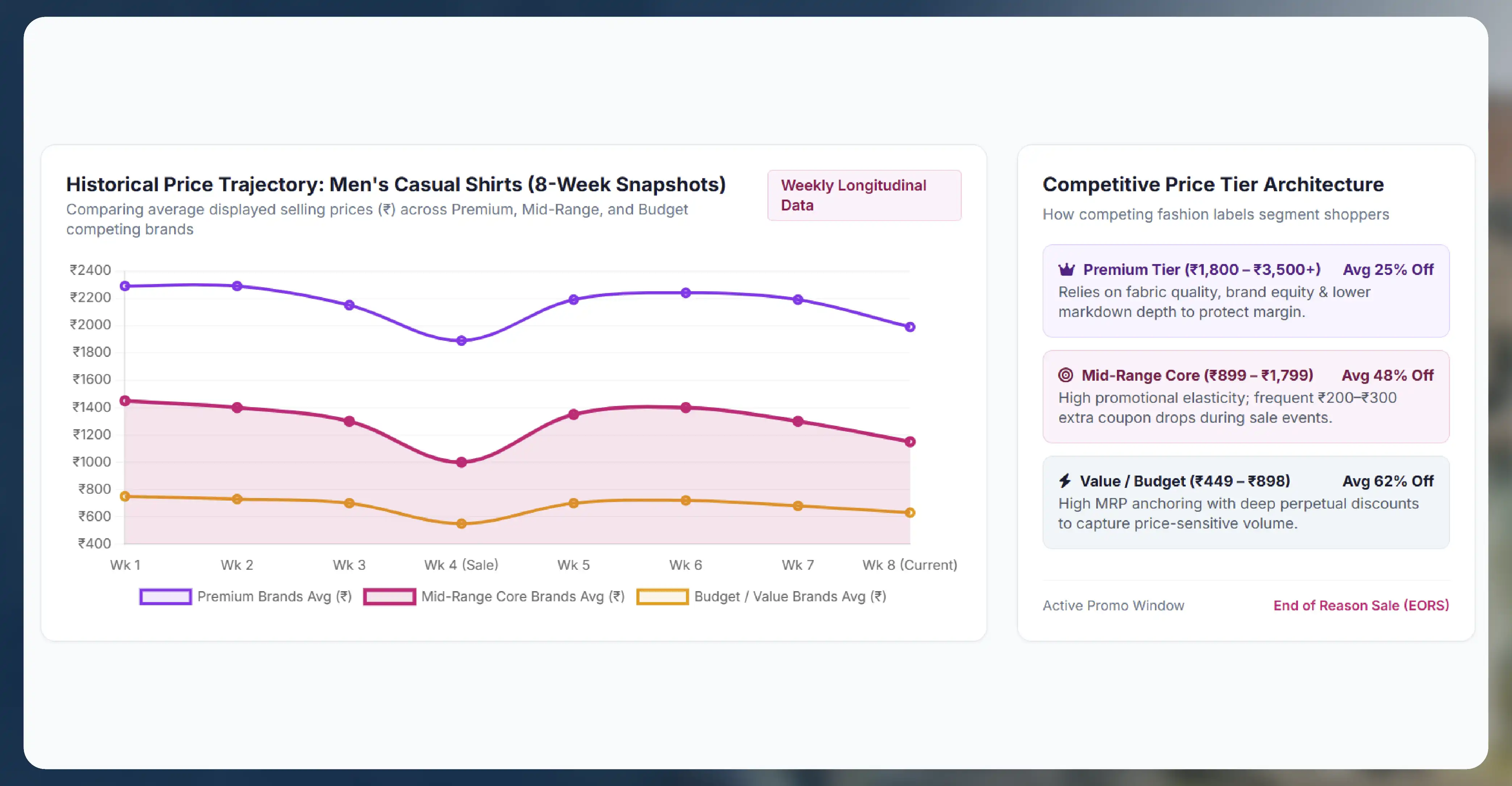
For example, a fashion retailer selling men's casual shirts can compare its pricing with similar products listed by competing brands. The analysis can reveal whether competitors are targeting premium, mid-range, or budget-conscious customers.
Historical observations are particularly valuable. A single product-page snapshot only shows the price at a particular moment, whereas repeated collection helps identify price reductions, promotional cycles, and changes in competitive positioning.
3. Analysing Discounts and Promotional Campaigns
Discounts are an important part of fashion marketplace competition. Online retailers frequently use promotional campaigns, limited-period offers, coupon codes, and seasonal sales to encourage purchases.
However, discount percentages alone do not provide a complete picture of promotional effectiveness. Businesses must also consider product categories, original prices, selling prices, brand participation, and campaign duration.
Myntra discount data can help companies examine promotional activity across different product segments.
Important discount-related attributes include:
| Data Attribute | Business Application |
|---|---|
| Original price | Establishes the listed reference price |
| Selling price | Identifies the current displayed price |
| Discount percentage | Measures advertised markdown depth |
| Coupon information | Highlights additional promotional incentives |
| Brand name | Compares promotional activity by brand |
| Product category | Identifies categories receiving higher discounts |
| Collection date | Tracks changes throughout campaigns |
Consider a retailer analysing women's ethnic wear. By monitoring discount patterns across different brands, the business can identify which labels frequently offer promotional reductions and which maintain relatively stable prices.
This information can help retailers plan seasonal campaigns, improve pricing strategies, and evaluate promotional competitiveness.
4. Monitoring Brand Assortment and Product Diversity
Brand assortment is another important dimension of fashion marketplace intelligence. Myntra offers products from different price segments, styles, and consumer-oriented fashion labels.
Understanding this assortment can help businesses evaluate market concentration, identify underserved categories, and discover emerging competitors.
Myntra brand assortment data can be used to examine:
- Number of brands represented in each category.
- Product counts across individual brands.
- Brand distribution across price segments.
- Availability of premium and affordable labels.
- Product variety within different collections.
- New product introductions and discontinued listings.
- Brand presence across men's, women's, and children's fashion.
For example, a footwear manufacturer may want to understand how sports shoes, casual sneakers, formal footwear, and sandals are represented across different brands.
This information can reveal category gaps and provide a better understanding of how competitors distribute their products.
Businesses can also compare established brands with newer labels to identify changes in marketplace assortment and competitive visibility.
5. Understanding Fashion Trends Through Product Attributes
Fashion trends change with seasons, consumer preferences, cultural events, and evolving lifestyles. Product attributes provide useful indicators of these changes.
A structured dataset containing product descriptions, colours, patterns, materials, styles, and category information can help businesses identify emerging merchandise trends.
For instance, analysing women's apparel listings may reveal increasing representation of oversized shirts, co-ord sets, wide-leg trousers, ethnic fusion wear, or particular colour palettes.
Similarly, footwear analysis can identify changing product representation across sneakers, running shoes, loafers, boots, and everyday sandals.
India fashion ecommerce data can support trend analysis by combining information from multiple categories and product attributes.
Businesses can use this intelligence to:
- Identify frequently appearing product styles.
- Compare category-level assortment changes.
- Examine seasonal product introductions.
- Track popular colours and patterns.
- Discover emerging fashion segments.
- Evaluate product variety across competing brands.
These insights can support buying decisions, inventory planning, product development, and marketing campaigns.
6. Tracking Product Availability, Sizes, and Variants
Product availability is an important factor in understanding the competitive fashion landscape. A product may appear attractive because of its price and design, but limited size availability can affect its purchasing potential.
Businesses can monitor publicly displayed availability information to understand how product assortments change over time.
Useful attributes include:
- Available sizes such as XS, S, M, L, XL, and XXL.
- Colour variations associated with individual products.
- Product listing status.
- Displayed stock or availability indicators, where accessible.
- New arrivals and recently unavailable listings.
- Differences in assortment across product categories.
For example, a retailer analysing women's dresses may discover that particular styles frequently have limited size availability. Comparing these observations over multiple collection periods can help identify assortment changes and potential inventory gaps.
However, product availability should not automatically be interpreted as actual sales. A listing disappearing could reflect stock depletion, catalogue changes, or temporary listing removal. Combining availability observations with other indicators produces more reliable market intelligence.
7. Analysing Ratings, Reviews, and Consumer Preferences
Customer feedback provides another useful dimension for understanding fashion products. Ratings and reviews can reveal how shoppers perceive product quality, fit, comfort, design, and value.
A retailer can analyse customer feedback across similar products to identify recurring satisfaction factors and potential product weaknesses.
For example, reviews of footwear may frequently mention comfort, durability, sizing accuracy, and material quality. Apparel feedback may highlight fabric thickness, colour differences, stitching, or fitting concerns.
A structured review dataset can support:
- Average rating comparisons across brands.
- Review volume analysis.
- Identification of frequently discussed product attributes.
- Detection of recurring product complaints.
- Comparison of customer sentiment across categories.
- Identification of products receiving significant customer attention.
Businesses can use these findings to improve product descriptions, refine quality standards, and understand customer expectations.
It is important to distinguish ratings and review counts from actual sales performance. They are engagement indicators, not direct evidence of product revenue or conversion.
8. Comparing Myntra with Competing Fashion Marketplaces
Monitoring a single marketplace provides useful information, but cross-platform comparisons offer a broader understanding of India's fashion retail environment.
Retailers can compare Myntra with platforms such as AJIO, Amazon Fashion, Flipkart, and other relevant online fashion destinations.
Cross-platform research can examine:
| Comparison Parameter | Intelligence Generated |
|---|---|
| Product pricing | Identifies price differences for comparable products |
| Discount percentages | Measures promotional competitiveness |
| Brand availability | Compares brand representation |
| Category assortment | Highlights differences in product selection |
| Product ratings | Evaluates customer feedback |
| Size availability | Identifies assortment differences |
| Product launches | Tracks new catalogue introductions |
| Seasonal offers | Compares promotional activity |
For example, a fashion brand selling casual sneakers can compare the same product's displayed price across different marketplaces.
This analysis helps identify pricing inconsistencies, promotional differences, and opportunities to improve marketplace positioning.
Product matching requires careful attention to brand, SKU, model, colour, and size. Comparing similar-looking but different products can produce misleading conclusions.
9. New Market Developments Creating Opportunities for Fashion Data Intelligence
India's fashion e-commerce market is experiencing changes beyond conventional discount-driven shopping.
A particularly important development is the growing importance of premiumisation. Business Standard reported in April 2026 that fashion platforms, including Myntra, were expanding premium offerings while attempting to improve margins rather than depending exclusively on discounts. The report also highlighted demand for international brands and premium categories beyond major metropolitan markets.
Another significant development is the expansion of non-metro fashion consumption. Recent festive-sale reporting highlighted strong customer additions from smaller cities, including Dehradun, Guwahati, Bhubaneswar, Jammu, and Gorakhpur. It also reported growing interest in sports footwear, ethnic wear, beauty, and lifestyle categories.
These developments create several opportunities for structured marketplace data collection.
- Premium fashion monitoring: Businesses can identify premium brands, higher-priced products, and changes in luxury-oriented assortment.
- Regional demand analysis: Product assortment and category availability can be compared across relevant location-specific marketplace experiences where accessible.
- Category diversification: Retailers can examine the growing representation of sportswear, footwear, beauty, and accessories.
- Creator-led commerce research: Product discovery formats, styling content, and influencer-associated merchandise can be studied where publicly accessible.
- Rapid-delivery assortment tracking: Myntra's M-Now development creates another area for studying product selection, pricing, and availability in supported locations.
These trends demonstrate why fashion intelligence needs to extend beyond product prices. Businesses increasingly require a combined understanding of assortment, consumer engagement, promotional positioning, and marketplace developments.
10. Building a Structured Myntra Fashion Dataset
Collecting marketplace information is only the first step. Businesses also need a consistent data structure that supports analysis and integration with their existing systems.
A comprehensive dataset can contain the following fields:
| Dataset Field | Description |
|---|---|
| Product ID | Unique product or SKU identifier |
| Product Name | Listed product title |
| Brand | Associated fashion brand |
| Category | Main product category |
| Subcategory | Detailed product classification |
| Product URL | Source listing reference |
| Original Price | Displayed original or MRP value |
| Selling Price | Current displayed price |
| Discount | Advertised discount percentage |
| Rating | Customer rating, where available |
| Review Count | Number of displayed reviews |
| Colour | Primary product colour |
| Size Variants | Available size options |
| Image URL | Product image reference |
| Availability | Publicly displayed availability status |
| Collection Timestamp | Date and time of data collection |
The dataset can be delivered in CSV, JSON, Excel, or database-ready formats, depending on business requirements.
Data cleaning is equally important. Duplicate listings, inconsistent brand names, missing values, changing product identifiers, and incorrect price formats can affect analytical accuracy.
Businesses should establish product-matching rules, standardise category names, maintain collection timestamps, and preserve historical snapshots.
A recurring collection schedule can then support daily pricing intelligence, weekly assortment comparisons, and monthly fashion trend analysis.
11. Challenges in Myntra Data Collection and How to Address Them
Automated fashion marketplace data collection requires careful technical planning.
- Dynamic website structures: Product listings and page elements may change. Extraction workflows need regular validation to maintain field consistency.
- Pagination challenges: Large categories contain extensive product catalogues. Collection systems should manage pagination and avoid repeatedly collecting identical listings.
- Variant-level complexity: A single fashion style may have several colours and sizes. Product identifiers and variant relationships must be handled carefully.
- Frequent price changes: Discounts can change during major campaigns. Timestamped snapshots help distinguish temporary promotions from longer-term pricing patterns.
- Data quality: Missing ratings, incomplete descriptions, and inconsistent product attributes require validation and cleaning.
- Access restrictions: Websites may use technical controls to manage automated access. Collection activities should respect applicable laws, website terms, access restrictions, and privacy requirements.
A reliable data extraction framework should prioritise accuracy, responsible collection practices, scalability, and consistent monitoring.
How iWeb Data Scraping Can Help You?
iWeb Data Scraping helps businesses transform Myntra marketplace information into structured, actionable fashion intelligence.
1. Competitive Price Intelligence
iWeb Data Scraping collects product prices, original prices, and discounts across Myntra categories, helping retailers benchmark competitors, identify pricing gaps, and develop more effective pricing strategies.
2. Brand Assortment Monitoring
Businesses can track brand representation, product counts, category coverage, and new arrivals to understand competitor positioning, discover assortment opportunities, and make better merchandise planning decisions.
3. Discount and Promotion Analysis
Automated data collection captures promotional changes, discount percentages, and campaign-related pricing, helping brands evaluate markdown strategies, compare promotional intensity, and plan competitive seasonal offers.
4. Fashion Trend Identification
Structured product attributes, including colours, patterns, styles, materials, and sizes, help businesses identify emerging fashion trends, understand assortment changes, and support future product development.
5. Historical Marketplace Intelligence
iWeb Data Scraping maintains recurring product snapshots to identify pricing movements, availability changes, and assortment developments, enabling businesses to build historical datasets and improve strategic decision-making.
Conclusion
The Indian fashion e-commerce industry offers significant opportunities for retailers, fashion brands, manufacturers, and market research companies. However, succeeding in this competitive environment requires more than simply understanding product listings. Businesses need reliable intelligence about pricing, discounts, brand assortment, product availability, and changing consumer preferences.
Myntra data scraping provides a structured approach to collecting marketplace information and transforming it into actionable business intelligence. By analysing historical pricing, promotional campaigns, product variations, and brand representation, companies can improve competitive benchmarking, assortment planning, and pricing decisions.
Businesses looking to scrape ecommerce website data can also expand their research across multiple fashion marketplaces and international platforms. For example, a Grailed product dataset can provide additional insights into resale fashion, designer merchandise, second-hand apparel, and premium streetwear categories.
With iWeb Data Scraping, organisations can build scalable fashion intelligence solutions that support informed decisions, stronger competitive analysis, and better visibility into evolving e-commerce opportunities.
Frequently Asked Questions (FAQs)
Myntra data scraping is the automated collection of publicly accessible product information, including brand names, prices, discounts, descriptions, ratings, categories, sizes, colours, and availability.
Businesses can collect product IDs, product names, brand details, categories, original prices, selling prices, discount percentages, ratings, review counts, product images, size variations, and listing information.
Myntra price tracking helps retailers compare competitor prices, monitor promotional changes, identify discount patterns, understand category-level pricing differences, and develop competitive pricing strategies.
Yes. Analysing product colours, designs, materials, categories, sizes, and brand assortment over time can help identify emerging fashion preferences and seasonal merchandise trends.
Businesses can integrate Myntra datasets into dashboards and analytical systems to compare brands, monitor discounts, evaluate product assortment, track pricing changes, and identify new marketplace opportunities.