
18.6K+
MYNTRA PRODUCT REVIEWS ANALYZED

Myntra Review Tracking to Improve Product Ratings and Strengthen Customer Satisfaction, Product Insights, and Brand Performance for Indian D2C Fashion Brands
This case study presents an enterprise-style scenario involving an Indian direct-to-consumer fashion brand that wanted to understand why some of its products were receiving inconsistent ratings on Myntra despite strong sales and repeat purchases.
The case study is designed for brands, retailers, marketplace teams, product managers, and analytics organizations looking to transform customer reviews into actionable product intelligence.
Myntra Review Tracking can help fashion businesses continuously monitor ratings, review volumes, customer complaints, product attributes, and recurring feedback patterns across large product catalogs.
It is particularly relevant for:
Myntra review tracking for D2C brands becomes particularly valuable when a company manages hundreds or thousands of SKUs and cannot manually inspect every customer review.
The client in this case study operated a growing Indian D2C fashion business with a broad portfolio of casualwear, ethnicwear, activewear, and everyday fashion products. While sales were increasing, several products were experiencing rating fluctuations that were affecting marketplace visibility and customer conversion.
The larger goal was straightforward: turn customer reviews into a product improvement system rather than treating them only as marketplace feedback.
The client had strong product demand but lacked a structured mechanism for understanding how customers perceived individual products after purchase. Reviews were arriving continuously, but teams were examining them manually and primarily focusing on average ratings.
To solve this problem, the brand implemented a structured review intelligence workflow designed to collect, normalize, classify, and analyze customer feedback across its Myntra product portfolio.
The system enabled the team to Scrape Myntra reviews for product rating analysis, allowing product managers to examine rating changes alongside review themes, product attributes, and recurring complaints.
Instead of looking only at whether a product had four or five stars, analysts could determine why customers were assigning those ratings. Review text was categorized into themes such as fitting, fabric quality, color accuracy, stitching, comfort, sizing, delivery experience, packaging, and value perception.
The brand also implemented Myntra rating tracking for fashion brands to monitor rating movement over time and identify products showing sudden deterioration or improvement.
The resulting intelligence layer connected customer sentiment with product-level business decisions. Products with repeated fit complaints could be reviewed by the sizing team. Products receiving fabric-related complaints could be evaluated by sourcing and quality teams. Products with positive feedback around design but weak ratings around sizing could be retained while their size guidance was improved.
The client operated across a highly competitive fashion marketplace environment where ratings and reviews strongly influenced customer confidence.
The first challenge was review volume. As the product catalog expanded, the number of reviews increased beyond what the internal team could realistically inspect manually.
The second challenge was that star ratings did not explain the underlying causes of dissatisfaction. A three-star review could result from sizing problems, quality concerns, color differences, delivery expectations, or a combination of several factors.
The company therefore needed Myntra product review sentiment analysis for brands to classify customer opinions into positive, neutral, and negative categories while also identifying the specific product attributes driving sentiment.
Another challenge was fragmented information. Reviews were available at the product level, while product teams maintained separate information about category, price, material, color, size, and variant performance.
The brand needed Myntra review data scraping to create a structured dataset connecting review content with product attributes and rating information.
Another challenge involved prioritization. The client had limited resources and could not redesign every product receiving occasional negative feedback. It needed a framework for determining which products deserved immediate attention.
This created a requirement for a scalable Fashion Product Data Scraping Service capable of collecting marketplace product and review intelligence at catalog scale.
Before the implementation, the client relied heavily on manual marketplace monitoring.
Team members periodically opened product pages, checked recent ratings, read selected reviews, and recorded observations in spreadsheets.
This process created several limitations.
| Dimension | Manual Review Monitoring | Structured Intelligence System |
|---|---|---|
| Review collection | Periodic manual checks | Automated scheduled collection |
| Product coverage | Limited number of SKUs | Large-scale catalog coverage |
| Rating monitoring | Occasional snapshots | Continuous historical tracking |
| Sentiment analysis | Manual interpretation | Automated sentiment classification |
| Complaint detection | Dependent on reviewer selection | Theme-based pattern detection |
| Variant analysis | Difficult to maintain | Product and variant-level comparison |
| Trend detection | Reactive | Early identification of rating movement |
| Data storage | Separate spreadsheets | Centralized structured datasets |
| Reporting | Manual summaries | Automated dashboards and reports |
| Product decisions | Experience-driven | Evidence-driven |
The brand in this case study represents a fast-growing Indian D2C fashion company selling products across multiple lifestyle categories through its own digital channels and major online marketplaces.
Its Myntra portfolio included everyday apparel, casual fashion, seasonal collections, accessories, and selected premium products.
The company had successfully built customer demand but encountered a familiar challenge during scale: increasing product volume also increased the amount of customer feedback that needed to be analyzed.
The product team traditionally reviewed customer feedback during monthly performance meetings. However, this approach made it difficult to detect fast-changing problems.
For example, a new collection could receive strong initial ratings but experience a decline after a larger number of customers purchased it. Similarly, a product could receive negative feedback only from certain sizes or variants.
The implementation began with the creation of a structured marketplace intelligence pipeline covering product information, ratings, review text, review dates, variant information, and relevant product attributes.
The first layer focused on Myntra Product Data Collection, establishing a consistent product-level foundation for the review intelligence system.
Product records were standardized using fields such as product name, category, brand, price, rating, review count, product URL, variant information, and availability indicators.
The second layer created Myntra Product Datasets that connected product information with review-level attributes.
This allowed analysts to study not only individual reviews but also relationships between products, ratings, sentiment, complaint categories, and product characteristics.
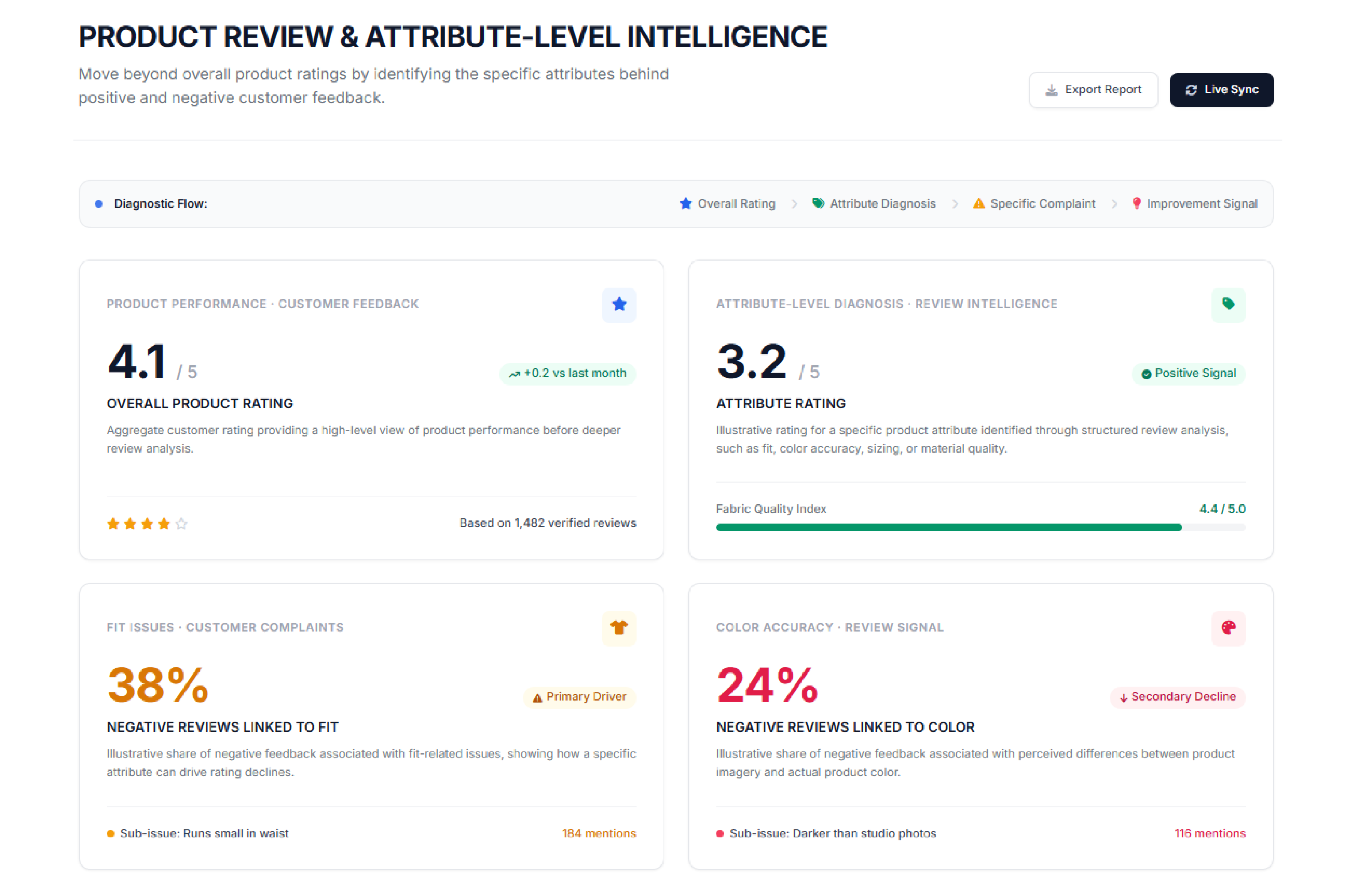
The analysis revealed that low ratings were not evenly distributed across the catalog.
Instead, certain products accumulated negative reviews around specific attributes.
For example, one apparel category showed strong customer appreciation for design but recurring complaints about fit.
Another product line received positive feedback for fabric softness but lower ratings because customers believed the actual color differed from the product imagery.
This distinction was important.
Without review-level analysis, the product team might conclude that a product was simply "underperforming."
With structured feedback analysis, the team could identify the exact attribute requiring attention.
The findings encouraged the brand to move from general product-level quality discussions toward attribute-level diagnosis.
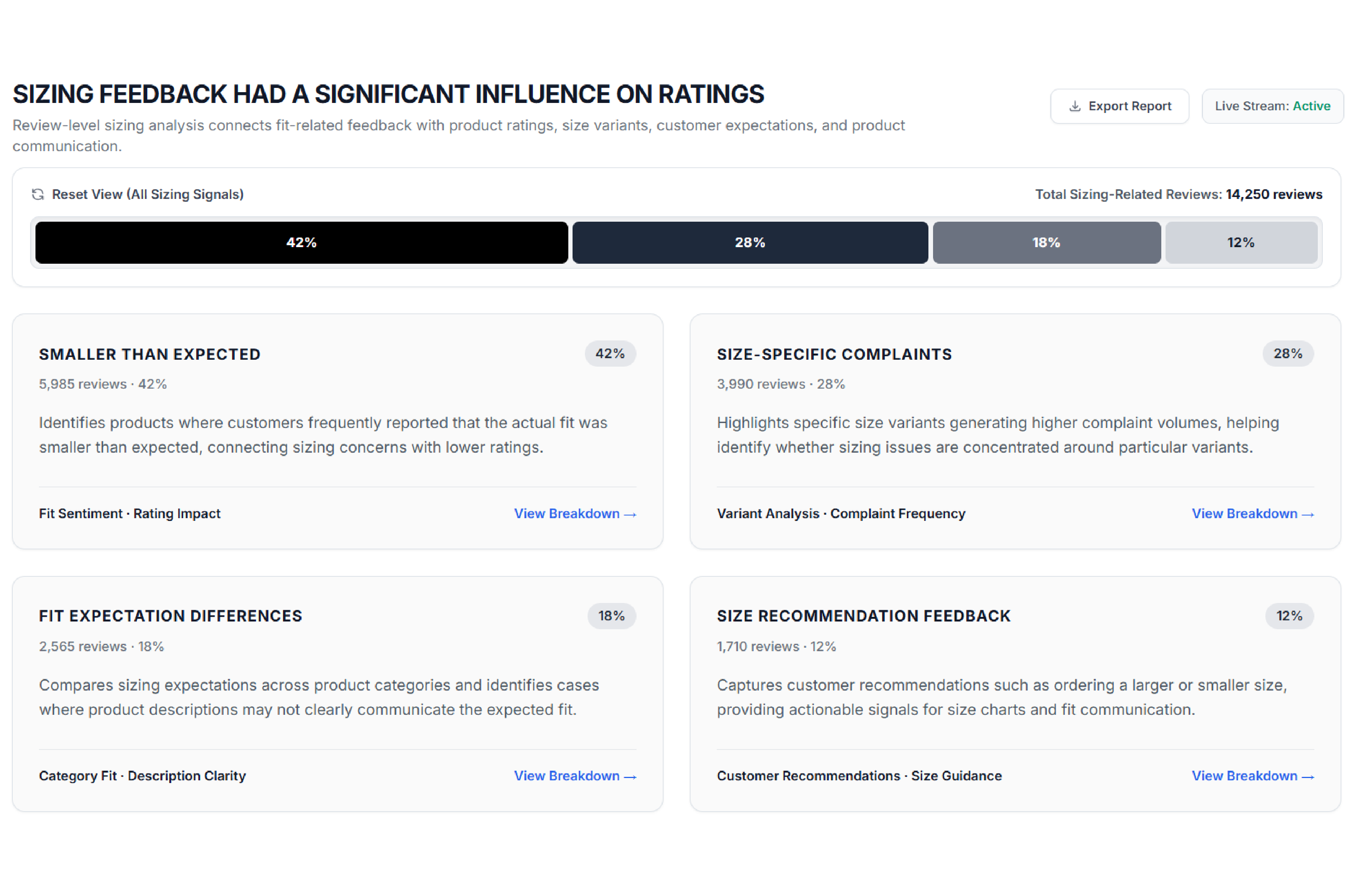
Sizing emerged as one of the most important recurring themes in the dataset.
Several products maintained strong design and fabric sentiment but received lower ratings because customers reported inconsistent sizing.
The brand compared review sentiment against available product and variant information.
This helped identify products where:
The brand responded by reviewing size charts, fit descriptions, and product communication.
Instead of immediately discontinuing products with weaker ratings, the company was able to distinguish between manufacturing-quality problems and expectation-management problems.
Not all insights came from negative reviews.
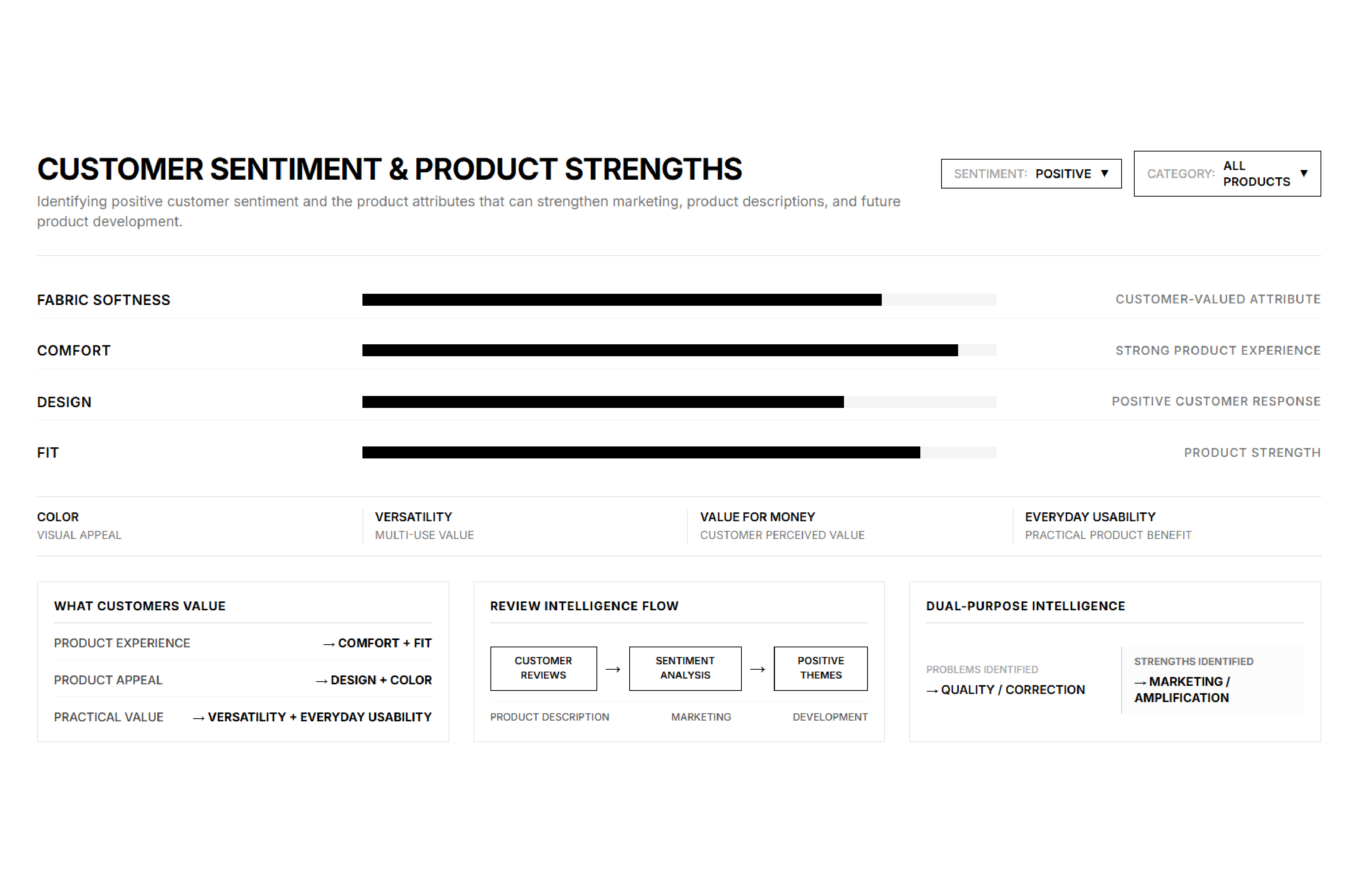
Positive reviews revealed attributes that customers consistently valued.
Certain products received strong feedback for:
These positive themes were subsequently considered in product descriptions, marketing communication, and future product development.
The review intelligence system therefore served two purposes.
It identified problems that required correction and strengths that could be amplified.
This transformed reviews from a quality-control source into a broader customer intelligence resource.
The client discovered that overall rating alone was not enough to identify emerging problems.
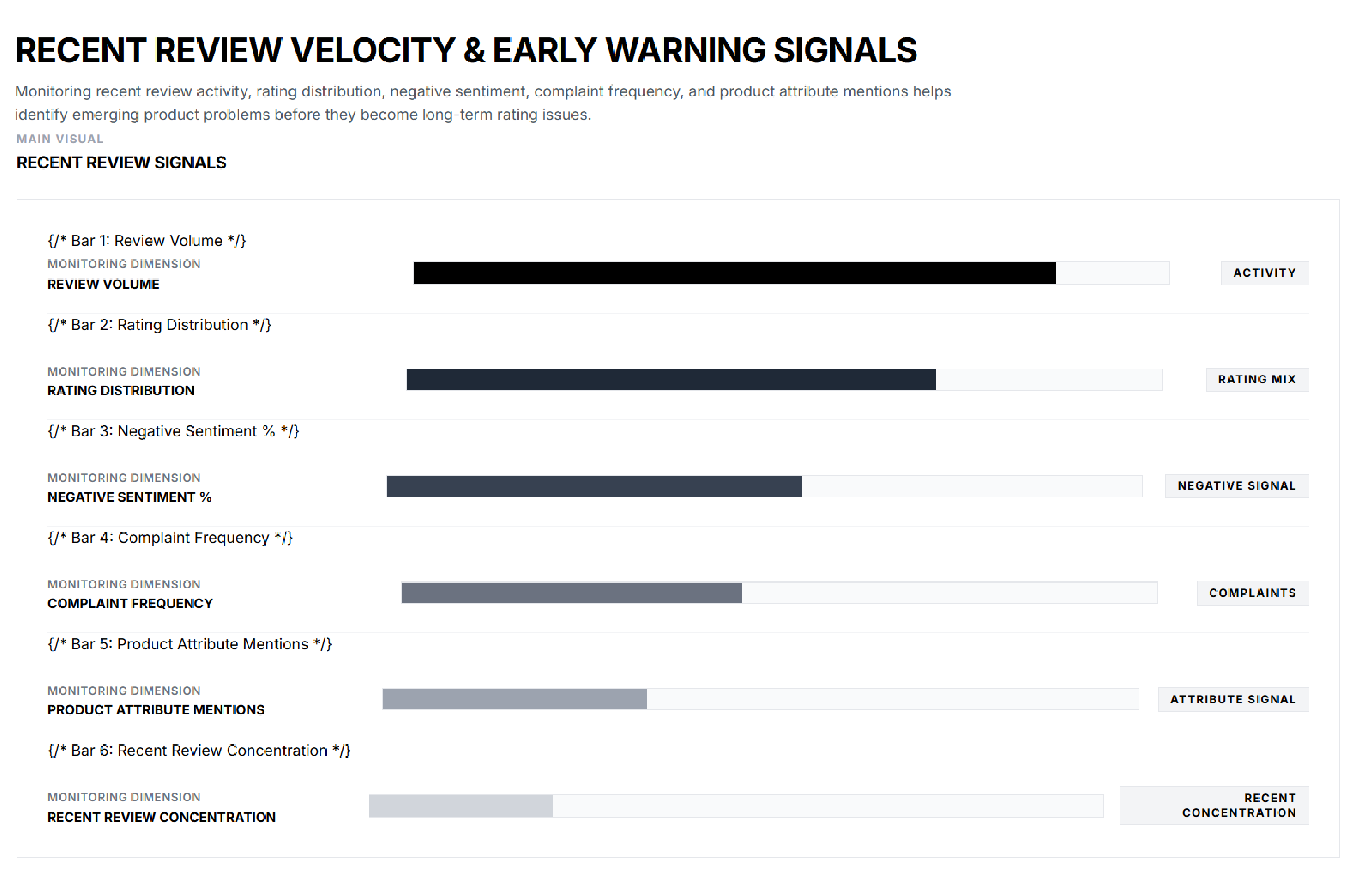
Review velocity offered an additional signal.
A product that historically maintained strong ratings could suddenly experience a higher concentration of negative reviews following a new production batch, material change, sizing adjustment, or seasonal collection launch.
The system therefore monitored changes in:
This allowed the team to identify emerging problems before they became long-term rating issues.
The final analytical layer converted review intelligence into an action-priority framework.
Products were classified into different intervention categories.
| Product Signal | Review Pattern | Recommended Action |
|---|---|---|
| High rating + positive sentiment | Strong customer satisfaction | Maintain and scale |
| High rating + emerging negative theme | Early warning | Monitor closely |
| Medium rating + high review volume | Significant mixed feedback | Detailed investigation |
| Low rating + recurring quality complaints | Persistent dissatisfaction | Product improvement |
| Low rating + sizing complaints | Fit-related issue | Review sizing guidance |
| Low rating + color complaints | Expectation mismatch | Improve imagery/details |
| High rating + strong positive theme | Product strength | Use in marketing |
| Declining rating + rising review volume | Emerging issue | Immediate investigation |
This framework allowed product managers to focus resources on the products where intervention could generate the greatest impact.
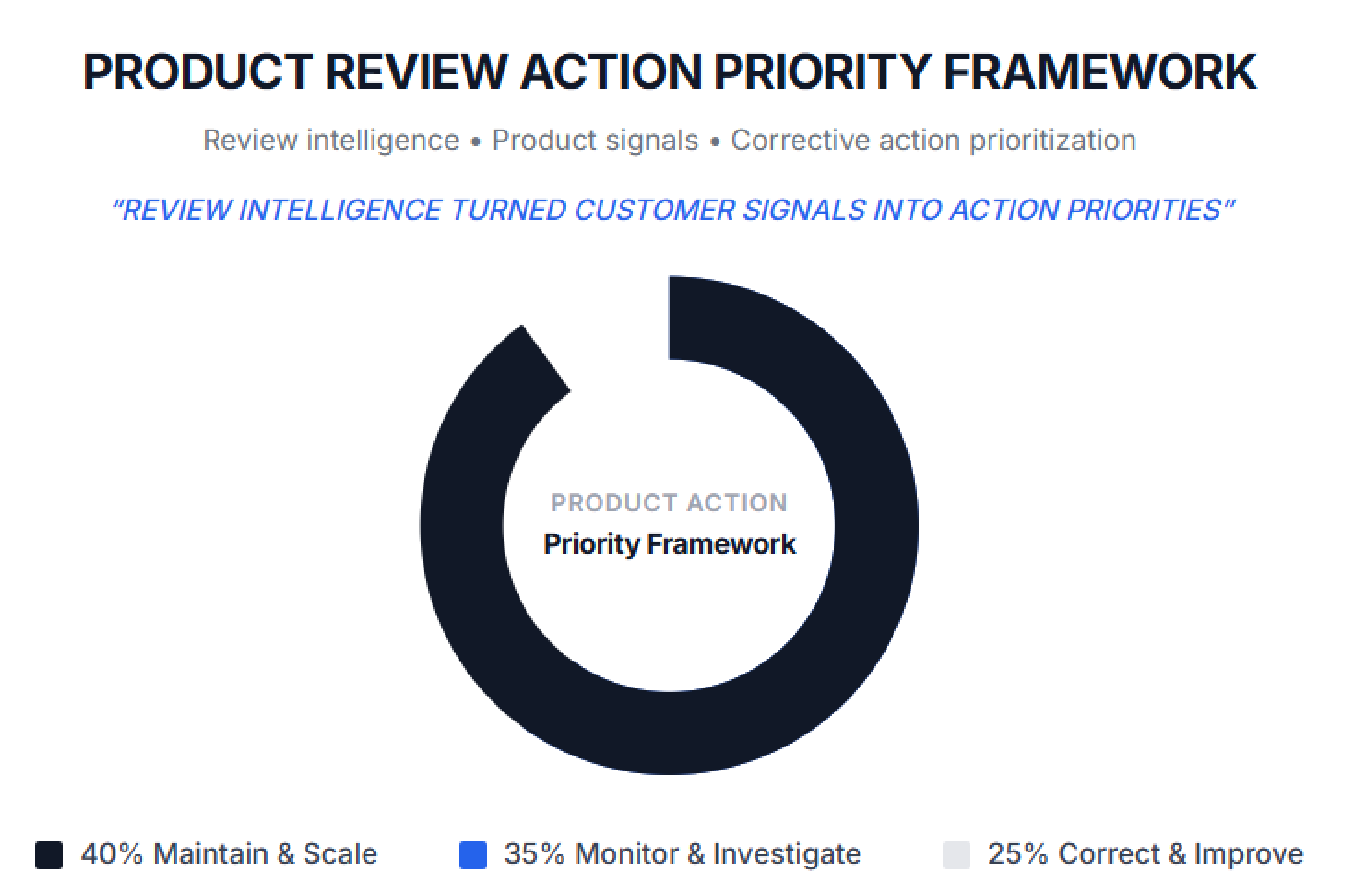
A structured dataset was created to demonstrate how marketplace reviews could be transformed into actionable product intelligence.
| Product | Category | Avg. Rating | Reviews Analyzed | Positive Sentiment | Main Complaint | Priority |
|---|---|---|---|---|---|---|
| Everyday Cotton Kurta | Ethnicwear | 4.42 | 1,860 | 88% | Slight sizing variation | Medium |
| Relaxed Fit Shirt | Casualwear | 4.08 | 1,420 | 73% | Fit inconsistency | High |
| Essential Joggers | Activewear | 4.36 | 1,175 | 84% | Limited color options | Low |
| Printed Summer Dress | Womenswear | 3.94 | 1,680 | 69% | Color difference | High |
| Comfort Polo T-Shirt | Menswear | 4.51 | 1,240 | 91% | Minimal complaints | Low |
| Everyday Sneakers | Footwear | 4.16 | 980 | 76% | Size running small | High |
The dataset allowed stakeholders to move beyond average ratings and understand the reasons behind product performance.
After implementing structured review intelligence, the brand began using marketplace feedback as an ongoing product optimization mechanism.
The pilot produced several measurable improvements across review monitoring and product decision workflows.
The solution provided the brand with a scalable framework for transforming marketplace information into usable business intelligence.
The first advantage was structured data collection. Product and review information could be organized into standardized records, allowing teams to analyze thousands of observations consistently.
The second advantage was scalability. As the brand's product catalog expanded, the same analytical framework could be extended to additional categories and products.
The third advantage was historical visibility.
Instead of relying exclusively on the rating visible at a particular point in time, the business could compare changes across monitoring periods.
Another major benefit was data enrichment.
Review text could be connected with product category, pricing, rating, review volume, and other relevant attributes.
This created a richer analytical environment for product teams.
The solution also supported faster identification of recurring customer concerns. Rather than manually reading every review, analysts could prioritize themes based on frequency, sentiment, and business importance.
"The biggest change was not simply knowing which products had lower ratings. We finally understood why customers were rating them differently. The review intelligence system helped our product and marketplace teams identify recurring sizing, quality, and expectation issues much faster. It gave us a structured way to prioritize improvements and monitor whether those changes were actually improving customer perception. The visibility has made review analysis a much more valuable part of our product decision-making process."
— Head of E-commerce & Marketplace Strategy
The final outcome was a structured marketplace intelligence framework that helped the D2C brand connect customer feedback with measurable product improvement decisions.
The company moved away from occasional manual review inspection and established a more systematic approach to monitoring product ratings, sentiment, review themes, and emerging customer concerns.
The solution supported Myntra.com data extraction services as part of a broader marketplace intelligence framework, enabling the organization to create standardized datasets for ongoing product and review analysis.
The implementation also incorporated a Myntra Product Data Scraping API Service, giving the client a scalable foundation for integrating marketplace product intelligence into internal dashboards, reporting systems, and analytical workflows.
The resulting framework helped the company:
Most importantly, the project demonstrated that marketplace reviews can become significantly more valuable when transformed from unstructured customer comments into structured product intelligence.
For a growing D2C fashion brand, improving ratings is not simply about asking customers for better reviews.
It requires understanding the actual reasons behind customer satisfaction and dissatisfaction.
By systematically collecting, organizing, classifying, and analyzing review signals, brands can identify product weaknesses, strengthen successful product attributes, and make faster decisions based on real customer experiences.
The case demonstrates how review intelligence can become an ongoing feedback loop:
Customer Feedback → Data Collection → Sentiment → Product Issue → Corrective Action → Rating Improvement
This creates a continuous product optimization cycle that can support stronger customer satisfaction, better marketplace performance, and more informed D2C growth.
Myntra reviews provide direct customer feedback about product quality, fit, comfort, design, pricing perception, and overall satisfaction. Structured monitoring helps brands identify recurring patterns instead of relying on individual comments.
Review datasets can be analyzed for ratings, review text, sentiment, recurring keywords, complaint themes, review volume, rating distribution, and changes in customer feedback over time.
Review tracking helps identify the specific issues contributing to lower ratings. Brands can then address problems involving sizing, quality, descriptions, materials, colors, or product expectations and monitor subsequent rating changes.
Yes. Repeated customer feedback can reveal which product attributes customers value most and which features consistently create dissatisfaction. Product teams can use these patterns when planning future collections.
A scalable data architecture can support monitoring across large product portfolios, making it practical for D2C brands managing hundreds or thousands of marketplace listings.
Our marketplace data intelligence solutions help fashion and D2C brands monitor ratings, analyze customer sentiment, identify recurring product issues, and transform review data into smarter product and marketplace decisions at scale.
Start a projectFields marked * are required. Everything else just helps us scope faster — skip what you don't know yet.