
52.8K+
TOTAL SPORTSWEAR PRODUCT RECORDS PROCESSED

Nike vs Adidas vs New Balance Market Analysis In Australia Delivering Real-Time Pricing Intelligence, Product Benchmarking, and Consumer Insights
This case study is based on a real-world enterprise scenario where a retail intelligence company analyzed Australia's leading sportswear brands using automated product, pricing, inventory, and consumer engagement analytics to transform fragmented retail information into actionable competitive intelligence. It is particularly valuable for organizations conducting Nike vs Adidas vs New Balance Market Analysis In Australia to benchmark pricing strategies, assortment performance, and customer engagement across Australia's retail ecosystem.
It is designed for:
The client's primary challenge was understanding how Nike, Adidas, and New Balance competed across Australia's rapidly evolving omnichannel retail ecosystem. Product launches, discounts, stock availability, consumer reviews, and category demand changed daily across numerous online retailers, making manual tracking inefficient and incomplete. The organization required an automated intelligence platform capable of delivering structured market insights in near real time.
A leading retail intelligence organization conducted an in-depth competitive assessment of Australia's sportswear industry by continuously monitoring product catalogs, pricing strategies, promotional campaigns, inventory availability, customer ratings, reviews, and engagement metrics across major online retailers. Leveraging Adidas Australia Market Intelligence, analysts gained valuable insights into assortment diversity, discount trends, seasonal pricing behavior, and consumer purchasing preferences across footwear, apparel, and accessories. To enhance market visibility, the organization implemented Nike Australia Sportswear market Data Scraping pipelines that automatically collected thousands of product listings, price updates, stock availability records, customer feedback, and promotional changes from Australia's leading eCommerce platforms. The standardized datasets enabled accurate brand comparisons, trend forecasting, demand analysis, and merchandising optimization while providing executives with real-time dashboards that supported faster strategic decision-making, improved competitive benchmarking, and more effective retail planning across Australia's rapidly evolving sportswear market.
The client struggled to maintain continuous visibility across Australia's rapidly changing sportswear retail environment where prices, promotions, inventory, and customer preferences evolved daily.
They lacked the capability to Extract New Balance product trend in Australia, making it difficult to identify emerging product categories, bestselling footwear collections, and growing consumer preferences.
Manual monitoring prevented accurate Sportswear Pricing Analysis In Australia, resulting in delayed pricing decisions and inconsistent competitive benchmarking across retailers.
The business also found it challenging to perform comprehensive Sportswear brand comparison In Australia, as product specifications, promotional strategies, customer ratings, and inventory levels varied significantly between retailers.
After implementing an automated competitive intelligence framework, the organization replaced manual retailer monitoring with continuous product intelligence capable of tracking pricing, assortment, inventory, ratings, and promotions across Australia's sportswear ecosystem.
| Dimension | Manual Monitoring | Automated Retail Intelligence Platform |
|---|---|---|
| Product Collection | Individual retailer browsing | Continuous multi-retailer product collection |
| Pricing Updates | Manual price checking | Real-time pricing synchronization |
| Promotion Tracking | Limited observation | Automated campaign monitoring |
| Inventory Visibility | Occasional stock checks | Continuous inventory monitoring |
| Product Comparison | Spreadsheet-based | Automated normalized comparison |
| Market Insights | Delayed reporting | Real-time competitive dashboards |
The organization specializes in retail intelligence solutions supporting global consumer brands operating across Australia's highly competitive sportswear industry.
Its analytical framework captures structured product information from major online retailers while monitoring pricing changes, product assortment, customer sentiment, promotional campaigns, inventory availability, and seasonal buying behavior.
As Australia's athletic footwear and apparel market became increasingly competitive, manual competitive analysis could no longer provide sufficient visibility into rapidly changing retail dynamics.
The company therefore implemented a scalable automated intelligence platform capable of continuously monitoring thousands of products across Nike, Adidas, and New Balance, enabling executives to make evidence-based merchandising and pricing decisions supported by live market intelligence.
Our team designed a fully automated retail intelligence solution capable of collecting product information, pricing, inventory, promotions, ratings, and customer reviews from Australia's leading online sportswear retailers. The platform incorporated Adidas data extraction services to automate collection of product specifications, pricing updates, inventory availability, promotional campaigns, and assortment changes across multiple retail marketplaces.
We also deployed eCommerce Data Scraping Services to normalize data collected from various Australian eCommerce websites, eliminating duplicate records while improving SKU matching and pricing consistency.
Integrated Ecommerce Product Ratings and Review Dataset pipelines continuously collected customer ratings, review volumes, review sentiment, and engagement metrics, enabling detailed comparison of consumer perception across competing brands.
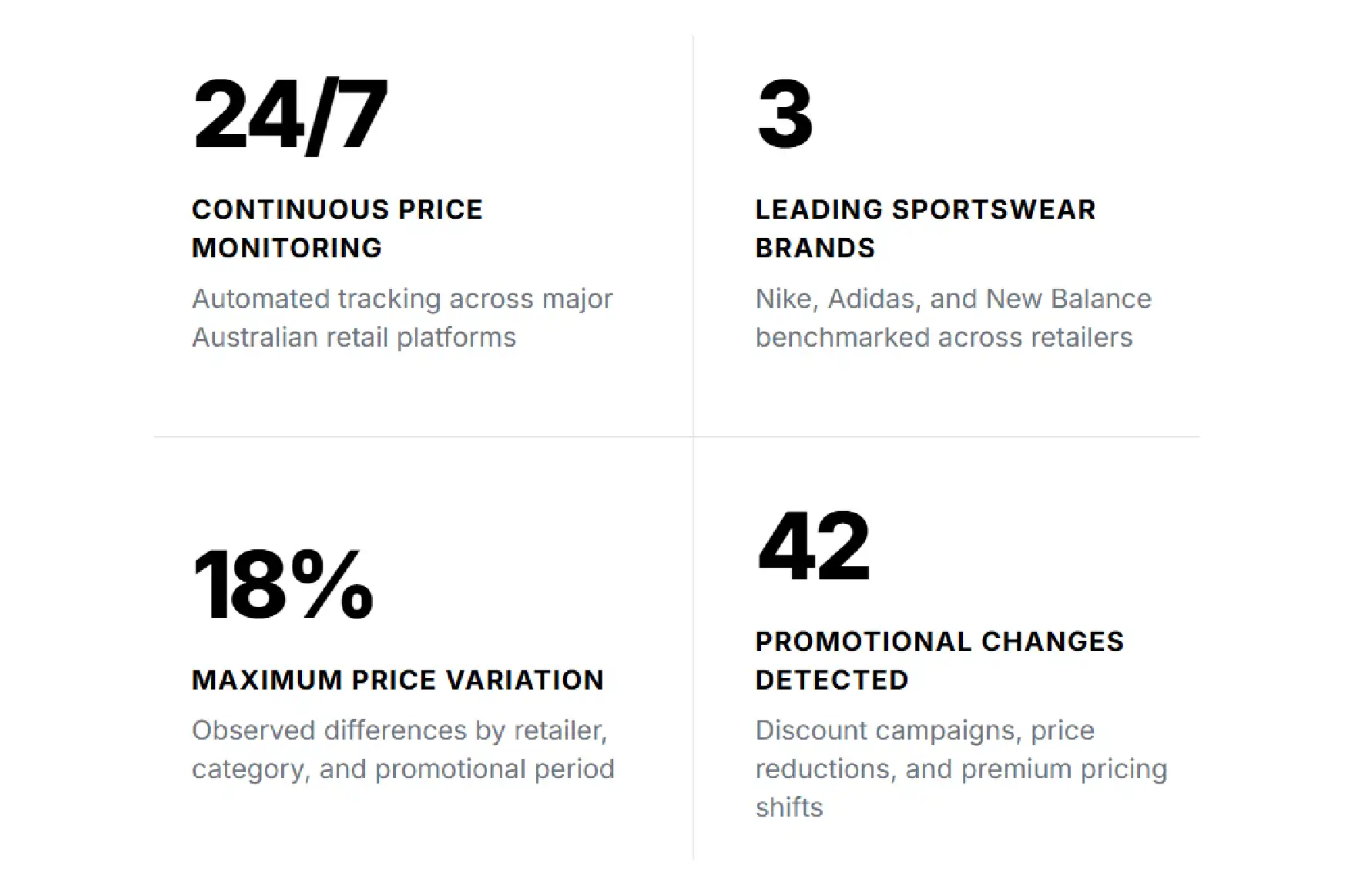
Continuous monitoring revealed substantial differences in pricing strategies among Nike, Adidas, and New Balance depending on retailer, promotional period, and product category.
Automated intelligence enabled immediate detection of discount campaigns, price reductions, premium pricing strategies, and regional promotional variations, allowing pricing teams to benchmark competitors with significantly greater accuracy.
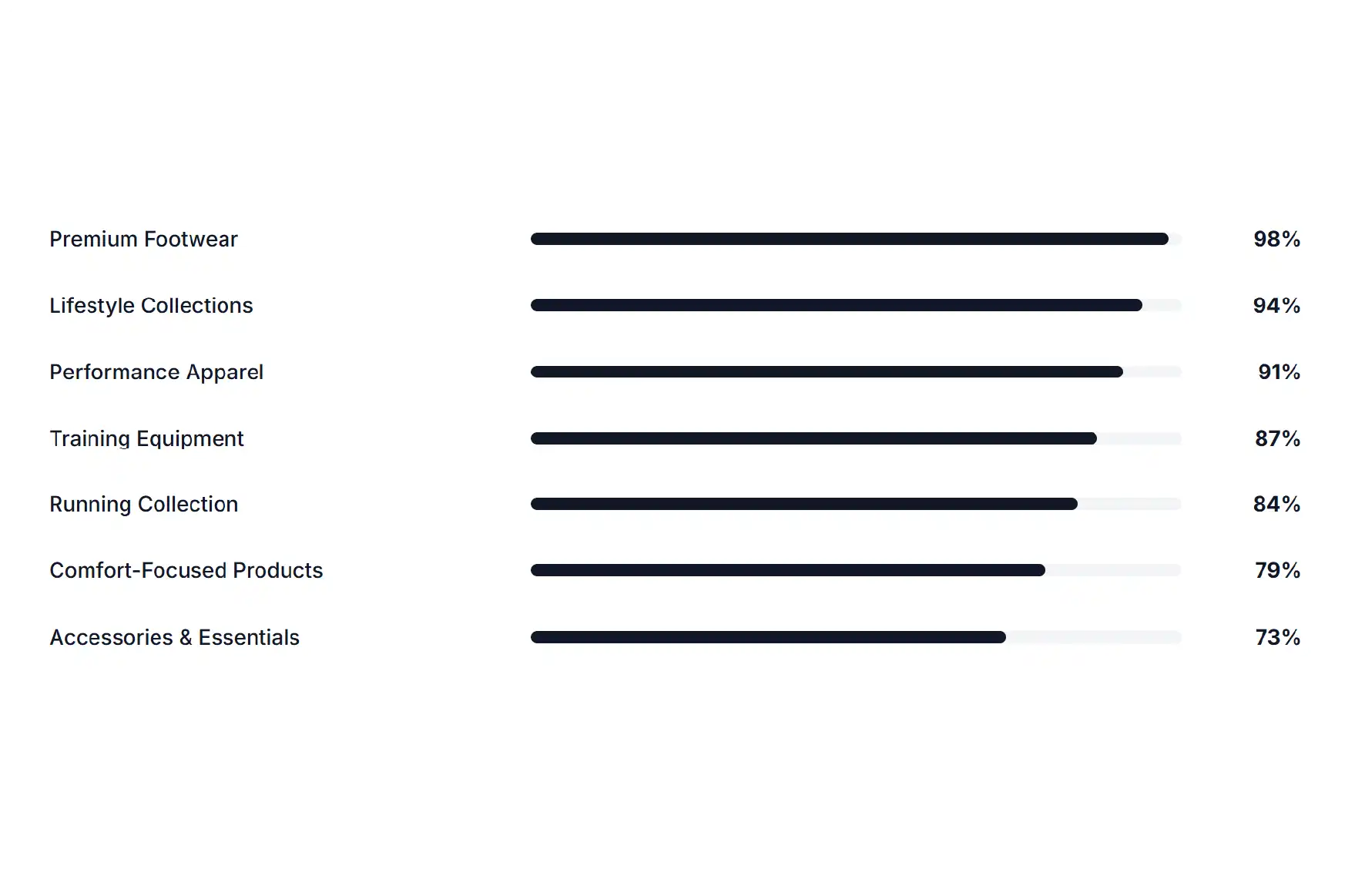
Analysis showed that category breadth differed considerably across footwear, apparel, training equipment, and lifestyle products.
Nike maintained the broadest premium assortment, Adidas demonstrated strong category diversity across performance and lifestyle collections, while New Balance strengthened its market presence through specialized running footwear and comfort-focused product lines.
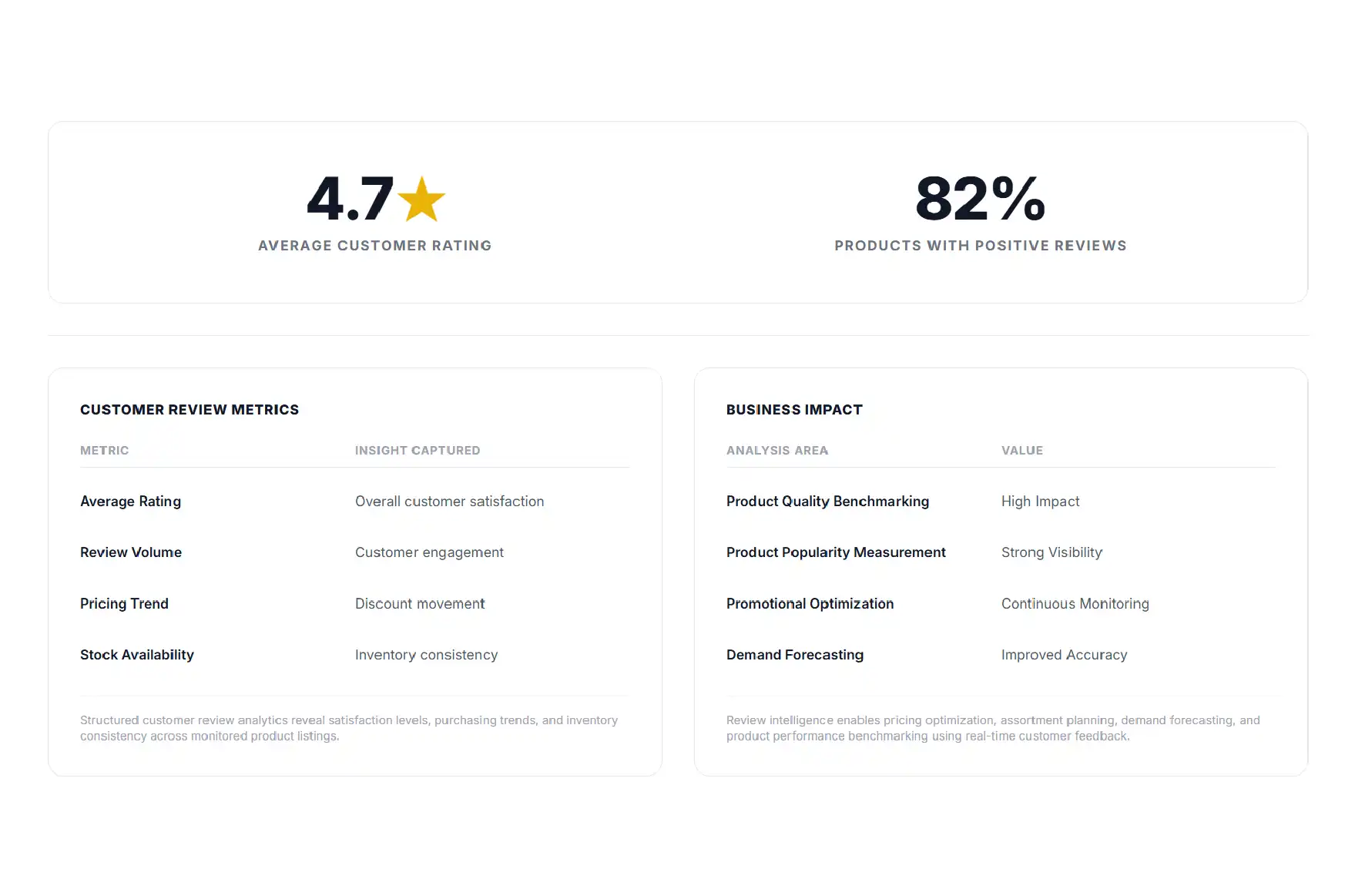
Structured review analytics identified clear relationships between customer ratings, review volume, repeat purchasing behavior, and product visibility.
| Metric | Insight Captured | Business Impact |
|---|---|---|
| Average Rating | Overall customer satisfaction | Product quality benchmarking |
| Review Volume | Customer engagement | Product popularity measurement |
| Pricing Trend | Discount movement | Promotional optimization |
| Stock Availability | Inventory consistency | Demand forecasting |
Real-time inventory monitoring identified stock shortages, replenishment frequency, and seasonal demand fluctuations across Australia's leading sportswear retailers.
The intelligence platform enabled merchandising teams to forecast inventory requirements more accurately while identifying fast-selling categories before competitors responded.
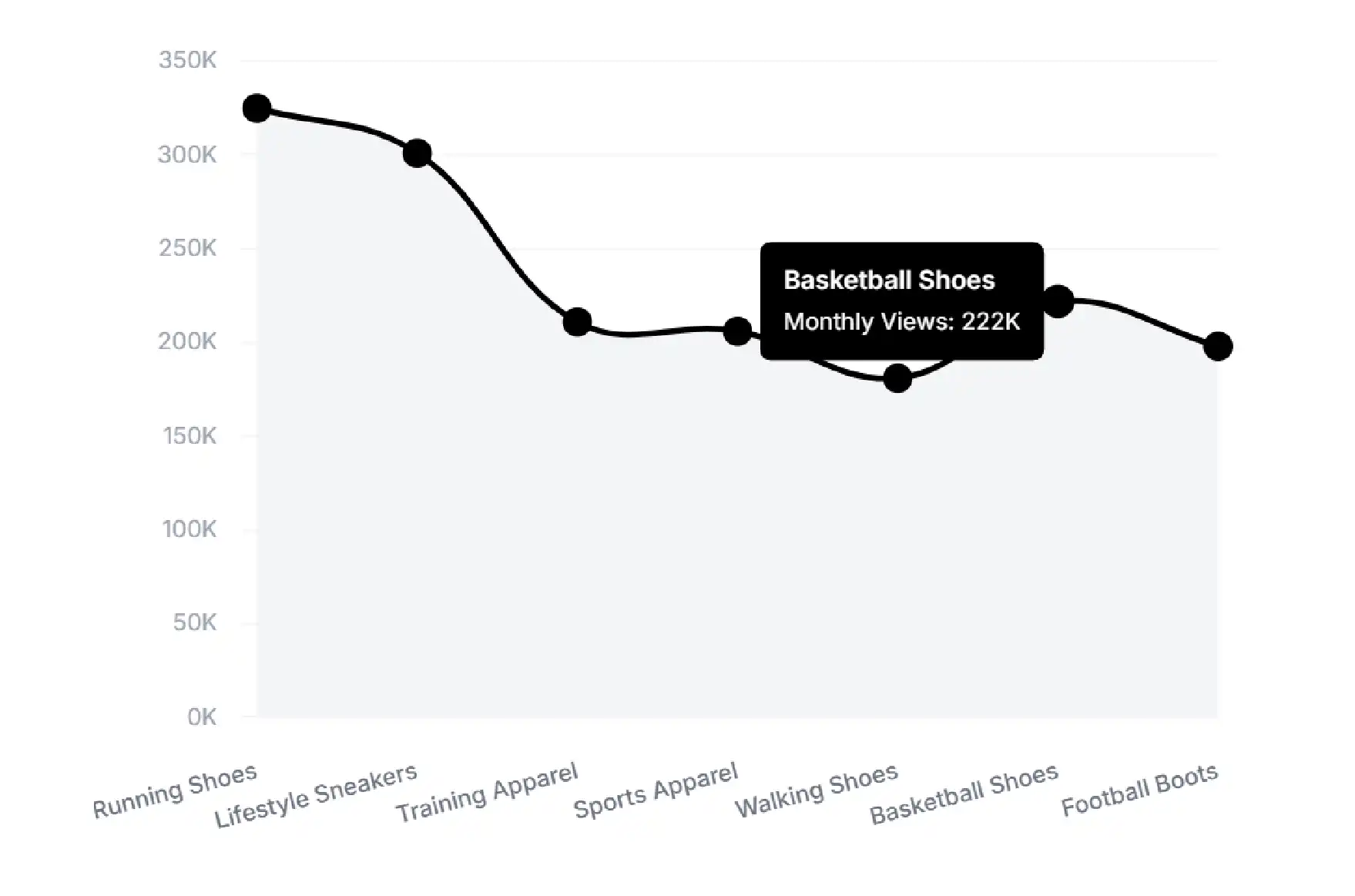
The following sample dataset presents a comparative snapshot of Nike, Adidas, and New Balance across Australia's sportswear market, highlighting key performance indicators including average pricing, customer ratings, promotional discounts, monthly product views, inventory status, and top-performing products across major online retail platforms.
| Brand | Category | Avg. Price (AUD) | Avg. Rating | Discount (%) | Monthly Views | Stock Status | Top Product |
|---|---|---|---|---|---|---|---|
| Nike | Running Shoes | 219 | 4.7 | 18 | 325K | In Stock | Air Zoom Pegasus |
| Adidas | Lifestyle Sneakers | 189 | 4.6 | 22 | 301K | In Stock | Ultraboost |
| New Balance | Running Shoes | 199 | 4.8 | 15 | 248K | In Stock | Fresh Foam 1080 |
| Nike | Training Apparel | 95 | 4.5 | 20 | 211K | In Stock | Dri-FIT Tee |
| Adidas | Sports Apparel | 88 | 4.6 | 25 | 206K | In Stock | Own The Run Tee |
| New Balance | Walking Shoes | 179 | 4.8 | 12 | 181K | Limited Stock | Fresh Foam X |
| Nike | Basketball Shoes | 245 | 4.7 | 14 | 222K | Limited Stock | LeBron Series |
| Adidas | Football Boots | 210 | 4.6 | 19 | 198K | In Stock | Predator Elite |
Following implementation of the automated retail intelligence platform, the client achieved significant operational improvements across Australia's highly competitive sportswear market. Continuous monitoring of product pricing, inventory availability, promotions, customer ratings, and assortment changes enabled faster decision-making, improved competitive visibility, and more accurate merchandising strategies. By replacing manual data collection with automated intelligence pipelines, the organization enhanced reporting efficiency while gaining deeper insights into evolving consumer preferences and retail trends.
Our retail intelligence framework consolidates fragmented product information into standardized datasets that support pricing analysis, assortment optimization, promotional benchmarking, and customer behavior analytics across Australia's leading sportswear retailers.
Automated collection continuously monitors retailer activity, ensuring businesses receive updated competitive intelligence without relying on manual tracking.
Advanced validation, duplicate removal, SKU normalization, and structured metadata enrichment significantly improve reporting accuracy while supporting executive-level analytics.
The scalable infrastructure processes expanding product catalogs efficiently while maintaining high performance, allowing organizations to monitor evolving retail ecosystems with confidence.
By transforming complex retail data into meaningful business intelligence, organizations improve forecasting accuracy, pricing competitiveness, merchandising effectiveness, and long-term strategic planning.
"The intelligence platform delivered exceptional visibility across Australia's sportswear market. We now compare Nike, Adidas, and New Balance with significantly greater accuracy using structured pricing, inventory, assortment, and customer engagement data. Automated reporting has reduced manual effort while providing executives with faster, more reliable competitive insights that directly support merchandising and pricing strategies."
— Director of Retail Intelligence
The project resulted in a fully automated competitive intelligence platform capable of continuously monitoring Australia's sportswear retail ecosystem across multiple online retailers.
Implementation of eCommerce Data Intelligence enabled executives to compare pricing, promotions, inventory availability, customer engagement, and assortment performance through standardized analytical dashboards that supported faster strategic decision-making.
Deployment of Web Scraping API Services automated large-scale product collection while maintaining highly accurate synchronization of pricing, ratings, promotional campaigns, and inventory updates across multiple retail sources.
The infrastructure further leveraged Web Scraping Services to provide scalable monitoring capabilities capable of supporting growing product catalogs, expanding retailer coverage, and increasing analytical complexity without compromising processing performance.
Comparing these brands helps retailers understand pricing strategies, product assortment, customer preferences, promotional activity, and competitive positioning within Australia's rapidly growing sportswear market.
Product pricing, discounts, inventory availability, product specifications, ratings, customer reviews, retailer information, category performance, promotional campaigns, and historical pricing trends can all be analyzed.
Automated pipelines can capture pricing, inventory, and promotional changes continuously or at scheduled intervals depending on business requirements.
Automation eliminates manual monitoring, standardizes retailer data, improves reporting accuracy, and provides near real-time competitive insights for faster business decisions.
Sportswear brands, retailers, distributors, consulting firms, market research organizations, investment firms, and eCommerce businesses all benefit from automated retail intelligence and competitive benchmarking.
Fields marked * are required. Everything else just helps us scope faster — skip what you don't know yet.