
Introduction
The healthcare industry has entered a new era where data plays a central role in improving pricing transparency, patient accessibility, inventory planning, and competitive decision-making. Pharmacies, healthcare retailers, insurance providers, pharmaceutical companies, and healthcare technology firms increasingly rely on digital information to understand changing market conditions and consumer demand. This growing dependence on accurate information has made Pharmacy & healthcare data Scraping one of the most valuable technologies for healthcare intelligence.
Organizations operating in competitive pharmaceutical markets need continuous access to medicine prices, product availability, prescription information, promotional campaigns, health supplements, medical devices, and customer feedback. Businesses that Scrape CVS, Walgreens and E-Pharmacy Drug Pricing Data gain a significant advantage by comparing competitors, tracking regional price differences, and identifying emerging healthcare trends before competitors respond.
At the same time, real-time pharmacy & healthcare price monitoring enables organizations to capture dynamic pricing updates throughout the day, helping retailers maintain competitive pricing strategies while ensuring accurate market intelligence across online pharmacies and healthcare marketplaces.
Why Healthcare Data Has Become a Strategic Asset?
Healthcare data has expanded far beyond traditional patient records. Modern healthcare ecosystems generate enormous volumes of publicly available information through pharmacy websites, telemedicine platforms, online drug stores, healthcare marketplaces, insurance portals, wellness platforms, and medical product catalogs.
Every price update, product launch, prescription medicine listing, promotional offer, stock availability notification, or customer review provides valuable intelligence for organizations looking to improve business performance.
Rather than relying on manual research, companies automate data collection from multiple sources, creating structured datasets that support pricing analytics, inventory forecasting, product benchmarking, regulatory monitoring, and competitive analysis.
As healthcare continues shifting toward digital channels, organizations require faster access to reliable information that reflects current market conditions.
The Growing Importance of Pharmacy Data Scraping
Online pharmacies continuously update prices, discounts, inventory, dosage information, manufacturer details, substitute medicines, package sizes, and delivery options.
Capturing these updates manually becomes impossible when thousands of products change every day across multiple pharmacy platforms.
Automated scraping solutions collect structured information from pharmacy websites at scheduled intervals, allowing businesses to maintain updated healthcare databases without human intervention.
This automated approach supports pharmaceutical companies, distributors, wholesalers, insurers, healthcare startups, researchers, and analytics firms.
Data Commonly Extracted from Pharmacy Platforms
Healthcare data scraping solutions collect numerous data attributes that help businesses improve strategic planning.
Common datasets include medicine names, active ingredients, dosage strengths, manufacturers, package sizes, prescription requirements, availability status, promotional offers, discounts, pricing history, SKU information, product descriptions, ratings, reviews, delivery timelines, pharmacy locations, and category classifications.
These structured datasets enable organizations to build powerful healthcare intelligence platforms.
Competitive Pricing Intelligence
Medicine pricing differs across pharmacies due to supplier agreements, insurance partnerships, regional taxes, promotional campaigns, and inventory levels.
Organizations continuously compare competitor pricing to optimize retail margins while remaining attractive to consumers.
Dynamic pricing intelligence allows companies to monitor competitors several times daily, identify aggressive pricing strategies, evaluate discount campaigns, and adjust prices quickly.
Historical pricing data further supports long-term forecasting and seasonal demand analysis.
SKU-Level Product Intelligence
Accurate product-level information forms the foundation of healthcare analytics.
Organizations performing Walgreens SKU-level medicine Data Extraction obtain detailed product identifiers, medicine specifications, packaging variations, prescription classifications, dosage forms, and inventory status for thousands of pharmaceutical products.
SKU-level visibility enables retailers to compare identical medicines across competing pharmacies while identifying assortment differences and pricing opportunities.
E-Pharmacy Market Expansion
The rapid growth of online pharmacies has significantly increased demand for healthcare data intelligence.
Consumers increasingly compare medicine prices before purchasing, encouraging pharmacies to update promotions and pricing more frequently.
Businesses that Scrape e-pharmacy medicine pricing data gain continuous visibility into digital healthcare marketplaces, enabling them to monitor changing consumer behavior, promotional trends, and pricing fluctuations across multiple platforms simultaneously.
This intelligence supports competitive positioning while improving customer acquisition strategies.
Doctor and Clinic Pricing Analysis
Healthcare pricing extends beyond medicines.
Consultation fees, diagnostic services, preventive care packages, specialist appointments, telehealth services, and health checkups also vary significantly across providers.
Organizations using doctor and clinic Pricing data Scraping collect publicly available consultation fees, appointment availability, specialty listings, healthcare packages, patient ratings, and location-based pricing.
Healthcare aggregators use these insights to improve transparency while helping patients compare providers.
Healthcare Product Catalog Intelligence

Healthcare retailers sell thousands of products beyond prescription medicines.
These include vitamins, nutrition supplements, personal care products, diabetic supplies, medical devices, wellness products, orthopedic equipment, first-aid products, diagnostic kits, and home healthcare solutions.
Businesses increasingly rely on method to Extract Healthcare Products Data API solutions to integrate continuously updated healthcare catalogs into internal analytics platforms, enabling faster synchronization of pricing, availability, and product specifications.
API-driven integration reduces manual effort while improving operational efficiency.
Pharmaceutical Market Intelligence
Healthcare organizations require more than individual product information.
They need broader visibility into market dynamics, pricing behavior, consumer demand, emerging product categories, seasonal purchasing patterns, and competitor strategies.
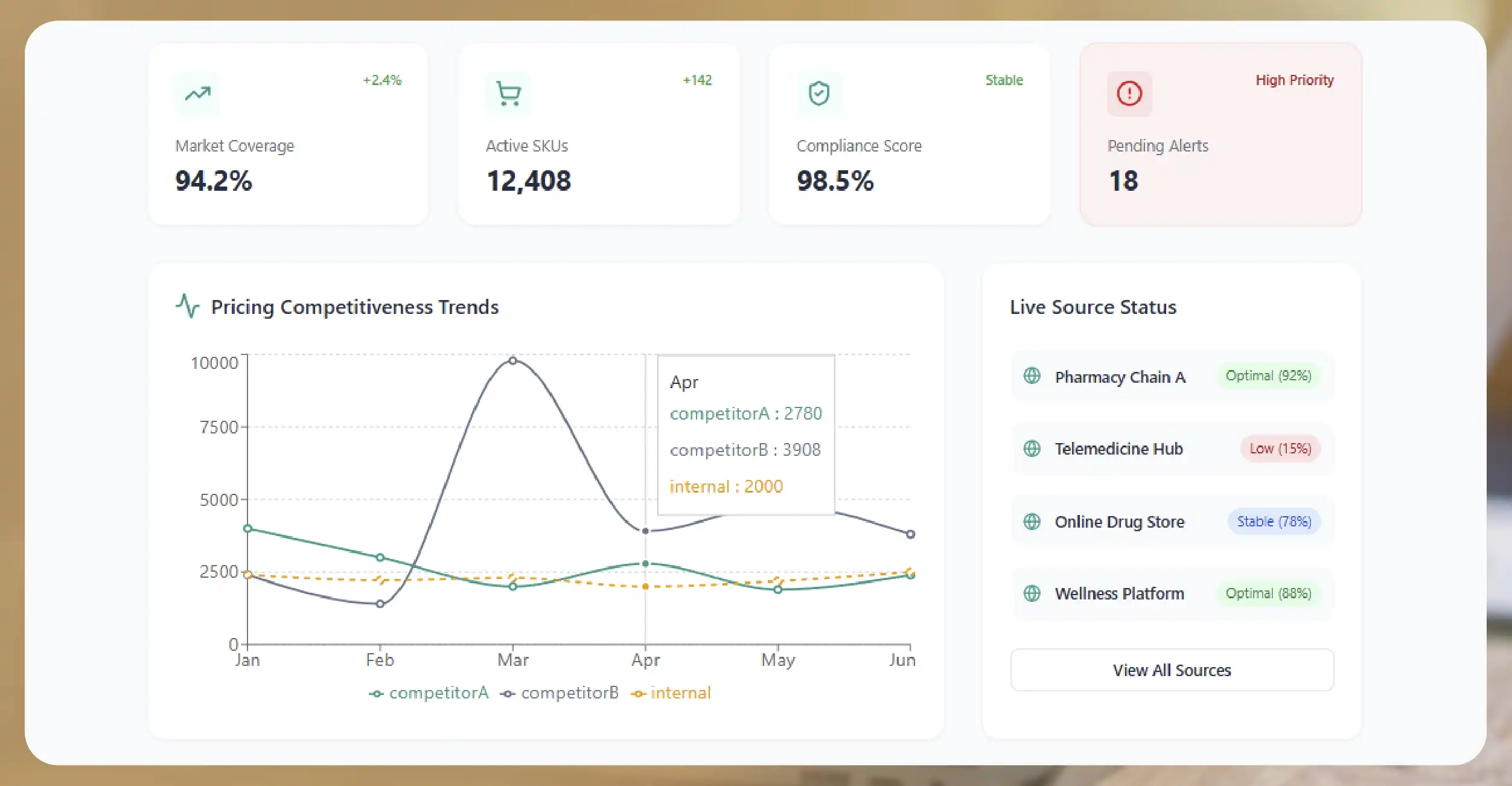
Comprehensive Pharmacy market Data intelligence combines pricing data, product availability, customer sentiment, category growth, and promotional activity into centralized dashboards that support strategic decision-making.
These insights help organizations optimize pricing policies while improving long-term business planning.
Product Catalog Monitoring
Retail pharmacies frequently expand their catalogs with new medicines, generic alternatives, wellness products, and healthcare devices.
Automated monitoring detects newly listed products, discontinued medicines, pricing changes, packaging updates, manufacturer replacements, and inventory fluctuations.
Historical product tracking allows businesses to evaluate catalog evolution across multiple pharmacy chains while identifying competitive gaps.
Customer Review Analysis
Customer feedback provides valuable information about product effectiveness, delivery quality, packaging, customer service, and purchasing experience.
Healthcare companies analyze reviews to identify frequently discussed products, recurring complaints, positive purchasing trends, and consumer preferences.
Sentiment analysis transforms thousands of customer comments into actionable business intelligence.
Retail Pharmacy Benchmarking
Large pharmacy chains compete through pricing, inventory, promotions, delivery speed, loyalty programs, and product assortment.
Using a Walgreens Product Data Scraper, organizations benchmark competitor catalogs, compare medicine availability, evaluate promotional campaigns, and analyze pricing consistency across regions.
Retail benchmarking supports strategic pricing while improving category management.
Pharmaceutical Research Applications
Healthcare researchers increasingly analyze pharmacy datasets to understand pricing evolution, generic medicine adoption, healthcare accessibility, product availability, and regional healthcare disparities.
Large-scale structured datasets improve healthcare research while enabling statistical analysis across multiple years.
Researchers also evaluate medicine shortages, seasonal demand changes, and pricing behavior during public health events.
Supply Chain Optimization
Distributors and wholesalers benefit from continuous pharmacy monitoring.
Availability tracking identifies stock shortages before they become widespread, allowing suppliers to improve inventory allocation.
Demand forecasting also becomes more accurate when organizations combine pricing trends with availability data and regional purchasing behavior.
Supply chain optimization reduces operational costs while improving customer satisfaction.
Regulatory Monitoring
Healthcare regulations often influence pricing, labeling, prescription classifications, and product availability.
Automated monitoring identifies catalog updates that may reflect regulatory changes, enabling organizations to respond faster while maintaining compliance.
Historical archives also simplify regulatory audits and reporting.
Healthcare Analytics for Decision Makers
Executives increasingly depend on dashboards powered by Pharmaceutical and Medical Data Scraping to evaluate pricing performance, competitor activity, product launches, regional demand, promotional effectiveness, and healthcare market growth.
Interactive dashboards provide real-time insights that support faster business decisions across marketing, procurement, merchandising, and executive leadership.
How iWeb Data Scraping Can Help You?
Real-Time Market Visibility
Our automated scraping platform continuously collects pharmacy pricing, availability, promotions, product specifications, healthcare catalogs, and competitor updates, enabling organizations to access accurate market intelligence for faster decisions across rapidly changing pharmaceutical marketplaces.
Comprehensive Competitive Intelligence
We monitor multiple pharmacy platforms simultaneously, helping businesses compare medicine prices, analyze promotional campaigns, benchmark competitors, identify assortment gaps, evaluate regional pricing differences, and strengthen long-term pharmaceutical pricing strategies through structured datasets.
High-Quality Structured Data
Our solutions transform complex healthcare websites into clean, standardized, validated datasets that integrate seamlessly with analytics platforms, business intelligence systems, machine learning models, CRM applications, and enterprise reporting environments for reliable insights.
Custom API and Data Delivery
We deliver healthcare datasets through APIs, cloud storage, databases, secure file transfers, or scheduled exports, allowing organizations to automate workflows while maintaining consistent access to fresh pharmacy intelligence every day.
Scalable Enterprise Data Collection
Our infrastructure supports large-scale data extraction across thousands of pharmacy websites, healthcare portals, retailer catalogs, and medical marketplaces while maintaining speed, accuracy, scalability, compliance, and continuous monitoring for enterprise requirements.
Conclusion
Healthcare organizations increasingly depend on accurate, timely, and structured market intelligence to remain competitive in rapidly evolving pharmaceutical markets. Automated pharmacy data collection enables businesses to monitor pricing, product availability, healthcare catalogs, promotional campaigns, customer behavior, and competitor activities with far greater efficiency than traditional research methods.
Organizations investing in Price Monitoring Services gain continuous visibility into changing pharmacy prices, helping optimize pricing strategies and improve competitive positioning across digital healthcare marketplaces.
Similarly, Price Intelligence Services transform raw pharmacy information into actionable insights that support procurement, merchandising, forecasting, and strategic planning across the healthcare value chain.
Modern Web Scraping API Services further simplify enterprise integration by delivering structured healthcare datasets directly into business applications, analytics platforms, and decision-support systems, allowing organizations to build scalable, data-driven healthcare intelligence ecosystems.
Frequently Asked Questions
Pharmacy and healthcare data scraping is the automated process of collecting publicly available information such as medicine prices, product catalogs, availability, healthcare services, promotions, and customer reviews from pharmacy and healthcare websites for business intelligence and market analysis.
Pharmaceutical manufacturers, online pharmacies, healthcare retailers, distributors, insurers, market research firms, healthcare startups, pricing intelligence providers, and analytics companies benefit significantly from structured pharmacy datasets.
Organizations can collect medicine prices, SKU information, dosage details, manufacturers, product descriptions, inventory status, promotional offers, healthcare product catalogs, consultation fees, clinic information, customer reviews, and historical pricing data.
Most organizations monitor pharmacy pricing daily or multiple times throughout the day to capture dynamic pricing changes, promotional updates, inventory fluctuations, and new product launches for accurate competitive intelligence.
Structured healthcare datasets enable organizations to optimize pricing strategies, benchmark competitors, forecast demand, improve inventory planning, identify market trends, enhance customer experiences, support research initiatives, and build comprehensive healthcare intelligence dashboards.