
1.26M+
HISTORICAL PRODUCT PRICE RECORDS PROCESSED

Price-Tracking App Using Amazon.sa Historical ASIN Data for Smarter E-Commerce Pricing Intelligence and Competitive Market Analysis
This case study presents a real-world enterprise scenario where an e-commerce intelligence organization developed a sophisticated Price-Tracking App Using Amazon.sa Historical ASIN Data to monitor product price movements, identify discount patterns, benchmark competitors, and transform historical marketplace information into actionable pricing intelligence.
The solution is particularly relevant for:
The client's primary objective was to create an always-available historical pricing layer that could show how products moved in price over time rather than relying only on their current marketplace prices.
Amazon.sa contains extensive product information across electronics, groceries, beauty, fashion, home products, appliances, sports equipment, automotive products, and other categories. However, observing only today's price provides limited insight into whether a displayed discount is genuinely competitive, seasonal, temporary, or part of a longer pricing pattern.
The client therefore required a scalable solution capable of collecting historical ASIN-level pricing records, standardizing product information, maintaining chronological price histories, and presenting the resulting intelligence through an easy-to-use price-tracking application.
The project focused on developing a structured historical pricing intelligence system capable of transforming marketplace records into searchable product-level price histories. The foundation was Amazon.sa historical ASIN price data for price tracking, allowing analysts and end users to understand price changes across different products and time periods.
The system collected product-level records and organized them around ASIN identifiers, product names, categories, sellers, prices, discounts, availability indicators, ratings, and collection timestamps. This created a historical timeline that could be queried by product, category, price range, or date.
A major component of the project involved Amazon Saudi Arabia historical pricing data Scraping, designed to support recurring collection and historical comparison. Instead of treating marketplace pricing as a static value, the system treated each observed price as a time-based event that could be compared with previous observations.
The resulting application enabled users to view minimum prices, maximum prices, average prices, price volatility, discount periods, and recent changes. Historical records could also support automated alerts when products crossed predefined pricing thresholds.
For retailers, this created a stronger foundation for competitive benchmarking. For consumers and price-comparison platforms, it provided greater transparency into price movements. For analysts, the historical database created an opportunity to study pricing behavior at category and marketplace scale.
The project ultimately transformed fragmented product observations into a continuously expanding historical pricing intelligence repository. By connecting ASIN-level product identities with chronological price observations, the client gained the ability to move beyond simple price monitoring toward predictive and strategic pricing analysis.
The client operated in a competitive Saudi Arabian e-commerce environment where product prices could change frequently due to promotions, seller competition, inventory conditions, seasonal campaigns, and marketplace dynamics.
The first challenge was the absence of a dependable historical database. Current product prices could be viewed easily, but understanding how those prices changed over previous days or weeks required systematic historical collection. The client therefore required reliable Amazon.sa historical price Data Extraction capable of creating a chronological record for individual products.
A second challenge involved product identification. A single product could have multiple sellers, changing prices, promotional offers, and listing attributes. Maintaining consistent product identity across historical observations required ASIN-based structuring. The client needed scalable Amazon.sa ASIN data Scraping to associate individual observations with the correct product identifiers and preserve historical continuity.
Another issue was price volatility. A product could move from SAR 899 to SAR 749 and later return to SAR 899 within a short period. Without historical records, analysts could not determine whether SAR 749 represented a genuine long-term reduction or a temporary promotion.
The absence of reliable Amazon.sa pricing intelligence also made it difficult for businesses to understand category-level pricing behavior, identify competitive price gaps, evaluate discount depth, and determine the frequency of promotional changes.
By adopting an automated historical pricing architecture, the client replaced spreadsheet-based monitoring and manual product checks with a scalable system capable of continuously organizing ASIN-level price observations.
| Dimension | Manual Price Tracking | Client Historical Price System |
|---|---|---|
| Product coverage | Limited number of products | 84K+ ASINs monitored |
| Price collection | Manual checks | Automated recurring collection |
| Historical records | Spreadsheet-based | Centralized historical database |
| ASIN identification | Manual matching | ASIN-based product identity |
| Price comparison | Current price focused | Historical timeline comparison |
| Discount analysis | Manual calculation | Automated discount analysis |
| Price alerts | Reactive | Threshold-based monitoring |
| Trend detection | Delayed | Automated movement detection |
| Category analysis | Limited | Multi-category benchmarking |
| Data scalability | Difficult to expand | Designed for large datasets |
| Reporting | Manual reports | Automated dashboards |
| Forecasting | Limited historical depth | Historical datasets for modeling |
The structured system allowed the client to compare current prices against historical benchmarks and determine whether a product was experiencing an actual pricing opportunity.
The brand in focus was a digital commerce intelligence organization developing data-driven tools for consumers, retailers, and e-commerce analysts across the Saudi Arabian market.
Its objective was to build a marketplace intelligence platform capable of tracking product pricing over time and converting historical marketplace observations into accessible insights.
As the number of products being monitored increased, traditional spreadsheet-based methods became difficult to maintain. Product prices changed frequently, seller information evolved, and the same ASIN needed to be connected with multiple historical observations.
The organization wanted its application to answer questions such as:
To support these requirements, the company needed an infrastructure that could transform marketplace observations into reliable time-series datasets.
Our approach focused on building a scalable product intelligence pipeline capable of collecting, validating, normalizing, and storing marketplace information over time.
The first layer established ASIN-based product identification. Each product record was associated with its ASIN and enriched with product name, category, seller information, pricing attributes, availability, ratings, and collection timestamp.
For broader regional intelligence, the architecture incorporated MENA Marketplace Monitor Saudi Vision 2030 Data Scraping, helping position Saudi marketplace pricing within a wider MENA-oriented intelligence framework and supporting scalable monitoring requirements associated with the region's rapidly developing digital commerce environment.
The next stage was designed to Extract Amazon.sa Datasets containing structured product and pricing attributes. Historical observations were retained instead of overwriting previous values, creating a time-series record for each monitored ASIN.
The project also incorporated Amazon data scraping capabilities to support scalable product information collection, enrichment, validation, and recurring marketplace monitoring.
Data normalization was an important part of the architecture. Product prices were standardized into consistent numeric values, timestamps were converted into a common format, and duplicate records were removed.
The most important outcome was the transition from current-price monitoring to historical price intelligence.
Before implementation, a user could see the price displayed at a specific moment but had limited context about whether it represented an attractive price.
After implementation, each monitored ASIN contained a historical timeline. Users could compare today's price with previous observations and understand the broader movement pattern.
For example, an ASIN observed at SAR 899 could be evaluated against a 90-day average of SAR 965. This immediately provided context that the current price was approximately SAR 66 below the historical average.
Similarly, a product listed at SAR 749 could be compared with its previous minimum and maximum prices to determine whether the current promotion represented an unusually low point.
This historical perspective improved the quality of purchase decisions and provided retailers with more meaningful competitive intelligence.
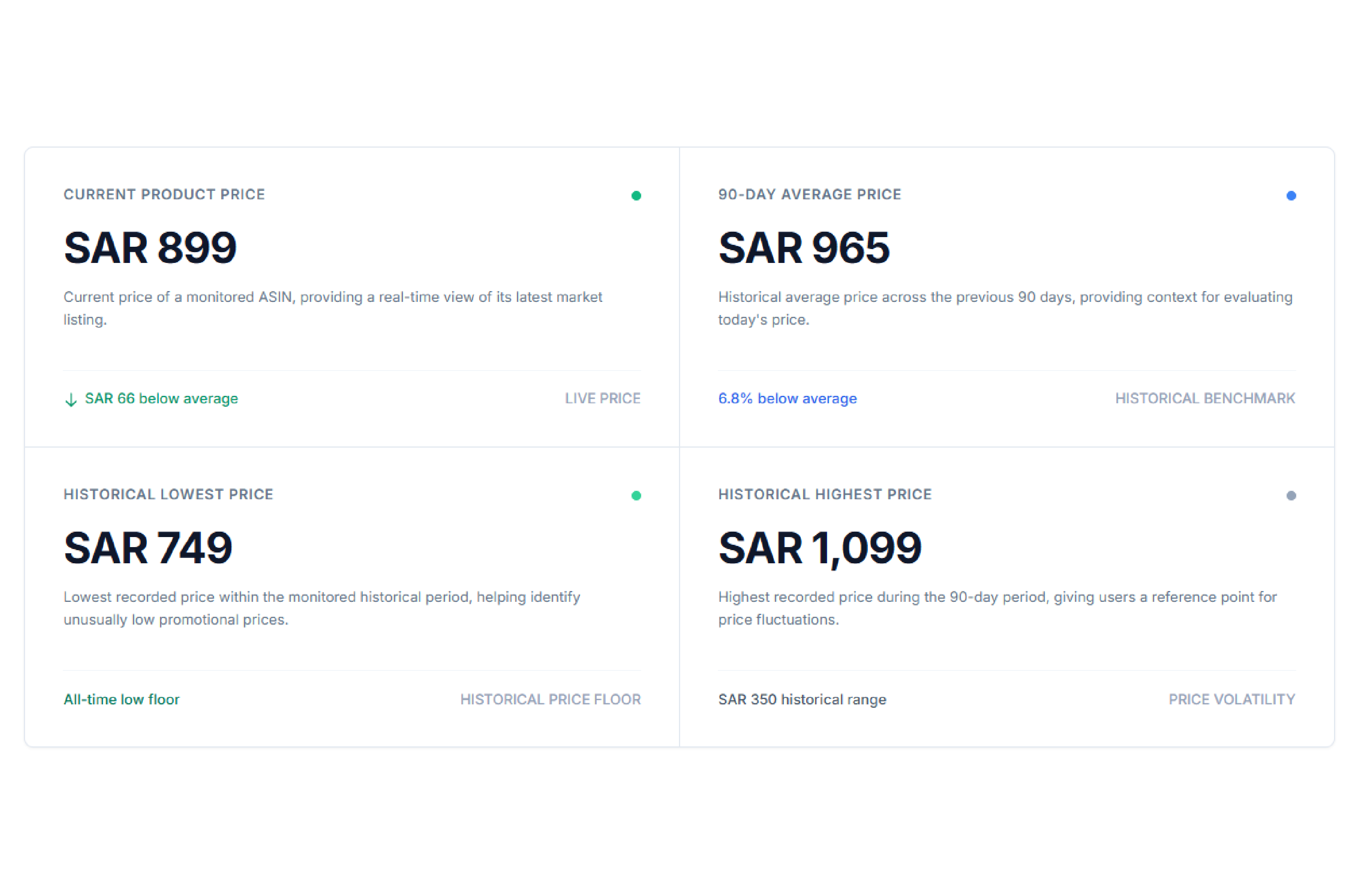
The application converted price changes into measurable events instead of treating them as isolated observations.
Each time a product price changed, the system could record:
This allowed the platform to identify meaningful price reductions and increases.
A product moving from SAR 1,199 to SAR 999 represented a reduction of SAR 200, or approximately 16.7%. When combined with historical information, the platform could determine whether the new price was close to the product's historical minimum.
This distinction was valuable because not every advertised discount represented a genuine pricing opportunity.
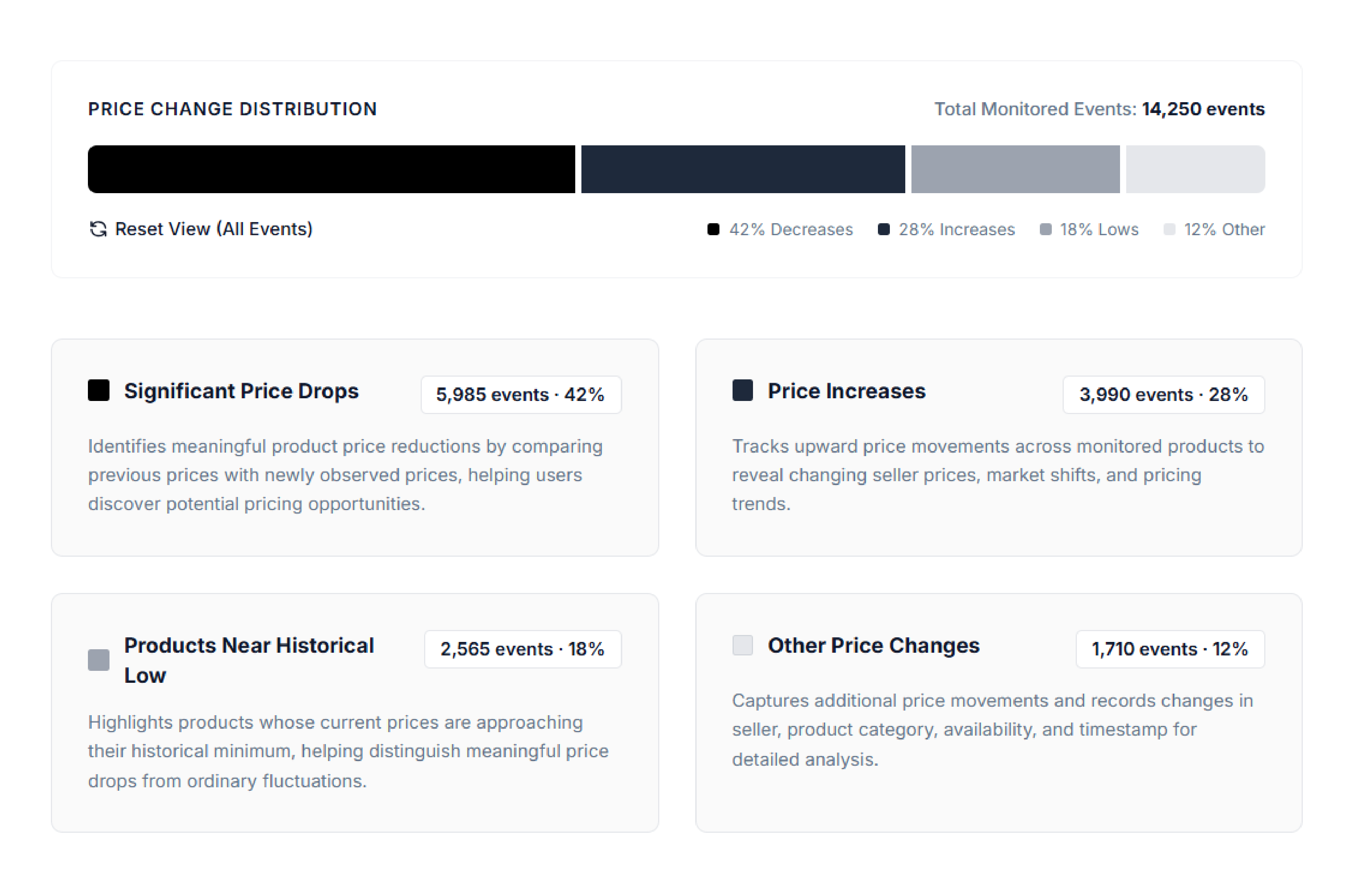
Historical data also enabled category-level analysis.
The client could calculate average price movement, price-change frequency, and discount depth across product categories.
| Category | ASINs Tracked | Avg. Price | Lowest Avg. Price | Avg. Discount | Price Changes | Volatility |
|---|---|---|---|---|---|---|
| Electronics | 18,420 | SAR 742 | SAR 598 | 11.8% | 42,180 | High |
| Home Appliances | 9,860 | SAR 615 | SAR 492 | 14.6% | 27,940 | Medium |
| Beauty | 12,740 | SAR 168 | SAR 139 | 17.2% | 31,620 | High |
| Fashion | 15,320 | SAR 214 | SAR 172 | 19.5% | 39,480 | High |
| Grocery | 8,410 | SAR 74 | SAR 66 | 8.7% | 18,240 | Medium |
| Sports | 6,930 | SAR 286 | SAR 238 | 13.4% | 16,850 | Medium |
| Automotive | 5,720 | SAR 338 | SAR 291 | 9.6% | 12,470 | Low |
| Home & Kitchen | 11,600 | SAR 193 | SAR 158 | 15.1% | 28,310 | Medium |
This dataset demonstrated that pricing behavior differed significantly between categories.
Fashion and beauty showed stronger promotional movement, while automotive products demonstrated comparatively lower volatility. Such intelligence helped the client prioritize monitoring resources according to category behavior.
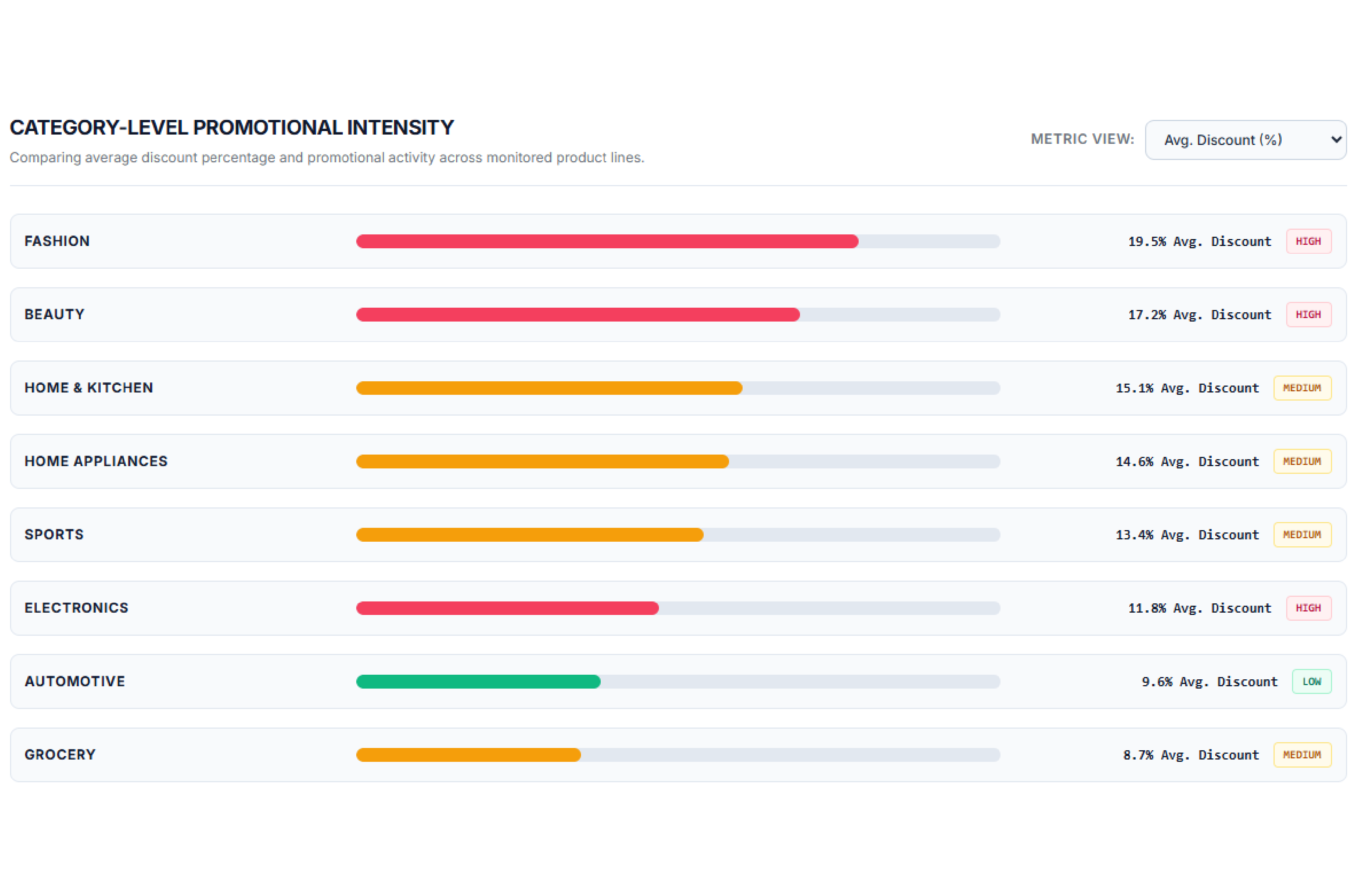
One of the most valuable capabilities was historical deal validation.
The application could evaluate a current product price against historical minimum, maximum, and average values.
For example:
| ASIN | Product Type | Current Price | 30-Day Avg. | 90-Day Avg. | Historical Low | Price Drop | Deal Signal |
|---|---|---|---|---|---|---|---|
| B0A1001X01 | Smartphone | SAR 1,899 | SAR 2,049 | SAR 2,125 | SAR 1,849 | -10.4% | Strong |
| B0A1002X02 | Headphones | SAR 329 | SAR 379 | SAR 395 | SAR 299 | -13.2% | Moderate |
| B0A1003X03 | Air Fryer | SAR 449 | SAR 512 | SAR 529 | SAR 399 | -12.3% | Strong |
| B0A1004X04 | Smartwatch | SAR 599 | SAR 624 | SAR 645 | SAR 549 | -7.0% | Moderate |
| B0A1005X05 | Vacuum Cleaner | SAR 799 | SAR 895 | SAR 918 | SAR 749 | -10.7% | Strong |
| B0A1006X06 | Beauty Device | SAR 249 | SAR 298 | SAR 315 | SAR 219 | -16.4% | Strong |
This functionality made deal identification more meaningful because the application considered historical context rather than simply highlighting products with a percentage discount.
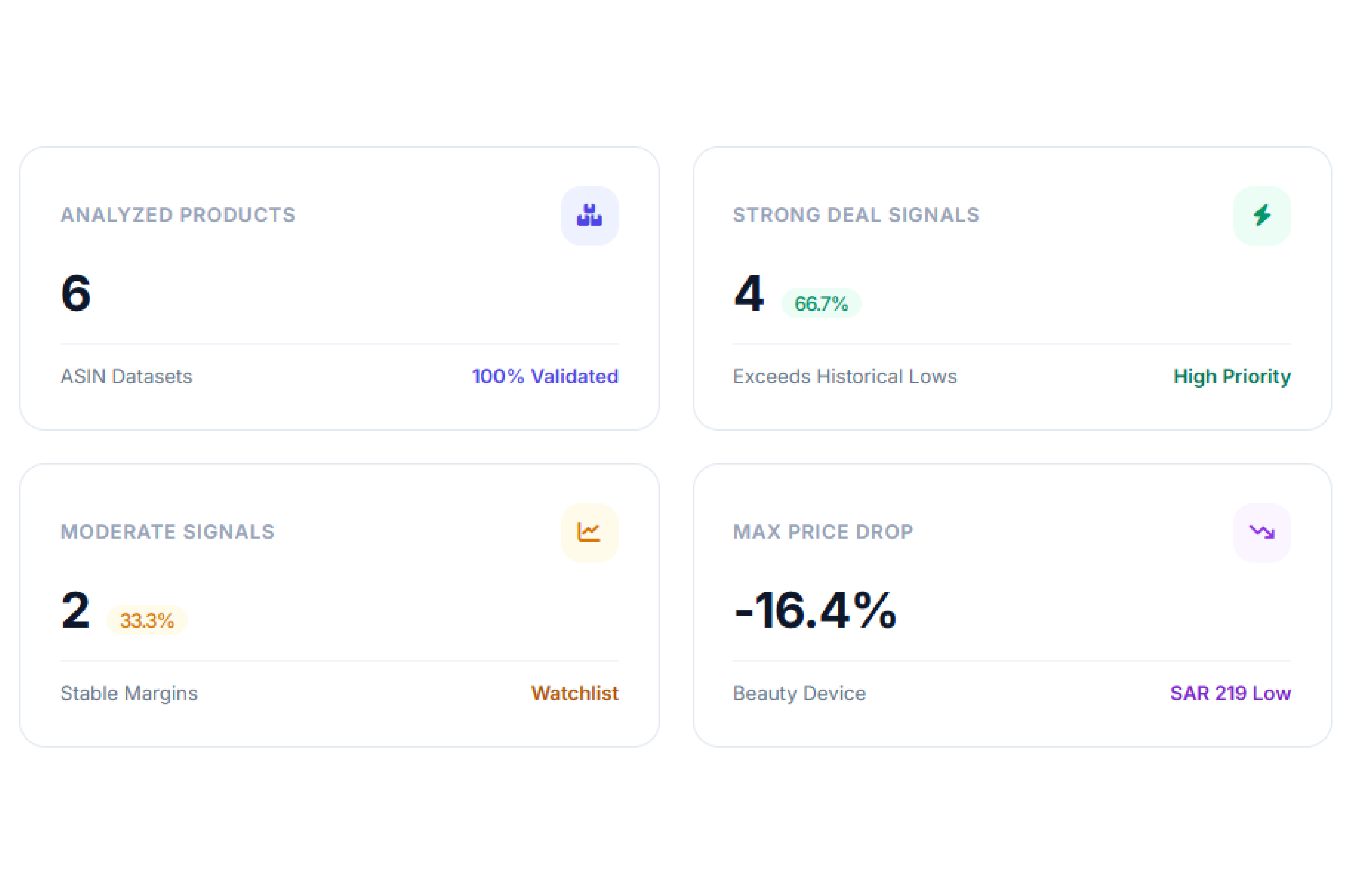
The platform introduced automated price-alert capabilities based on user-defined thresholds.
A customer could monitor an ASIN and specify a desired target price. When the historical tracking system detected that the product reached or moved below the threshold, an alert could be generated.
Businesses could apply similar logic at scale.
For example, a retailer could monitor competitor products and receive alerts when:
This shifted price intelligence from passive reporting toward proactive decision support.
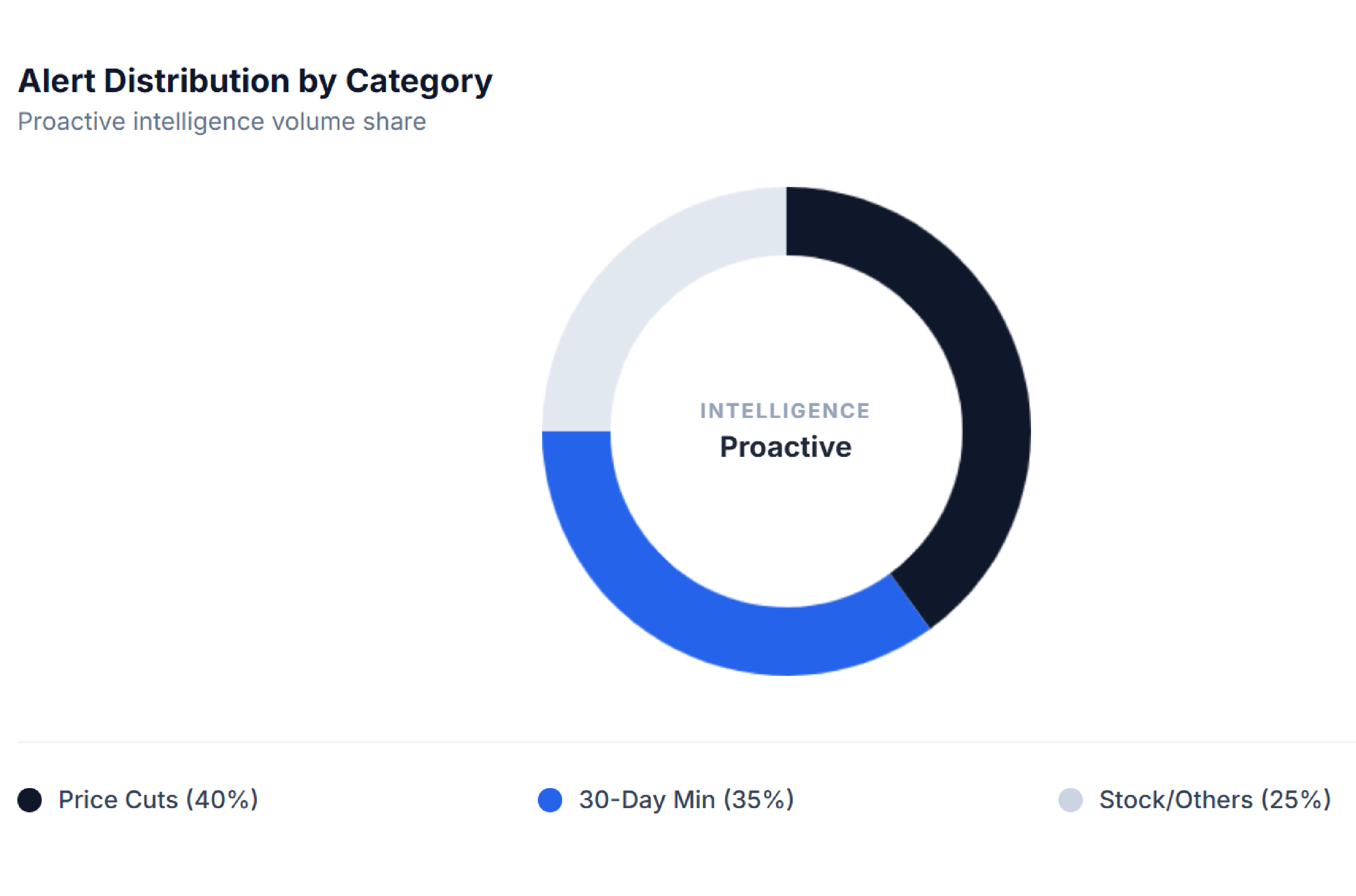
The final structured dataset was designed to support both application interfaces and downstream analytics.
| ASIN | Product Category | Current Price | Previous Price | 30-Day Avg. | Historical Low | Historical High | Change % | Availability | Rating |
|---|---|---|---|---|---|---|---|---|---|
| B0A2001A01 | Electronics | SAR 1,899 | SAR 2,049 | SAR 2,020 | SAR 1,849 | SAR 2,299 | -7.3% | In Stock | 4.6 |
| B0A2002A02 | Beauty | SAR 159 | SAR 179 | SAR 171 | SAR 149 | SAR 219 | -11.2% | In Stock | 4.4 |
| B0A2003A03 | Home | SAR 429 | SAR 479 | SAR 451 | SAR 399 | SAR 549 | -10.4% | In Stock | 4.5 |
| B0A2004A04 | Sports | SAR 289 | SAR 319 | SAR 306 | SAR 269 | SAR 379 | -9.4% | In Stock | 4.3 |
| B0A2005A05 | Grocery | SAR 68 | SAR 72 | SAR 70 | SAR 64 | SAR 79 | -5.6% | In Stock | 4.2 |
| B0A2006A06 | Appliances | SAR 679 | SAR 749 | SAR 715 | SAR 629 | SAR 849 | -9.3% | Limited | 4.5 |
| B0A2007A07 | Fashion | SAR 199 | SAR 249 | SAR 224 | SAR 179 | SAR 299 | -20.1% | In Stock | 4.1 |
| B0A2008A08 | Automotive | SAR 349 | SAR 369 | SAR 361 | SAR 329 | SAR 419 | -5.4% | In Stock | 4.4 |
This structure provided the application with enough historical context to calculate price trends, deal signals, product rankings, and alert conditions.
After implementation, the client achieved measurable improvements in marketplace monitoring, pricing visibility, and analytical responsiveness.
The combination of historical records and automated analysis gave the client a more complete understanding of marketplace pricing behavior.
The solution was designed around scalability, structured data quality, and continuous intelligence generation.
A major advantage was centralized historical storage. Rather than keeping isolated observations, the system maintained product-level timelines that could be queried and analyzed over time.
The architecture also supported automated validation. Duplicate records, malformed prices, inconsistent fields, and incomplete observations could be identified before entering analytical datasets.
Another benefit was flexible data structuring. The client could organize information by ASIN, category, seller, price range, date, discount percentage, or availability status depending on the business requirement.
The system also supported historical benchmarking. Current prices could be compared with previous observations, category averages, minimum prices, maximum prices, and other reference points.
Scalability was another important factor. As the client expanded its monitoring scope, the infrastructure could accommodate additional ASINs, categories, historical observations, and analytical requirements.
We are extremely satisfied with the historical pricing intelligence platform delivered by the team. The solution transformed the way we monitor marketplace prices by giving us structured ASIN-level histories instead of isolated current-price observations.
The ability to compare current prices with historical averages, minimums, and previous price points has significantly improved our understanding of product pricing behavior. Automated monitoring has reduced manual work while allowing our analysts to respond faster to meaningful pricing changes.
The application has also created a stronger foundation for competitive benchmarking, deal detection, and future predictive analytics. The accuracy, scalability, and flexibility of the data solution exceeded our expectations.
— Head of E-commerce Intelligence
The final outcome was a scalable historical marketplace intelligence platform that transformed ASIN-level product observations into searchable, structured, and actionable pricing histories.
The application enabled users to understand how product prices changed over time rather than relying solely on current marketplace information.
Integration of an Amazon Reviews Scraper capability further expanded the intelligence layer by allowing product reviews and customer feedback signals to complement historical pricing information. Combining pricing movement with ratings and review trends created opportunities for deeper product-level analysis.
The solution also generated reusable E-commerce Datasets that could support dashboards, pricing models, competitive benchmarking, forecasting systems, product research, and other downstream analytical applications.
Historical ASIN price tracking involves collecting product prices associated with individual Amazon Standard Identification Numbers over time. This creates a chronological record that helps users analyze price changes, discounts, averages, and historical lows.
Historical pricing data provides context that current prices cannot. It helps businesses and consumers determine whether a price is genuinely competitive, temporarily discounted, seasonally reduced, or close to an item's historical minimum.
Yes. A scalable architecture can monitor large numbers of ASINs while maintaining product identities, timestamps, historical observations, pricing attributes, and other relevant fields in structured databases.
A dataset can include ASIN, product title, category, seller, current price, previous price, historical minimum, historical maximum, average price, discount percentage, availability, rating, review count, and collection timestamp.
Retailers can use historical price intelligence for competitor benchmarking, promotional planning, assortment analysis, pricing decisions, price alerts, market research, and identifying changes in category-level pricing behavior.
Fields marked * are required. Everything else just helps us scope faster — skip what you don't know yet.