

Introduction
The rapid expansion of online marketplaces and instant delivery platforms has transformed how consumers discover, compare, and purchase products. From traditional e-commerce websites to 10-minute delivery applications, prices, discounts, product availability, and promotional offers change frequently. For brands, retailers, manufacturers, and market research teams, understanding these changes is essential for maintaining competitiveness and protecting profit margins. This makes e-commerce and quick commerce price tracking an important part of modern retail intelligence.
Unlike traditional retail, where prices may remain relatively stable for longer periods, digital commerce platforms frequently adjust prices based on demand, location, inventory, competition, and promotional strategies. Effective quick commerce price monitoring helps businesses identify these changes and understand how pricing decisions influence customer purchasing behaviour.
However, implementing a large-scale data monitoring system without testing its effectiveness can involve unnecessary costs and operational complexity. This is where a price tracking proof of concept (POC) becomes valuable. A POC allows businesses to test data collection methods, validate pricing accuracy, assess platform coverage, and evaluate whether the collected intelligence supports their business objectives before committing to a larger implementation.
1. Understanding Price Tracking Across E-commerce and Quick Commerce
Price tracking involves systematically collecting, organising, and analysing product pricing information from multiple online platforms. It helps businesses understand how their products are priced against competitors and how market conditions influence price movements.
E-commerce platforms typically provide broader product catalogues, multiple sellers, customer reviews, and marketplace-level promotions. Quick commerce platforms, on the other hand, focus on rapid delivery and location-specific product availability. Their pricing structures can vary considerably depending on delivery zones, nearby dark stores, inventory levels, and local demand.
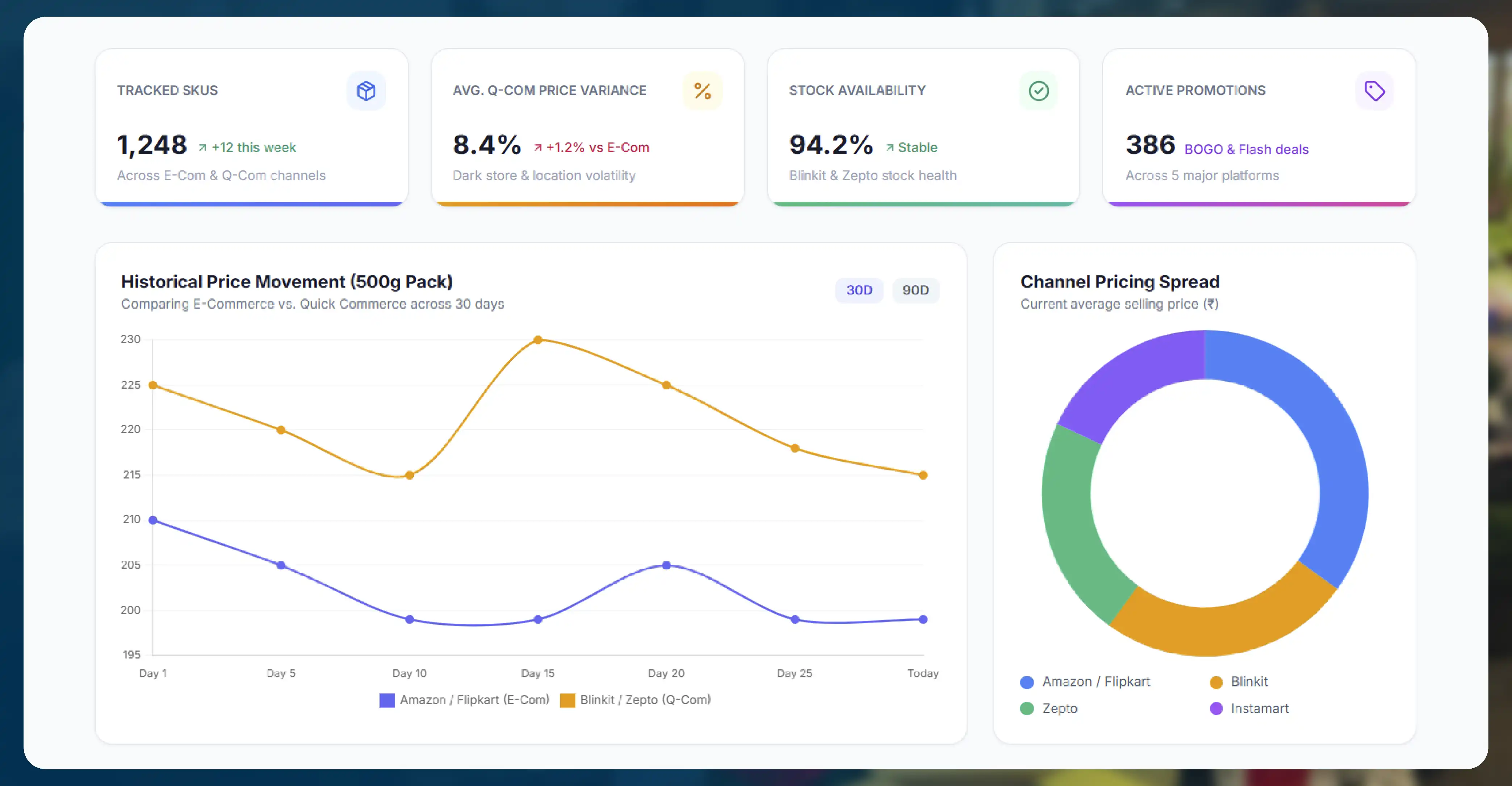
For example, a packaged food brand may sell a 500-gram product at different prices across Amazon, Flipkart, Blinkit, Zepto, and Instamart. Even when the product and pack size remain identical, discounts, delivery charges, and promotional offers can create different purchasing experiences.
A structured price tracking solution helps businesses monitor:
- Regular selling prices and maximum retail prices (MRP).
- Discount percentages and promotional offers.
- Product availability and stock status.
- Seller-level pricing differences.
- Pack sizes, variants, and product specifications.
- Location-specific price variations.
- Historical price movements and competitor changes.
Combining these datasets provides a comprehensive understanding of the digital retail pricing environment.
2. Why Businesses Should Start with a Proof of Concept?
A POC allows organisations to evaluate whether a proposed data collection and monitoring solution can deliver reliable, relevant, and actionable information.
Instead of immediately monitoring hundreds of products across multiple platforms, businesses can begin with a controlled sample. This makes it easier to identify technical limitations, evaluate data quality, and establish realistic expectations.
A well-designed POC offers several advantages.
- Reduced Implementation Risk: Businesses can identify potential challenges in collecting data from different platforms before investing in a full-scale monitoring infrastructure.
- Data Accuracy Validation: The pilot helps verify whether product names, prices, pack sizes, discounts, and availability information are captured correctly.
- Platform Feasibility: Organisations can assess which platforms provide the required information and how consistently the data can be collected.
- Cost Assessment: A limited exercise helps estimate the resources, infrastructure, and operational requirements for continuous monitoring.
- Business Relevance: Teams can determine whether the collected information answers important commercial questions, such as competitor pricing gaps and promotional effectiveness.
A successful POC creates a measurable foundation for expanding the monitoring programme.
3. Define Clear Objectives Before Starting the POC
The first step is identifying what the business wants to achieve through price tracking. Without defined objectives, a POC may collect large volumes of information without generating meaningful insights.
Different business teams may have different requirements.
- Brand Managers: Understand competitor pricing, discount strategies, and product positioning.
- E-commerce Managers: Monitor marketplace selling prices and seller-level variations.
- Revenue Teams: Evaluate price movements and their potential impact on margins.
- Category Managers: Identify promotional trends and category-level pricing differences.
- Market Research Teams: Study geographical pricing patterns and competitive intensity.
For instance, a packaged beverage manufacturer may want to understand whether competitors offer deeper discounts on quick commerce applications than on traditional marketplaces.
Another business may want to identify whether a product is consistently more expensive in metropolitan areas compared with smaller cities.
These objectives should translate into measurable POC outcomes, including the number of products tracked, platforms covered, locations monitored, collection frequency, and expected data accuracy.
4. Select the Right Platforms and Product Categories
Platform selection determines the usefulness of the pilot. Businesses should choose platforms based on their market presence, customer reach, product availability, and competitive relevance.
For an Indian retail monitoring project, the initial platform scope could include:
The POC does not need to cover every platform immediately. Selecting three to five relevant platforms can provide sufficient information for initial evaluation.
Product categories should also be carefully selected. FMCG, personal care, packaged foods, beverages, household essentials, and electronics are useful starting points because they contain comparable products across multiple platforms.
Businesses should prioritise products with clearly identifiable brands, pack sizes, product variants, and identifiers such as EAN or GTIN codes.
This makes product matching more reliable and reduces incorrect comparisons.
5. Establish the Product Matching Framework
One of the biggest challenges in multi-platform price tracking is identifying identical products across different websites and applications.
The same product may appear with slightly different titles, descriptions, abbreviations, or packaging information.
For example, a 1-litre cooking oil product might be listed as:
- Brand X Refined Oil 1 Litre.
- Brand X Cooking Oil 1000 ml.
- Brand X Refined Sunflower Oil 1L Pack.
Although the titles differ, these listings may represent the same product.
A reliable product matching framework should consider:
- Brand name and manufacturer.
- Product title and description.
- Pack size and unit of measurement.
- Product variant and flavour.
- EAN, GTIN, or other product identifiers.
- Packaging and product images.
Businesses should distinguish exact product matches from similar products. A 500-gram pack should not be directly compared with a 1-kilogram pack without normalising the price per unit.
This ensures that pricing comparisons remain commercially meaningful.
6. Include Location-Level Pricing in the Pilot
Quick commerce pricing is often influenced by geographical factors. Two customers accessing the same platform from different delivery locations may encounter different prices, discounts, and product availability.
Therefore, location selection should be an important part of the POC.
Businesses can select representative pincodes from metropolitan cities and compare pricing across delivery zones. For example, a pilot could include selected locations in Delhi NCR, Mumbai, Bengaluru, Hyderabad, and Pune.
Collecting pincode-level price data helps businesses understand how product prices vary across neighbourhoods and delivery locations.
The monitoring framework should capture:
- Pincode or delivery location.
- Product selling price.
- MRP and displayed discount.
- Availability status.
- Delivery-related charges, where relevant.
- Promotional pricing and offer conditions.
- Collection date and timestamp.
A structured geographical dataset helps businesses distinguish between nationwide pricing strategies and local market variations.
It also allows category managers to identify locations where competitors are offering more attractive prices or stronger discounts.
7. Design the Data Collection and Monitoring Process
Once the platforms, products, and locations are finalised, the next step is establishing the data collection process.
Automated data extraction can collect product information from relevant digital platforms at predefined intervals. Depending on the business requirement, the POC may use scheduled collection, API-based integration, or a combination of available methods.
A typical data collection workflow includes:
Step 1: Source Identification
Identify relevant websites, applications, product pages, and delivery locations.
Step 2: Data Extraction
Collect product titles, prices, MRP, discounts, pack sizes, seller details, and availability information.
Step 3: Data Cleaning
Remove duplicate records, standardise product names, normalise units, and correct formatting inconsistencies.
Step 4: Product Matching
Map identical products across platforms using product identifiers and matching attributes.
Step 5: Data Validation
Compare collected records against visible platform information and identify missing or inconsistent values.
Step 6: Structured Delivery
Organise the final dataset into CSV, Excel, JSON, database tables, or API-ready formats.
For a POC, businesses should begin with a manageable collection schedule, such as once or twice daily. More frequent collection can be introduced when the business needs to understand intraday price changes.
The collection process should also respect applicable platform terms, access restrictions, and privacy requirements.
8. Compare Competitor Prices Across Platforms
Once the dataset is collected and validated, businesses can begin evaluating competitive pricing differences.
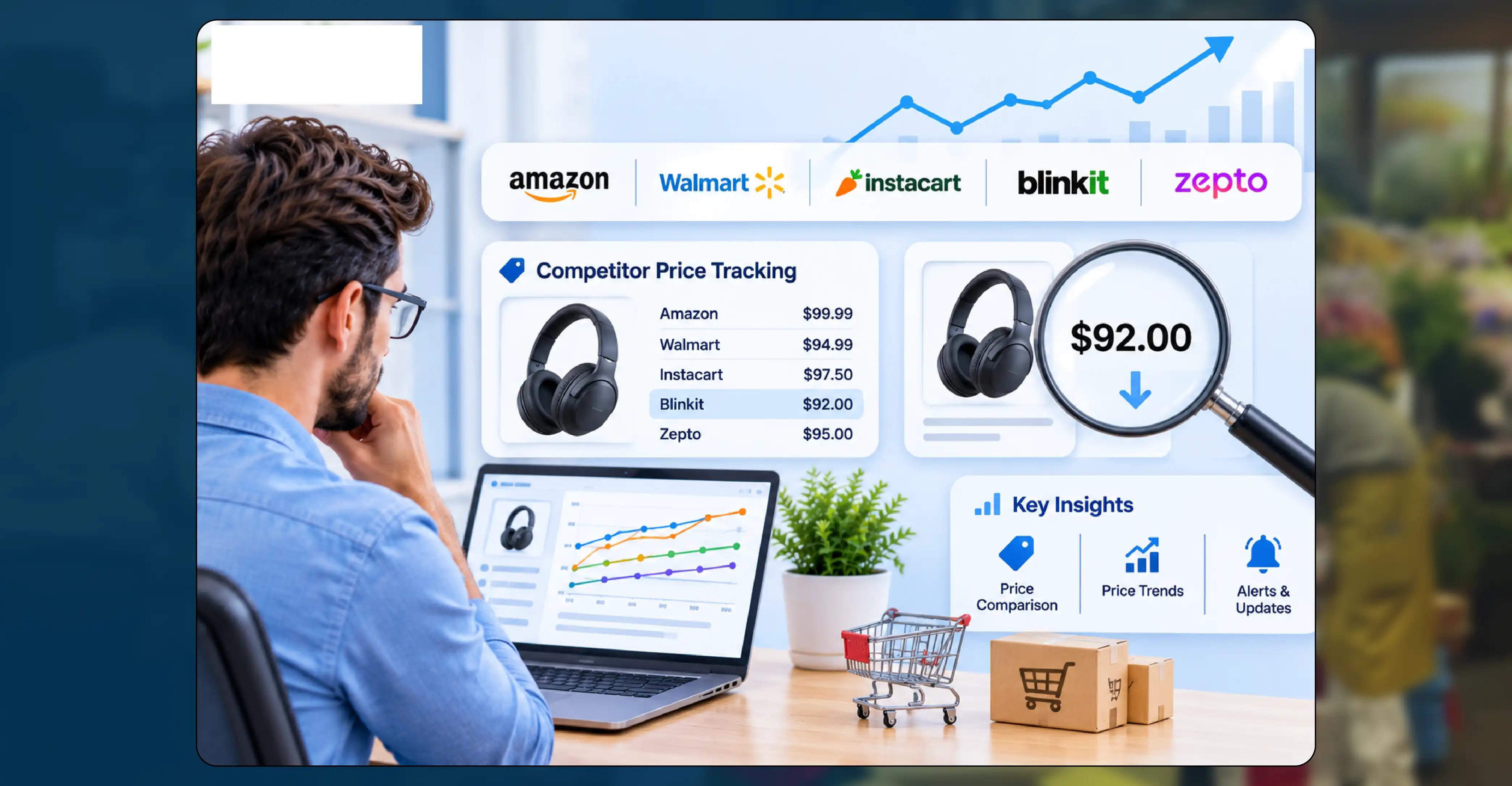
For example, a retailer may compare the same product across Blinkit, Zepto, and Amazon to understand differences in selling prices, discounts, and availability.
A structured Blinkit Zepto Amazon price comparison can reveal which platform offers the lowest effective price, where promotional activity is strongest, and how pricing varies between marketplace and quick commerce models.
Consider this illustrative dataset:
This comparison helps identify pricing gaps, competitive positioning, and promotional opportunities.
Businesses should also compare effective prices after applicable coupons and offers rather than relying exclusively on displayed selling prices.
9. Build a Dashboard for Actionable Pricing Insights
A POC should demonstrate how raw pricing information can be converted into business intelligence.
A central dashboard allows stakeholders to examine pricing trends without manually reviewing individual platform listings.
Important dashboard components include:
- Average Selling Price: Understand average product prices across platforms and locations.
- Lowest Competitor Price: Identify the most competitively priced products.
- Discount Depth: Compare promotional intensity between platforms.
- Price Difference: Measure the gap between a company's pricing and competitor prices.
- Availability Tracking: Identify products that are unavailable in selected locations.
- Price Movement: Monitor changes between consecutive collection periods.
- Location Comparison: Analyse pricing differences across cities and pincodes.
For example, a brand may discover that its competitor consistently offers a 12% discount in selected delivery zones while maintaining regular prices elsewhere.
This information can help pricing teams evaluate promotional strategies and identify opportunities for more targeted campaigns.
10. Measure POC Performance Using Defined KPIs
A POC should conclude with a performance assessment. Simply collecting data is not enough; businesses must determine whether the solution meets their operational and analytical expectations.
Recommended evaluation metrics include:
Businesses should establish target thresholds before beginning the pilot.
For example, they may aim for a 95% product matching rate and 98% accuracy across validated price records. These are illustrative targets and should be adjusted according to the project scope.
A final POC report should document achievements, technical limitations, data quality observations, and recommendations for full-scale deployment.
11. Scale the POC into an Omnichannel Pricing Intelligence System
After validating the pilot, businesses can gradually expand their monitoring infrastructure.
A successful omnichannel price monitoring India programme can connect marketplace pricing, quick commerce listings, grocery platforms, and other digital retail sources into a unified intelligence framework.
The expansion can include:
- Increasing the number of tracked SKUs.
- Adding more e-commerce and quick commerce platforms.
- Expanding coverage across cities and pincodes.
- Increasing data collection frequency.
- Introducing historical price comparisons.
- Monitoring promotional campaigns and seller behaviour.
- Integrating dashboards with internal business systems.
Organisations can also introduce automated alerts for significant price changes, sudden discount increases, product unavailability, and competitor pricing violations.
For businesses seeking an end-to-end implementation, quick commerce data scraping services can support structured data extraction, product matching, location-level monitoring, and recurring dataset delivery.
The objective is to move beyond isolated price comparisons and establish a consistent pricing intelligence system that supports everyday commercial decisions.
How iWeb Data Scraping Can Help You?
1. Multi-Platform Coverage
iWeb Data Scraping helps collect product prices, discounts, availability, and seller information across selected e-commerce marketplaces and quick commerce platforms.
2. Location-Based Intelligence
Capture product pricing across selected cities and pincodes to identify geographical variations, competitive gaps, and location-specific promotional opportunities.
3. Accurate Product Matching
Organise product listings using brand names, identifiers, descriptions, and pack sizes to create consistent and meaningful competitor pricing comparisons.
4. Customised Data Delivery
Receive structured datasets in Excel, CSV, JSON, or API formats, making pricing information easier to analyse, integrate, and share.
5. Scalable Monitoring Solutions
Begin with a focused pilot and expand into recurring data collection, historical comparisons, automated alerts, and comprehensive pricing intelligence dashboards.
Conclusion
Price tracking across e-commerce and quick commerce platforms gives businesses the visibility needed to understand competitive pricing, promotional activity, and geographical differences. Starting with a structured POC helps organisations validate their requirements, test data quality, and establish a scalable monitoring framework before making larger investments.
By combining ecommerce data scraping with reliable product matching, location-level collection, and automated reporting, businesses can transform fragmented online listings into actionable market intelligence. A structured quick commerce price index can further help brands compare product prices, analyse discount movements, and understand competitive positioning across platforms.
Understanding how our pilot works begins with selecting relevant platforms, products, locations, and data fields. iWeb Data Scraping helps businesses evaluate their requirements through a focused POC and build a practical foundation for long-term pricing intelligence. The result is a more transparent, data-driven approach to monitoring digital retail markets and making informed pricing decisions.
FAQs
A price tracking POC is a small-scale pilot designed to test automated price collection across selected e-commerce and quick commerce platforms. It validates data accuracy, product matching, platform coverage, and reporting capabilities before full-scale implementation.
A POC can include platforms such as Amazon, Flipkart, Blinkit, Zepto, Swiggy Instamart, and BigBasket, depending on product availability, business requirements, and the selected geographical coverage.
Quick commerce prices and availability may differ across delivery locations because of inventory levels, local demand, promotions, and fulfilment operations. Pincode-based monitoring helps businesses identify these variations and understand local competitive positioning.
The timeline depends on the number of platforms, products, locations, data fields, and validation requirements. A focused pilot can generally be planned over a few weeks, subject to source accessibility and technical complexity.
Yes. Once the POC validates data quality and collection feasibility, businesses can expand product coverage, add platforms and locations, increase monitoring frequency, and integrate automated dashboards and price alerts.