
42.6K+
PRODUCT RECORDS PROCESSED

Product-level Data Collection from Chalenow App for Advanced Grocery Pricing, Assortment, SKU, Competitive, and Demand Intelligence.
This case study is designed for businesses, retailers, grocery brands, marketplace operators, and analytics teams that need structured product intelligence from fast-moving on-demand commerce platforms. The project demonstrates how Product-level Data Collection from Chalenow App can transform fragmented catalog information into structured datasets for pricing, assortment, competitive intelligence, and demand analysis.
It is particularly relevant for:
Businesses can also use Chalenow product data extraction to monitor changing product catalogs, identify assortment gaps, compare product-level pricing, and understand how digital grocery offerings evolve over time.
The client's primary requirement was to establish a scalable product intelligence pipeline capable of collecting granular catalog information from the Chalenow App and converting it into reliable, analysis-ready records.
The client wanted to understand product-level assortment, pricing, availability, and category structures across a rapidly changing on-demand commerce environment. Manual catalog monitoring was unable to keep pace with frequent product additions, removals, price changes, and assortment updates.
To address this challenge, the team implemented an automated solution to Scrape Chalenow app product catalog and SKU data, capturing structured product information across multiple categories and subcategories.
The extracted records included product titles, SKU identifiers, images, categories, pricing information, promotional values, availability indicators, pack sizes, and other relevant catalog attributes. Data was standardized and validated before being delivered into structured datasets for downstream analytics.
The solution also supported on-demand delivery analytics from Chalenow App, enabling the client to analyze assortment depth, product visibility, pricing movements, and category-level changes through continuously refreshed datasets.
By transforming raw product information into structured records, the client gained a stronger foundation for competitive benchmarking, assortment planning, pricing analysis, and demand intelligence.
The client operated in a highly dynamic digital grocery environment where product catalogs could change frequently. New SKUs appeared, existing products changed prices, promotional offers were updated, and product availability varied across locations and time periods.
One of the major challenges was maintaining consistent visibility into product-level pricing and assortment. Without automated monitoring, identifying these changes required extensive manual effort and produced incomplete historical records.
The client required Chalenow pricing and assortment Data Scraping to systematically capture product-level information and compare pricing and assortment changes across categories.
Another challenge involved collecting comprehensive catalog attributes. Product information was distributed across different catalog structures, making standardized extraction difficult.
The project therefore needed to Extract product titles, images, and categories from Chalenow while preserving relationships between products, SKUs, categories, and other catalog attributes.
The client also needed historical and continuously refreshed records rather than isolated snapshots. This would allow analysts to identify product additions, removals, price movements, and assortment changes over time.
To support these requirements, the business needed a scalable method to Collect product-level data from Chalenow for analytics, enabling structured datasets to flow directly into reporting and intelligence workflows.
Additional challenges included:
By implementing an automated product data collection pipeline, the client replaced fragmented catalog monitoring with a scalable system capable of continuously processing product-level information and generating standardized datasets.
| Dimension | Manual Chalenow Tracking | Client Data Collection System |
|---|---|---|
| Data collection | Manual product and category checking | Automated catalog-level data extraction |
| SKU coverage | Limited and inconsistent | Broad SKU-level coverage |
| Price monitoring | Periodic manual checks | Automated recurring price capture |
| Assortment tracking | Difficult to maintain historically | Structured product and assortment records |
| Product attributes | Manually recorded | Standardized product fields |
| Image collection | Selective downloads | Automated image URL collection |
| Category mapping | Manual classification | Structured category and subcategory mapping |
| Historical intelligence | Limited snapshots | Time-series product records |
| Scalability | Restricted by analyst capacity | Designed for large catalog volumes |
| Reporting | Spreadsheet-based analysis | Structured datasets for dashboards and BI |
The brand in focus is an on-demand commerce intelligence organization seeking deeper visibility into digital grocery catalogs and SKU-level market movements. Its analytical operations depend on accurate product information to understand pricing, assortment depth, product availability, and category behavior.
As the monitored catalog expanded, manually maintaining product records became increasingly inefficient. Analysts needed a reliable way to identify product changes without repeatedly checking individual catalog entries.
The organization therefore shifted toward an automated data intelligence framework capable of continuously transforming product information into standardized, analysis-ready records.
This approach allowed the client to move beyond simple catalog observation and develop a broader understanding of digital assortment behavior, pricing patterns, product availability, and category-level competition.
We developed an end-to-end product intelligence workflow using Grocery data scraping techniques to collect, normalize, validate, and structure product information from the Chalenow App.
The extraction workflow captured relevant product attributes such as product names, SKU information, category and subcategory, pricing, promotional values, product images, pack sizes, availability, and other catalog-level information required for analysis.
The collected information was converted into standardized Grocery datasets so analysts could compare products consistently across categories, brands, and product groups.
The pipeline applied automated validation and normalization to reduce duplicate records, inconsistent naming, missing values, and formatting differences. Product records were organized using standardized fields, making them suitable for Excel, CSV, JSON, databases, dashboards, and business intelligence systems.
We also implemented Managed web scraping practices to support recurring collection, monitoring, validation, and dataset maintenance. This ensured that the client could receive refreshed product information without depending on repetitive manual catalog checks.
The overall workflow included:
The automated pipeline provided the client with significantly broader visibility into the Chalenow product catalog. Instead of reviewing individual product pages manually, analysts could work with structured records containing product attributes, categories, SKUs, prices, and availability information.
This improved the organization's ability to understand assortment depth across different product groups and identify categories containing large or rapidly changing numbers of SKUs.
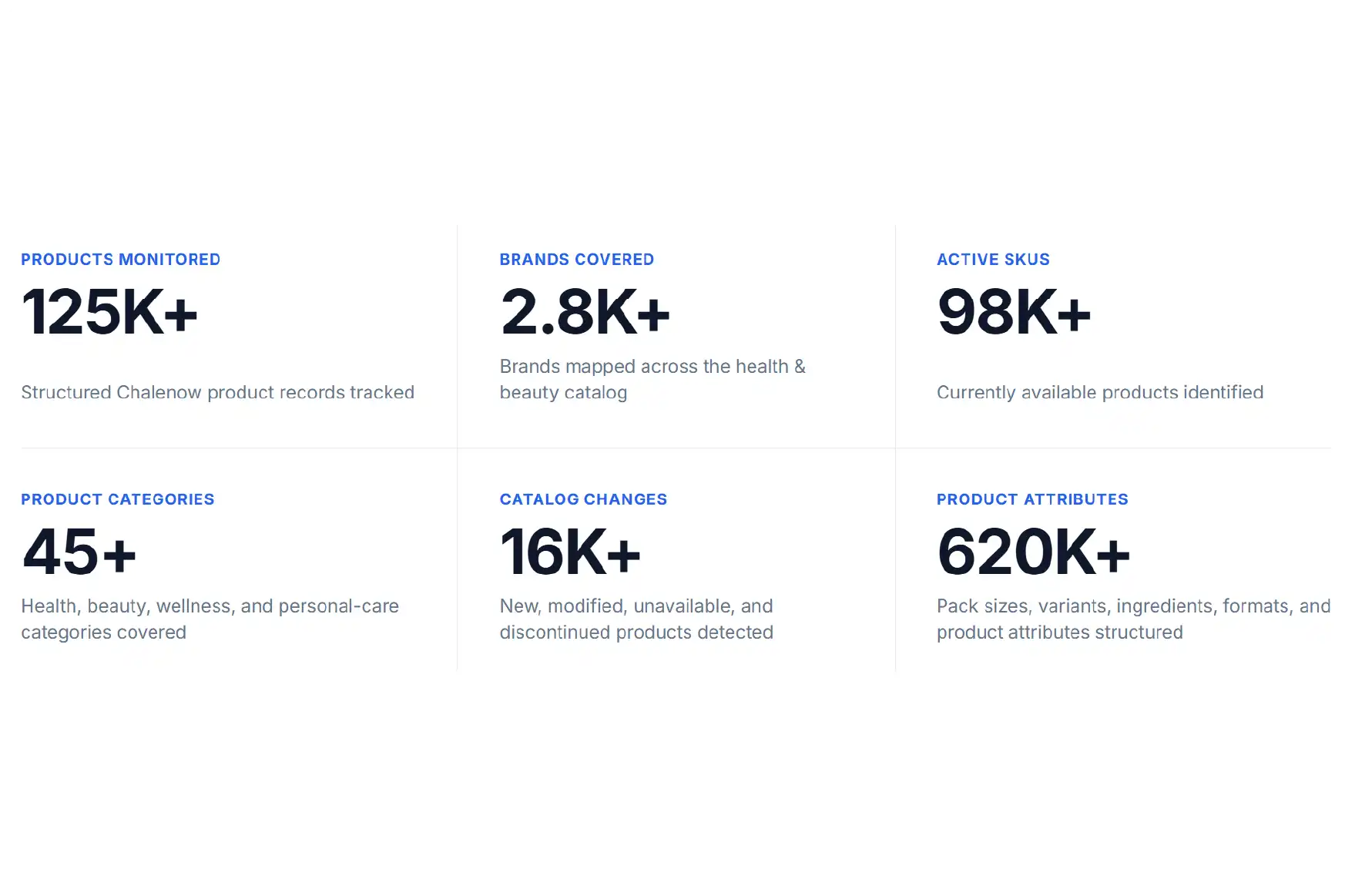
The structured dataset enabled analysts to compare product prices at the SKU level rather than relying only on category-level averages.
By maintaining standardized product identifiers and pricing fields, the client could detect price changes, compare pack-size variations, identify promotional movements, and evaluate category-level pricing behavior.
This created a stronger foundation for competitive pricing analysis and assortment optimization.
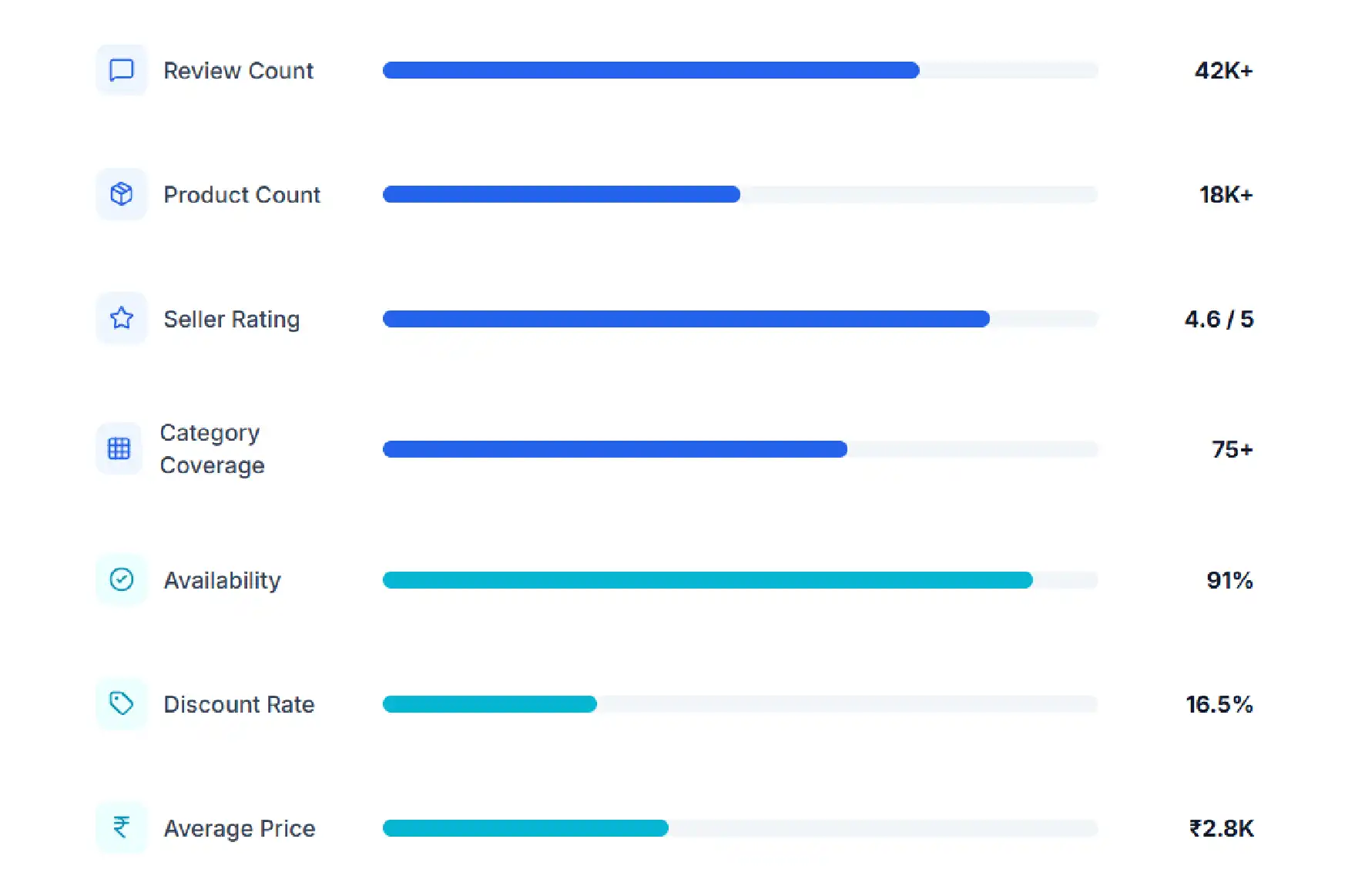
Product records were normalized into consistent categories and subcategories, making it easier to analyze assortment distribution.
The structured classification helped identify heavily represented categories, underserved product groups, changing assortment patterns, and opportunities for category expansion.
| Metric | Insight Captured | Business Impact |
|---|---|---|
| Product Count | Number of active product records | Measures assortment depth |
| SKU Coverage | Unique SKU-level records | Enables detailed product analysis |
| Category Depth | Products across categories and subcategories | Identifies assortment opportunities |
| Price Movement | Product-level price changes | Supports pricing decisions |
| Availability | Available and unavailable products | Helps identify supply gaps |
| Product Visibility | Product presence across catalog segments | Supports digital assortment analysis |
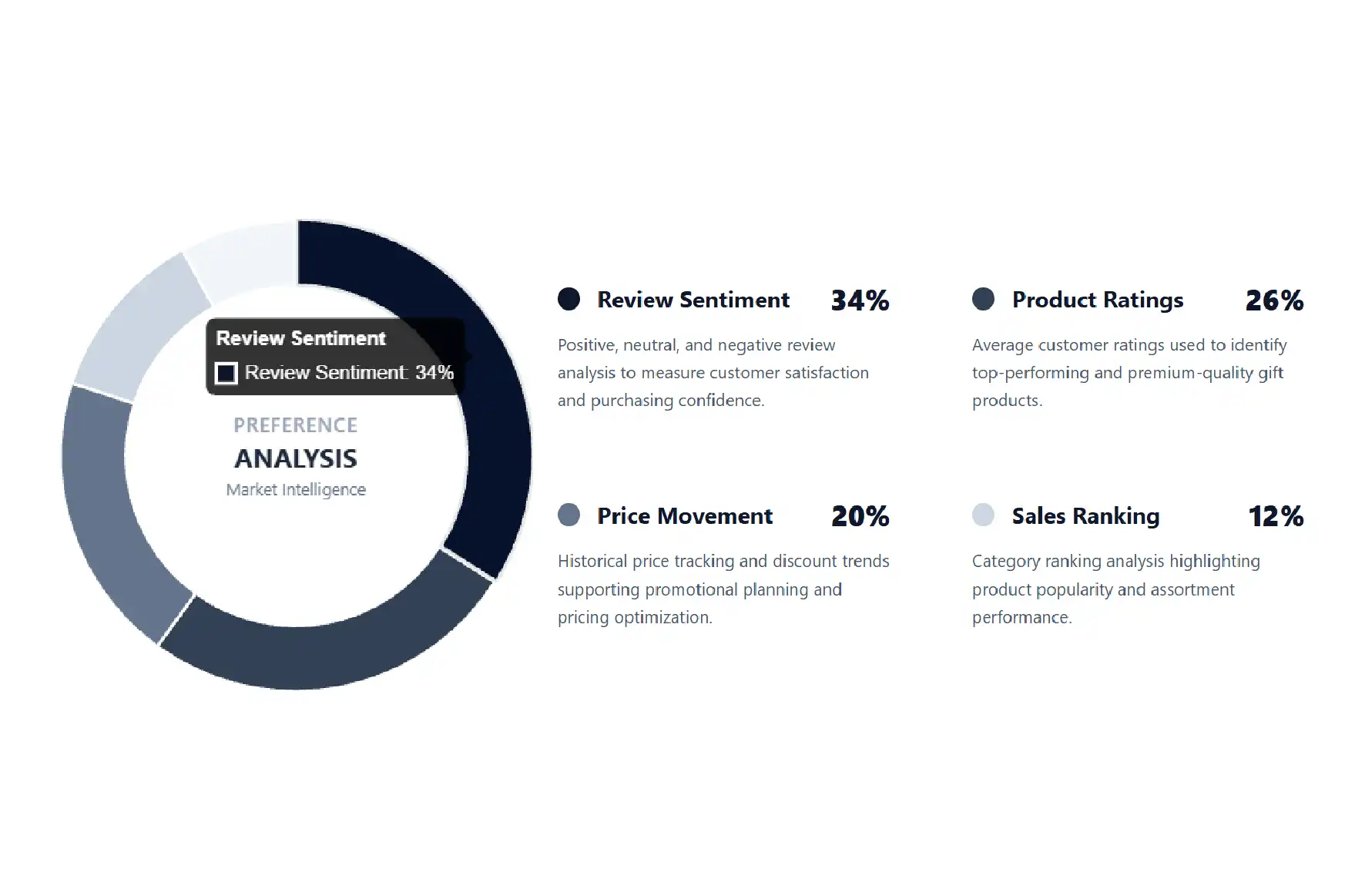
The data pipeline created a historical layer that allowed the client to compare product records over multiple collection cycles.
This made it possible to identify newly introduced SKUs, discontinued products, changed prices, updated product attributes, and assortment fluctuations.
Historical product intelligence also enabled analysts to distinguish temporary changes from sustained market movements, improving the reliability of category and demand analysis.
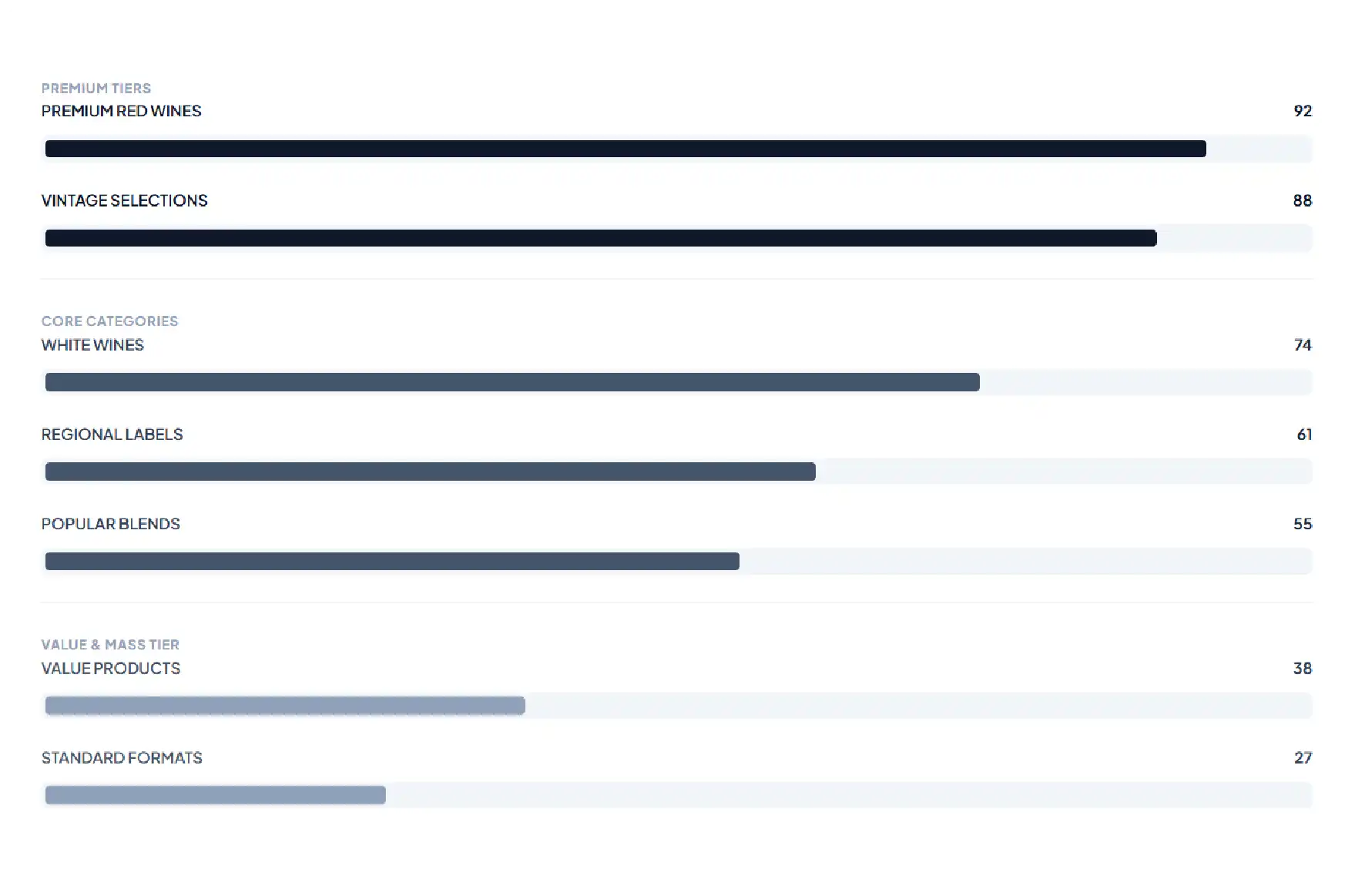
The following sample dataset demonstrates how product-level Chalenow information can be structured for analytical use.
| Product Title | SKU | Category | Price | Availability | Rating | Image |
|---|---|---|---|---|---|---|
| Premium Basmati Rice 5kg | CHN-RC-501 | Rice & Grains | ₹699 | Available | 4.5 | Image URL |
| Full Cream Milk 1L | CHN-ML-102 | Dairy | ₹68 | Available | 4.3 | Image URL |
| Organic Wheat Flour 5kg | CHN-FL-208 | Flour & Staples | ₹385 | Available | 4.4 | Image URL |
| Fresh Bananas 1kg | CHN-FR-315 | Fruits | ₹72 | Available | 4.2 | Image URL |
| Chocolate Cookies 300g | CHN-SN-426 | Snacks & Biscuits | ₹145 | Limited | 4.1 | Image URL |
After implementing the structured Chalenow product data pipeline, the client achieved stronger catalog visibility and improved the speed at which product-level intelligence could be generated.
Our approach combines automated extraction, data validation, normalization, and recurring monitoring to create reliable product intelligence from dynamic digital commerce environments.
The solution helps businesses consolidate fragmented product information into standardized datasets that can be analyzed across SKUs, categories, prices, brands, and availability indicators.
It also supports flexible data delivery through structured formats and database-ready outputs, allowing organizations to integrate product intelligence into existing BI systems, dashboards, analytics platforms, and reporting workflows.
By automating repetitive collection processes, businesses can reduce manual catalog monitoring while improving data consistency and analytical speed.
The scalable architecture also makes it possible to increase product coverage as catalog volumes grow, supporting organizations that require ongoing digital commerce intelligence rather than one-time data collection.
"We were impressed by the accuracy and structure of the product dataset delivered by the team. The solution gave our analysts much better visibility into SKU-level pricing, assortment, categories, and availability. Previously, maintaining this information required considerable manual effort. The automated pipeline has made product monitoring faster, more consistent, and significantly easier to analyze. The structured datasets have become an important input for our pricing, assortment, and market intelligence workflows."
— Director of Retail Analytics
The final outcome was a scalable product intelligence system capable of converting Chalenow catalog information into structured, analysis-ready datasets. The client gained improved visibility into product titles, SKUs, categories, pricing, availability, images, and assortment movements.
The solution supported Market trend and demand intelligence by providing historical and recurring product-level records that could be analyzed to understand changing category behavior, product demand signals, assortment expansion, and pricing movements.
The automated workflow also reduced dependence on manual product monitoring and improved the consistency of data used across analytical processes.
By implementing Real-time web scraping, the organization established a stronger foundation for continuously refreshed product intelligence and faster detection of catalog-level changes.
Overall, the project enabled the client to transform fragmented product information into a reliable intelligence asset. The resulting datasets supported pricing analysis, assortment planning, SKU monitoring, competitive benchmarking, demand forecasting, and broader digital commerce decision-making.
The solution also created a scalable framework that can accommodate growing catalog volumes and additional analytical requirements, positioning the organization for more proactive and data-driven commerce intelligence.
Product-level datasets can include product titles, SKUs, categories, subcategories, prices, promotional values, availability, pack sizes, images, ratings, and other relevant catalog attributes depending on the available data.
Structured Chalenow product data can help businesses analyze pricing movements, assortment depth, category performance, product availability, SKU changes, and competitive positioning.
Yes. Automated collection workflows can be configured for recurring extraction, allowing businesses to maintain refreshed product datasets and monitor catalog changes over time.
Yes. Structured datasets can be delivered in formats such as CSV, Excel, JSON, or database-ready structures, making them suitable for dashboards, analytics platforms, and internal reporting systems.
Yes. The architecture can be designed to process growing product volumes while applying validation, normalization, deduplication, and structured data management to maintain dataset quality.
Fields marked * are required. Everything else just helps us scope faster — skip what you don't know yet.