

Introduction
India's quick commerce industry is moving beyond metropolitan markets as consumers in smaller cities increasingly embrace app-based grocery shopping, instant delivery, and convenient access to everyday essentials. Rising smartphone penetration, digital payment adoption, changing lifestyles, and growing demand for convenience are creating new opportunities for platforms such as Blinkit, Zepto, and Swiggy Instamart.
The growth of quick commerce tier 2 India Data Scraping is helping businesses understand how these platforms are entering emerging markets, adjusting product assortments, and competing through pricing and delivery availability. The quick commerce tier 2 India market is becoming an important growth opportunity as companies explore cities with expanding middle-income populations and developing retail infrastructure.
Unlike metropolitan markets, where quick commerce competition is already intense, quick commerce tier 2 cities offer opportunities to establish early customer relationships, build localized delivery networks, and capture demand before markets become saturated. However, successful expansion requires more than opening dark stores. Companies must understand local purchasing behaviour, product preferences, operating costs, delivery distances, and competitive pricing.
This shift is creating a new phase of q-commerce expansion India, where geographical reach, neighbourhood-level demand, and sustainable store economics will determine which platforms gain a competitive advantage.
1. Why Tier 2 Cities Are Becoming Quick Commerce Growth Engines?
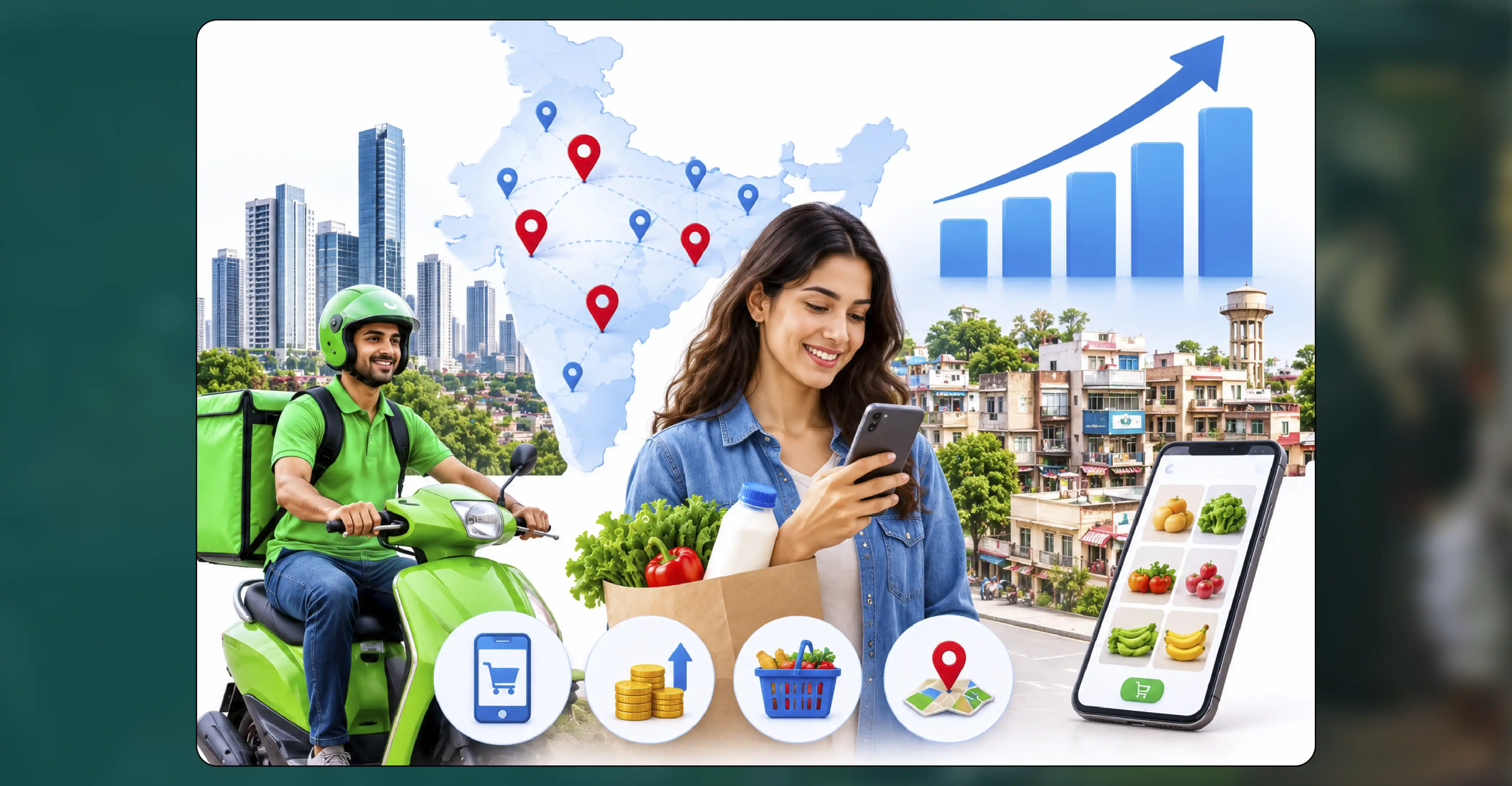
For years, quick commerce companies concentrated on metropolitan markets such as Delhi, Mumbai, Bengaluru, Hyderabad, and Pune. These cities offered higher population density, established digital shopping habits, and sufficient order volumes to support rapid deliveries.
However, competition in established markets has increased significantly. Platforms are now exploring smaller cities to identify additional growth opportunities.
Several factors are driving this transition:
- Rising digital adoption: Consumers increasingly use smartphones, UPI payments, and shopping applications for everyday purchases. This makes app-based grocery delivery more accessible across smaller urban markets.
- Growing disposable incomes: Expanding employment opportunities, business activity, and household purchasing power are supporting demand for branded groceries, packaged foods, personal care products, and household essentials.
- Changing consumer expectations: Customers increasingly value convenience, transparent pricing, product variety, and doorstep delivery instead of travelling to multiple neighbourhood stores.
- Untapped geographical opportunities: Several Tier 2 markets have fewer established quick commerce fulfilment networks, allowing companies to build customer awareness and secure early market positions.
According to a CLSA report published in August 2026, quick commerce operations had expanded to 477 Indian cities. The report highlighted that companies were adopting measured expansion strategies in newer markets, testing demand and store economics before increasing their investments.
This indicates that smaller cities are becoming an important part of the industry's next growth phase.
2. Where Blinkit, Zepto and Instamart Are Expanding?
The three major platforms are approaching smaller-city expansion differently. Their strategies reflect differences in fulfilment infrastructure, investment priorities, assortment planning, and existing customer networks.
Blinkit: Building a Wider Geographical Presence
Blinkit is pursuing an aggressive geographical expansion strategy, strengthening its position beyond major metropolitan markets.
According to an August 2026 CLSA analysis reported by Business Standard, Blinkit operated in more than 180 cities and accounted for over 34% of the nationally tracked dark-store network. It also led dark-store counts in six of the ten largest quick commerce markets.
Its expansion opportunities include emerging commercial centres, state capitals, and developing residential clusters.
Cities such as Patna, Ranchi, Kanpur, Jamshedpur, Siliguri, and Bhubaneswar represent interesting markets for tracking its competitive footprint and serviceability.
The company's advantage lies in establishing sufficient neighbourhood-level store density to improve delivery coverage and product availability.
For market researchers, Blinkit tier 2 cities provide valuable opportunities to monitor store openings, serviceable pincodes, product assortment, and city-level price differences.
Zepto: Selective Expansion and Competitive Market Positioning
Zepto has developed its business around rapid fulfilment, strong customer engagement, and a broad assortment of everyday products.
Its expansion strategy needs to balance geographical growth with order density and fulfilment efficiency. Rather than treating every smaller city as an immediate expansion opportunity, platforms can evaluate markets based on purchasing power, delivery infrastructure, and competitive intensity.
Emerging markets in Uttar Pradesh, Rajasthan, Madhya Pradesh, Gujarat, and southern India offer potential areas for monitoring future serviceability developments.
Zepto's competitive positioning can be assessed through:
- New city and neighbourhood launches.
- Changes in product assortment and pack sizes.
- Discounts on frequently purchased grocery products.
- Delivery charges and minimum order values.
- Availability of fresh produce and branded FMCG products.
- Differences in delivery estimates across pincodes.
Tracking these indicators helps businesses understand where Zepto is strengthening its presence and how its customer proposition differs from competitors.
Swiggy Instamart: Leveraging Its Existing Ecosystem
Swiggy Instamart has demonstrated significant interest in smaller Indian cities.
In April 2025, Swiggy announced its expansion to 100 cities, introducing the service to 32 new cities during that year. Its launches included Raipur, Siliguri, Jodhpur, and Thanjavur.
The company also highlighted the growing contribution of Tier 2 and Tier 3 consumers, noting that one in four new users in 2025 came from these markets.
An interesting development was its introduction of larger fulfilment facilities called megapods, ranging from 10,000 to 12,000 square feet and designed to accommodate up to 50,000 SKUs.
Local product preferences are also important. Swiggy specifically highlighted products such as Sudha Milk and Maharaja bread in Patna, demonstrating how regional brands can strengthen the relevance of quick commerce platforms.
This localization strategy can help Instamart attract customers who want familiar regional products alongside national FMCG brands.
3. Which Tier 2 Markets Offer the Strongest Opportunities?
Not every smaller city offers the same expansion potential. Population size, residential density, household income, organized retail penetration, and logistics infrastructure influence market attractiveness.
Some important markets to monitor include:
| City | Market opportunity |
|---|---|
| Patna | Regional grocery demand, dairy, packaged foods, and household essentials |
| Jaipur | Growing residential clusters, tourism-linked consumption, and branded FMCG |
| Lucknow | Large urban population and organized grocery demand |
| Indore | Strong retail ecosystem and packaged food consumption |
| Bhubaneswar | Growing residential development and digital shopping adoption |
| Ranchi | Regional grocery demand and developing organized retail |
| Coimbatore | Household essentials, dairy, and regional food preferences |
| Visakhapatnam | Coastal urban demand and neighbourhood grocery consumption |
| Siliguri | Regional trading activity and growing convenience-led shopping |
| Kanpur | Dense residential markets and demand for everyday essentials |
These cities should be viewed as market-monitoring priorities rather than confirmed future launch announcements for all three platforms.
Their potential can be evaluated using neighbourhood-level serviceability, observed store presence, product availability, and order economics.
For example, a city may have strong demand for grocery delivery but insufficient residential density in certain areas to support a sustainable dark-store operation.
Consequently, expansion decisions increasingly depend on identifying profitable neighbourhoods rather than simply entering new cities.
4. Dark Store Expansion Is Reshaping Competition
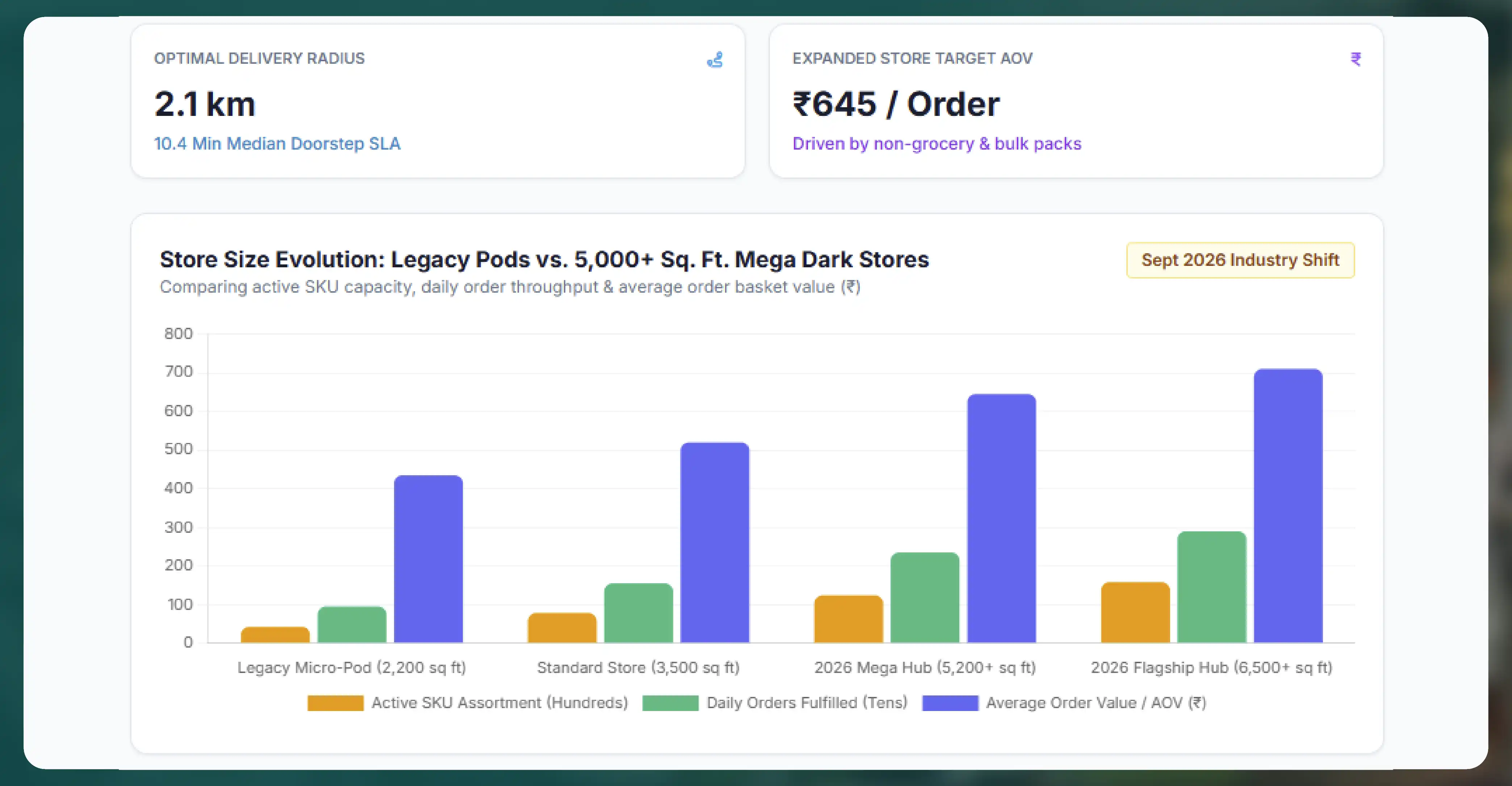
Dark stores are the operational foundation of quick commerce. These facilities hold inventory close to customers and enable platforms to fulfil orders within short delivery windows.
The next phase of dark store expansion India is likely to focus on balancing geographical coverage with fulfilment efficiency.
Companies need to evaluate several operational factors:
- Store location: Dark stores must be positioned near high-demand residential areas, commercial clusters, and accessible road networks.
- Inventory capacity: Stores require sufficient inventory to fulfil frequently ordered products without excessive stockholding.
- Delivery radius: Shorter delivery distances can improve fulfilment times and reduce delivery-related expenses.
- Neighbourhood demand: Store investments should reflect local order frequency, basket sizes, and repeat-purchase behaviour.
- Product assortment: Different cities require different combinations of national brands, regional products, fresh groceries, and household essentials.
Another important development is the shift towards larger fulfilment facilities.
A September 2026 Business Standard report highlighted that newer dark stores operated by major quick commerce companies were increasingly exceeding 5,000 square feet. Higher investments are supporting broader assortments, greater inventory capacity, and improved fulfilment infrastructure.
This suggests that future competition will involve not just delivery speed but also assortment depth and inventory availability.
5. What Makes Tier 2 Expansion Different from Metro Expansion?
Expanding into smaller cities involves a different set of commercial and operational challenges.
First, order density may be lower than in metropolitan neighbourhoods. A dark store that performs well in a densely populated urban area may experience lower utilization in a less concentrated market.
Second, local purchasing preferences vary considerably. Consumers in Bihar, Rajasthan, Odisha, and Tamil Nadu may have different preferences for dairy products, regional snacks, cooking ingredients, and household brands.
Third, customers can be more sensitive to delivery fees, discounts, and product price differences. Competitive pricing becomes particularly important when neighbourhood grocery stores already provide familiar purchasing options.
Fourth, inventory planning becomes more complicated. Companies must identify which products deserve local stocking and which can be supplied through larger fulfilment hubs.
Finally, customer acquisition requires localized marketing, reliable delivery experiences, and attractive introductory offers.
Platforms that understand these differences can develop stronger customer relationships while improving operational efficiency.
6. The Role of Data in Tracking Tier 2 Quick Commerce Markets
As competition expands geographically, businesses need accurate and frequently updated information to understand market developments.
Tier 2 grocery delivery data can provide insights into product prices, availability, delivery estimates, discounts, ratings, pack sizes, and assortment changes across different platforms.
For retailers, FMCG brands, investors, and market research companies, these insights can support several business decisions.
For example, an FMCG manufacturer can compare the availability of its products across Blinkit, Zepto, and Instamart in Patna, Jaipur, and Lucknow.
A grocery retailer can identify which categories receive stronger promotional support in different cities.
A competitor intelligence team can monitor how delivery charges, product assortment, and discounts change when a new platform enters a market.
Useful data points include:
- City-wise and pincode-wise serviceability.
- Dark-store locations and coverage patterns.
- Product prices and promotional discounts.
- Stock availability and out-of-stock frequency.
- Regional and national brand assortment.
- Delivery estimates and additional charges.
- Customer ratings and product reviews.
- Changes in product listings over time.
Combining these indicators creates a more comprehensive understanding of competitive activity than simply tracking the number of cities served.
7. What Should Businesses Watch Next?
The next stage of quick commerce expansion will likely involve more selective investments, localized assortment strategies, and improvements in store utilization.
Businesses should monitor three important developments.
- First, geographical expansion: Watch for new serviceable pincodes, additional dark stores, and launches in emerging commercial centres.
- Second, assortment localization: Track whether platforms introduce regional dairy brands, bakery products, traditional snacks, and locally preferred household essentials.
- Third, profitability and operational efficiency: Examine delivery fees, basket sizes, discount intensity, inventory availability, and order fulfilment performance.
The competitive landscape may also change as companies explore larger fulfilment centres and broader non-grocery categories, including electronics, beauty, personal care, and lifestyle products.
These developments could make Tier 2 markets important not only for grocery delivery but also for broader convenience-led digital retail.
How iWeb Data Scraping Can Help You?
iWeb Data Scraping helps businesses transform quick commerce platform information into structured, location-specific market intelligence.
1. City Expansion Tracking
Monitor Blinkit, Zepto, and Instamart launches across emerging cities, identifying new serviceable pincodes, geographical coverage, and competitive expansion opportunities through structured market intelligence.
2. Dark Store Intelligence
Collect publicly available location and coverage information to analyse fulfilment networks, neighbourhood penetration, competitor density, and potential areas for strategic retail expansion.
3. Price Benchmarking
Compare grocery prices, promotional discounts, pack sizes, and product variations across platforms to identify pricing gaps and understand changing consumer value propositions.
4. Product Availability Monitoring
Track stock availability, assortment changes, regional brands, and out-of-stock patterns to help FMCG manufacturers and retailers improve distribution and inventory planning.
5. Market Trend Analysis
Analyse historical and current platform data to identify category growth, regional preferences, promotional patterns, and emerging opportunities for data-driven business decisions.
Conclusion
Tier 2 cities are becoming an increasingly important part of India's quick commerce growth story. Expanding digital adoption, changing shopping preferences, and demand for convenient grocery delivery are encouraging platforms to explore markets beyond metropolitan India.
Blinkit is building a wider geographical footprint, Zepto is competing through selective market positioning, and Swiggy Instamart is leveraging regional assortment and its broader ecosystem to strengthen its presence.
However, sustainable expansion will depend on more than city launches. Store utilization, local product preferences, delivery economics, pricing competitiveness, and neighbourhood-level availability will determine long-term success.
Businesses looking to understand quick commerce tier 2 India should monitor platform activity through consistent, location-specific data collection. Combining pricing, availability, and serviceability intelligence with Blinkit dark store coverage mapping can reveal competitive gaps, emerging markets, and opportunities for strategic growth.
With iWeb Data Scraping, businesses can convert scattered platform information into structured intelligence and make more informed decisions in India's evolving quick commerce ecosystem.
Frequently Asked Questions (FAQs)
Companies are targeting Tier 2 cities because of rising digital adoption, growing disposable incomes, increasing demand for convenience, and opportunities to establish early market presence before competition intensifies.
Cities such as Patna, Jaipur, Lucknow, Indore, Ranchi, Bhubaneswar, Siliguri, Coimbatore, and Visakhapatnam are important markets to monitor for serviceability, store coverage, and future expansion opportunities.
Dark stores operate as neighbourhood fulfilment centres, holding products closer to customers. They help platforms manage inventory, process orders efficiently, reduce delivery distances, and improve product availability.
Businesses should monitor product prices, discounts, stock availability, delivery charges, delivery estimates, dark-store locations, serviceable pincodes, product assortment, and regional brand performance.
Data scraping collects publicly accessible platform information and organizes it into structured datasets. Businesses can use these datasets for competitor benchmarking, pricing analysis, market expansion research, inventory planning, and location-based intelligence.