


Introduction
The UK property market generates enormous volumes of listing, pricing, location, and property-level information every day. For estate agencies, property portals, investors, developers, lenders, and market intelligence companies, converting this information into actionable insights can create a significant competitive advantage. Real-estate Businesses Benefit from the Rightmove API when property information needs to move efficiently between systems, applications, analytics platforms, and operational workflows.
Rightmove's API documentation currently documents API products and data feeds covering areas such as commercial listings, while Rightmove also maintains automated and real-time data feeds for property listings. Access is governed by Rightmove's licensing and technical requirements.
For companies studying Rightmove property listings and market analytics, structured property information can support pricing analysis, competitor monitoring, portfolio evaluation, investment research, and geographic opportunity assessment.
The growing demand for Real estate automation using Rightmove API reflects a broader shift away from manually collecting property information. Instead of analysts repeatedly checking listings, organizations can connect authorized data feeds to internal applications and automate appropriate workflows.
Why Rightmove Data Matters for Real-Estate Businesses?
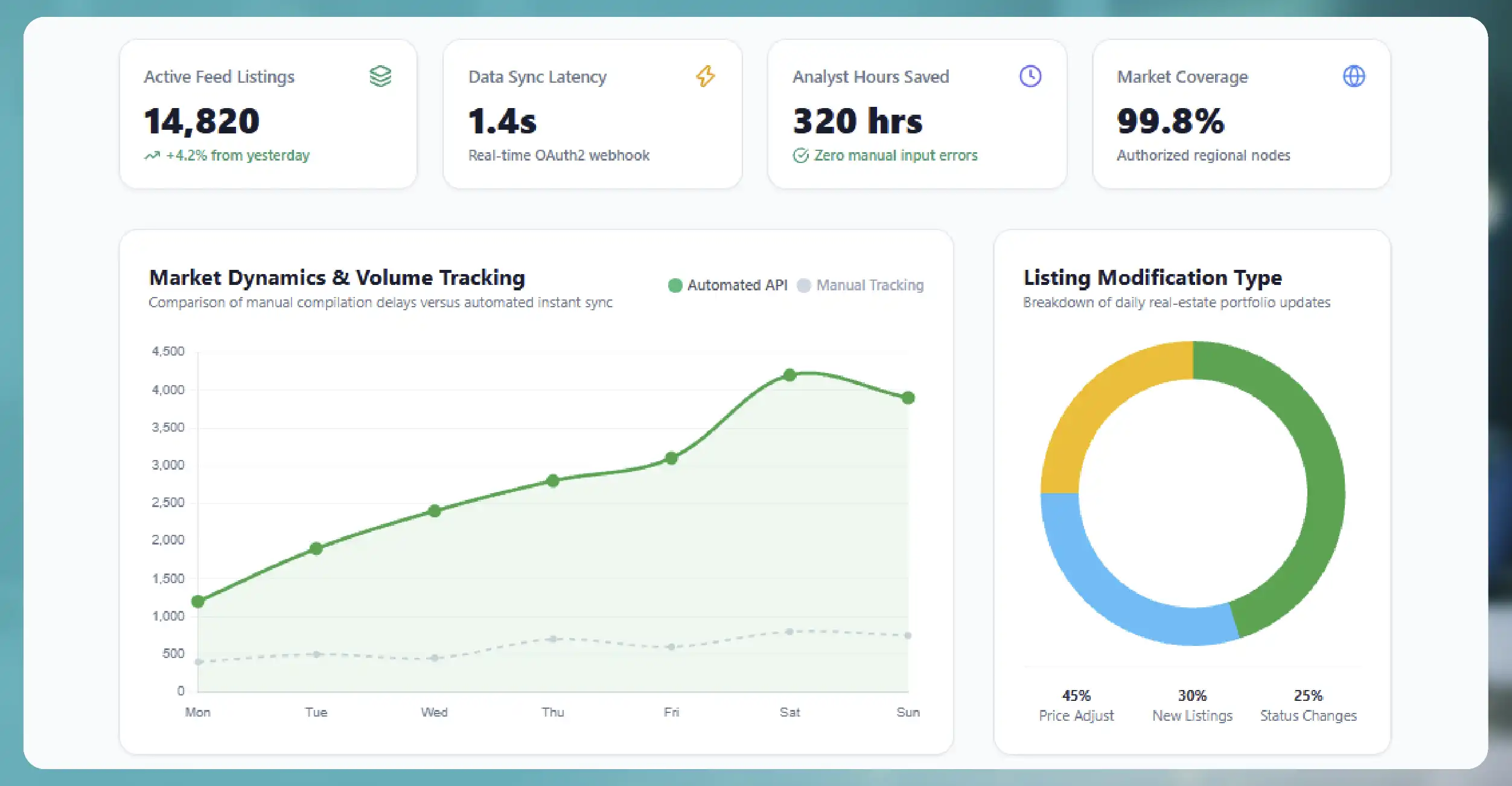
Property businesses make decisions based on rapidly changing information. Asking prices change, properties enter or leave the market, listings are updated, locations vary in demand, and competitors continuously adjust their portfolios.
Manually gathering these changes creates several problems. It consumes analyst time, introduces inconsistencies, and makes historical comparisons difficult.
An API-based approach can create a structured connection between an authorized Rightmove data feed and a company's technology environment. Rightmove's current documentation describes authenticated API access, including OAuth2 client-credentials authentication for commercial API endpoints.
This enables businesses to build workflows around structured data rather than relying entirely on manual observation.
The result is faster access to information, better consistency, and greater potential for automation.
Building Property Intelligence from Rightmove Data
Modern agencies increasingly need more than individual listings. They need a broader view of the market.
Property intelligence with Rightmove data can involve analyzing attributes such as location, property type, pricing, listing status, property references, and other available fields, depending on the applicable feed and license.
For example, a property investment company could compare asking prices across selected postcodes. A developer could identify areas where particular property types are appearing more frequently. An agency could monitor its competitive landscape and identify pricing differences between comparable properties.
The key advantage comes from transforming individual records into measurable patterns.
Instead of asking:
"What properties are available today?"
a business can ask:
- Which areas have the strongest listing activity?
- How do asking prices vary by postcode?
- Which property categories are becoming more competitive?
- How frequently do comparable listings change?
- Where are pricing opportunities emerging?
- Which markets require deeper investigation?
These questions turn property data into business intelligence.
Understanding UK Housing Market Trends
The UK property sector is highly localized. Market conditions can differ substantially between cities, boroughs, postcodes, and property categories.
UK housing market insights using Rightmove data can therefore help organizations examine local market behavior instead of relying solely on national averages.
A structured dataset can support analysis of:
| Data Dimension | Potential Business Analysis |
|---|---|
| Property Type | Demand by residential category |
| Asking Price | Pricing benchmarks |
| Location | Geographic opportunity mapping |
| Postcode | Micro-market comparisons |
| Listing Status | Supply and availability analysis |
| Property Features | Comparable-property analysis |
| Listing History | Market movement tracking |
| Property Reference | Record matching |
| Latitude/Longitude | Geographic segmentation |
| Branch Information | Agency-level analysis |
Rightmove's commercial API documentation, for example, identifies fields related to location, postcode, latitude, longitude, UPRN, property references, pricing, sizing, and classifications.
The availability of specific information depends on the relevant Rightmove product, access rights, and licensing arrangement.
API Integration Versus Traditional Data Collection

Businesses often assume that an API simply means "scraping faster." That is not necessarily correct.
The method to Scrape Rightmove property data API should be understood carefully because Rightmove distinguishes its authorized APIs and data feeds from unauthorized automated collection. Its website terms expressly prohibit bots, crawlers, scrapers, and automated programs from accessing or collecting platform content without the required permission.
For organizations requiring Rightmove information, the appropriate route is therefore to determine which authorized data feed or API product matches the intended use.
Rightmove's documentation currently describes different feed capabilities. Its Commercial Listings API supports uploading, updating, retrieving, and removing commercial property listings, while residential properties are handled through Rightmove's real-time data feed APIs rather than that commercial API.
This distinction is important when designing a property-data solution.
What a Rightmove Data Workflow Can Look Like?
A professional property intelligence workflow can be structured into several stages.
Define the Business Requirement
First, the organization determines whether it
needs listing distribution, internal analytics, market monitoring, competitive intelligence,
investment research, or another permitted purpose.
Establish Authorized Access
The business identifies the relevant Rightmove API or
data-feed product and completes the applicable authentication, licensing, and onboarding
requirements. Rightmove's API documentation states that credentials are issued for its commercial
API environments.
Connect the Data
The authorized feed can then be integrated with internal
applications, CRM systems, databases, analytics platforms, or dashboards.
Standardize Records
Data can be normalized into consistent formats so that
property types, locations, prices, references, and timestamps can be analyzed systematically.
Analyze the Market
The resulting dataset can support dashboards, pricing models,
geographic comparisons, competitor analysis, and other approved analytical applications.
Automate Reporting
Instead of manually preparing spreadsheets, businesses can
create scheduled pipelines that transform incoming data into recurring reports and business
intelligence outputs.
How a Rightmove Scraper Fits Into a Broader Strategy?
A Rightmove Scraper is often discussed by organizations seeking large-scale property information. However, businesses must distinguish between authorized API/data-feed integration and unauthorized scraping.
For permitted data-collection projects, a professional data provider can help determine whether an API, licensed feed, or another compliant collection method is appropriate.
This is especially valuable when businesses need to combine property information from several sources. A standardized architecture can bring together permitted Rightmove data with public datasets, transaction information, demographic indicators, geographic data, and internal records.
The objective is not simply to collect more records.
The objective is to create a reliable analytical foundation.
Major Benefits for Real-Estate Companies
Faster Decision-Making
Automated data workflows reduce repetitive manual
research. Analysts can spend more time interpreting market movements rather than copying information
between websites and spreadsheets.
Better Competitive Intelligence
Organizations can compare property portfolios,
pricing structures, locations, and listing activity to understand their competitive position.
More Efficient Pricing Analysis
Historical and current datasets can help analysts
establish comparable-property benchmarks and investigate pricing variations across locations.
Scalable Market Research
Instead of researching one neighborhood at a time,
structured datasets can support analysis across cities, regions, property categories, or selected
geographic segments.
Stronger Investment Research
Investors can combine property-level information
with financial, demographic, infrastructure, and economic indicators to evaluate potential
opportunities.
Improved CRM Workflows
Authorized property feeds can be connected to internal
systems, helping businesses synchronize relevant listing information and reduce repetitive
data-entry work.
Turning Property Data into Predictive Intelligence
The biggest opportunity appears when property data is combined with analytics.
For instance, historical listing records can help identify recurring patterns in asking prices, supply levels, property categories, and geographic activity.
Machine-learning systems can potentially use structured datasets for forecasting, segmentation, anomaly detection, and market classification, provided the underlying data is suitable and the intended use complies with applicable licensing and legal requirements.
A property company could develop a scoring model that ranks areas according to selected indicators. An investment team could create dashboards showing price movements by postcode. A property technology platform could build recommendation engines around permitted datasets.
This is where API integration moves beyond data collection and becomes a technology strategy.
Challenges Businesses Should Consider
Implementing a property-data pipeline also requires careful planning.
Data Licensing: API access does not automatically mean unrestricted commercial use. Rightmove's terms specify permitted uses and restrictions, so businesses should review the applicable agreement before building a solution.
Data Quality: Property information may change frequently. Pipelines should therefore validate, normalize, and timestamp incoming records.
API Management: Authentication, error handling, rate management, monitoring, logging, and version changes need to be incorporated into production systems.
Historical Storage: If the business needs trend analysis, it must establish an appropriate historical data architecture rather than relying only on the latest records.
Integration: Data becomes more useful when connected with CRM platforms, warehouses, dashboards, analytics systems, and other approved data sources.
Choosing the Right Data Strategy
There is no single architecture that works for every real-estate company.
An estate agency may need listing synchronization and CRM integration.
An investment company may prioritize historical market analysis.
A property-tech startup may require structured datasets for analytics applications.
A research organization may need recurring market snapshots across multiple geographic areas.
The right solution therefore starts with the business objective rather than the technology.
The strongest implementations typically combine authorized access, robust data engineering, standardized schemas, quality controls, historical storage, and analytics.
How iWeb Data Scraping Can Help You?
Authorized Data Strategy
iWeb Data Scraping can help businesses evaluate suitable data-collection approaches, including authorized APIs, feeds, and compliant extraction workflows based on project requirements and permitted use cases.
Data Pipeline Development
The team can design scalable pipelines that collect, validate, normalize, and organize property information into structured formats suitable for databases, analytics platforms, dashboards, or internal applications.
Property Data Enrichment
Property datasets can be organized with additional approved business fields, geographic attributes, classifications, timestamps, and identifiers to make downstream analysis more practical and consistent.
Historical Market Monitoring
Businesses can develop recurring collection workflows that preserve historical snapshots, enabling analysts to compare property activity, pricing movements, supply changes, and geographic patterns over time.
Scalable Data Delivery
iWeb Data Scraping can support structured delivery through formats and integrations suited to business requirements, helping real-estate organizations turn recurring property information into usable intelligence.
Conclusion
The value of Rightmove data extends far beyond individual property listings. When accessed through the appropriate authorized channels and integrated into a structured technology environment, property information can support competitive analysis, market research, pricing intelligence, investment evaluation, and automation.
Businesses should approach the opportunity strategically, beginning with licensing, data requirements, integration architecture, and analytical objectives. Properly designed Real-estate datasets can become a valuable foundation for market intelligence rather than another collection of disconnected records.
For organizations that need recurring collection and transformation, Managed web scraping can provide an alternative or complementary approach where legally and contractually appropriate.
Professional Web Scraping API Services can further help businesses build scalable pipelines, integrate multiple data sources, and deliver structured information to their analytics or operational environments.
The real advantage comes from converting property information into timely, organized, decision-ready intelligence.
FAQs
Rightmove provides API and data-feed products for specific use cases, including property listing management and data integration. The available functionality depends on the particular API product and applicable agreement.
Rightmove's website terms prohibit automated scraping and similar collection methods without the required permission. Businesses should use authorized APIs or data feeds where available and review the applicable licensing terms.
Depending on the authorized data source, businesses may work with information such as property references, locations, postcodes, classifications, pricing, sizing, and other listing attributes. Exact fields depend on the relevant feed.
Yes, where permitted by the applicable Rightmove API or data-feed agreement. Rightmove's terms specifically reference internal business use and CRM operation in its licensing provisions.
Automation can reduce repetitive research, standardize records, preserve historical information, and make property datasets easier to analyze across locations, categories, and time periods.