
Introduction
The real estate industry is increasingly becoming a data-driven marketplace where timing, location, project details, and buyer intent can determine whether a prospect becomes a qualified lead. Instead of relying entirely on purchased contact lists, cold outreach, or manually researched prospects, real estate businesses can use publicly available project information to discover opportunities at scale. Real Estate Lead Generation Using Public Project Databases enables brokers, developers, agencies, investors, lenders, and property technology companies to transform scattered public information into structured prospecting intelligence.
Public project databases can contain valuable information about upcoming developments, residential communities, commercial properties, construction activity, developers, project locations, property types, expected completion dates, and other indicators of market activity. When collected responsibly and organized into a usable dataset, this information can support targeted lead-generation campaigns and improve sales prioritization.
For companies looking to automate prospect discovery, the ability to Scrape public real estate project databases for leads can reduce repetitive research and create a consistent flow of project-level intelligence. Rather than searching hundreds of websites individually, businesses can establish automated workflows that collect relevant records, standardize them, remove duplicates, and deliver the resulting information into CRM systems or analytical platforms.
Another valuable approach is to Build real estate leads using public property databases by combining project information with geographic, market, and development attributes. This can help sales teams identify newly launched communities, expansion markets, developing neighborhoods, and property segments that align with their target audience.
Why Public Project Databases Matter for Real Estate Lead Generation?
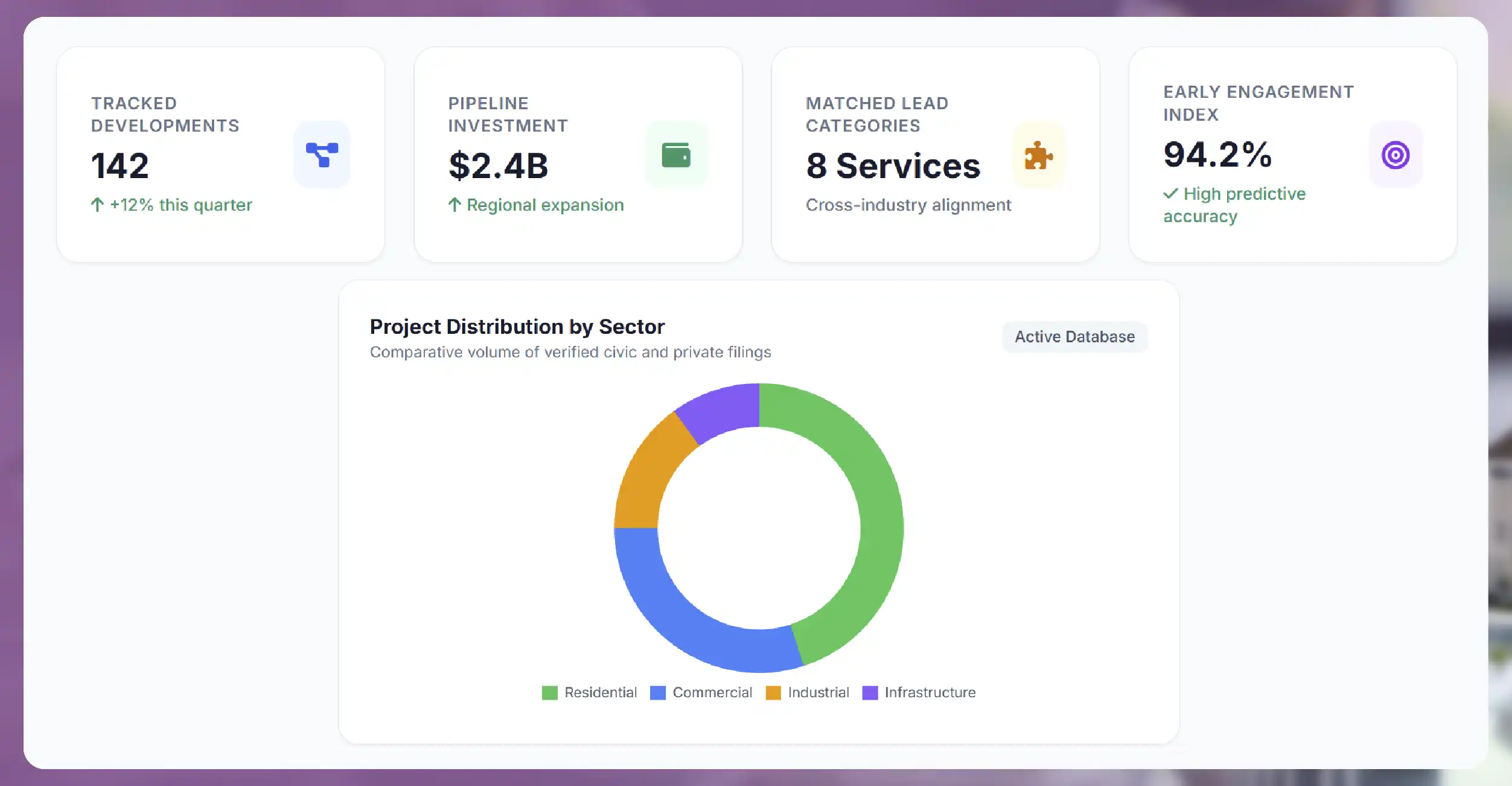
Traditional lead-generation strategies often concentrate on individuals who have already expressed an interest in buying, selling, renting, or investing. Public project databases provide a different perspective. They can reveal the projects and market activities around which future demand is likely to develop.
For example, a newly announced residential development can represent an opportunity for mortgage providers, interior designers, moving companies, insurance providers, property managers, construction suppliers, and real estate agencies. A commercial development may create opportunities for office furniture providers, facility-management companies, business service providers, and commercial brokers.
The key is connecting project information with a company's ideal customer profile. Data collection can therefore become more than simple prospect discovery; it can support systematic market intelligence.
Turning Project Information Into Actionable Leads
Real estate lead generation data Scraping involves collecting relevant information from publicly accessible sources and converting it into structured records. Depending on the project and source, useful fields may include project name, developer, address, city, state, ZIP or postal code, property category, project status, estimated completion date, number of units, development size, website, public contact information, and source URL.
Once collected, these fields can be standardized into a consistent database. Duplicate project names can be resolved, addresses can be normalized, missing values can be flagged, and project categories can be classified.
This structured approach makes it easier for sales teams to filter prospects according to specific criteria. A company could prioritize developments within selected cities, focus on projects nearing completion, or identify commercial developments exceeding a particular size.
Identifying High-Value Property Opportunities
Property project data extraction for Lead Generation helps businesses move beyond generic real estate directories. Project-level information provides context about what is being developed, where it is happening, who is involved, and potentially when commercial activity may accelerate.
Consider a real estate marketing agency targeting new residential communities. Instead of contacting every property developer in a region, the agency can prioritize projects that are under construction or approaching launch. Similarly, a mortgage company may use project information to identify locations where new housing inventory is expected to enter the market.
The resulting database can support segmentation by:
- Residential and commercial projects
- New developments and redevelopment projects
- Construction status
- Geographic market
- Developer or builder
- Property category
- Estimated completion period
- Project size
- Investment potential
Such segmentation allows marketing teams to create campaigns that are more relevant than broad, untargeted outreach.
The Role of New Development Data

New property project data scraping can be particularly valuable because newly announced or developing projects may signal emerging demand before traditional market datasets fully reflect it.
New projects can indicate population growth, infrastructure investment, urban expansion, commercial activity, or changing consumer preferences. Tracking these developments over time enables organizations to build a continuously updated view of real estate activity.
For instance, a property services company could monitor new developments within selected metropolitan areas and automatically identify projects entering important stages. Sales representatives could then research the relevant business opportunity and prioritize outreach based on project characteristics.
The same information can also support competitor monitoring. Developers can track competing projects, compare locations, observe development activity, and identify areas where competitors are increasing their presence.
Automating Real Estate Data Collection
Extract Real Estate Public Project Data API to integrate with existing technology environments. Instead of manually downloading spreadsheets, businesses can receive structured project records through automated data pipelines.
An API-oriented workflow can connect project data with CRM platforms, business intelligence dashboards, analytics systems, internal databases, or lead-scoring applications. New records can be processed periodically, while previously collected records can be compared against updated information.
A typical workflow may involve source discovery, page retrieval, data extraction, validation, normalization, duplicate removal, enrichment, storage, and delivery.
Automation is particularly useful for organizations monitoring thousands of projects across multiple cities or countries. It can reduce manual research and help maintain a more consistent data-refresh schedule.
Lead Scoring and Prioritization
Collecting data is only the first step. The real value comes from determining which records deserve attention.
Businesses can create lead-scoring models using project characteristics. A development may receive a higher priority score if it is located in a strategic market, has substantial project capacity, belongs to a target property category, or is approaching a commercially important milestone.
For example:
| Project Factor | Potential Lead Signal |
|---|---|
| Project status | Construction or launch activity |
| Location | Target geographic market |
| Property type | Matches target customer segment |
| Project scale | Large commercial opportunity |
| Developer | Strategic prospect |
| Completion timeline | Near-term sales opportunity |
| Market activity | High development concentration |
These signals can help sales teams focus their efforts on opportunities with stronger business potential.
Geographic Intelligence for Better Prospecting
Location is one of the most important dimensions of real estate intelligence. A project located near transportation infrastructure, business districts, universities, shopping centers, or expanding residential areas may have different commercial potential from an otherwise similar project in another location.
By combining project records with geographic information, businesses can identify clusters of development and emerging real estate markets. This can support territory planning, sales expansion, franchise decisions, investment research, and localized advertising.
Geographic analysis can also reveal where multiple projects are appearing simultaneously. Such clusters may indicate areas experiencing significant development activity and therefore represent attractive targets for real estate-related service providers.
Data Quality and Compliance Considerations
Public data does not automatically mean unrestricted data usage. Businesses should review the terms and conditions, robots directives, applicable laws, privacy requirements, and data usage policies associated with each source.
Lead-generation workflows should prioritize business and project information that is publicly available and appropriate for the intended purpose. Personally identifiable information should be handled carefully, particularly when combining datasets from multiple sources.
Data quality is equally important. Public project information can contain outdated addresses, duplicate records, inconsistent project names, missing fields, or changing development timelines. Validation routines and periodic refreshes can significantly improve reliability.
A professional pipeline should therefore include duplicate detection, field validation, source tracking, timestamping, error handling, and regular updates.
How Real Estate Businesses Can Use the Data?
Real estate data scraping can support numerous commercial applications beyond conventional lead generation.
Developers can monitor competing projects and identify market expansion opportunities. Brokers can discover new developments before they become saturated with competitors. Property service providers can identify buildings that may soon require their services. Investors can monitor development pipelines across selected markets.
Marketing teams can also use project-level datasets to build highly segmented campaigns. Instead of sending one generic message to an entire region, they can develop campaigns around property type, project status, location, or development stage.
Financial institutions may use project intelligence to understand development activity, while construction suppliers can identify upcoming projects where their products or services could be relevant.
Building a Scalable Real Estate Lead Pipeline
A successful public-project data strategy should be designed as an ongoing pipeline rather than a one-time scraping exercise.
The process can begin with defining target markets and project categories. Relevant public sources can then be identified and mapped to the required data fields. Automated extraction collects records, after which data is cleaned and standardized.
The next stage involves enrichment and classification. Geographic attributes, project categories, developer information, and market indicators can be added where appropriate. Records can then be scored according to business priorities.
Finally, the cleaned dataset can be delivered to CRM systems, dashboards, cloud storage, databases, or internal applications. Scheduled updates help ensure that sales teams are working with current information rather than outdated spreadsheets.
How iWeb Data Scraping Can Help You?
Targeted Lead Discovery
Identify relevant property projects, developers, locations, and development stages from public sources to create focused, high-quality prospect lists for sales and marketing campaigns.
Automated Data Collection
Collect large volumes of real estate project information automatically, reducing manual research while maintaining structured datasets that sales teams can access and analyze efficiently.
Accurate Data Structuring
Clean, normalize, categorize, and organize collected property information into consistent formats, making project records easier to search, filter, compare, and integrate into business systems.
Market Opportunity Identification
Discover emerging developments, growing locations, new construction activity, and competitive projects to help businesses recognize promising markets and prioritize potential commercial opportunities.
Scalable Data Delivery
Deliver refreshed real estate datasets through preferred formats, databases, or APIs, helping organizations continuously update prospecting pipelines and support data-driven lead-generation strategies.
Conclusion
Public real estate project information can become a powerful source of commercial intelligence when it is collected, structured, validated, and connected to meaningful business objectives. Instead of treating public project databases as static directories, organizations can use them to identify emerging developments, discover market opportunities, prioritize territories, monitor competitors, and strengthen prospecting strategies.
Well-organized Real-estate datasets can help businesses transform fragmented project information into searchable and actionable intelligence. Combined with Location intelligence, these datasets can reveal development clusters, emerging markets, and geographic opportunities that traditional lead lists may overlook.
For organizations seeking scalable collection and delivery infrastructure, professional Web Scraping API Services can automate data acquisition, standardization, enrichment, and integration into existing workflows. The result is a more efficient real estate intelligence pipeline that enables teams to spend less time searching for opportunities and more time converting relevant prospects into valuable business relationships.
FAQs
It involves collecting publicly available information about property projects, developers, locations, construction stages, and related details to identify potential business opportunities.
We can collect project names, developer details, property types, locations, addresses, project status, completion timelines, unit information, websites, and other publicly available business-related attributes.
Structured property data helps businesses identify relevant projects, segment prospects by location and project characteristics, prioritize opportunities, and create more targeted sales and marketing campaigns.
Yes. Depending on project requirements, collected and processed data can be delivered through APIs, databases, CSV, Excel, JSON, or other suitable formats.
Update frequency depends on the source, project requirements, and business objectives. Data can be refreshed periodically to help track new projects, status changes, and evolving market activity.