
47.8K+
COMPETITOR DRUG PRICING RECORDS PROCESSED

Real-Time Competitor Drug Pricing Using Custom API for Pharmaceutical Market Intelligence and Competitive Price Monitoring Solutions
This case study is based on a real-world enterprise scenario where a pharmaceutical company built a centralized pricing intelligence infrastructure to monitor competitor medicines, product availability, discounts, pack sizes, and healthcare listings across multiple online pharmacy and healthcare platforms. The objective was to transform fragmented pricing information into a structured, continuously refreshed intelligence layer that could support commercial teams, pricing managers, market researchers, and business analysts.
The project is particularly relevant for pharmaceutical organizations operating in highly competitive markets where medicine prices can change frequently because of promotions, availability, regional demand, marketplace competition, and product-level pricing strategies.
It is designed for:
The client wanted a system capable of Real-Time Competitor Drug Pricing Using Custom API architecture rather than depending on manual searches and disconnected spreadsheets. The requirement was to capture pricing signals continuously, standardize product information, identify comparable medicines, and deliver reliable updates to internal commercial teams.
The organization also needed to Scrape real-time competitor drug pricing data API outputs across a broad set of pharmacy and healthcare sources. This required a scalable data collection framework capable of handling different website structures, product naming conventions, pack formats, currencies, discount models, and availability indicators.
The ultimate objective was to establish a reliable pricing intelligence foundation that could help the pharmaceutical company understand competitive positioning faster, identify pricing anomalies, and make informed commercial decisions without waiting for periodic manual research reports.
The pharmaceutical company operated in an environment where competitor drug prices changed frequently across online pharmacies, healthcare marketplaces, and digital pharmacy platforms. Existing monitoring processes depended heavily on manual searches, spreadsheets, and periodic market checks, making it difficult to identify price changes immediately.
The organization therefore implemented a structured data intelligence framework focused on Real-time pharmaceutical competitor price monitoring. The system continuously captured medicine prices, discounts, pack sizes, product availability, seller information, and listing attributes from multiple digital healthcare sources.
A major component of the solution was a Custom API for drug price tracking, which provided standardized pricing feeds to internal dashboards and analytical systems. Instead of requiring analysts to repeatedly visit individual websites, the API delivered normalized records that could be queried, compared, filtered, and analyzed automatically.
The system mapped equivalent and comparable products across competitors despite differences in product names, formulations, pack sizes, and listing formats. Data validation rules helped identify duplicate products, missing fields, unusual price movements, and inconsistent records.
The pharmaceutical company had access to large quantities of market information, but the information was fragmented across online pharmacy websites, healthcare marketplaces, product listings, and competitor storefronts.
One of the biggest challenges was price volatility. Medicine prices could change because of discounts, promotions, stock conditions, seller adjustments, or marketplace-level pricing decisions. A price collected manually in the morning could become outdated within hours.
The client also lacked Real-time medicine price comparison using API, which meant pricing teams had to manually visit several competitor websites before preparing a meaningful comparison. This process consumed significant analyst time and created delays between market changes and business responses.
Another challenge was the absence of standardized competitive intelligence. Different sources displayed the same medicine using different product titles, abbreviations, dosage descriptions, pack quantities, or manufacturer information. Without normalization, comparing products accurately became difficult.
The organization therefore needed Competitor drug pricing analytics using custom API to create a unified pricing layer where competitor records could be compared using standardized product attributes.
Data availability presented another problem. Some competitors displayed prices prominently while others embedded pricing within different page structures. Product information could also change depending on location, stock status, seller, or promotional eligibility.
The client additionally needed to Extract E-Pharmacy Pricing & Healthcare Listing Data at scale to capture not only prices but also product availability, discounts, seller information, pack sizes, formulation details, and listing status.
By moving from manual research to an automated competitor pricing pipeline, the pharmaceutical company created a structured system for collecting, validating, normalizing, and distributing drug pricing intelligence.
| Dimension | Manual Competitor Tracking | Custom API Pricing System |
|---|---|---|
| Data collection | Manual website searches | Automated multi-source collection |
| Update frequency | Periodic | Continuous scheduled updates |
| Price comparison | Spreadsheet-based | API-powered comparison |
| Product matching | Manual interpretation | Automated normalization |
| Discount tracking | Frequently missed | Systematic capture |
| Availability monitoring | Limited | Automated availability signals |
| Historical data | Scattered | Centralized time-series database |
| Reporting | Manual | Dashboard and API outputs |
| Scalability | Limited | Designed for large product catalogs |
| Data validation | Analyst-dependent | Automated validation rules |
| Competitor coverage | Small source set | Broad multi-source monitoring |
| Alerting | Manual review | Automated price-change triggers |
The custom pipeline was designed around several layers. The first layer collected product and pricing information from selected digital sources. The second layer cleaned and normalized the records. The third layer matched competitor products using product attributes. The fourth layer stored historical observations for longitudinal analysis.
The brand in focus is a pharmaceutical organization operating across a highly competitive healthcare market with a growing digital sales and research ecosystem. Its product portfolio included multiple medicine categories, dosage forms, pack sizes, and branded healthcare products.
As online pharmacy adoption increased, the company recognized that competitor pricing was no longer limited to traditional pharmacy shelves. Digital healthcare marketplaces were increasingly becoming important sources of pricing information and consumer purchase signals.
Competitors could adjust prices, introduce discounts, change product availability, or promote specific pack sizes without providing direct visibility to the client's commercial team.
The organization therefore required a technology-led approach capable of converting public digital pricing signals into structured intelligence.
The new system established a unified pricing database where each observation could be connected to a product, competitor, source, timestamp, geography, pack configuration, and price type.
This gave the company a stronger foundation for competitor benchmarking, pricing strategy, commercial planning, and market intelligence.
We delivered an end-to-end data intelligence architecture designed to collect, normalize, validate, and distribute competitor medicine pricing information across multiple digital healthcare sources.
The solution incorporated Healthcare and pharma data scraping capabilities to collect product listings, pricing attributes, promotional information, availability indicators, manufacturer details, pack sizes, and related healthcare metadata.
The infrastructure was designed to accommodate different website layouts, product structures, naming conventions, and update frequencies. Automated extraction processes continuously monitored selected sources and generated structured records for downstream processing.
The project also incorporated Pharmaceutical and Medical Data Scraping processes to organize medicine-level information into standardized fields. These fields included product name, generic name where available, manufacturer, strength, dosage form, pack size, listed price, discounted price, discount percentage, seller, availability, source, location, and collection timestamp.
Product Identification and Normalization
One of the most important parts of the project was product normalization.
The same medicine could appear across different competitors with slightly different titles. One platform might list a product using a shortened brand name, while another could include strength, manufacturer, and pack quantity within the title.
The system therefore separated product attributes into individual fields.
For example:
| Product Attribute | Example Structured Value |
|---|---|
| Brand | Product Alpha |
| Generic | Active Ingredient A |
| Strength | 500 mg |
| Form | Tablet |
| Pack Size | 20 tablets |
| Manufacturer | Manufacturer Alpha |
| Listed Price | $18.90 |
| Selling Price | $15.95 |
| Discount | 15.6% |
| Availability | In Stock |
| Source | Online Pharmacy |
| Timestamp | 2026-09-15 10:30 |
This structure allowed comparable products to be analyzed consistently.
Price Validation
The pricing engine applied automated validation rules to identify unusual records. Sudden price movements, missing values, duplicate records, and inconsistent pack sizes were flagged for additional validation.
Price fields were also separated into listed price, promotional price, effective selling price, and discount percentage where available.
This prevented analysts from treating every displayed number as directly comparable.
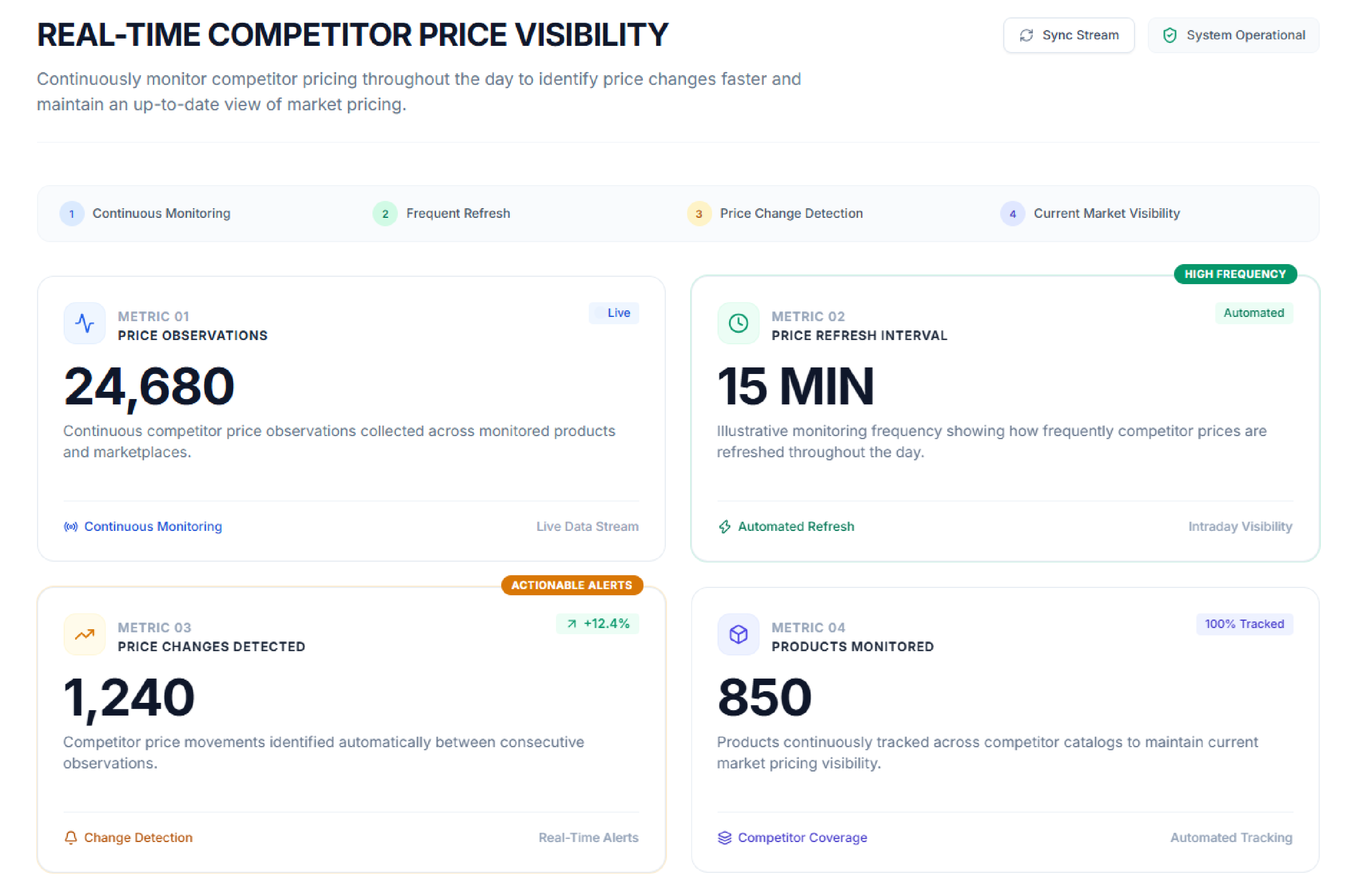
The first major finding was the improvement in pricing visibility.
Before implementation, the company relied on periodic competitor checks. Analysts could only capture a limited number of products during each research cycle.
The automated system created a continuous stream of pricing observations. This made it possible to monitor competitor movements throughout the day and maintain a current view of market pricing.
The company could now identify when competitor prices changed rather than discovering changes during the next scheduled research cycle.
This improved the responsiveness of pricing and commercial teams and reduced dependency on manually prepared reports.
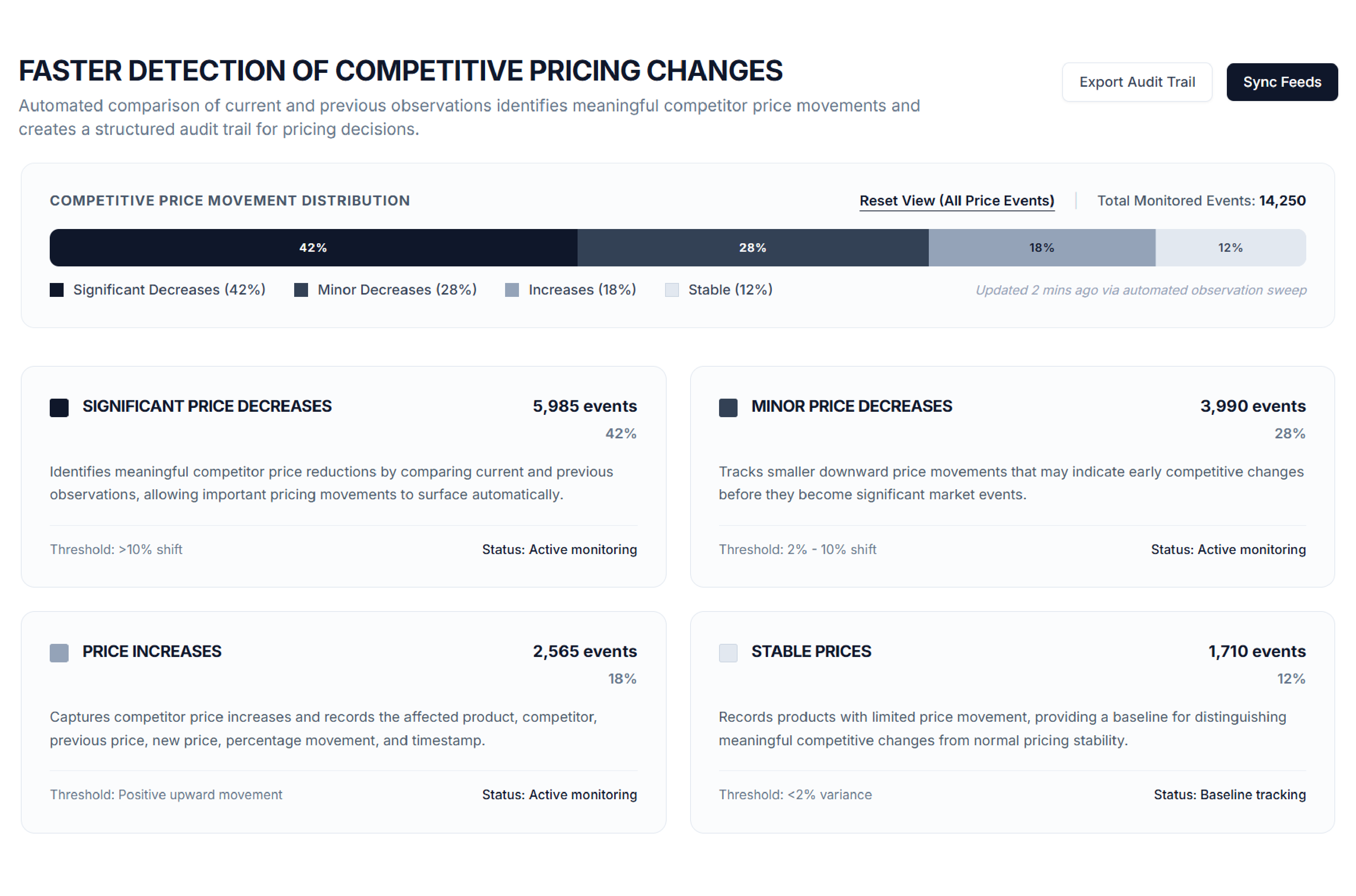
The system detected meaningful price changes through automated comparison between current and previous observations.
For example, if a competitor reduced the selling price of a high-volume medicine by 12%, the change could be identified immediately within the monitoring workflow.
Rather than requiring analysts to discover the change manually, the platform generated a structured event containing the product, competitor, previous price, new price, percentage movement, and timestamp.
This created a clear audit trail for pricing decisions.
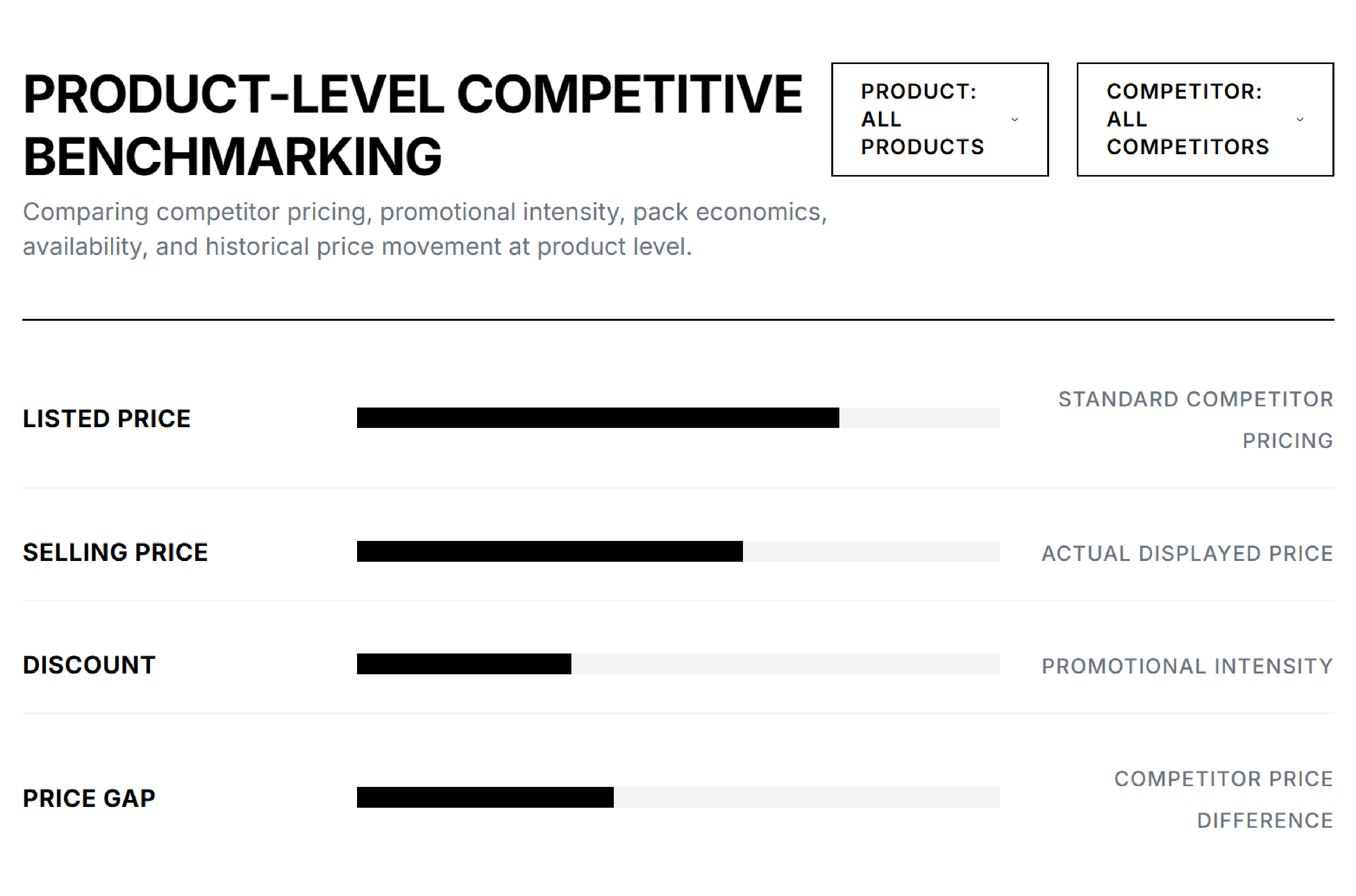
A major benefit of the project was the ability to compare competitors at the product level.
The company could evaluate:
| Metric | Competitive Insight |
|---|---|
| Listed Price | Standard competitor pricing |
| Selling Price | Actual displayed selling price |
| Discount | Promotional intensity |
| Price Gap | Difference between competitors |
| Pack Price | Pack-level comparison |
| Unit Price | Normalized product comparison |
| Availability | Competitive stock visibility |
| Price Frequency | How often pricing changes |
| Volatility | Stability of competitor pricing |
| Historical Trend | Long-term price movement |
This enabled commercial teams to distinguish between genuine competitive pricing changes and differences caused by pack size, product configuration, or promotional mechanics.
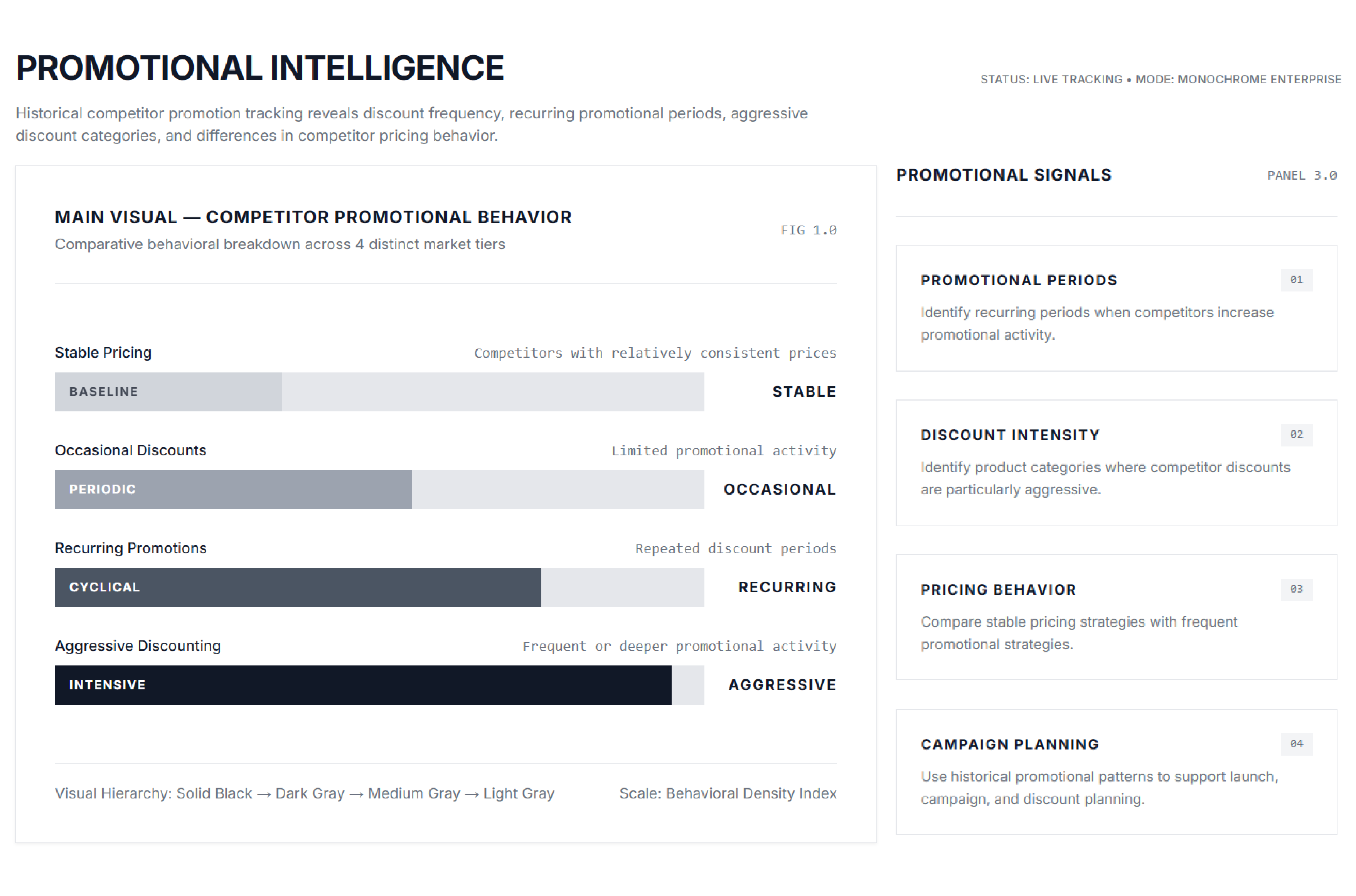
The system also revealed patterns in competitor promotions.
Some competitors relied on relatively stable pricing, while others frequently introduced discounts. By tracking promotional activity historically, the client could identify recurring promotional periods and product categories where discounts were particularly aggressive.
This information helped commercial teams understand not only competitor prices but also competitor pricing behavior.
The resulting intelligence supported better planning around product launches, campaigns, discounts, and competitive positioning.
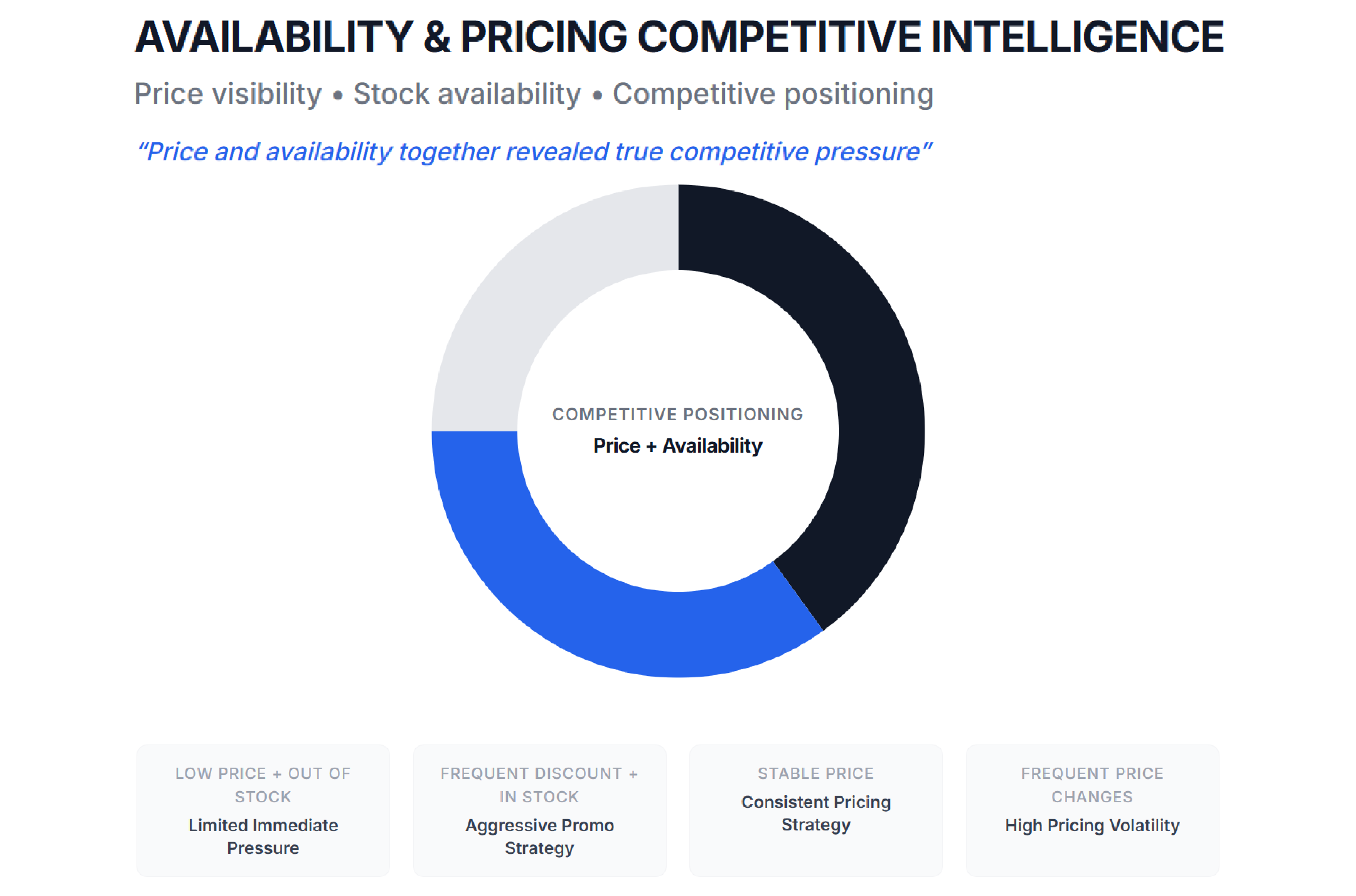
Price information alone does not always explain competitive positioning.
A medicine listed at a lower price may have limited availability, while a higher-priced product may be consistently in stock.
The new dataset therefore connected price observations with availability information.
This created a more comprehensive view of competitive market conditions.
| Observation | Interpretation |
|---|---|
| Low price + in stock | Strong competitive pressure |
| Low price + out of stock | Limited immediate pressure |
| High price + in stock | Potential premium positioning |
| Frequent discount + in stock | Aggressive promotional strategy |
| Frequent price changes | High pricing volatility |
| Stable price | Consistent pricing strategy |
This combination of pricing and availability data strengthened the quality of competitive analysis.
The following representative dataset illustrates how the structured pricing intelligence layer organized competitor medicine information.
| Medicine | Competitor | Pack Size | Listed Price | Selling Price | Discount | Availability | Price Change |
|---|---|---|---|---|---|---|---|
| Product Alpha | Pharmacy One | 20 tablets | $18.90 | $15.95 | 15.6% | In Stock | -8.2% |
| Product Alpha | Pharmacy Two | 20 tablets | $19.40 | $17.20 | 11.3% | In Stock | -3.6% |
| Product Beta | Pharmacy One | 30 tablets | $26.80 | $23.50 | 12.3% | In Stock | -6.4% |
| Product Beta | Pharmacy Three | 30 tablets | $27.10 | $25.10 | 7.4% | Limited | +2.1% |
| Product Gamma | Pharmacy Two | 10 capsules | $12.80 | $10.90 | 14.8% | In Stock | -9.5% |
| Product Gamma | Pharmacy Four | 10 capsules | $13.20 | $12.30 | 6.8% | In Stock | -2.3% |
| Product Delta | Pharmacy One | 15 tablets | $21.60 | $19.80 | 8.3% | In Stock | +1.8% |
| Product Delta | Pharmacy Three | 15 tablets | $22.40 | $20.10 | 10.3% | In Stock | -5.7% |
The dataset demonstrates how product-level information can be compared across competitors while preserving important attributes such as pack size, availability, discounts, and historical price movement.
After implementation, the pharmaceutical company achieved significant improvements in competitive pricing visibility and commercial responsiveness.
The project demonstrated how a properly designed data intelligence framework can transform fragmented healthcare pricing information into a centralized competitive intelligence resource.
The architecture unified pricing records from multiple digital sources and standardized them into consistent product-level fields. This reduced the complexity of comparing products across competitors with different website structures and listing conventions.
Another major advantage was scalability. As the pharmaceutical company expanded its monitoring requirements, additional competitors, product categories, and markets could be integrated into the same framework.
The system also supported continuous data validation. Duplicate records, incomplete fields, unusual price movements, and inconsistent product attributes could be identified before reaching analytical dashboards.
Historical storage created another important advantage. Instead of analyzing only current prices, the company could study how competitors behaved over time.
The resulting intelligence supported pricing strategy, commercial planning, competitive benchmarking, market research, and executive reporting.
"We were previously spending significant time collecting competitor medicine prices manually across different online pharmacy sources. The new intelligence platform changed the way our commercial teams monitor the market. We now have structured, continuously updated pricing information that can be accessed through dashboards and internal systems. The ability to compare competitor prices, discounts, availability, and historical movements has significantly improved our pricing visibility. The solution has reduced manual research and helped our teams respond faster to important competitive changes."
— Head of Commercial Intelligence
The final outcome was a scalable pharmaceutical pricing intelligence infrastructure capable of transforming fragmented online medicine pricing information into structured, continuously updated business data.
The company gained centralized visibility into competitor prices, discounts, availability, product configurations, and historical pricing movements.
Implementation of a scraping API enabled automated data delivery into internal analytics systems, dashboards, and reporting workflows. The API architecture also provided a standardized interface for requesting product-level competitive pricing information.
The solution supported scalable data collection across multiple healthcare and pharmacy sources while maintaining structured records for historical analysis.
Deployment of Managed web scraping further strengthened the infrastructure by reducing the operational burden associated with maintaining multiple source integrations. Continuous monitoring, extraction, validation, and maintenance helped keep the pricing intelligence pipeline reliable as source structures changed.
A custom API is an application interface designed to deliver structured pharmaceutical pricing information from a centralized data system. It allows authorized applications, dashboards, and analytics platforms to retrieve standardized pricing records without manually collecting data.
Depending on the source and permitted data access, the system can monitor product names, manufacturers, strengths, dosage forms, pack sizes, listed prices, selling prices, discounts, availability, sellers, timestamps, and other publicly displayed listing attributes.
The system periodically collects pricing information from selected sources, validates the records, compares them with previous observations, and stores updated values. Significant changes can then be surfaced through dashboards, reports, or automated alerts.
Yes. A properly structured system can normalize pack sizes and calculate comparable unit-level pricing where the required product information is available. This helps prevent misleading comparisons between different product configurations.
Yes. Each pricing observation can be stored with a timestamp, allowing businesses to build historical datasets and analyze pricing trends, promotional patterns, volatility, and competitor behavior over time.
Explore smarter pharmaceutical pricing intelligence with real-time competitor drug data, API-powered tracking, and actionable market insights.
Start a projectFields marked * are required. Everything else just helps us scope faster — skip what you don't know yet.