

Introduction
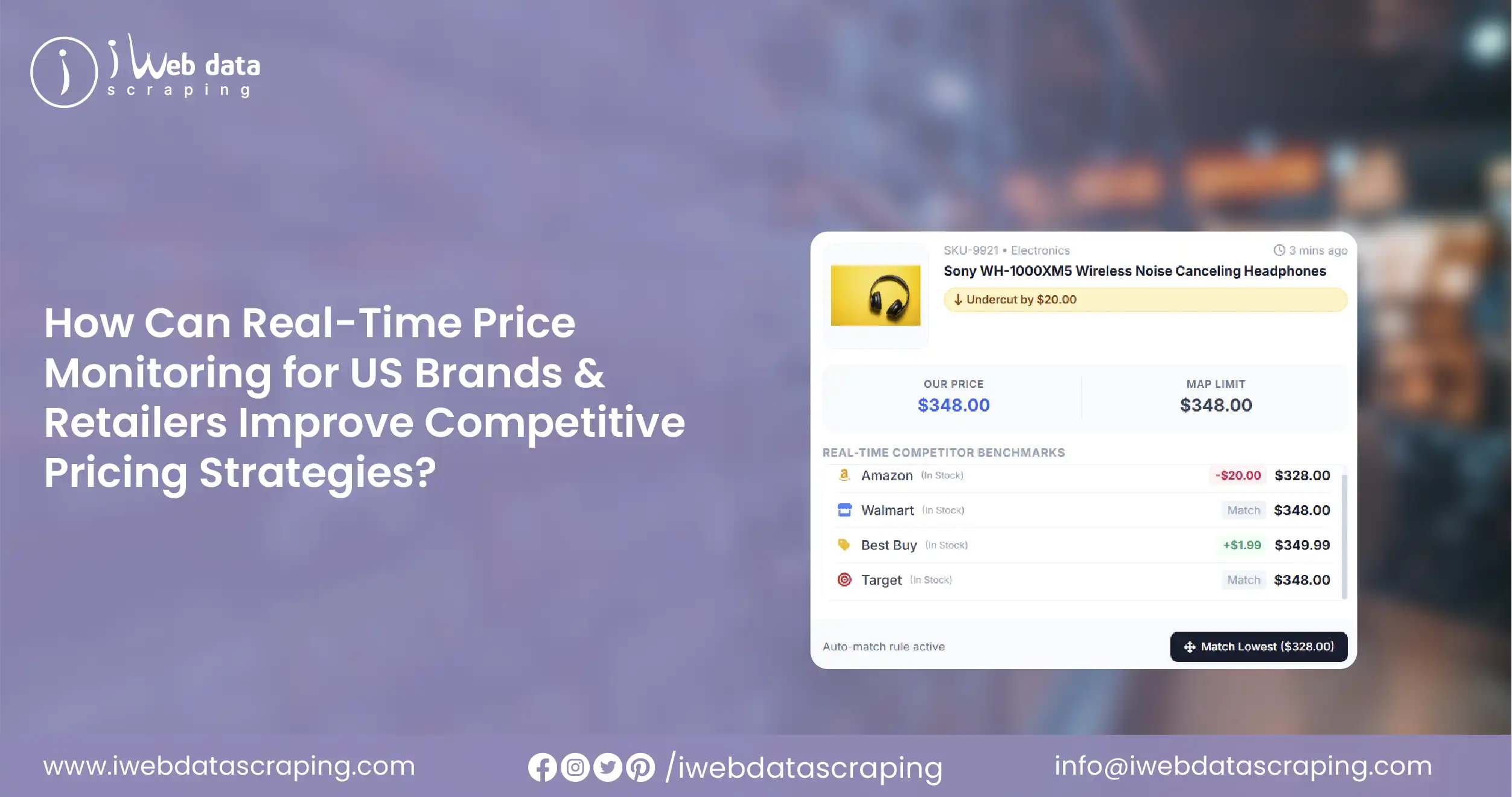
Pricing has become one of the most dynamic competitive factors in the US retail market. Brands and retailers continuously adjust product prices based on competitor movements, promotions, demand, inventory, seasonality, marketplace activity, and changing consumer behavior. In this environment, Real-Time Price Monitoring for US Brands & Retailers enables businesses to identify pricing changes quickly and respond with greater precision.
Modern retailers cannot rely solely on occasional manual checks or static spreadsheets. A competitor may launch a discount in the morning, change its price by afternoon, and restore the original price the following day. Without automated monitoring, brands can easily miss these changes and make pricing decisions using outdated information.
Competitor price tracking across US retailers gives businesses a structured way to monitor competing products, brands, retailers, marketplaces, and promotional offers across multiple locations. Instead of collecting pricing information manually, automated data collection can continuously capture product names, SKUs, prices, discounts, availability, ratings, promotions, and other important attributes.
A US retail pricing intelligence platform can transform these large volumes of pricing data into actionable intelligence. Businesses can compare prices across retailers, detect price gaps, identify discount patterns, monitor product positioning, and understand how competitors respond to market conditions.
Why Real-Time Price Monitoring Matters for US Retail?
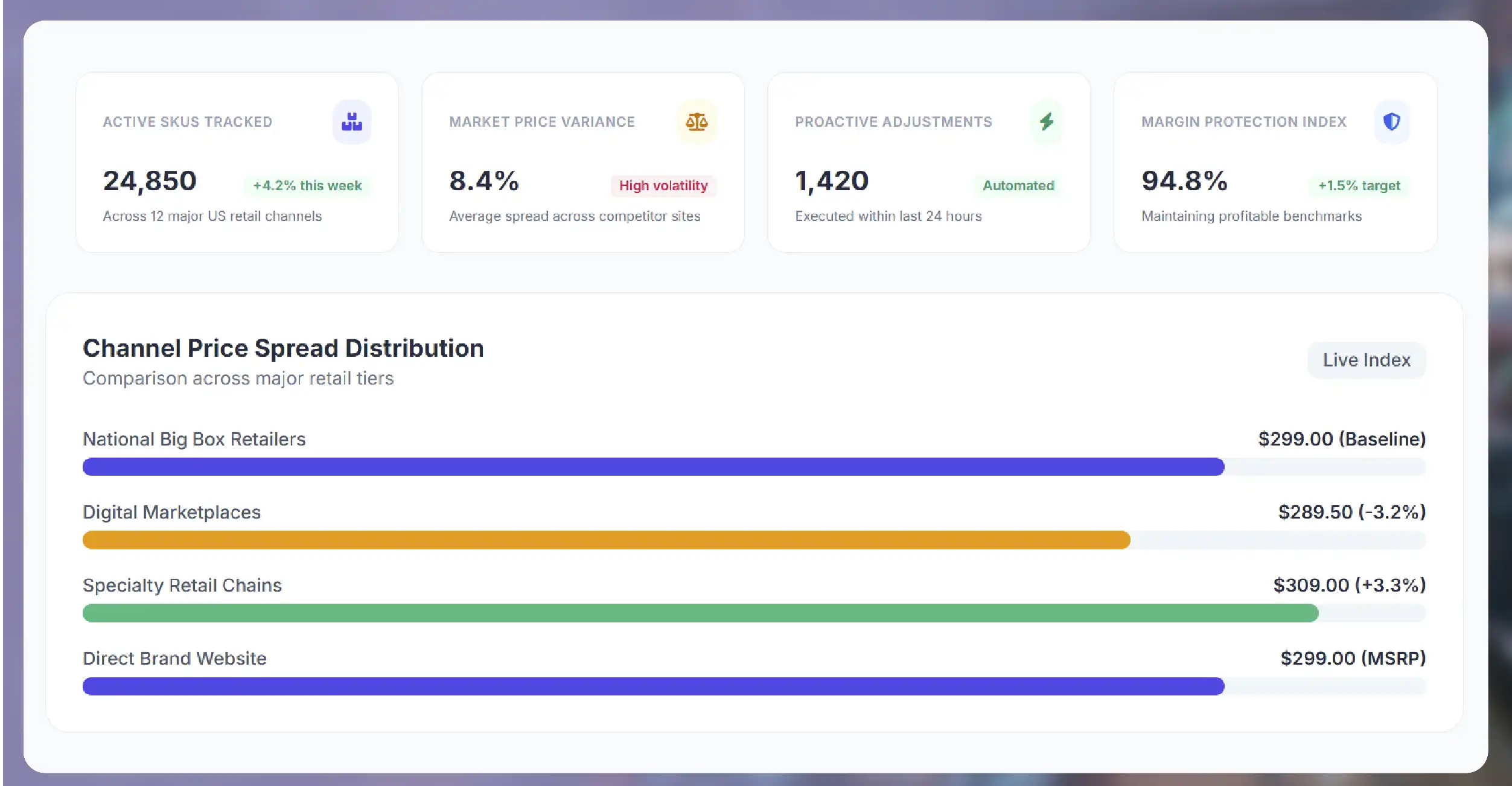
The US retail ecosystem is highly fragmented. Consumers can compare products across brand websites, national retailers, regional chains, marketplaces, grocery stores, specialty retailers, and delivery platforms within seconds.
This transparency has increased pressure on businesses to maintain competitive yet profitable prices. A small difference in price can influence where consumers purchase a product, particularly for frequently purchased or highly comparable products.
Real-time monitoring allows pricing teams to move from reactive decision-making to proactive market management. Instead of discovering a competitor's promotion after sales decline, businesses can identify the pricing change almost immediately and investigate its potential impact.
For example, a consumer electronics brand selling through several US retailers may monitor the same SKU across different channels. If one retailer suddenly reduces the price, the brand can identify the change, determine whether other retailers have followed, and evaluate whether its own pricing strategy requires adjustment.
What Data Can Be Monitored?
An effective monitoring system should capture more than just the listed product price. A broader dataset provides greater context for understanding competitive movements.
Key attributes can include:
- Product name and description
- SKU, UPC, or product identifier
- Current selling price
- Original or list price
- Discount percentage
- Promotional price
- Coupon availability
- Retailer name
- Product URL
- Brand
- Category
- Product availability
- Stock status
- Ratings and review counts
- Shipping charges
- Delivery information
- Seller information
- Promotion details
- Timestamp
- Location-specific pricing
This information can be collected at scheduled intervals or through real-time pipelines, depending on business requirements. Timestamped records are particularly valuable because they allow companies to understand not only what the price is, but also how and when it changed.
Cross-Retailer Price Comparison for Brands
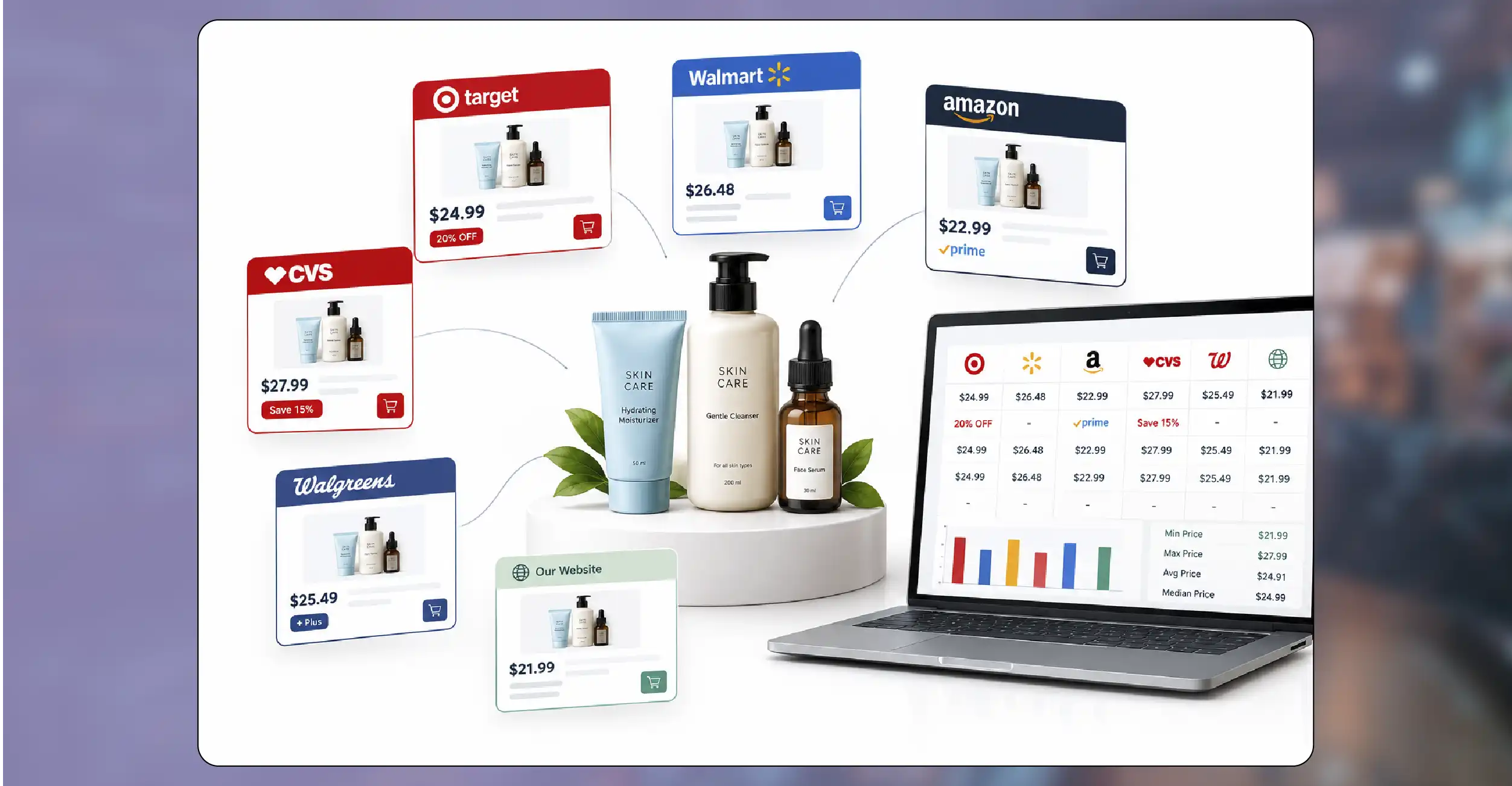
Cross-retailer price comparison for brands provides visibility into how the same product is positioned across different sales channels.
Consider a personal care brand selling through Target, Walmart, Amazon, CVS, Walgreens, and its own website. The advertised price may differ across these channels because of retailer promotions, seller activity, coupons, membership programs, or localized pricing strategies.
Automated monitoring can consolidate these observations into a unified dataset. Pricing teams can then examine minimum prices, maximum prices, average prices, median prices, discount depth, and price differences between retailers.
This can help brands identify unusual price gaps and understand channel-level pricing behavior. It can also support monitoring of minimum advertised pricing policies where applicable and help teams investigate potential pricing inconsistencies.
Building a Real-Time Pricing Data Pipeline
A reliable price monitoring system typically involves multiple stages. First, product and retailer sources are identified based on the monitoring requirements. Product URLs, SKUs, categories, retailer pages, and relevant geographic markets are then mapped.
The data collection layer gathers pricing and product information from selected sources. The extraction process should accommodate different page structures, dynamic content, pagination, product variants, and changing website layouts.
After collection, the data passes through validation and normalization. Prices may be standardized into consistent formats, product identifiers can be matched, duplicate records can be removed, and timestamps can be attached to every observation.
The processed information can then be delivered into databases, dashboards, spreadsheets, data warehouses, or analytical applications. This creates a repeatable pipeline through which pricing teams can continuously monitor market movements.
Real-Time Pricing API for Product Monitoring
A real-time pricing API for product monitoring can make competitive pricing data easier to integrate into existing business systems.
Instead of requiring analysts to repeatedly download files, an API can provide structured product and pricing information to internal applications, dashboards, pricing engines, and analytical workflows.
For example, an enterprise pricing application could retrieve the latest monitored price for selected SKUs and compare it against internal pricing rules. A dashboard could visualize retailer-level changes, while an alerting system could identify significant price movements.
API-based delivery is particularly useful for organizations monitoring thousands or millions of product records because it supports scalable data consumption and integration.
Historical and Live Pricing Analysis
Historical and live price tracking across US retailers provides two complementary perspectives.
Live monitoring answers questions such as:
- What is the current competitor price?
- Which retailer changed its price?
- Which products are currently discounted?
- Where is the largest price difference?
- Which products are currently unavailable?
Historical analysis answers different questions:
- How frequently does a competitor change prices?
- How deep are its typical discounts?
- Which products experience seasonal price changes?
- How long do promotions usually remain active?
- How has a retailer's pricing strategy changed over time?
Combining both perspectives allows businesses to identify recurring patterns rather than reacting to isolated price changes.
Detecting Competitor Pricing Strategies
Price monitoring becomes significantly more valuable when businesses analyze patterns across multiple observations.
A retailer may consistently undercut competitors on high-volume products while maintaining higher margins on premium products. Another retailer may use aggressive promotional pricing during weekends or holiday periods. A marketplace seller might change prices several times a day based on competition and inventory.
Automated monitoring can identify these patterns at scale.
Businesses can segment products by category, brand, retailer, geography, price range, or promotional status. This allows pricing teams to investigate whether specific categories experience greater volatility than others.
Price-change frequency can also become an important competitive indicator. A competitor changing thousands of prices daily may require a different monitoring cadence than a retailer whose assortment changes only occasionally.
Supporting Dynamic Pricing Decisions
Real-time competitive information can also support dynamic pricing strategies.
Retailers can combine competitor prices with internal sales, inventory, demand, margin, and promotional data. Rather than treating competitor pricing as an isolated metric, they can incorporate it into broader pricing models.
For example, a retailer holding excess inventory may identify that competitors have reduced prices for similar products. This information can support an evaluation of whether a promotional adjustment is appropriate.
Similarly, a brand may discover that its product is consistently priced significantly above comparable offerings. Instead of immediately changing the price, the business can investigate whether the difference is justified by product positioning, packaging, ratings, availability, or brand equity.
Monitoring Promotions and Discounts
Price monitoring should also capture promotional activity because the headline price alone can be misleading.
Retailers may use percentage discounts, dollar-off promotions, coupons, loyalty pricing, buy-one-get-one offers, bundle deals, clearance pricing, and limited-time campaigns.
Capturing these signals helps brands distinguish between permanent price changes and temporary promotions.
For instance, a retailer reducing a product from $49.99 to $39.99 for a weekend promotion represents a different competitive signal from permanently changing the price to $39.99. Historical records help businesses make this distinction.
Geographic and Retailer-Level Monitoring
US retail prices can vary by location. Regional promotions, local competition, store-level inventory, taxes, fulfillment options, and market-specific campaigns can influence observed prices.
Therefore, brands may need monitoring across multiple US markets rather than relying on a single national price observation.
Location-aware datasets can help businesses identify regional pricing differences and determine whether certain retailers consistently offer different prices in particular markets.
This becomes particularly important for grocery, consumer packaged goods, pharmacy, home improvement, electronics, and other categories where localized retail activity can influence competitive pricing.
Turning Pricing Data Into Actionable Intelligence
Collecting data is only the first step. The real value comes from organizing the information into useful business signals.
A pricing dashboard can display current prices, price changes, discount percentages, retailer comparisons, historical trends, and alerts. Teams can filter information by product, category, retailer, brand, market, or time period.
Automated alerts can notify users when competitors cross predefined thresholds. For example, a team could receive an alert when a competitor price falls by more than 10%, when a major product becomes unavailable, or when a monitored retailer launches a significant promotion.
This reduces the time analysts spend searching for changes and allows them to focus on interpreting the underlying market signals.
Benefits for US Brands and Retailers
Real-time price monitoring can support several business functions simultaneously.
- Pricing teams gain continuous visibility into competitor movements and can benchmark products more efficiently.
- Merchandising teams can identify promotional patterns and evaluate assortment-level positioning.
- Sales teams can understand channel-level price differences and prepare more informed conversations with retail partners.
- Market intelligence teams can study competitor behavior over longer periods.
- Executives can access summarized pricing trends through dashboards and reports rather than relying on fragmented manual research.
The result is a more connected pricing intelligence workflow in which market observations can move rapidly from data collection to analysis and decision support.
How iWeb Data Scraping Can Help You?
1. Automated Retailer Monitoring
iWeb Data Scraping can automate the collection of product prices, discounts, availability, promotions, SKUs, and retailer information across selected US retail sources.
2. Scalable Competitive Data
Our data pipelines can support monitoring across large product catalogs, multiple retailers, categories, markets, and geographic locations while maintaining structured and consistent datasets.
3. Historical Price Intelligence
iWeb can organize timestamped pricing records, helping businesses compare current observations with previous prices and identify recurring promotional or competitive pricing patterns.
4. Flexible Data Delivery
Collected pricing information can be structured for dashboards, databases, analytics systems, spreadsheets, or API-based workflows according to specific business requirements.
5. Actionable Pricing Insights
iWeb Data Scraping can help transform continuously collected retail pricing data into organized intelligence that supports benchmarking, competitor analysis, promotion monitoring, and market research.
Conclusion
For modern US brands and retailers, pricing visibility is increasingly connected to competitive performance, channel management, promotions, and customer expectations. Manual price checks provide only fragmented snapshots, while automated monitoring creates a continuous view of market movements.
Businesses can use Price Monitoring Services to track products, retailers, promotions, discounts, availability, and price changes at scale. With structured data pipelines, organizations can transform scattered retail observations into consistent datasets for analysis and reporting.
A scalable scraping API can further connect monitored pricing information with dashboards, databases, analytics applications, and internal pricing workflows, making competitive data easier to consume.
Ultimately, Price Monitoring vs Price Intelligence for US is not simply about collecting prices. Monitoring identifies what changed, while broader intelligence helps businesses understand patterns, context, competitive positioning, and potential business implications. When real-time observations are combined with historical records and structured analytics, brands and retailers gain a stronger foundation for understanding the constantly changing US retail pricing environment.
FAQs
Real-time price monitoring is the automated collection and observation of product prices, discounts, promotions, and availability across selected retailers or marketplaces at frequent intervals.
Monitoring competitor prices helps brands understand channel-level pricing movements, promotional activity, price gaps, and changes in competitive positioning across the US retail market.
A monitoring system can capture product names, SKUs, discounts, original prices, availability, ratings, promotions, seller information, shipping details, URLs, and timestamps.
Historical records help retailers identify recurring price changes, seasonal patterns, promotional cycles, competitor behavior, and long-term pricing trends rather than relying only on current observations.
Yes. Structured pricing data can be delivered through an API or other formats and integrated with dashboards, databases, analytics platforms, pricing systems, and internal applications.