

Introduction
India's real estate industry is expanding across residential, commercial, affordable housing and mixed-use developments. With thousands of projects being registered, updated, extended and completed across different states, accessing reliable regulatory information has become essential for developers, investors, financial institutions, property consultants and proptech companies. The Real Estate (Regulation and Development) Act, 2016, introduced greater transparency by requiring promoters to disclose important project information through regulatory authorities.
RERA data scraping India enables businesses to systematically collect publicly available information from state-specific regulatory portals, transforming scattered records into structured datasets for research, monitoring and business intelligence.
By extracting RERA project data, organisations can examine registration numbers, project locations, construction timelines, approvals, inventory details and completion status. These insights help businesses understand development activity and evaluate property opportunities across different markets.
Similarly, collecting RERA promoter data provides visibility into developer identities, business registrations, associated projects, financial disclosures and compliance-related information. Combining project and promoter intelligence creates a more comprehensive understanding of India's property development ecosystem.
This blog explores how state-wise RERA data extraction works, what information can be collected from regulatory portals, how businesses use this intelligence, and how automated data collection helps organisations build structured real estate datasets.
1. Understanding India's State-Wise RERA Data Ecosystem
RERA operates through state and Union Territory regulatory authorities rather than one uniform operational database. Each authority maintains its own portal, search functionality, registration procedures, disclosure requirements and document formats.
Consequently, collecting real estate intelligence across India requires accessing multiple regulatory websites and standardising their information.
Some important state portals include:
| State | Regulatory Portal | Important Information |
|---|---|---|
| Maharashtra | MahaRERA | Project registrations, promoters, quarterly updates and complaints |
| Karnataka | Karnataka RERA | Project approvals, registration and progress |
| Uttar Pradesh | UP-RERA | Project status, promoters and agent registrations |
| Gujarat | Gujarat RERA | Project details, approvals and compliance |
| Telangana | TG-RERA | Registered projects, agents and complaints |
| Rajasthan | Rajasthan RERA | Project, promoter, agent and complaint records |
| Bihar | Bihar RERA | Project registrations, promoter information and quarterly updates |
| Haryana | HRERA | Project registrations, licences and compliance |
| Kerala | K-RERA | Project disclosures and progress reports |
| Tamil Nadu | TNRERA | Project registrations and promoter disclosures |
The information published by these authorities can vary significantly. Some portals provide advanced filters, while others require users to navigate individual project pages and download supporting documents.
For data intelligence companies, this creates an opportunity to build a unified database from multiple regulatory sources.
2. What Information Can Be Extracted from State RERA Portals?
State regulatory websites contain several categories of information that can support real estate research and business decisions.
A. Project Registration and Development Details
Project registration information establishes the regulatory identity of a development.
Important fields include:
- Project name and RERA registration number.
- Registration approval and validity dates.
- Project category and development type.
- State, district, city and locality.
- Project address and geographical coordinates, where published.
- Total land area and proposed development.
- Residential and commercial unit configurations.
- Original and revised completion dates.
- Current registration or project status.
This information supports geographical project mapping, competitive supply analysis and development pipeline monitoring.
For example, a property consultancy analysing residential opportunities in Pune can compare registered projects across different localities, identify upcoming developments and examine declared completion timelines.
B. Promoter and Developer Information
Promoters play a central role in real estate development. Their registration history, associated projects and regulatory disclosures can provide useful business intelligence.
A structured extraction process can capture:
- Promoter or company name.
- Registered business address.
- Contact information published on the portal.
- Company or registration identifiers, where disclosed.
- Co-promoter and landowner details.
- Associated project registrations.
- Previous and ongoing developments.
- Disclosed financial and project information.
- Complaints, regulatory orders and penalties, where available.
Analysing this information allows businesses to connect developers with their registered projects across different geographical markets.
For instance, an investor can examine a promoter's disclosed project portfolio and identify developments with delayed completion dates or unresolved regulatory matters.
However, regulatory records should be interpreted carefully. A complaint does not automatically establish wrongdoing, and a promoter's historical project record should be evaluated alongside supporting documents and current disclosures.
C. Real Estate Agent Registration Details
Agents influence property transactions by connecting buyers, sellers and developers. Their registration information is another valuable component of regulatory intelligence.
A structured RERA agents list can include:
- Agent or agency name.
- Registration number.
- Registration validity.
- Business address.
- Contact information, where publicly available.
- Registered state or operating jurisdiction.
- Renewal details.
- Registration status.
- Published disciplinary actions or regulatory orders.
This dataset can help property marketplaces validate agent credentials, identify registered intermediaries and organise geographically segmented agent directories.
Real estate companies can also use agent information to study intermediary networks across residential and commercial markets.
3. Monitoring Quarterly Project Updates and Construction Progress
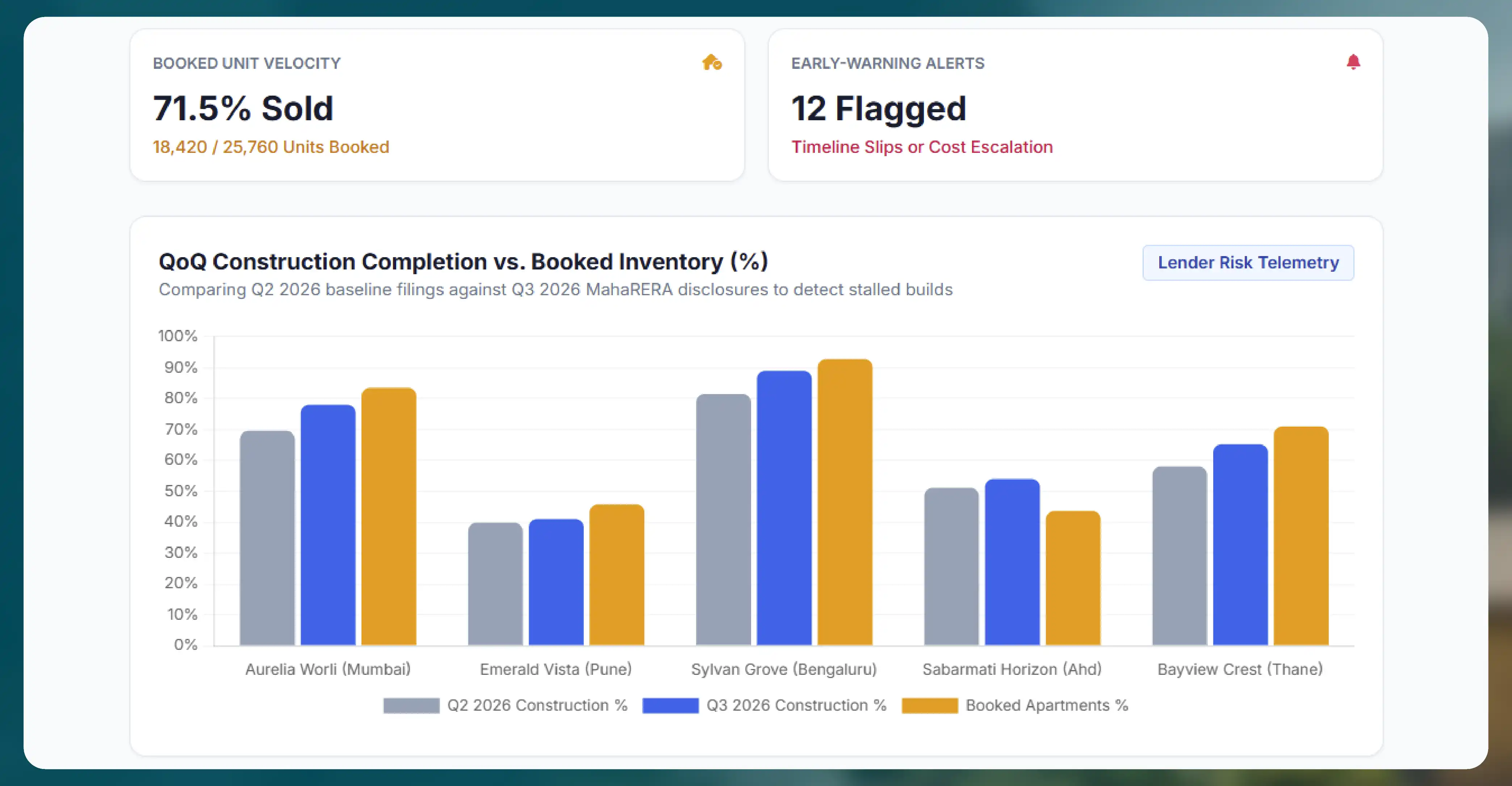
One of the most valuable aspects of RERA intelligence is the ability to track project changes over time.
Under Section 11 of the RERA Act, promoters must maintain project information on the regulatory authority's website and provide prescribed updates. These include booked inventory, project status and approvals.
Depending on the applicable state rules and portal disclosures, businesses can extract:
- Quarterly progress reports.
- Construction completion percentages.
- Number and types of booked apartments.
- Garage booking information.
- Pending and approved permissions.
- Changes in project timelines.
- Building-wise completion information.
- Updated project costs.
- Details of professionals associated with development.
MahaRERA, for example, provides project update guidance covering building details, booked units, construction activities, actual project costs, encumbrance-related documents and professional information.
These updates become particularly useful when collected periodically rather than through one-time extraction.
Consider a financial institution monitoring 100 residential developments. By comparing successive project updates, it can identify changes in construction progress, revised completion dates and variations in disclosed inventory.
This helps create early-warning indicators for project monitoring and lending decisions.
4. Tracking Complaints, Orders and Regulatory Compliance
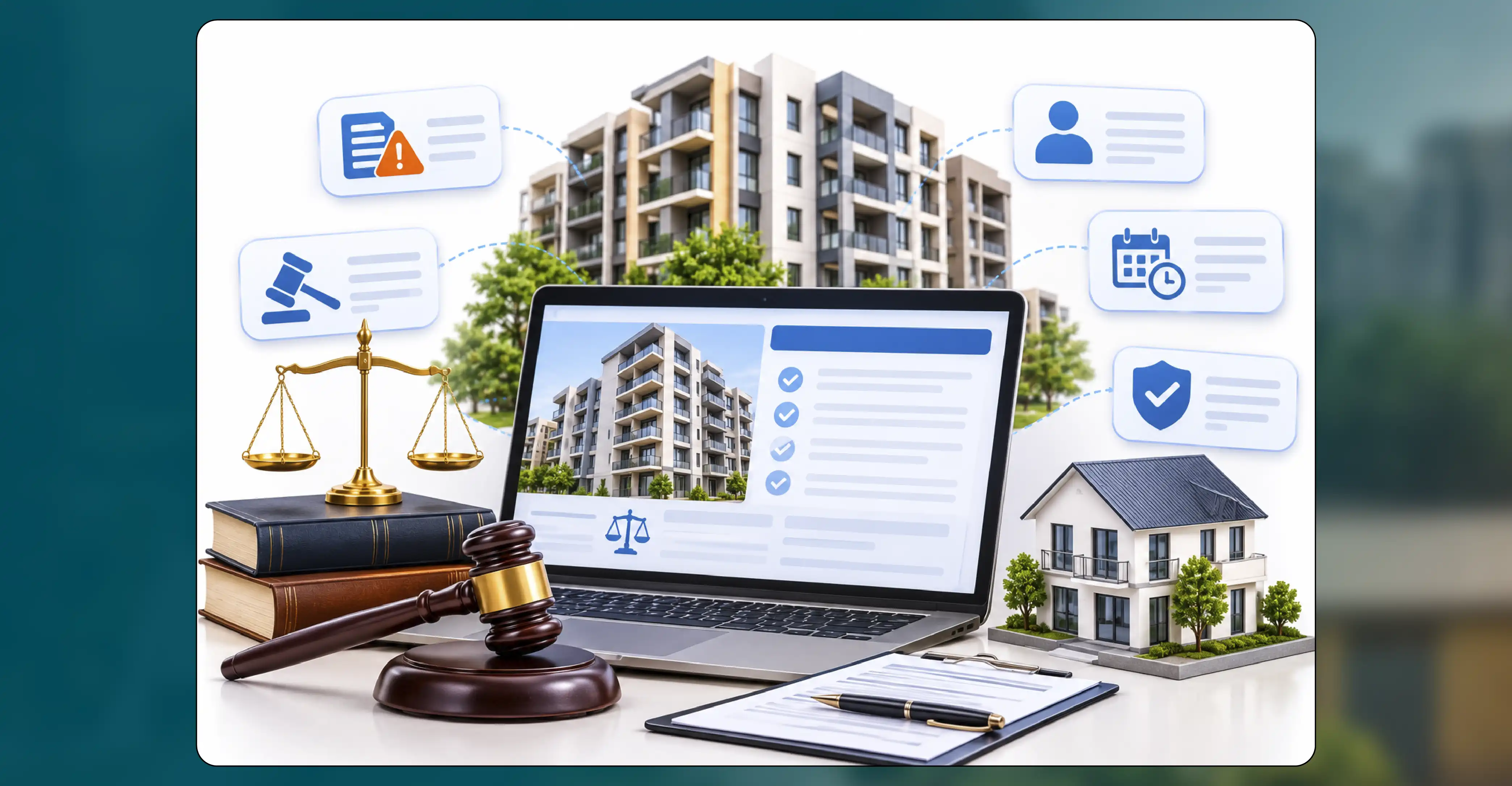
Project registration alone does not provide a complete picture of regulatory performance. Complaint records, authority orders, penalties and registration-related actions add another layer of information.
RERA portals may publish:
- Complaint reference numbers.
- Project and promoter names.
- Respondent details.
- Complaint categories.
- Hearing dates and case status.
- Regulatory orders and judgments.
- Penalties imposed.
- Registration suspensions or revocations.
- Compliance directions.
These records can support legal research, developer monitoring and regulatory risk assessment.
For example, a lender evaluating a developer can combine project registration information with published complaint and order records to identify matters requiring further due diligence.
It is important to distinguish between filed complaints, ongoing proceedings and final orders. Treating all complaints as confirmed violations can produce misleading risk assessments.
5. How Real Estate Businesses Use RERA Data for Market Intelligence?
Extracted regulatory information becomes more valuable when combined with analytical models and other property datasets.
Project Supply and Competition Analysis
Developers can analyse the number of registered projects across cities, localities and property categories. This helps identify development clusters, competing supply and areas experiencing increased construction activity.
Promoter Portfolio Intelligence
Investors and property consultants can examine promoters with multiple registered developments, compare their disclosed project histories and identify expansion patterns across different states.
Construction Delay Monitoring
Comparing proposed completion dates with revised timelines and available progress reports helps businesses identify developments requiring additional monitoring.
Geographical Market Research
Combining project addresses, locations and development categories supports city-level and locality-level real estate supply analysis.
Agent Network Intelligence
Property marketplaces can organise registered agents by location, registration status and business category to improve agent verification and directory management.
6. Challenges in Extracting Data from Multiple RERA Portals
Despite the public availability of regulatory information, building a reliable nationwide dataset requires overcoming several technical and data-quality challenges.
- Different Portal Structures: Every state authority may use different navigation systems, search filters, field names and registration formats. Extraction workflows must accommodate these differences.
- PDF-Based Disclosures: Important information may be available only through uploaded certificates, financial statements, approvals and progress reports. Some documents require additional text extraction or OCR processing.
- Inconsistent Data Formats: Project names, promoter identities, addresses and registration numbers may follow different formatting conventions. Standardisation is necessary before cross-state comparisons.
- Frequent Information Changes: New registrations, extensions, corrections and quarterly updates can change previously collected records. Scheduled extraction helps maintain data freshness.
- Duplicate Promoter Records: The same developer may appear under different company names, subsidiaries or project-specific registrations. Entity matching helps connect related records without incorrectly merging separate legal entities.
- Incomplete Disclosures: Not every authority publishes the same information, and some project pages may contain missing or outdated fields. Missing information should be clearly identified rather than assumed.
A 2023 assessment of 18 RERA authorities by the Indian Institute for Human Settlements highlighted differences in disclosure coverage and the availability of quarterly project updates. This reinforces the importance of state-wise validation and consistent data-quality checks.
7. Building a Unified RERA Database Through Automated Data Extraction
A scalable RERA data collection system should combine automated extraction, document processing, validation and database integration.
A typical workflow includes:
1. Source Identification
Identify relevant state RERA portal data and determine their publicly accessible project, promoter, agent and complaint records.
2. Automated Data Collection
Extract available information from search results, registration pages, project profiles, public documents and regulatory disclosures.
3. Document Processing
Extract relevant information from PDFs, certificates and reports using document parsing and OCR wherever required.
4. Data Standardisation
Convert different state-specific formats into a consistent structure using standard field names, registration identifiers and geographical classifications.
5. Data Validation
Check missing fields, duplicate records, invalid dates, inconsistent registration numbers and conflicting project information.
6. Database Integration
Organise validated information into structured datasets, APIs, spreadsheets or cloud databases.
7. Continuous Monitoring
Schedule periodic collection to identify new registrations, project amendments, quarterly updates and changes in regulatory status.
The resulting real estate project data India can support dashboards, lending analytics, property research platforms and enterprise reporting systems.
Automated extraction should respect portal terms, applicable laws, access restrictions and reasonable request limits. Public availability does not automatically mean every record can be collected or reused without conditions.
8. Combining RERA Data with Property Listing Intelligence
Regulatory records and property listings serve different purposes, making their combination particularly valuable.
RERA portals primarily provide regulatory disclosures, while property marketplaces provide information about properties being marketed to prospective buyers.
Combining these datasets can help businesses examine:
| RERA Information | Property Listing Information | Business Application |
|---|---|---|
| Project registration | Advertised project name | Project verification |
| Promoter details | Developer profile | Developer intelligence |
| Approved unit configurations | Listed apartment configurations | Inventory comparison |
| Declared completion date | Advertised possession timeline | Timeline monitoring |
| Project location | Listing locality | Geographical benchmarking |
| Regulatory project status | Listing availability | Market monitoring |
| Project approvals | Property descriptions | Disclosure comparison |
For example, combining regulatory records with Housing.com listings can help property research companies compare registered developments with properties actively advertised online.
However, listing availability should not be interpreted as confirmed RERA inventory, and differences in project names or unit configurations require careful matching.
9. The Future of RERA Data Intelligence in India
The next stage of real estate intelligence will involve connecting regulatory disclosures with financial, geographical and marketplace information.
Artificial intelligence and machine learning can support promoter entity matching, document classification, project-status monitoring and anomaly detection.
Geospatial analytics can help identify development concentration across districts and urban corridors. Historical datasets can support construction-delay analysis and project supply forecasting.
Lenders can integrate verified regulatory information into their internal risk assessment systems, while property marketplaces can improve project verification and listing accuracy.
As more businesses adopt data-driven real estate strategies, structured regulatory information will become an increasingly important foundation for market research and operational intelligence.
How iWeb Data Scraping Can Help You?
iWeb Data Scraping can help businesses transform regulatory disclosures into organised datasets, competitive intelligence, and actionable real estate insights.
1. Nationwide Project Extraction
iWeb Data Scraping collects publicly available registrations, project details, locations and completion timelines across multiple state RERA portals for structured nationwide market research.
2. Promoter Intelligence
Extract developer profiles, associated projects, registration information and published compliance records to support promoter research, portfolio comparisons and business due diligence.
3. Agent Database Development
Collect publicly disclosed agent registrations, validity details, business information and geographical coverage to develop organised datasets for property marketplaces and verification platforms.
4. Continuous Project Monitoring
Track quarterly updates, construction progress, inventory disclosures, revised timelines and regulatory changes through scheduled extraction workflows for timely real estate intelligence.
5. Customised Data Integration
iWeb delivers standardised RERA datasets through flexible formats, APIs and database integrations, helping lenders, investors and proptech businesses build analytical dashboards and reporting systems.
Conclusion
India's real estate sector requires reliable regulatory information to support investment research, project monitoring, promoter evaluation and property market analysis. State RERA portals provide valuable disclosures, but differences in website structures, document formats and reporting practices make nationwide data collection challenging.
RERA data scraping India helps businesses transform fragmented regulatory disclosures into organised, searchable and analysis-ready information covering projects, promoters, agents, approvals and compliance records.
With automated RERA data for lending analytics, financial institutions can strengthen project monitoring, conduct structured promoter assessments and identify potential areas requiring further investigation.
Furthermore, integrating regulatory disclosures with a Housing.com real estate dataset can help property businesses compare registered developments with advertised listings and develop broader market intelligence.
iWeb Data Scraping delivers customised extraction, validation, standardisation and integration solutions to help organisations convert publicly available real estate information into actionable business intelligence.
Frequently Asked Questions (FAQs)
RERA data scraping involves automatically collecting publicly available information from state and Union Territory RERA portals, including project registrations, promoter profiles, agent details, construction updates, approvals and regulatory records.
Depending on accessibility and project requirements, extraction can cover MahaRERA, UP-RERA, Karnataka RERA, Gujarat RERA, Bihar RERA, Telangana RERA, Rajasthan RERA, Haryana RERA, Kerala RERA and other state authorities.
Available information may include project names, registration numbers, promoter details, project locations, development categories, approved configurations, completion timelines, construction updates and supporting regulatory documents.
Banks and financial institutions can use structured RERA information to monitor construction progress, examine promoter portfolios, review published regulatory orders, track completion timelines and support property-related lending due diligence.
Yes. iWeb Data Scraping can develop customised extraction workflows and deliver structured RERA datasets through Excel, CSV, JSON, APIs and database integrations, subject to source availability and permitted access.