

Introduction
The restaurant and food delivery industry is increasingly driven by real-time digital information. Menu availability, prices, restaurant ratings, delivery times, discounts, cuisines, locations, and customer reviews can change throughout the day. Businesses that can systematically collect and analyze this information gain valuable visibility into market movements, competitor positioning, and consumer demand.
Restaurant & Food Delivery APIs help businesses collect structured restaurant and food delivery information from multiple digital platforms and transform scattered online data into usable datasets and intelligence. APIs and automated extraction workflows can support applications such as competitive intelligence, restaurant discovery, menu monitoring, price comparison, delivery analysis, and location-based food research.
For businesses working across India's food ecosystem, a Zomato, Swiggy & EazyDiner API integration guide can help explain how restaurant information can be collected, standardized, and delivered into internal applications, dashboards, databases, or analytics systems.
Similarly, Zomato, Swiggy & EazyDiner restaurant data extraction can provide information such as restaurant names, cuisines, addresses, ratings, menu items, prices, discounts, opening hours, delivery information, and dining offers in structured formats.
Why Restaurant and Food Delivery APIs Matter?
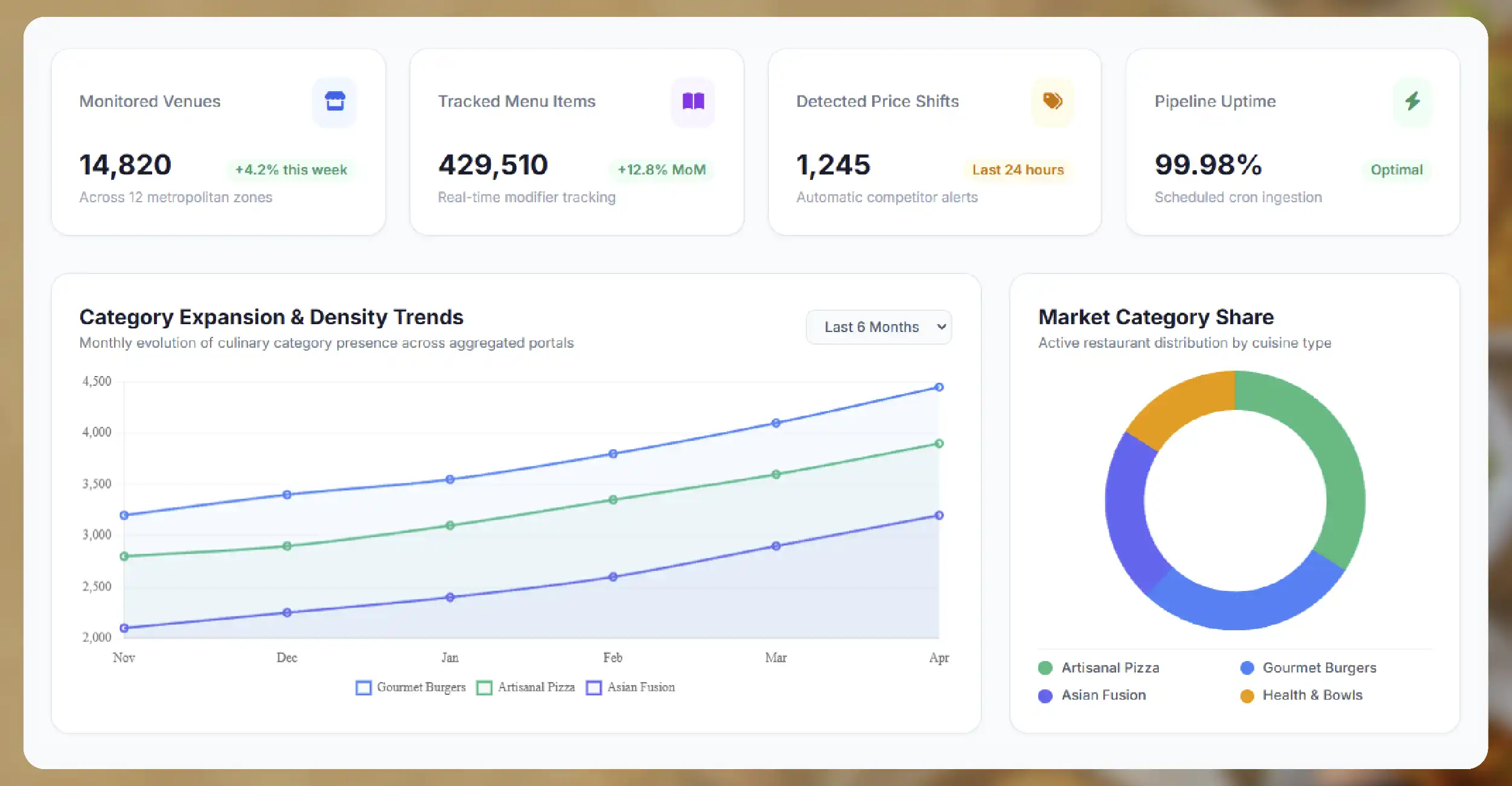
Restaurant platforms generate enormous amounts of information every day. A single platform may contain thousands of restaurants across cities, with each restaurant offering dozens or hundreds of menu items. Manually collecting this information is time-consuming and difficult to maintain.
An automated API-based approach enables organizations to establish repeatable data collection pipelines. Instead of depending on occasional manual research, businesses can configure workflows to collect selected fields at scheduled intervals.
For example, a restaurant intelligence platform may monitor menu changes and identify when competitors introduce new products. A pricing application can compare similar dishes across multiple restaurants. Investors can analyze restaurant density and category expansion, while food brands can study consumer-facing pricing and promotional activity.
What Restaurant Data Can Be Collected?
A comprehensive restaurant data pipeline can capture multiple categories of information, depending on the source and permitted access method.
Restaurant Information
Typical fields include restaurant name, location, address, phone number, cuisine category, restaurant type, operating hours, service options, ratings, review counts, and geographic coordinates.
Menu Information
Menu datasets can contain category names, dish names, descriptions, serving sizes, prices, variants, add-ons, dietary attributes, and availability indicators.
Pricing and Promotions
Businesses can monitor listed prices, discounted prices, promotional offers, coupons, combo deals, delivery charges, minimum order values, and other pricing signals.
Delivery Information
Food delivery datasets may include delivery estimates, service availability, restaurant delivery status, ordering conditions, and location-specific delivery information where available.
Dining Information
Dining platforms can provide information about restaurant reservations, dining offers, cuisines, ratings, addresses, and promotional deals. Such information can support restaurant discovery and dining intelligence applications.
Building a Restaurant Menu and Pricing Data Pipeline
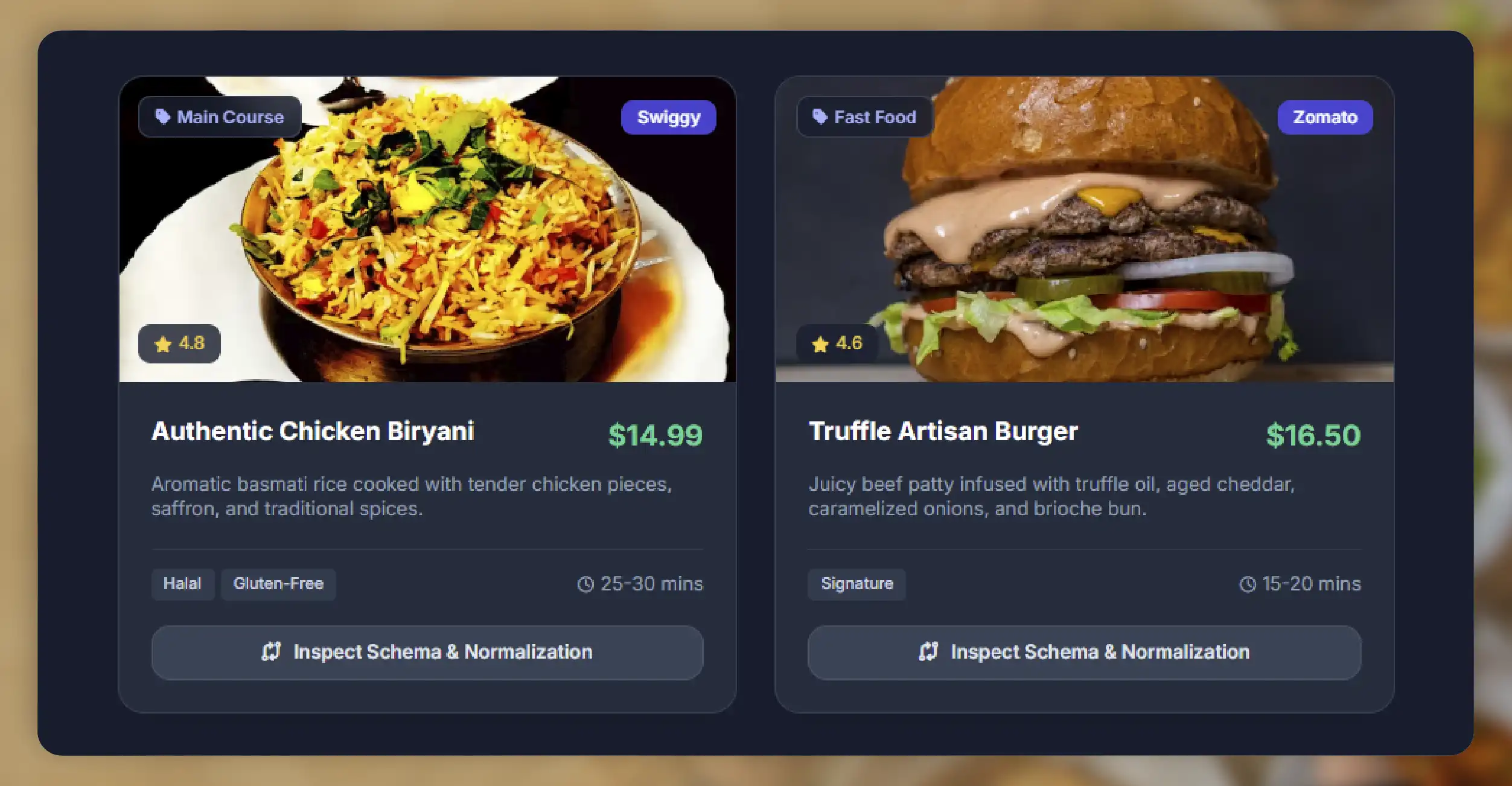
A successful restaurant data pipeline generally consists of several connected stages. First, the required sources and fields are identified. Next, data is collected through suitable APIs or automated extraction mechanisms. The raw information is then transformed into standardized records.
A method to Scarpe Restaurant menu and pricing data API workflow can be designed to normalize restaurant and menu information across different platforms. Since every platform may use different naming conventions, formats, categories, and identifiers, normalization is important for meaningful comparison.
For example, one platform might list a dish as "Chicken Biryani," while another may use "Chicken Biriyani." A normalization layer can help standardize names and categories for analytical purposes without losing the original source information.
The processed data can then be delivered through JSON, CSV, databases, cloud storage, dashboards, or custom API endpoints according to business requirements.
Real-Time Food Delivery Intelligence
Food delivery markets can change rapidly. Prices may fluctuate, restaurants can become temporarily unavailable, and delivery estimates can vary according to location and demand.
A strategy to Extract Real-time food delivery data API solution can support applications that require frequently refreshed information. Businesses can define collection schedules according to their use case, such as hourly, daily, or event-driven monitoring.
Real-time or near-real-time information is particularly useful for competitive pricing analysis. Businesses can identify changes in menu pricing, promotions, restaurant availability, and delivery conditions without waiting for periodic manual research.
Tracking Dining Platforms and Restaurant Offers
Restaurant discovery and dining platforms contain another valuable layer of information. Dining offers, restaurant ratings, cuisines, locations, and reservation-related information can help businesses understand how restaurants position themselves across different channels.
Tracking EazyDiner or Zomato Dining data can help build structured restaurant intelligence covering dining locations, cuisines, ratings, offers, menu information, and other available attributes.
For restaurant aggregators, location intelligence companies, and market researchers, this information can support city-level analysis. Researchers can identify restaurant clusters, cuisine trends, pricing patterns, and changes in competitive positioning.
Swiggy Restaurant Data Extraction
Restaurant information available through food delivery platforms can provide a detailed view of local food markets.
Swiggy restaurant data extraction can capture relevant restaurant, menu, pricing, location, rating, cuisine, availability, and promotional information where accessible through the selected collection methodology.
When combined with information from other platforms, this data can enable cross-platform comparison. Businesses can identify restaurants appearing on multiple services, compare menu prices, analyze promotional differences, and study geographic coverage.
How APIs Improve Food Data Workflows?
API-based data delivery can simplify the movement of extracted information into business systems. Instead of maintaining isolated spreadsheets, organizations can connect structured data with analytics platforms, CRM systems, pricing engines, recommendation applications, or internal databases.
Food Data Scraping API Services can be configured around specific business requirements, including selected sources, fields, locations, refresh frequencies, output formats, and validation processes.
Data quality is equally important. Duplicate records, missing fields, inconsistent restaurant names, outdated prices, and formatting differences can reduce the value of a dataset. Validation, normalization, deduplication, and monitoring therefore form essential components of a reliable pipeline.
Cross-Platform Restaurant Intelligence
One of the strongest applications of restaurant data collection is cross-platform comparison.
A Zomato & Swiggy Data Scraping API workflow can combine information from multiple food platforms into standardized records. Businesses can then compare restaurant availability, menu items, prices, ratings, promotions, and other attributes.
For example, a restaurant intelligence dashboard could display the same restaurant across different platforms and highlight differences in listed prices or promotional offers. Analysts could also examine how restaurant coverage varies between neighborhoods and cities.
Supporting Competitive Analysis
Competitive intelligence is another major use case. Restaurant chains and food brands can monitor competitors without relying entirely on manual research.
Zomato and Swiggy data scraping can support recurring collection of restaurant and menu information for market analysis. Historical datasets can help businesses identify pricing movements, menu additions, promotional patterns, and restaurant expansion.
This information can contribute to pricing strategies, menu planning, location analysis, competitor benchmarking, and campaign research.
Creating Scalable Restaurant Datasets
Large-scale restaurant intelligence requires more than simply collecting information once. Businesses need repeatable pipelines capable of handling changing sources, growing restaurant inventories, and evolving data requirements.
A scalable workflow can include source monitoring, automated collection, data validation, normalization, duplicate removal, structured storage, and scheduled delivery. Businesses can also create separate datasets for restaurants, menus, prices, reviews, promotions, delivery information, and locations.
This approach allows teams to use the same underlying data for multiple analytical applications instead of repeatedly collecting similar information for different departments.
Business Applications of Restaurant API Data
Restaurant and food delivery data can support a broad range of applications:
- Price intelligence: Compare menu prices and promotional pricing across platforms.
- Restaurant discovery: Build searchable databases of restaurants by location, cuisine, rating, or service type.
- Menu analytics: Track menu composition, new dishes, categories, and pricing changes.
- Competitive benchmarking: Compare restaurant offerings and market positioning.
- Location intelligence: Analyze restaurant density and cuisine distribution across cities.
- Investment research: Study restaurant market expansion and competitive activity.
- Food delivery analytics: Examine delivery-related information and service availability.
- Consumer applications: Power restaurant discovery, comparison, and recommendation platforms.
Data Accuracy and Compliance Considerations
A professional restaurant data pipeline should prioritize responsible collection practices. Businesses should review applicable platform terms, access policies, privacy requirements, and legal obligations before implementing data collection workflows.
Data should also be refreshed according to its intended purpose. Menu prices and availability can become outdated quickly, while restaurant addresses or cuisine categories may change less frequently.
Quality checks should therefore be designed around each field's expected frequency of change. This creates a more efficient pipeline while improving the usefulness of the resulting datasets.
How iWeb Data Scraping Can Help You?
1. Multi-Platform Data Collection
iWeb Data Scraping can develop structured workflows for collecting restaurant, menu, pricing, location, and delivery information from multiple permitted sources according to defined business requirements and refresh schedules.
2. Customized Data Fields
Businesses can specify the exact restaurant and food delivery fields they require, helping create focused datasets instead of unnecessarily collecting large volumes of irrelevant information.
3. Data Cleaning and Standardization
Collected information can be processed through normalization, validation, deduplication, and formatting workflows, making datasets easier to integrate with dashboards, databases, analytics tools, and applications.
4. Flexible Delivery Formats
iWeb Data Scraping can provide processed restaurant intelligence in formats such as JSON, CSV, databases, or customized API outputs, supporting different technical and analytical workflows.
5. Scalable Intelligence Pipelines
Whether monitoring a handful of restaurants or thousands of locations, scalable workflows can support recurring data collection, historical storage, monitoring, and structured delivery for long-term restaurant intelligence.
Conclusion
Restaurant and food delivery data has become an important foundation for competitive intelligence, menu analytics, pricing research, restaurant discovery, and food-market analysis. Automated collection allows businesses to move beyond occasional manual research and create structured, continuously updated information pipelines.
An Eazydiner Restaurant Data Scraping API can help businesses integrate dining-focused information into broader restaurant intelligence workflows, while Restaurant Menu Datasets can support menu comparison, pricing analysis, and product-level research.
Likewise, Food-delivery datasets can help organizations analyze restaurant availability, delivery-related information, promotions, pricing, and market activity across selected locations. With appropriate data validation, normalization, refresh schedules, and responsible collection practices, restaurant API data can become a valuable resource for modern food-tech and analytics applications.
FAQs
It is an automated process for collecting structured restaurant, menu, pricing, location, promotion, and delivery-related information from accessible digital sources for analysis or integration.
Depending on the source, businesses may collect restaurant names, addresses, cuisines, ratings, menus, dish prices, offers, operating hours, delivery information, and location attributes.
The ideal frequency depends on the use case. Pricing and availability may require frequent refreshes, while restaurant addresses and other relatively stable attributes may need less frequent updates.
Yes. Data pipelines can normalize restaurant names, categories, locations, menu structures, prices, and other fields to create consistent records for cross-platform analysis.
Restaurant datasets can support competitive intelligence, menu analytics, price monitoring, restaurant discovery, market research, location analysis, investment research, and food delivery applications.