

Introduction
Customer reviews have become one of the most valuable sources of market intelligence for modern businesses. Every rating, comment, complaint, compliment, and recommendation can reveal what customers truly think about a product, service, or brand. For global organizations operating across countries, languages, marketplaces, and digital channels, monitoring this information manually is increasingly difficult.
Review Monitoring Automation for Global Brands helps businesses continuously collect, organize, monitor, and analyze customer feedback at scale. Instead of relying on scattered spreadsheets or manually checking review platforms, companies can establish an automated process that captures fresh customer feedback and transforms it into structured intelligence.
When thousands of Review sentiment analysis for Global Brands are published every day, the biggest challenge is not collecting information but understanding it quickly. Automated systems can identify positive and negative patterns, detect recurring complaints, monitor rating movements, and highlight important changes in customer expectations.
This approach Automate customer review data Extraction allows businesses to move beyond simple review management. Customer feedback can become a strategic resource for product development, customer experience improvement, competitor benchmarking, reputation management, and market intelligence.
Why Global Brands Need Automated Review Monitoring?
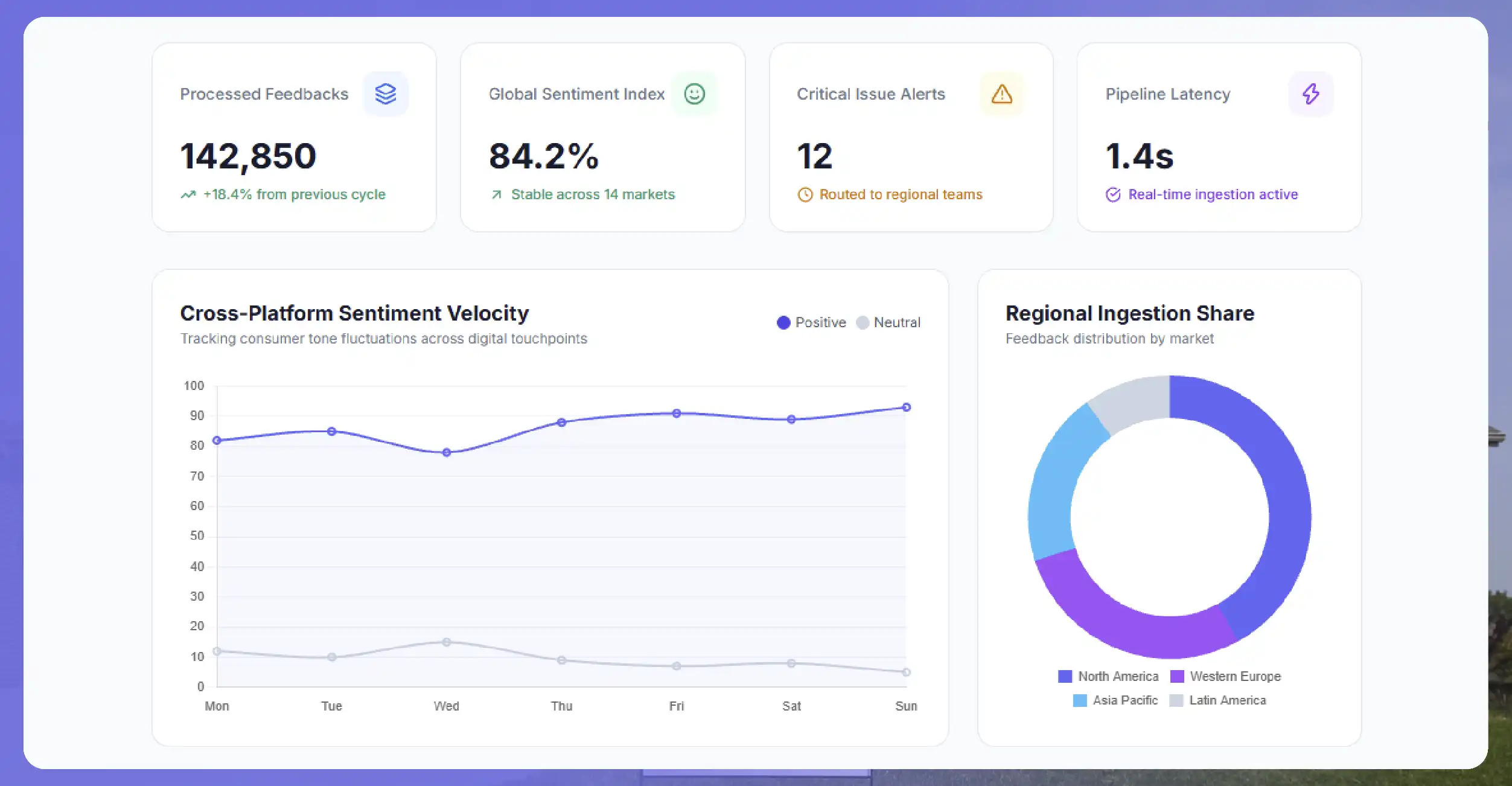
Global brands operate in highly competitive environments where customer opinions can change rapidly. A product launch, packaging redesign, pricing adjustment, delivery disruption, or service problem can generate thousands of customer reactions within a short period.
Manually monitoring these reactions creates several challenges. Teams may overlook important reviews, spend excessive time collecting information, or struggle to compare customer feedback across different countries and platforms.
Automation creates a consistent monitoring framework. New reviews can be collected according to predefined schedules, structured into standardized datasets, and prepared for analysis.
This is particularly valuable for organizations managing hundreds or thousands of products. Rather than asking employees to inspect individual pages, automated workflows can process large quantities of information and direct attention toward the issues that matter most.
The result is faster awareness and better decision-making.
Building a Reliable Customer Review Dataset
Effective monitoring starts with quality data collection. Reviews may appear across brand websites, online marketplaces, food platforms, travel websites, app stores, retailer websites, and specialized review portals.
Each source can use a different structure, terminology, rating system, and review format. A robust data collection process therefore needs to standardize information from multiple sources.
Typical review datasets can contain product names, brand names, review titles, review text, ratings, review dates, categories, locations, reviewer identifiers, verified-purchase indicators, helpful votes, and source URLs.
Additional commercial information can also be connected with review records. Product prices, availability, SKUs, categories, and seller information can provide valuable context for understanding why customers are reacting positively or negatively.
Once this information is organized, businesses can create centralized repositories for analysis and reporting.
Daily Customer Feedback Collection
Customer feedback changes every day. A review collected today may reveal an issue that did not exist last month, making continuous monitoring essential for brands that want to remain responsive.
Daily customer review Data scraping allows organizations to capture newly published reviews and maintain a historical record of customer sentiment.
Historical datasets are particularly useful because they reveal changes over time. A business can compare customer ratings before and after a product update, campaign, packaging change, pricing adjustment, or service improvement.
For example, if a product previously maintained a 4.5-star average but begins receiving an increasing number of two-star reviews, automated monitoring can identify the decline much earlier than a periodic manual audit.
This creates an early-warning mechanism for customer experience teams.
Understanding Customer Sentiment
A review's star rating provides a useful signal, but it does not always explain the complete customer experience. A customer may give a product four stars while criticizing delivery or customer service in the written review.
Sentiment analysis can evaluate the language used in reviews to determine whether customers express positive, negative, or neutral opinions.
More advanced Global brand review sentiment analysis can identify sentiment at the topic or attribute level. For instance, a customer might praise product quality while criticizing packaging. Another customer might like the price but complain about delivery.
This distinction gives brands a more detailed understanding of customer experiences.
Sentiment can also be segmented by geography, product, category, retailer, marketplace, and time period. Global organizations can therefore determine whether a particular issue is isolated to one market or occurring across multiple regions.
Discovering Recurring Customer Complaints
Large volumes of reviews often contain repeated themes. Identifying these themes manually is difficult, especially when customers describe the same problem using different words.
Automated analysis can group reviews according to topics such as delivery delays, damaged packaging, product quality, customer service, sizing, usability, taste, pricing, availability, or product performance.
Suppose hundreds of customers mention that a product arrived damaged. Individually, these comments may appear insignificant. Collectively, however, they could indicate a packaging or logistics problem.
Likewise, repeated positive comments about durability or product performance can help brands identify their strongest selling points.
This makes customer feedback useful not only for resolving complaints but also for identifying opportunities.
Monitoring Competitors Through Customer Feedback
Understanding what customers say about competitors can provide a major strategic advantage.
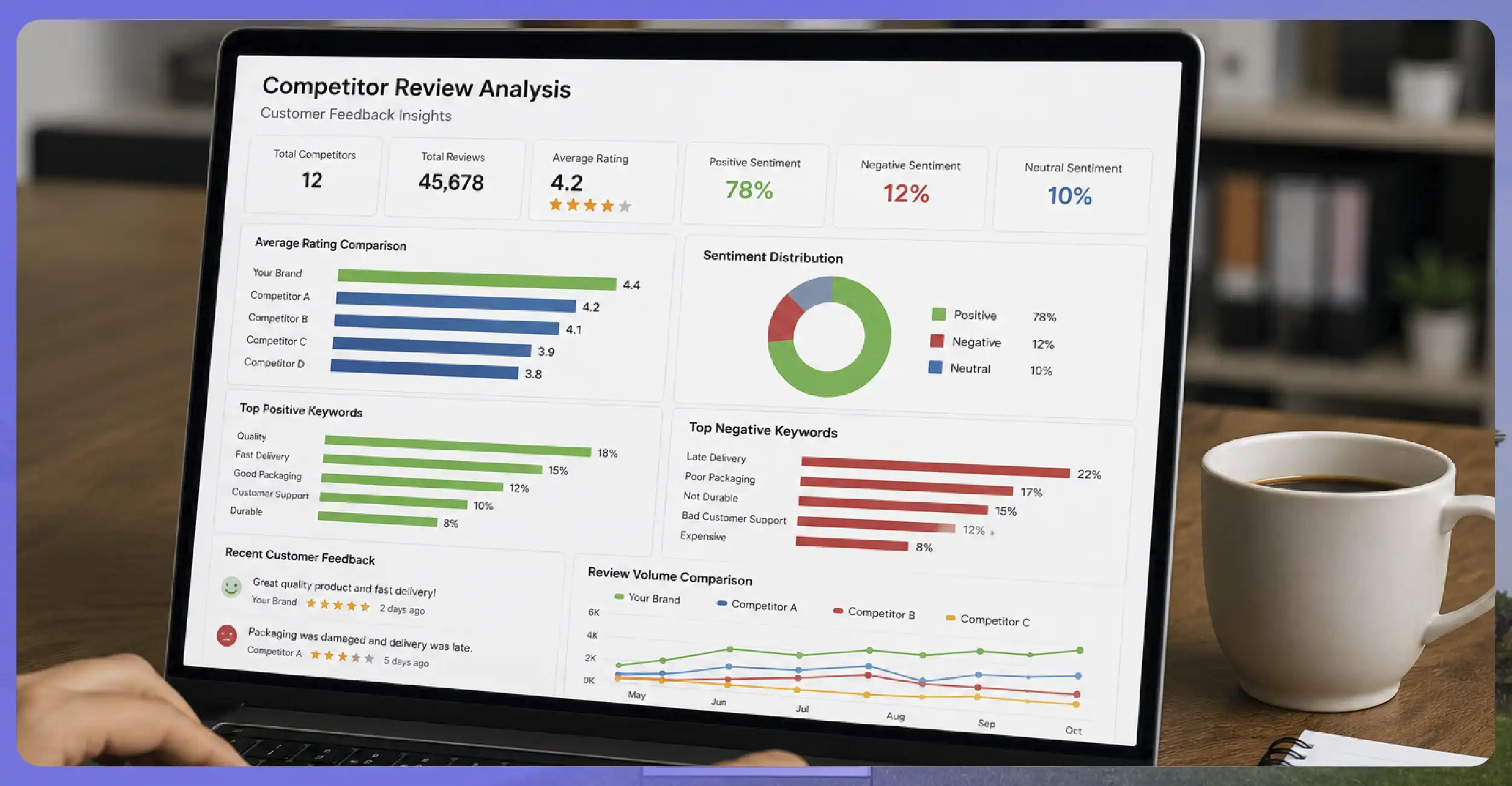
Competitor review monitoring for global brands can reveal what customers appreciate about alternative products and where competitors are struggling.
For example, customers may consistently praise a competitor's delivery speed, packaging, customer support, or product durability. Such patterns can highlight areas where a brand needs to improve.
Conversely, recurring complaints about a competitor can expose potential market opportunities.
Competitive review analysis can compare review volumes, average ratings, sentiment distribution, customer concerns, and frequently discussed product attributes.
This enables brands to understand competitive positioning from the customer's perspective rather than relying solely on advertising claims or market reports.
Turning Ratings into Business Intelligence
Ratings are among the simplest customer feedback indicators, but their value increases significantly when combined with review text and historical information.
Businesses can track average ratings, rating distributions, review volumes, sentiment ratios, complaint frequencies, and changes over time.
Reviews and ratings intelligence can provide executives with a market-level overview while allowing analysts to drill down into individual products, categories, countries, or competitors.
For example, management could identify a product whose average rating is stable but whose negative review volume is increasing. This may indicate an emerging issue that is not yet visible in the overall rating.
Historical comparisons can also help companies evaluate whether corrective actions are producing measurable improvements.
Creating Automated Alerts
Monitoring is most effective when important changes trigger immediate attention.
Brands can establish rules for unusual rating declines, sudden increases in negative reviews, significant review-volume changes, or specific keywords associated with serious complaints.
If a large number of customers suddenly mention a particular issue, an automated alert can notify the relevant team.
This helps businesses reduce the delay between problem detection and investigation.
Customer service teams can review individual cases, product teams can investigate product-related issues, and operations teams can examine fulfillment or logistics problems.
Automated alerts therefore transform review monitoring from passive observation into an active business-response system.
Supporting Product Development
Customer reviews can provide direct insight into product strengths and weaknesses.
Product managers can identify features customers want improved, common usability problems, missing functionalities, and frequently requested enhancements.
Positive feedback can also reveal features that customers value most.
For example, if customers repeatedly praise a product for its ease of use, durability, or design, that information can influence future product development and marketing communication.
Negative feedback can be equally valuable. Recurring complaints can help prioritize improvements according to actual customer demand rather than assumptions.
This creates a continuous feedback loop between customers and product teams.
Improving Customer Experience
Review monitoring can also strengthen customer experience strategies.
Customer complaints often reveal friction points that traditional surveys may not capture. Customers may voluntarily describe problems with checkout, delivery, returns, packaging, customer support, or product usage.
By analyzing these comments collectively, brands can identify where customer journeys are breaking down.
Companies can then prioritize improvements based on complaint frequency and sentiment severity.
This makes customer experience optimization more measurable and data-driven.
Protecting Brand Reputation
A brand's reputation can change quickly in the digital environment. A small issue can become highly visible when customers share negative experiences across multiple platforms.
Automated monitoring helps brands identify potential reputation threats earlier.
Teams can track unusual spikes in negative sentiment, repeated product complaints, suspicious review patterns, or rapidly increasing discussion around specific issues.
Early detection gives businesses more time to investigate facts, communicate appropriately, and implement corrective actions.
For multinational organizations, this capability becomes particularly important because a reputation issue in one market can quickly influence perceptions elsewhere.
Measuring Market and Consumer Trends
Customer reviews also provide a window into changing consumer preferences.
As customer expectations evolve, new words, topics, and concerns begin appearing more frequently in reviews.
Businesses can monitor these changes to identify emerging preferences before they become mainstream.
For example, customers may increasingly discuss sustainability, convenience, personalization, value, packaging, delivery speed, or specific product attributes.
When review data is collected consistently, these changes can be measured over time and connected with broader market movements.
This gives brands another source of evidence for strategic planning.
Scaling Monitoring Across Global Markets
Global organizations need monitoring systems that can handle different languages, currencies, product catalogs, marketplaces, and regional preferences.
A scalable framework can organize information by country, market, language, product, category, retailer, and platform.
This enables regional teams to access relevant information while headquarters maintains a broader global perspective.
Localization is also important. A complaint that is common in one country may be rare in another because customer expectations differ.
Comparing regional sentiment therefore helps brands understand both universal and market-specific customer concerns.
How iWeb Data Scraping Can Help You?
Automated Data Collection
iWeb Data Scraping can help businesses collect customer reviews, ratings, product information, restaurant details, and related data from relevant digital sources through structured and repeatable workflows.
Sentiment Monitoring
Collected review datasets can support sentiment analysis by organizing customer opinions into structured records that help identify positive experiences, negative feedback, recurring concerns, and changing perceptions.
Competitive Benchmarking
We can support competitor benchmarking by organizing review volumes, ratings, customer comments, product information, and other relevant signals into datasets suitable for comparative analysis.
Historical Intelligence
Consistent data collection creates historical datasets that businesses can use to measure rating changes, identify recurring problems, compare markets, and evaluate customer perception over extended periods.
Scalable Monitoring
We can support large-scale monitoring requirements by organizing information across brands, products, categories, locations, platforms, and markets for easier analysis and decision-making.
Conclusion
Review monitoring has evolved from a basic reputation-management activity into an important source of strategic business intelligence. Global brands can no longer depend entirely on occasional manual review checks when customers are generating feedback continuously across multiple digital channels.
Automation provides the infrastructure needed to collect, organize, analyze, and monitor this information at scale. Businesses can identify customer concerns faster, understand product strengths, benchmark competitors, detect emerging market patterns, and improve customer experiences.
Effective Brand protection also depends on identifying potential reputation problems before they become widespread. Automated monitoring provides a continuous view of customer conversations and creates opportunities for earlier intervention.
With Real-time web scraping businesses can maintain fresher datasets and reduce the gap between customer feedback and business response.
Combined with trend and demand intelligence review data becomes much more than a collection of comments. It becomes a strategic resource that helps global brands understand customers, anticipate changing expectations, strengthen products, and make better decisions in increasingly competitive markets.
FAQs
Review monitoring automation is the systematic collection and analysis of customer reviews and ratings from multiple online sources using automated workflows.
It allows global brands to monitor large volumes of feedback across markets and platforms while identifying customer concerns, sentiment changes, competitive movements, and emerging trends more efficiently.
Depending on the source and project requirements, datasets may include review text, ratings, dates, product names, categories, locations, reviewer identifiers, verified-purchase indicators, helpful votes, and source information.
Yes. Competitor review datasets can help brands compare ratings, review volumes, customer sentiment, recurring complaints, praised features, and changing customer expectations across competing products.
The ideal frequency depends on review volume and business requirements. High-volume global brands may benefit from daily or more frequent monitoring to detect significant changes as early as possible.