

Introduction
The UK real estate industry is evolving rapidly, with property prices, rental demand, buyer preferences, and regional market conditions influencing investment and business decisions. Online property portals have become important sources of information for understanding these developments. Among them, Rightmove provides extensive property listing information that helps businesses, investors, estate agents, and property analysts understand the housing market.
A structured Rightmove real estate dataset enables businesses to collect, organize, and analyze property information from publicly accessible listings. It can include property prices, rental values, addresses, property types, bedroom counts, descriptions, listing dates, agent information, and other relevant attributes. By converting individual listings into structured records, businesses can identify market patterns and evaluate property opportunities more efficiently.
Access to accurate Rightmove property data also helps organizations understand how residential properties are advertised across different UK locations. Instead of manually checking thousands of listings, businesses can use automated data collection to monitor property availability, compare asking prices, evaluate rental opportunities, and identify changes in local housing markets.
For property investors, real estate agencies, developers, mortgage providers, and market research companies, this information creates opportunities to make evidence-based decisions. A well-maintained dataset can support property valuation research, competitor monitoring, investment analysis, and regional market forecasting.
Understanding the Rightmove Real Estate Dataset
Rightmove is one of the UK's major online property marketplaces, connecting buyers, sellers, landlords, tenants, and estate agents. Its listings provide a useful view of advertised residential property supply across different regions and price categories.
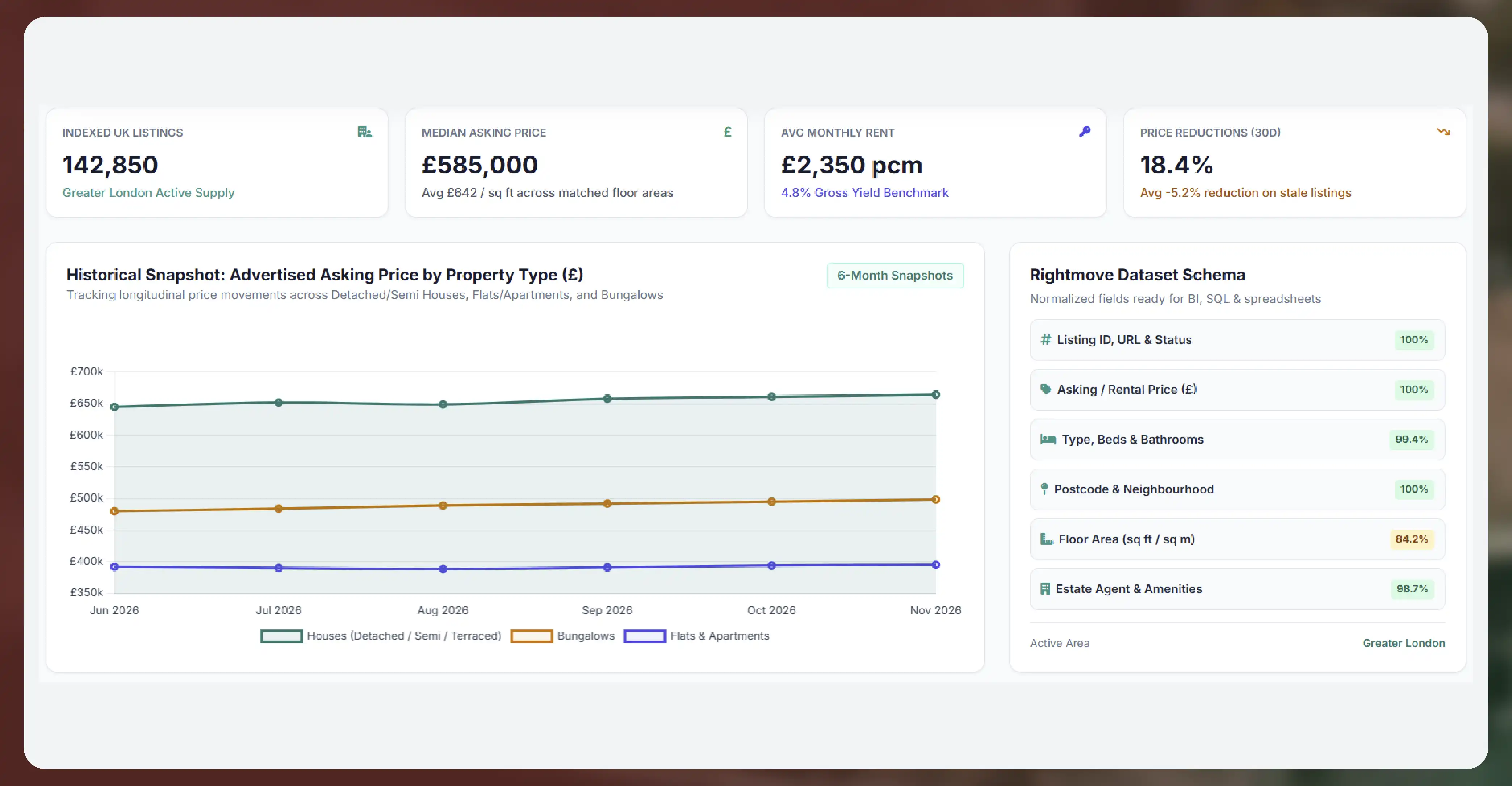
A Rightmove dataset organizes this listing information into a consistent format that can be processed using spreadsheets, databases, analytics platforms, and business intelligence tools.
Depending on the collection requirements and publicly available listing information, the dataset may contain:
- Property listing ID and URL.
- Property title and description.
- Asking price and rental price.
- Property type, including houses, flats, and bungalows.
- Number of bedrooms and bathrooms.
- Property location, postcode, and neighbourhood.
- Floor area, where available.
- Listing images and image references.
- Estate agent or letting agency details.
- Listing status and publication information.
- Property amenities and advertised features.
These attributes help businesses transform scattered property advertisements into organized market intelligence. Historical snapshots can also be maintained to compare changes in advertised prices, availability, and listing activity over time.
Why Rightmove Property Data Matters for the UK Real Estate Industry?

Property decisions depend on several factors, including location, affordability, demand, available inventory, and competition. Analyzing individual listings provides limited information, but examining thousands of properties together can reveal broader market movements.
For example, an investor evaluating residential opportunities in Manchester may want to compare apartment prices, rental advertisements, bedroom configurations, and neighbourhood-level availability. A structured dataset makes these comparisons easier and more consistent.
Similarly, estate agencies can examine competitor listings to understand how other businesses position properties, advertise rental prices, and promote different housing categories.
The value of property data extends beyond individual transactions. It can help businesses understand:
- Market demand: Identify locations with substantial listing activity and changing property availability.
- Price positioning: Compare advertised prices across similar properties and neighbourhoods.
- Rental opportunities: Evaluate advertised rents and differences between property categories.
- Competitive activity: Monitor estate agents and their advertised property portfolios.
- Investment research: Identify locations and property segments that deserve further investigation.
Important Data Categories Available Through Rightmove Scraping
1. Property Sale Listings
Property sale information is essential for understanding residential market conditions. Businesses can collect asking prices, property categories, bedroom counts, locations, descriptions, and other advertised attributes.
This information supports comparisons between similar properties and helps analysts identify differences in asking prices across neighbourhoods.
2. Rental Property Listings
Rental information is particularly useful for landlords, property managers, investment companies, and letting agencies.
Collecting UK rental price data can help businesses compare monthly rental advertisements across cities, neighbourhoods, and property categories. For example, analysts can evaluate whether two-bedroom apartments in Birmingham are advertised at different price levels from comparable properties in Leeds.
Rental listing records can also reveal changes in property availability and advertised rental values over time. However, asking rents should not automatically be treated as achieved rental prices.
3. Location and Neighbourhood Information
Location plays a significant role in property valuation. A structured dataset can include city names, postcodes, neighbourhood references, and other available geographical attributes.
Businesses can use these records to segment properties into local markets and compare housing supply across different regions.
4. Property Features and Specifications
Property descriptions and specifications help businesses understand what differentiates one listing from another.
Useful attributes include:
- Number of bedrooms and bathrooms.
- Property category and architectural style.
- Garden, parking, and balcony availability.
- Furnished or unfurnished status.
- Floor area and property layout.
- Advertised amenities and special features.
These details make it possible to conduct more meaningful comparisons between properties rather than relying exclusively on asking prices.
5. Estate Agent and Agency Information
Agent-level information can help businesses understand the competitive landscape. Depending on listing availability, records may include agency names, branch details, contact references, and the number of properties advertised.
This information can support agency benchmarking, portfolio analysis, and research into regional property distribution.
How Businesses Can Use UK Property Listings Data?
The applications of UK property listings data extend across several business functions. When organized into searchable datasets, listing information can support analytical models, competitive research, and property investment strategies.
1. Property Price Benchmarking
Real estate companies can compare advertised prices across similar properties, locations, and housing categories. Benchmarking helps identify properties positioned above or below local market averages and provides useful context for pricing strategies, property valuations, and investment assessments.
2. Rental Market Analysis
Landlords and property investors can examine rental advertisements to understand pricing differences between neighbourhoods. Comparing property sizes, bedroom configurations, and advertised rents can help identify rental segments with attractive potential returns.
3. Competitor Monitoring
Estate agencies can evaluate competitor portfolios, advertised property categories, and listing activity. This information helps businesses understand how competing agencies position their properties, identify underserved market segments, and improve their own marketing strategies.
4. Regional Market Research
Investors and developers can compare property availability across cities, towns, and neighbourhoods. Regional analysis can reveal differences in housing supply, advertised prices, and property characteristics, helping organizations prioritize locations for additional research.
5. Property Investment Research
Investment firms can combine listing information with historical transaction records, rental indicators, mortgage information, and economic statistics. These combined datasets support more comprehensive assessments of property affordability, potential rental yields, and regional investment opportunities.
Tracking Rightmove Price Trends and Market Movements
Property prices change according to economic conditions, mortgage affordability, housing supply, seasonal demand, and regional preferences. Monitoring Rightmove price trends can help businesses understand how advertised asking prices move across different market segments.
Rightmove's House Price Index provides an important reference for this analysis. According to its published methodology, the index is based on approximately 95% of newly marketed residential properties across England, Scotland, and Wales. It tracks monthly and annual movements in advertised asking prices.
For example, its September 2026 index reported an average asking price of £367,440, representing a monthly increase of 0.7%. The same release reported average stock of 65 properties per agent, indicating a high level of available inventory for that time of year.
Businesses can use historical listing snapshots to investigate:
- Monthly and quarterly asking-price movements.
- Differences between regional property markets.
- Changes in the number of advertised properties.
- Rental price movements across housing categories.
- Differences between newly advertised and previously listed properties.
- Seasonal changes in property availability.
However, asking prices should not be confused with completed transaction prices. Combining listing information with official transaction records provides a more balanced understanding of the market.
Combining Rightmove Data with Other Property Information
A single property portal cannot represent every aspect of the housing industry. Businesses can improve their research by combining listing information with other reliable property datasets.
For example, UK real estate market data can be enriched through relevant information from:
- HM Land Registry: Historical residential transaction prices in England and Wales.
- Office for National Statistics: Private rental price statistics and housing indicators.
- UK House Price Index: Official property price measurements.
- Energy Performance Certificate Register: Property energy efficiency information.
- Local planning authorities: Planning applications and development information.
- Other property portals: Additional advertised inventory and market comparisons.
Rightmove also explains that its sold-price information for England and Wales incorporates records supplied by HM Land Registry. This creates an opportunity to compare historical transaction information with property advertising information, subject to the relevant data rights and usage conditions.
Combining these sources helps analysts develop a broader understanding of property values, housing availability, rental conditions, and regional development activity.
Building a Structured Real Estate Dataset with iWeb Data Intelligence
iWeb Data Intelligence helps businesses develop structured data solutions for market research, competitor intelligence, and business analytics. For Rightmove-related research, the first step is defining the required information and establishing an appropriate, authorized data source.
An important consideration is that Rightmove's published terms prohibit automated scraping, bots, and crawlers without prior written consent. They also restrict commercial property-market research using its platform without the required permission. Therefore, automated collection should only proceed with appropriate written authorization or through permitted data services and licensed sources.
A structured real estate data solution can then be developed around the following stages:
- Data Source Identification: Identify permitted property information sources, licensed datasets, and approved access arrangements based on business requirements.
- Data Extraction: Collect authorized property records, including available prices, locations, descriptions, property specifications, and listing information.
- Data Cleaning: Standardize property categories, remove duplicate records, correct formatting inconsistencies, and organize geographical information.
- Data Structuring: Arrange the information into CSV, JSON, Excel, database-ready formats, or customized delivery structures.
- Data Analysis: Prepare the collected information for dashboards, price comparisons, regional analysis, and investment research.
This approach helps organizations establish reliable property intelligence workflows while considering source restrictions, data accuracy, and commercial usage rights.
Challenges in Real Estate Data Collection
Although property datasets provide valuable insights, developing a reliable real estate database requires careful planning.
- Data Accuracy: Advertised prices and property descriptions may contain outdated or incorrect information. Validation and source checks are important.
- Duplicate Listings: The same property may appear in multiple advertisements or be updated by an estate agency. Duplicate detection helps maintain dataset quality.
- Changing Availability: Properties can be sold, rented, withdrawn, or relisted. Historical snapshots help preserve a record of observed market conditions.
- Inconsistent Formats: Property descriptions, locations, and specifications may follow different formats. Standardization makes comparisons more meaningful.
- Data Permissions: Every source has its own access conditions, licensing requirements, and permitted uses. Businesses must review these before collecting or reusing information.
Addressing these challenges helps create datasets that are more useful for research, reporting, and business intelligence.
How iWeb Data Scraping Can Help You?
iWeb Data Intelligence helps businesses develop structured property datasets and analytics solutions while respecting source terms and data permissions.
1. Property Data Collection
iWeb Data Intelligence helps businesses build structured property datasets using authorized sources and licensed information. Relevant records can include property prices, locations, descriptions, bedroom counts, rental values, and agency details for comprehensive real estate research.
2. Price Comparison Analysis
Businesses can organize property pricing information to compare similar residential listings across different locations. iWeb helps structure these records into analytical datasets, supporting competitor benchmarking, regional price comparisons, and informed property pricing strategies for real estate businesses.
3. Rental Market Intelligence
iWeb helps businesses organize rental information from permitted property sources to evaluate advertised rents, property categories, and geographical differences. These insights support rental benchmarking, investment research, property management strategies, and assessments of changing rental market conditions.
4. Customized Dataset Development
iWeb can deliver property information in flexible formats, including CSV, JSON, Excel, and database-ready structures. Customized datasets help investors, developers, estate agencies, and research companies integrate relevant property information into their existing analytical workflows.
5. Real Estate Market Monitoring
iWeb supports recurring data collection from authorized sources, helping businesses maintain updated property intelligence. Comparing historical snapshots with recent records can reveal changes in advertised prices, property availability, rental conditions, and regional housing market activity.
Conclusion
The UK property industry offers significant opportunities for businesses that can interpret property information effectively. Structured datasets help investors, estate agents, developers, and research organizations understand property prices, rental conditions, regional competition, and housing availability.
A well-organized Rightmove real estate dataset can support property benchmarking, competitor research, rental analysis, and investment intelligence when developed through authorized data access and appropriate licensing arrangements. Businesses can also combine these insights with a Housing.com real estate dataset to compare property markets across the UK and India, identify regional differences, and develop broader real estate intelligence strategies.
With iWeb Data Intelligence, businesses can explore customized data collection, cleaning, structuring, and analytics solutions to transform property information into actionable business insights.
Frequently Asked Questions
A Rightmove real estate dataset is a structured collection of property listing information, potentially covering asking prices, rental values, property types, locations, bedroom counts, descriptions, and estate agency details.
Depending on availability and permitted access, property data can include listing IDs, prices, addresses, property descriptions, bedroom counts, bathrooms, property categories, agent information, images, and listing dates.
Businesses can use authorized property information for price benchmarking, rental market analysis, competitor research, regional property comparisons, investment assessments, and real estate market intelligence.
Yes. Permitted rental listing information can help businesses compare advertised rents across locations, property types, and bedroom configurations. Historical observations can also help identify rental pricing movements and changing market conditions.
iWeb Data Intelligence provides customized data solutions, including authorized data collection, data cleaning, structuring, and delivery in flexible formats. These datasets can support property research, competitive analysis, market monitoring, and business intelligence.