

Introduction
The rapid growth of online grocery shopping has created a strong demand for accurate, structured, and frequently updated retail data. Businesses can use RIMI API scraping to collect product, pricing, availability, category, brand, and promotional information from digital grocery environments for market research and competitive analysis.
For retailers, brands, price comparison platforms, and market researchers, Rimi grocery data API extraction provides an efficient way to organize large volumes of grocery information into structured datasets. Instead of manually checking thousands of products, automated data collection can make product information available for analysis, reporting, dashboards, and monitoring systems.
Competitive pricing has also become increasingly important, which is why businesses can use Rimi price monitoring services to observe price movements, promotions, discounts, and product-level changes over time. Historical pricing records can reveal trends that are difficult to identify through occasional manual research.
What Is RIMI API Scraping?
RIMI API scraping involves programmatically collecting structured information made available through relevant application interfaces or accessible data endpoints. Depending on the platform architecture and access permissions, an API can return product information in structured formats that are easier to process than traditional webpage content.
A typical extraction workflow identifies relevant endpoints, determines the required parameters, sends requests, processes responses, and stores the returned information in a structured database. Pagination, request limits, authentication requirements, response validation, and schema changes may also need to be handled.
The objective is not simply to collect individual records. A properly designed system creates a repeatable data pipeline capable of collecting information at defined intervals and maintaining historical records for business intelligence.
What Grocery Data Can Be Collected?
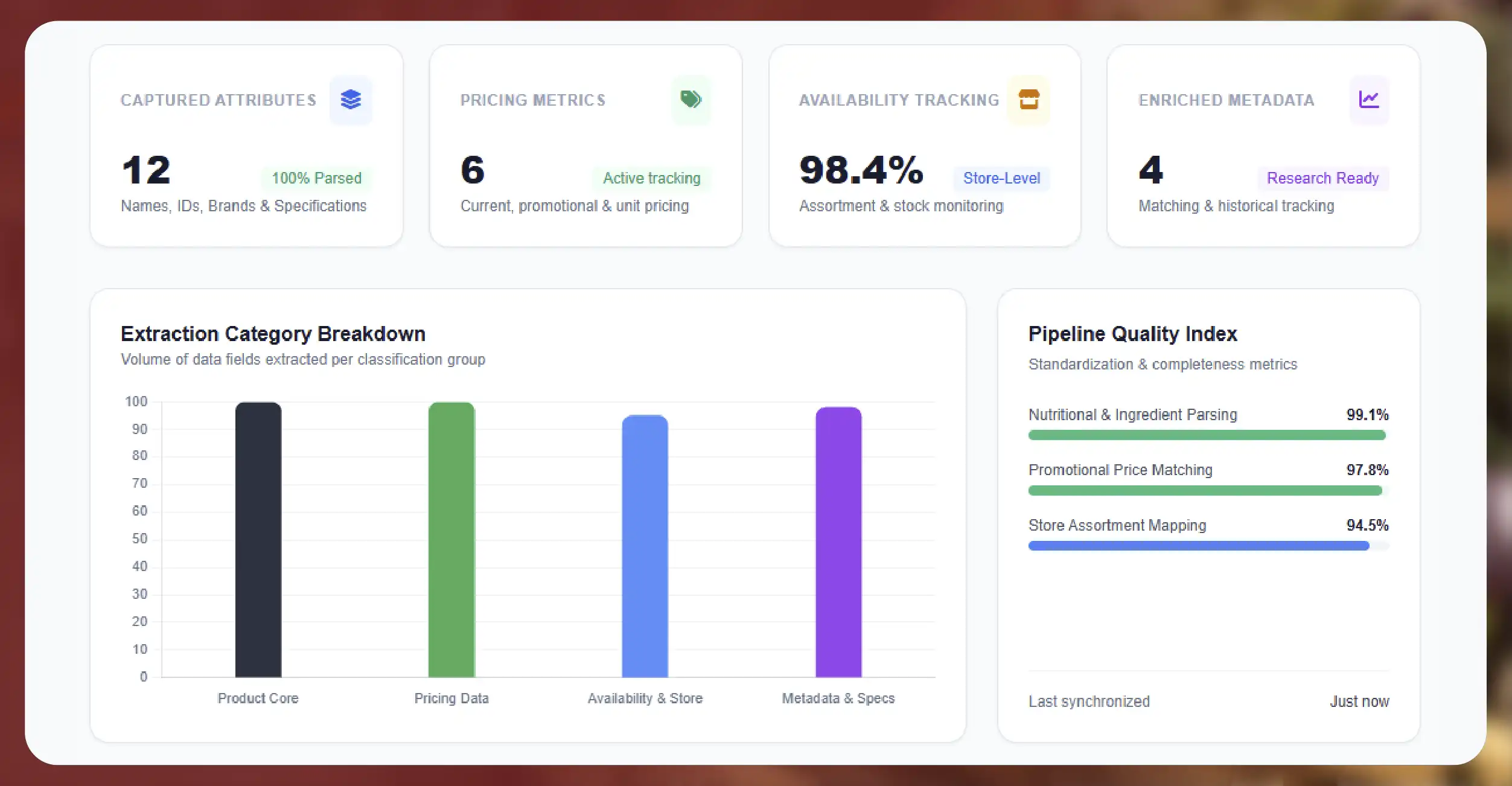
A comprehensive grocery extraction project can capture numerous product attributes. Depending on availability, the dataset may contain product names, product IDs, brands, categories, subcategories, descriptions, package sizes, unit measurements, images, ingredients, nutritional information, and product specifications.
Pricing information is another important component. Records may include current prices, original prices, promotional prices, unit prices, discount information, and promotional labels. Collecting these fields together makes it possible to conduct more meaningful price comparisons.
Availability data can indicate whether a product is available or unavailable at a particular time or location. Where store-level information is accessible, businesses can also analyze assortment differences between locations.
Additional metadata can be collected and standardized to support category analysis, product matching, historical tracking, and competitive research.
How RIMI Product Data Supports Market Research?
Businesses conducting product research can use Rimi product data API scraping to create continuously updated product datasets. Instead of relying on occasional manual collection, automated processes can capture product information repeatedly and create historical snapshots.
These snapshots make it possible to identify newly introduced products, discontinued products, changes in package sizes, category movements, and pricing adjustments. Brands can use this information to understand how their products are positioned within the online grocery market.
Market researchers can also compare competing products by brand, category, package size, and price. This creates a foundation for studying market positioning and identifying changes in consumer-facing retail strategies.
Building a Rimi Grocery Intelligence System
A broader analytical environment can turn collected information into a Rimi grocery intelligence platform capable of supporting dashboards, alerts, reports, and historical analysis.
The process generally starts with automated data collection. Raw responses are then cleaned, standardized, and validated before being transferred into a database or analytical storage environment.
Product identifiers can help connect records across different collection periods. Data normalization can standardize categories, units, brands, and price fields so that analysts can compare records consistently.
Once the dataset is structured, visualization tools can be connected to display pricing trends, assortment changes, promotional activity, and product availability. Automated alerts can also notify users when important changes are detected.
Rimi Product API & Grocery Data Extraction
A complete Rimi Product API & Grocery Data Extraction workflow can support businesses that need product intelligence at scale. Consumer research companies can analyze product assortments, while brands can monitor competing products and pricing strategies.
Price comparison platforms can use structured product information to create comparison datasets. Market research teams can examine category-level pricing, product availability, and promotional activity.
Data quality should remain a major consideration. Product IDs, names, brands, categories, package sizes, and prices should be validated before being used for analysis. Duplicate records and incomplete fields can otherwise create misleading results.
Timestamping each collection cycle is equally important. A historical timestamp allows analysts to determine exactly when a product or price was observed.
Pricing Analytics Through Grocery Data
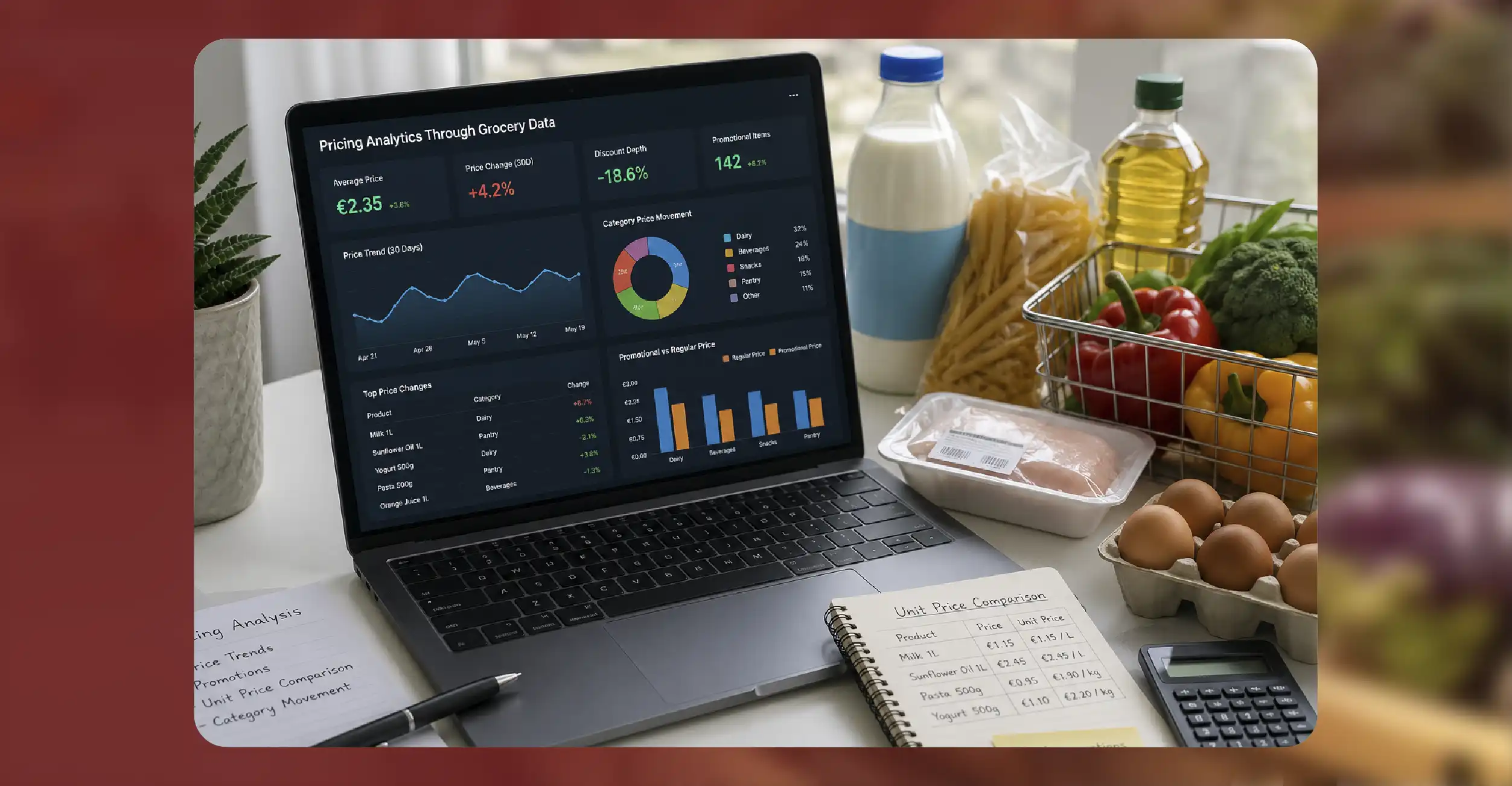
Businesses can use the Rimi Grocery API for Product and Pricing Analytics to develop structured pricing intelligence workflows. Repeated data collection allows analysts to compare prices across different dates and identify significant changes.
Historical price records can be used to calculate percentage changes, average prices, discount depths, and category-level movements. These metrics can help businesses understand pricing volatility and competitive positioning.
Promotional analysis is another valuable application. Analysts can identify products that frequently appear under promotional pricing and compare promotional prices with regular prices.
Unit-price information can make the analysis more accurate. Comparing price per kilogram, liter, or individual unit can reveal differences that headline product prices may hide.
Online Grocery & Supermarket Data Extraction
The growing importance of digital grocery channels has made Online Grocery & Supermarket Data Extraction valuable for retailers, brands, analysts, and technology companies.
Large-scale grocery datasets can reveal product availability, brand representation, pricing patterns, category depth, and promotional behavior. These insights can help organizations understand how products are positioned in an increasingly competitive digital marketplace.
Businesses can also use historical records to examine seasonal patterns. Grocery categories may experience significant changes around holidays, festivals, weather events, and other demand periods.
For companies considering expansion into new categories, grocery datasets can provide useful information about existing competitors, product ranges, price points, and promotional strategies.
Creating Grocery and Supermarket Store Datasets
Well-structured Grocery and Supermarket Store Datasets can combine product, pricing, availability, category, and location information into standardized records.
A typical dataset may include:
- Product ID
- Product name
- Brand
- Category
- Subcategory
- Package size
- Regular price
- Promotional price
- Unit price
- Availability
- Product image
- Store or location information
- Collection timestamp
Such datasets can be stored in relational databases, cloud storage, data warehouses, spreadsheets, or analytical platforms depending on project requirements.
Historical snapshots can also be retained to support time-series analysis and trend identification.
Applications of RIMI Grocery Data
RIMI grocery data can support multiple business applications. Competitive intelligence teams can monitor product and pricing changes, while brands can examine their position relative to competing products.
Retail analysts can study category structures and promotional patterns. Price comparison platforms can maintain current product and pricing datasets. Market researchers can evaluate grocery trends across different periods.
Data can also be integrated with internal business information. Combining external grocery pricing with sales, inventory, or product-performance data can create a broader analytical environment.
For example, a brand could compare changes in competitor pricing with its own sales performance to investigate potential relationships between market movements and commercial results.
Technical Challenges in API-Based Grocery Extraction
Automated grocery data collection can involve several technical challenges. API endpoints may change, response structures can be modified, and access requirements may vary over time.
Request limits can also affect large-scale collection. A robust system should manage request frequency responsibly and implement appropriate error handling rather than repeatedly sending unsuccessful requests.
Location-dependent information introduces another consideration. Product availability and pricing may differ according to store, region, or delivery area. The extraction architecture should therefore preserve relevant location information when it is available.
Product matching is also important. Products may change descriptions, packaging, or other attributes over time. Consistent identifiers and matching logic can help maintain accurate historical records.
Data collection should always be performed responsibly and in accordance with applicable laws, platform terms, access controls, and other relevant requirements.
Benefits of Automated Grocery Data Collection
Automated extraction can reduce repetitive manual research and make large-scale analysis more practical. Teams can schedule collection processes and receive updated datasets without manually reviewing individual product pages.
Historical information provides another major advantage. Instead of seeing only current prices, businesses can analyze how prices, products, and availability have changed over time.
Automation can also improve reporting efficiency. Structured datasets can feed dashboards, analytical tools, pricing systems, alert mechanisms, and business intelligence applications.
The result is a more systematic approach to grocery market research, where decisions can be supported by continuously collected and consistently structured information.
How Food Data Scrape Can Help You
Competitive Pricing Insights
Food Data Scrape helps monitor grocery prices, discounts, and promotions across markets, enabling businesses to identify pricing gaps, benchmark competitors, and develop informed pricing strategies.
Product Assortment Monitoring
Automated grocery data collection tracks products, categories, brands, package sizes, and availability, helping businesses understand assortment changes and identify emerging products across competitive online grocery channels.
Market Trend Analysis
Collected historical grocery datasets reveal pricing movements, promotional patterns, product launches, and availability trends, allowing businesses to recognize market opportunities and respond effectively to changing consumer demand.
Retail Intelligence Development
Food Data Scrape transforms grocery information into structured datasets that support dashboards, business intelligence systems, competitive research, category analysis, and strategic decision-making across retail operations.
Automated Data Collection
Automated extraction reduces repetitive research by continuously collecting accessible grocery information, helping teams maintain updated datasets while saving operational time and improving consistency for ongoing market monitoring.
Conclusion
RIMI API scraping provides a practical foundation for collecting grocery product, pricing, promotional, availability, and category information at scale. When combined with data validation, historical storage, analytics, and visualization, the resulting dataset can support a wide range of retail intelligence applications.
Businesses seeking scalable solutions can use Grocery Data Scraping Services to develop customized extraction workflows designed around specific product, pricing, location, and analytical requirements.
For organizations that need structured information for pricing intelligence and market research, Grocery API Data Scraping can help transform accessible grocery data into standardized datasets suitable for dashboards, databases, and analytical systems.
By connecting automated collection with broader Web Scraping API Services, businesses can create scalable data pipelines that continuously transform grocery information into actionable competitive, pricing, and market intelligence.
FAQs
RIMI grocery data can help businesses understand product assortments, pricing movements, promotions, availability patterns, and competitive positioning within the online grocery market.
Yes. Structured pricing records can be compared across products, brands, categories, and collection periods to identify competitive pricing differences and market movements.
Common challenges include changing data structures, request limitations, missing fields, product variations, location-specific information, and maintaining consistent records across multiple collection cycles.
Historical datasets allow businesses to examine previous prices, product availability, promotions, and assortment changes, helping them identify trends and recurring market patterns.
Yes. Structured grocery datasets can be connected with databases, dashboards, cloud platforms, reporting systems, pricing tools, and other analytical environments based on business requirements.