Introduction
The digital entertainment and dining ecosystem is rapidly evolving as consumers increasingly rely on mobile applications to discover concerts, festivals, live performances, restaurants, cafés, and exclusive dining experiences. Businesses operating in these industries require continuous access to structured market intelligence to monitor changing customer preferences, pricing dynamics, and venue performance. Scrape District event and restaurant data to build comprehensive datasets that support strategic planning, demand forecasting, and competitive benchmarking. At the same time, Event market analysis From District provides valuable insights into ticket demand, seasonal trends, event popularity, and regional consumer behavior. Companies also benefit from District event ticket price monitoring, allowing them to understand pricing fluctuations across multiple venues, dates, and event categories while improving revenue optimization strategies.
District by Zomato has emerged as an integrated platform connecting entertainment experiences with restaurant discovery, making it an important source of consumer engagement data. By extracting structured information from the platform, businesses gain access to real-time event schedules, restaurant listings, venue details, cuisine preferences, customer ratings, and promotional campaigns. These insights help hospitality brands, event organizers, investors, travel companies, and market researchers make informed decisions based on continuously updated intelligence.
Growing Importance of District Data Intelligence
The convergence of entertainment and food services has created new opportunities for data-driven decision-making. Consumers frequently combine dining experiences with concerts, comedy shows, sporting events, exhibitions, and cultural festivals. This interconnected behavior generates valuable datasets that reveal purchasing habits, location preferences, spending capacity, and engagement trends.
Organizations using automated data extraction can monitor event schedules, restaurant availability, reservation patterns, cuisine demand, customer reviews, seating capacity, and promotional discounts without relying on manual research. Continuous monitoring also enables businesses to detect emerging market trends before competitors.
The increasing popularity of digital event discovery platforms means organizations require scalable collection methods capable of processing thousands of listings across multiple cities simultaneously while maintaining data accuracy and consistency.
Comprehensive Venue Intelligence Collection
Modern analytics extend beyond simple event listings by collecting extensive venue-related information. Businesses often Scrape venue information from District by Zomato to evaluate venue popularity, seating capacity, location accessibility, operating schedules, and recurring event frequency.
Venue intelligence supports numerous business applications including expansion planning, sponsorship evaluation, investment research, tourism analysis, and hospitality partnerships. Companies can identify high-performing venues while understanding geographical demand distribution across metropolitan and emerging cities.
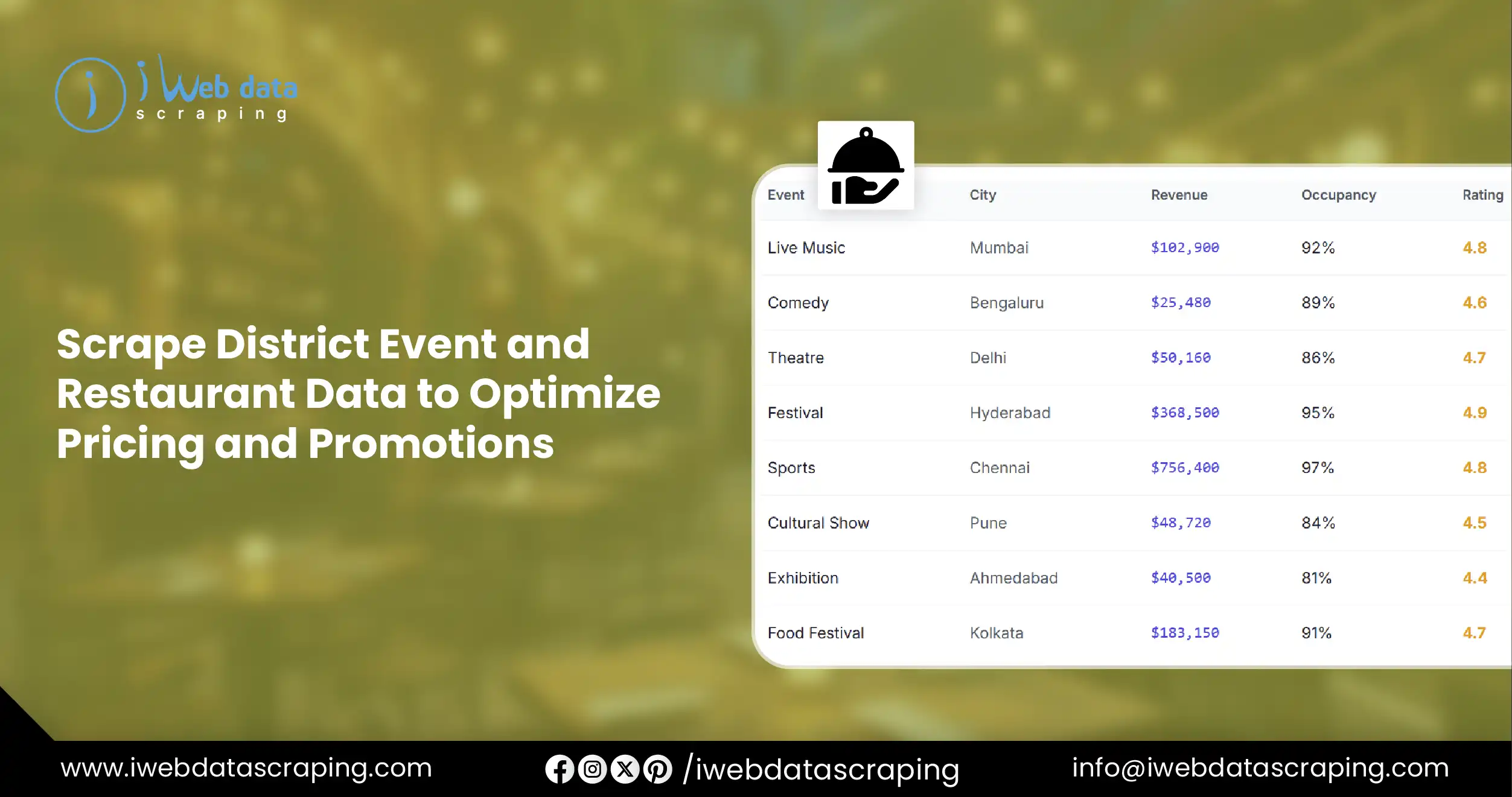
Sample Event Intelligence Dataset
| Live Music |
Mumbai |
42 |
118 |
2,450 |
28 |
3,500 |
92 |
4.8 |
102,900 |
| Comedy |
Bengaluru |
26 |
84 |
980 |
16 |
1,200 |
89 |
4.6 |
25,480 |
| Theatre |
Delhi |
33 |
72 |
1,520 |
21 |
2,100 |
86 |
4.7 |
50,160 |
| Festival |
Hyderabad |
55 |
40 |
6,700 |
35 |
8,000 |
95 |
4.9 |
368,500 |
| Sports |
Chennai |
61 |
24 |
12,400 |
42 |
18,000 |
97 |
4.8 |
756,400 |
| Cultural Show |
Pune |
29 |
63 |
1,680 |
18 |
2,300 |
84 |
4.5 |
48,720 |
| Exhibition |
Ahmedabad |
18 |
58 |
2,250 |
12 |
4,200 |
81 |
4.4 |
40,500 |
| Food Festival |
Kolkata |
37 |
31 |
4,950 |
27 |
6,500 |
91 |
4.7 |
183,150 |
Restaurant Intelligence Supporting Consumer Analytics
Entertainment visits often influence nearby dining choices, making restaurant intelligence equally valuable. Organizations leverage Restaurant menu data Scraping From District to analyze cuisine diversity, pricing patterns, menu expansion, promotional campaigns, seasonal offerings, and customer preferences.
Restaurant datasets provide insights into pricing strategies across neighborhoods, premium dining trends, menu innovation, popular dishes, customer ratings, and delivery availability. Businesses can identify market gaps while optimizing their own restaurant positioning based on competitive intelligence.
Integrated event and restaurant analytics reveal how entertainment demand directly impacts restaurant reservations, customer traffic, and promotional effectiveness during major city events.
Restaurant Listing Extraction for Competitive Benchmarking
Restaurants continuously update menus, pricing, images, operational hours, and promotional offers. Businesses frequently Extract restaurant listings from District by Zomato to monitor changing competitive landscapes across cities.
These structured datasets enable restaurant chains to compare pricing strategies, identify high-performing cuisines, evaluate neighborhood competition, and optimize expansion decisions. Investors can also use historical restaurant growth data to assess market opportunities across different geographic regions.
Continuous extraction supports dynamic dashboards where decision-makers monitor restaurant additions, closures, customer engagement, review growth, and cuisine popularity over extended periods.
Restaurant Market Intelligence Dataset
| Fine Dining |
86 |
48 |
4.8 |
5,840 |
3 |
82 |
390 |
91 |
68 |
| Casual Dining |
74 |
22 |
4.6 |
4,950 |
5 |
64 |
710 |
84 |
74 |
| Café |
58 |
16 |
4.5 |
3,820 |
6 |
39 |
560 |
72 |
69 |
| Fast Casual |
49 |
14 |
4.4 |
4,120 |
7 |
31 |
830 |
65 |
63 |
| Multi Cuisine |
105 |
34 |
4.7 |
6,920 |
4 |
71 |
670 |
95 |
77 |
| Regional Cuisine |
62 |
19 |
4.5 |
2,980 |
5 |
56 |
480 |
81 |
72 |
| Buffet |
89 |
39 |
4.6 |
3,670 |
2 |
76 |
420 |
88 |
61 |
| Rooftop Dining |
66 |
44 |
4.7 |
4,510 |
4 |
79 |
350 |
79 |
66 |
Building Structured District Datasets
Organizations increasingly rely on a centralized District by Zomato dataset to consolidate event information, restaurant intelligence, venue details, promotional campaigns, ticket availability, customer ratings, booking patterns, and pricing history.
Well-structured datasets enable advanced analytics through machine learning models, forecasting engines, visualization platforms, and business intelligence dashboards. Historical datasets become especially valuable for identifying long-term seasonal trends and evaluating campaign effectiveness.
Combining multiple data attributes creates comprehensive intelligence that supports pricing optimization, marketing effectiveness measurement, consumer segmentation, and location planning.
API-Based Data Collection for Enterprise Scale
Large enterprises require automated solutions capable of collecting millions of records efficiently while maintaining structured output formats. Many organizations deploy method to Scrape District by Zomato scraping API solutions to automate continuous extraction workflows.
API-driven architectures support scheduled data collection, incremental updates, cloud integration, real-time synchronization, and scalable processing across thousands of listings. These systems minimize manual intervention while improving operational efficiency and reducing data latency.
Automation also simplifies integration with CRM platforms, analytics dashboards, forecasting software, and enterprise reporting environments.
Mobile Application Intelligence
Consumer engagement increasingly occurs through mobile applications rather than traditional websites. Businesses therefore invest in Custom Mobile App Data Scraping Services to capture structured information directly from mobile ecosystems where event discovery, restaurant recommendations, booking confirmations, and promotional notifications originate.
Mobile application intelligence provides access to richer datasets including personalized recommendations, dynamic pricing, location-based promotions, loyalty programs, exclusive offers, and app-specific engagement metrics. These insights help businesses understand evolving digital consumer behavior more accurately than conventional data collection approaches.
Organizations serving hospitality, entertainment, tourism, and investment sectors increasingly depend on mobile intelligence to support real-time operational decisions.
Business Applications Across Industries
District event and restaurant intelligence supports numerous commercial use cases. Event organizers analyze attendance trends to improve scheduling and promotional planning. Restaurant chains evaluate pricing strategies and menu positioning relative to local competition. Hospitality companies monitor nearby events that influence hotel occupancy and restaurant reservations.
Travel companies develop destination recommendations by combining local events with restaurant popularity. Investors identify rapidly growing entertainment markets before expansion accelerates. Urban planners evaluate cultural engagement patterns across cities, while tourism boards monitor visitor activity during festivals and large-scale public events.
Marketing agencies also utilize integrated datasets to design localized campaigns targeting audiences based on event participation and dining preferences.
Future Outlook
Artificial intelligence, predictive analytics, and automation are transforming digital hospitality intelligence into a continuous decision-support system. Real-time extraction enables organizations to react immediately to changing consumer behavior, ticket pricing adjustments, restaurant promotions, and venue demand.
As digital entertainment platforms continue expanding, structured data collection will become increasingly valuable for forecasting attendance, optimizing pricing strategies, improving customer experiences, and identifying investment opportunities across hospitality ecosystems.
Businesses combining historical analysis with automated real-time intelligence will maintain stronger competitive positioning while making faster, evidence-based decisions. Integrating Digital Shelf Analytics Solutions enables organizations to improve competitive visibility and strengthen data-driven merchandising strategies.
Enterprise-grade Web Scraping API Services support continuous, automated data collection with high scalability and seamless integration. Professional Web Scraping Services help transform raw platform information into actionable market intelligence that drives sustainable growth across the evolving event and restaurant industry.
Experience top-notch web scraping service and mobile app scraping solutions with iWeb Data Scraping. Our skilled team excels in extracting various data sets, including retail store locations and beyond. Connect with us today to learn how our customized services can address your unique project needs, delivering the highest efficiency and dependability for all your data requirements.
Experience top-notch web scraping service and mobile app scraping solutions with iWeb Data Scraping. Our skilled team excels in extracting various data sets, including retail store locations and beyond. Connect with us today to learn how our customized services can address your unique project needs, delivering the highest efficiency and dependability for all your data requirements.