

Introduction
The UAE and Saudi Arabian food delivery markets are becoming increasingly data-driven, competitive, and technology-focused. Restaurants, aggregators, investors, delivery operators, and food-tech businesses need timely information on menus, prices, promotions, ratings, locations, delivery charges, and customer preferences to make better decisions. In this environment, Scrape Food Delivery Data for UAE & Saudi Arabia 2026 to provide a structured approach to collecting market intelligence at scale.
The UAE is one of the most competitive digital food-delivery environments in the GCC, while Saudi Arabia represents one of the region's largest markets. A 2026 GCC market estimate places Saudi Arabia at roughly 36% of the regional online food-delivery market, highlighting its strategic importance.
For businesses evaluating platforms and restaurant performance, Extract Deliveroo, Talabat & Uber Eats Data in UAE to reveal differences in menu availability, pricing, promotions, delivery fees, restaurant coverage, and customer ratings. Platform competition is also evolving rapidly, with subscription programs becoming an important retention mechanism in Saudi Arabia. Delivery Hero reported that around 60% of its Saudi customers were subscribers in August 2026.
At the same time, Saudi Arabia food delivery market intelligence can help businesses understand regional demand, restaurant expansion, cuisine trends, consumer preferences, and competitive positioning across Riyadh, Jeddah, Dammam, Mecca, Medina, and other important markets.
Why Food Delivery Data Matters in 2026?
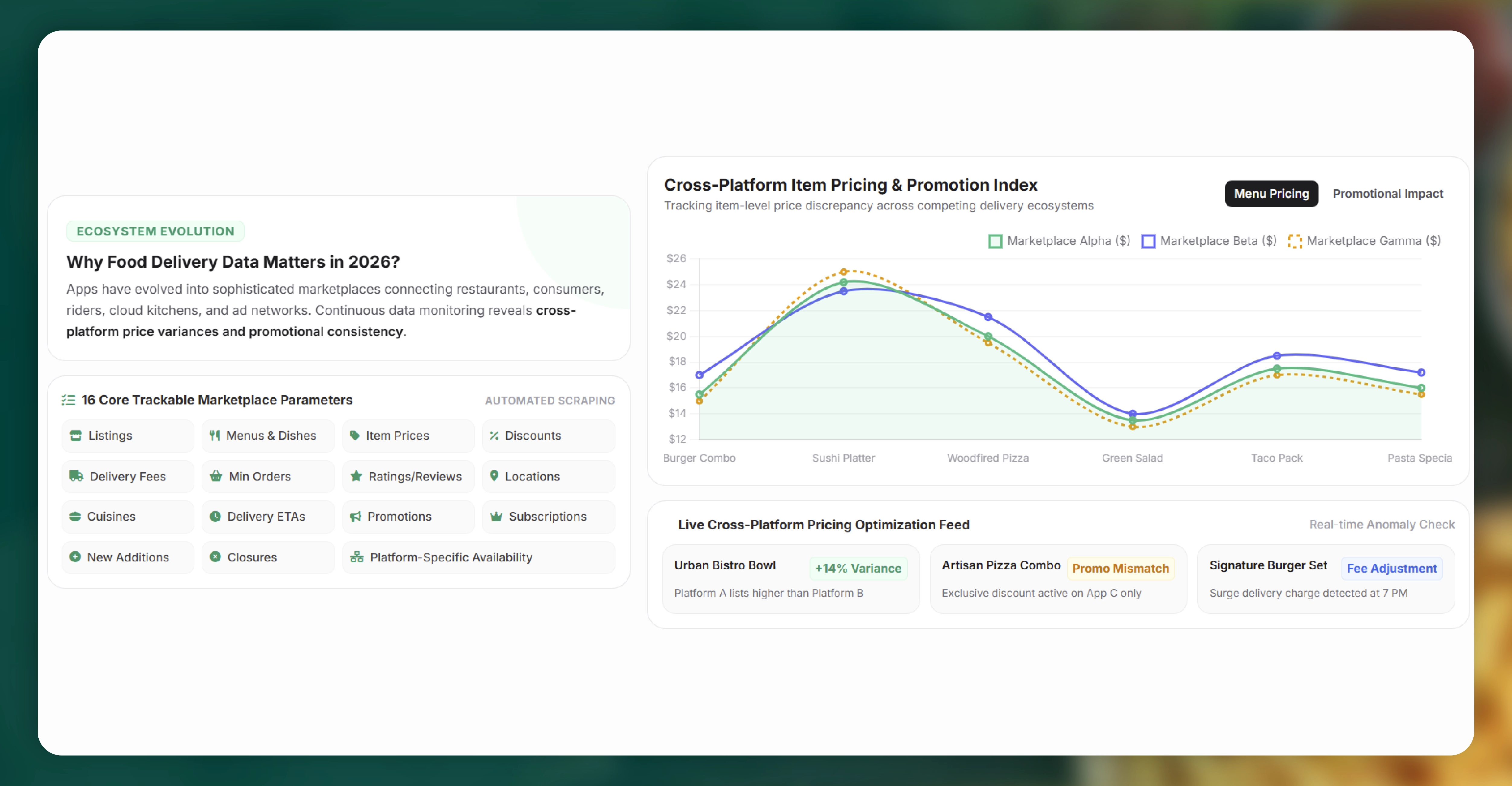
Food delivery is no longer simply about ordering meals through an application. Platforms have developed into sophisticated marketplaces connecting restaurants, consumers, riders, cloud kitchens, grocery businesses, advertisers, and technology providers.
The data generated by these ecosystems can provide valuable insight into how restaurants compete and how customers respond to pricing and promotions.
Businesses can monitor:
- Restaurant listings and availability
- Menu categories and individual dishes
- Item-level prices
- Discount percentages
- Delivery charges
- Minimum order values
- Ratings and review counts
- Restaurant locations
- Cuisine categories
- Delivery-time estimates
- Promotional campaigns
- Subscription benefits
- New restaurant additions
- Restaurant closures
- Platform-specific availability
For example, a restaurant may display different prices or promotions across platforms. Monitoring these variations enables brands to understand pricing consistency and identify opportunities for optimization.
UAE vs Saudi Arabia: A Data-Rich Competitive Landscape
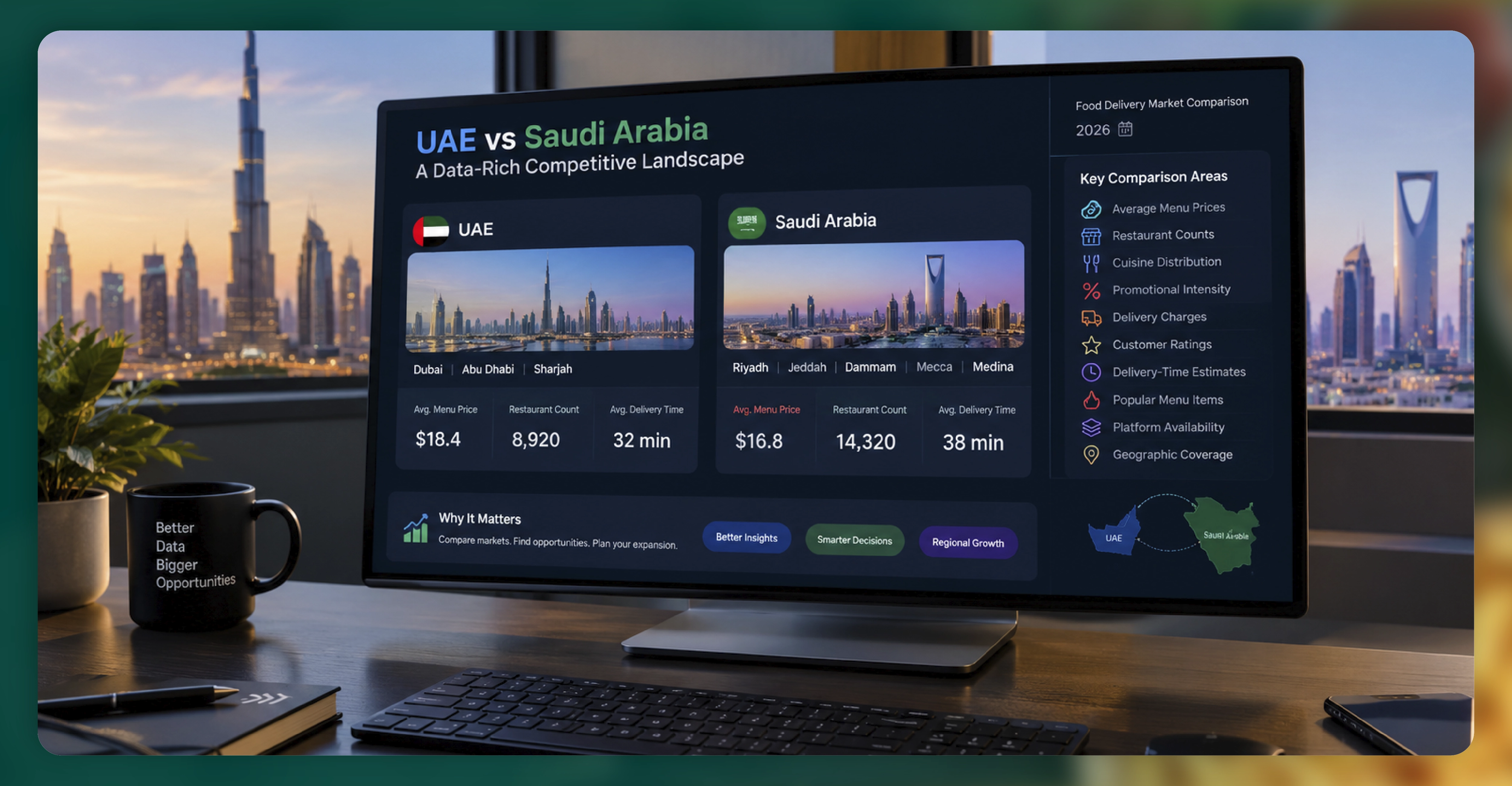
The UAE and Saudi Arabia have different market structures, consumer behaviors, geographic characteristics, and competitive dynamics.
The UAE market is particularly concentrated around highly connected urban centers such as Dubai, Abu Dhabi, and Sharjah. Delivery businesses compete through restaurant variety, promotions, memberships, convenience, delivery speed, and increasingly personalized experiences.
Saudi Arabia provides a much larger geographic market with major demand centers including Riyadh, Jeddah, Dammam, Mecca, and Medina. Its rapidly developing restaurant and hospitality ecosystem is also being supported by broader tourism and culinary investment under Vision 2030. Recent reporting highlights the country's expanding restaurant scene and growing international culinary presence.
This makes UAE & Saudi Arabia food delivery data comparison 2026 particularly valuable for companies planning regional expansion.
Instead of relying on occasional manual checks, businesses can continuously compare:
- Average menu prices
- Restaurant counts
- Cuisine distribution
- Promotional intensity
- Delivery charges
- Customer ratings
- Delivery-time estimates
- Popular menu items
- Platform availability
- Geographic coverage
Such information can help identify which markets, cities, cuisines, and restaurant categories offer the strongest opportunities.
Deliveroo vs Talabat vs Uber Eats Market Analysis
Competitive analysis becomes much more meaningful when it is based on structured, comparable datasets.
A Deliveroo vs Talabat vs Uber Eats market analysis can examine restaurant overlap, pricing differences, promotions, delivery fees, ratings, and menu availability across selected UAE locations.
For example, analysts can identify whether the same restaurant appears on multiple platforms and determine whether its prices are identical or platform-specific.
A restaurant might offer a particular burger at one price on one platform while applying a different price, discount, or meal bundle elsewhere. Monitoring this information at scale provides a clearer view of competitive pricing strategies.
It can also reveal which platforms have stronger coverage for particular cuisine categories.
Indian, Arabic, American, Chinese, Japanese, Italian, healthy-food, dessert, bakery, coffee, and fast-food categories can be evaluated independently to understand platform specialization.
UAE & Saudi Arabia Food Delivery Data Extraction
Effective UAE & Saudi Arabia food delivery data extraction requires more than collecting restaurant names.
A comprehensive dataset can contain multiple layers of information.
Restaurant-Level Data
Restaurant-level records can include:
- Restaurant name
- Brand
- Address
- City
- Neighborhood
- Cuisine
- Rating
- Review count
- Opening status
- Delivery availability
- Estimated delivery time
This information can support restaurant discovery, competitor benchmarking, market mapping, and expansion research.
Menu-Level Data
Menu extraction can capture:
- Category names
- Dish names
- Descriptions
- Prices
- Add-ons
- Sizes
- Meal combinations
- Dietary labels
- Promotional prices
- Availability
Menu-level information is particularly useful for businesses comparing products across thousands of restaurants.
Promotion Data
Discount monitoring can identify:
- Percentage discounts
- Buy-one-get-one offers
- Free-delivery promotions
- Voucher campaigns
- Minimum-spend offers
- Membership discounts
- Limited-time deals
This allows brands to understand promotional pressure and identify recurring campaign patterns.
Deliveroo Food Data Extraction Services
Deliveroo Food Data Extraction Services can help businesses collect structured information from relevant Deliveroo listings and transform it into datasets suitable for analysis.
The resulting information can support restaurant benchmarking, menu intelligence, price monitoring, competitive research, and location-level analysis.
For restaurant chains, the data can help identify whether menu prices and promotions are consistent across different locations.
For investors, it can support market screening and restaurant-sector research.
For food-tech companies, it can provide structured marketplace intelligence that can be incorporated into dashboards, analytical systems, or research platforms.
UAE Food Tech Data Scraping
The UAE food-tech ecosystem extends beyond traditional restaurant delivery.
Businesses increasingly operate across restaurants, grocery delivery, quick commerce, cloud kitchens, loyalty programs, subscriptions, and super-app ecosystems.
UAE Food Tech Data Scraping can therefore provide broader visibility into the digital food economy.
For example, a business could monitor how restaurant menus evolve, which cuisines are expanding, where new restaurants are appearing, and how promotional strategies change over time.
The UAE's broader digital delivery ecosystem is already characterized by strong competition between major platforms and rapid technological development.
Uber Eats Food Delivery Data Extraction
Uber Eats food delivery data Extraction can provide structured marketplace information for competitive research, menu monitoring, restaurant intelligence, and pricing analysis where the platform operates and relevant data is accessible.
A useful dataset can connect restaurant information with menu-level attributes, pricing, location, cuisine, ratings, promotions, and availability.
This becomes especially powerful when the information is collected repeatedly.
A single snapshot tells you what the marketplace looked like on one day.
Historical datasets show how the marketplace changed.
Businesses can therefore track price movements, newly listed restaurants, discontinued dishes, promotional cycles, and changing competitive conditions.
Building Historical Food Delivery Intelligence
One of the biggest advantages of systematic scraping is historical analysis.
Suppose a company collects restaurant and menu data every week throughout 2026. Over time, it can build a historical database showing how prices and offerings change.
This can help answer questions such as:
- Which cuisines are growing fastest?
- Which restaurants frequently change prices?
- Which platforms provide the strongest discounts?
- Which restaurants consistently receive high ratings?
- Where are new restaurants entering?
- Which menu categories are becoming more expensive?
- How frequently do restaurants introduce new dishes?
- Which locations show the strongest restaurant density?
Historical datasets can also support forecasting models.
Machine-learning systems can use structured historical information to identify patterns in demand, pricing, promotions, and restaurant activity.
Business Applications of Food Delivery Data
Food delivery datasets can serve multiple industries.
Restaurant Chains
Restaurant groups can compare their menu pricing and
promotional positioning against competing brands.
Investors
Investors can evaluate restaurant density, cuisine trends, geographic
expansion, platform penetration, and marketplace competition before making investment decisions.
Food-Tech Companies
Technology providers can use structured restaurant and menu
information to build comparison engines, recommendation systems, analytics dashboards, and market
intelligence solutions.
Market Researchers
Research organizations can use recurring datasets to study
pricing trends, restaurant expansion, customer preferences, and platform competition.
Delivery Platforms
Delivery companies can benchmark their restaurant coverage,
pricing, promotions, and service positioning against competing marketplaces.
The Role of Automation
Manual food-delivery research becomes increasingly difficult as the number of restaurants, menu items, locations, and platforms grows.
Automated data collection allows businesses to establish repeatable workflows for gathering, cleaning, validating, and organizing information.
Data can then be delivered in formats such as CSV, JSON, Excel, databases, or API-ready structures depending on business requirements.
Automation also makes recurring monitoring more practical. Instead of checking hundreds of restaurants manually, businesses can establish scheduled collection workflows and compare newly collected information against historical records.
How iWeb Data Scraping Can Help You?
Competitive Intelligence
iWeb Data Scraping can collect structured restaurant, menu, price, promotion, rating, and availability information, helping businesses benchmark competitors and identify market opportunities.
Price Monitoring
Automated collection can track item-level prices across platforms and locations, enabling brands to identify pricing differences, promotional changes, and emerging competitive pricing patterns.
Market Research
iWeb can organize large-scale UAE and Saudi Arabia restaurant data into structured datasets, helping analysts evaluate cuisines, locations, restaurant density, consumer trends, and marketplace development.
Historical Tracking
Recurring data collection creates historical datasets that reveal changes in menus, prices, ratings, restaurant availability, promotions, and platform coverage across different periods and markets.
Customized Datasets
Businesses can receive datasets tailored to their requirements, including selected platforms, cities, cuisines, restaurants, menu fields, pricing attributes, ratings, promotions, and other relevant data points.
Conclusion
The UAE and Saudi Arabia food delivery markets offer significant opportunities for businesses that can transform marketplace information into actionable intelligence. From restaurant discovery and menu monitoring to price benchmarking and competitive research, structured data can support better decisions across the entire food-tech ecosystem.
With Uber Eats data scraping integrated into a broader multi-platform strategy, companies can build richer competitive datasets instead of relying on isolated observations.
Similarly, a Talabat Food Delivery App Dataset can help organizations analyze restaurant coverage, menu structures, prices, promotions, ratings, and location-level marketplace activity.
Combining these sources with Food Delivery App Menu Datasets creates a broader intelligence layer for understanding restaurant competition, pricing movements, consumer-facing offers, and evolving food-delivery trends across the UAE and Saudi Arabia in 2026.
FAQs
Businesses can collect restaurant details, menus, prices, cuisines, ratings, reviews, delivery information, promotions, locations, availability, and other publicly accessible marketplace attributes.
Yes. Multi-platform collection can create comparable datasets covering platforms such as Talabat, Deliveroo, Uber Eats, and other relevant services, subject to platform availability and applicable access requirements.
Restaurants can use the data for competitor price monitoring, menu benchmarking, promotion analysis, cuisine research, location planning, and identifying opportunities for improving their marketplace positioning.
Yes. Recurring collection can create historical datasets that help businesses monitor changes in restaurant listings, menu prices, promotions, ratings, and platform coverage over time.
Depending on project requirements, datasets can be structured for formats such as CSV, JSON, Excel, databases, or API-ready applications, with customized fields and collection frequencies.