

Introduction
Food delivery platforms generate enormous amounts of structured information about restaurants, menus, prices, categories, promotions, ratings, delivery options, and availability. For businesses operating in food technology, competitive intelligence, market research, restaurant discovery, and pricing analytics, accessing this information consistently can create a major strategic advantage. Scrape Foodora Restaurant & Menu Data Using API to provide a scalable approach to collecting restaurant and menu information without depending on repetitive manual research.
Modern data collection systems can automate Foodora restaurant data scraping Using API workflows, helping businesses retrieve standardized information at scheduled intervals. Instead of manually opening restaurant pages and recording individual dishes, companies can collect thousands of records programmatically and transform them into structured datasets.
Another important requirement is Foodora restaurant menu data extraction, which can capture menu categories, item names, descriptions, prices, dietary attributes, promotions, and availability. When organized correctly, this information becomes useful for competitor benchmarking, menu optimization, pricing intelligence, and food delivery market analysis.
Why Restaurant and Menu Data Matters?
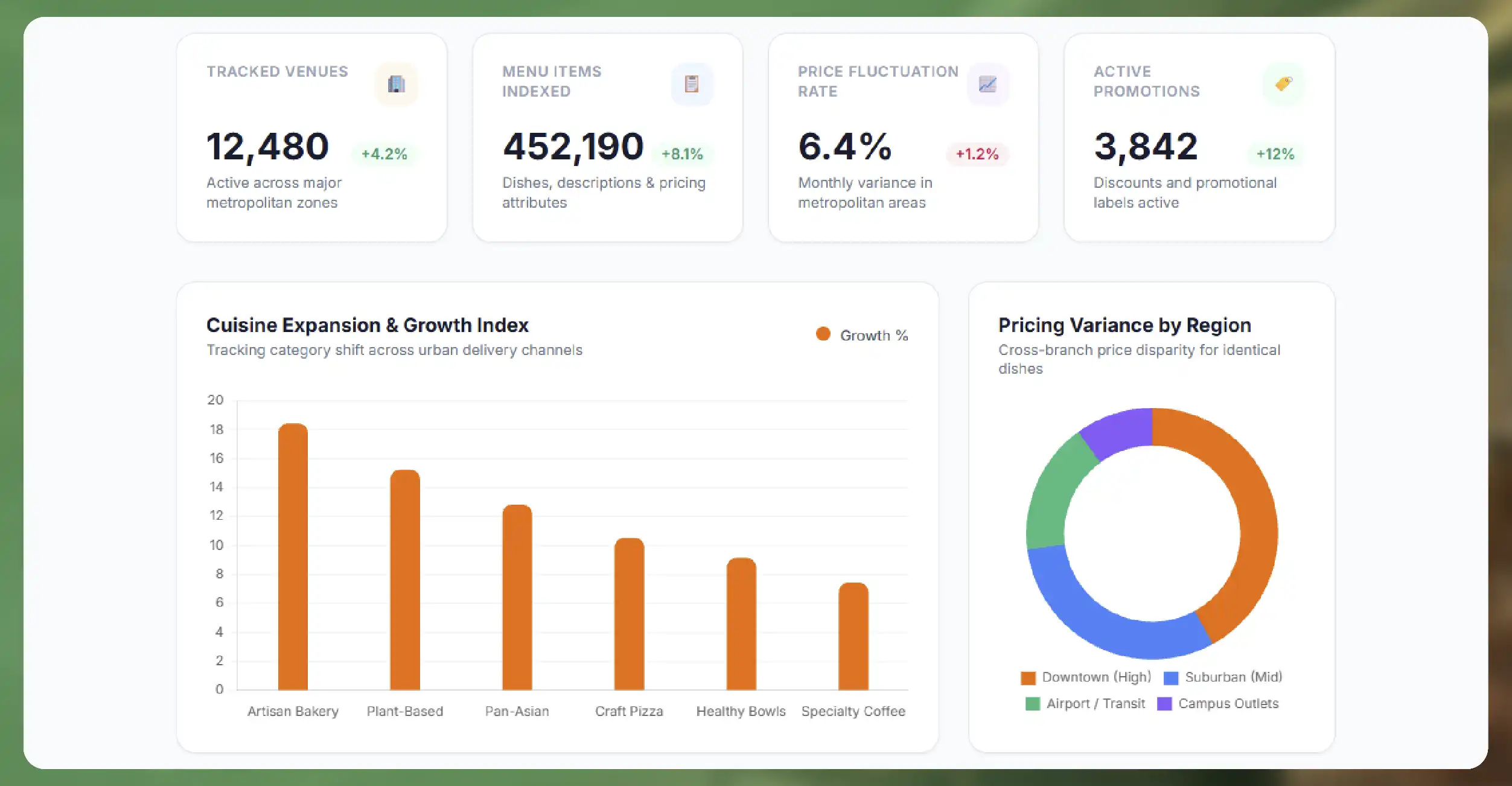
Restaurant data is no longer limited to basic names and addresses. Food delivery platforms contain commercially valuable signals that can reveal how restaurants position themselves, which cuisines are expanding, how menus change, and where pricing differences occur.
A structured dataset can include restaurant name, cuisine type, location, restaurant ID, ratings, review counts, delivery information, menu categories, dish names, item descriptions, prices, discounts, promotional labels, availability, and timestamps.
Foodora menu pricing and availability data can help businesses understand how menu prices fluctuate across locations and time periods. Tracking these changes can reveal promotional patterns, price increases, discontinued items, and availability shifts that may otherwise remain difficult to identify.
For restaurant chains, the information can support centralized monitoring across multiple branches. A business can compare identical dishes across locations and identify whether prices, promotions, or availability vary according to local market conditions.
Building a Scalable Data Collection Workflow
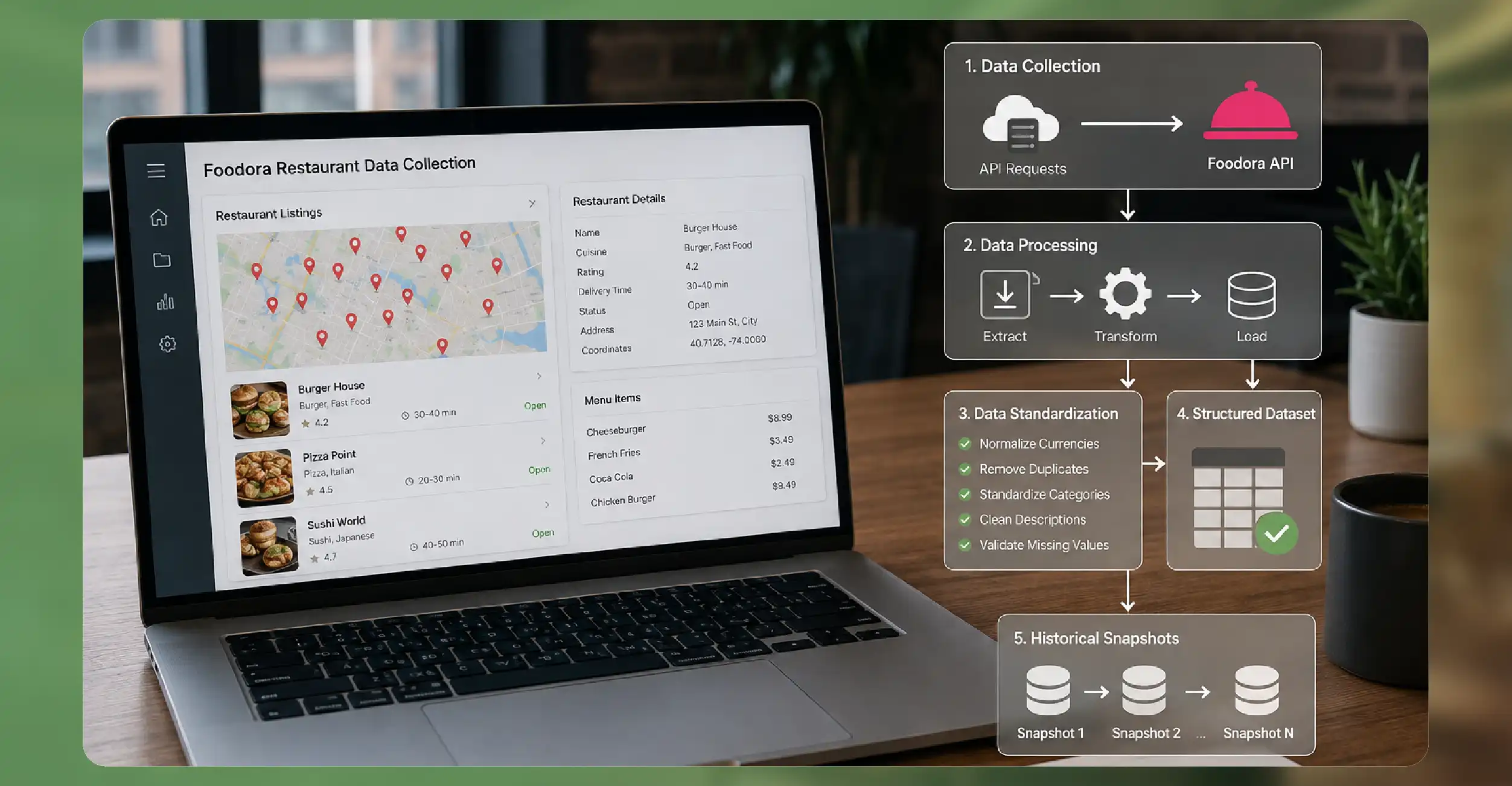
An API-driven collection process can begin with a defined list of restaurant locations, categories, cuisines, or geographic areas. The system then requests available records, processes the returned information, and maps the results into a standardized schema.
Foodora Restaurant Listings Scraping can capture restaurant-level information across selected markets, allowing businesses to build searchable databases of restaurants and their characteristics. Depending on the project requirements, the dataset can include restaurant identifiers, names, addresses, cuisines, ratings, delivery information, operating status, and geographic attributes.
The next stage focuses on menu-level extraction. Restaurant records can be connected with their respective menus so that each menu item remains associated with the correct restaurant, location, category, and collection timestamp.
A reliable pipeline should also normalize currencies, remove duplicate records, standardize category names, clean inconsistent descriptions, and validate missing values. Historical snapshots can then be retained to enable trend analysis rather than providing only a single point-in-time dataset.
Key Data Fields to Collect
A well-designed extraction project can collect multiple layers of information. Restaurant-level fields may include:
- Restaurant name and unique identifier
- Cuisine and restaurant category
- Address and geographic location
- Ratings and review counts
- Delivery information
- Restaurant operating status
- Menu categories
- Dish names and descriptions
- Item prices and promotional prices
- Availability status
- Dietary or allergen attributes
- Collection date and timestamp
At the menu level, businesses can create one record for every dish. This structure makes it easier to compare items across restaurants and identify changes over time.
For example, a burger restaurant may have several categories such as burgers, sides, beverages, desserts, and meal combinations. Rather than storing this information as an unstructured page, an API-powered pipeline can transform it into rows that are easy to analyze using databases, spreadsheets, dashboards, or business intelligence platforms.
Competitive Pricing Intelligence
Price monitoring is one of the strongest applications of restaurant and menu datasets. Restaurants frequently adjust prices because of ingredient costs, demand, competition, seasonal promotions, and local market conditions.
Foodora food delivery data analytics can help businesses identify these changes systematically. Historical records can be compared to determine whether a dish increased or decreased in price, whether a promotion was temporary, and how competitors position similar menu items.
A competitive pricing model can calculate average prices by cuisine, dish category, restaurant segment, or geographic area. Businesses can also compare their own prices against market benchmarks.
For example, if ten competing restaurants offer comparable pizza products, a structured dataset can calculate the median price, lowest price, highest price, promotional discount, and average price. This provides a stronger basis for pricing decisions than manually checking a handful of restaurant pages.
Menu Intelligence and Product Benchmarking
Menu analysis can also reveal consumer-facing trends. Businesses can identify which cuisines are gaining visibility, which dishes appear most frequently, and how restaurants structure their menus.
A restaurant technology company could use the dataset to identify popular categories and benchmark menu breadth. A food manufacturer could analyze how frequently specific ingredients or product types appear in restaurant offerings.
Foodora Food Data Extraction Services can support these applications by delivering cleaned and structured information suitable for ongoing analysis. Data can be supplied in formats such as CSV, JSON, Excel, or database-ready structures according to business requirements.
Historical menu snapshots are particularly valuable. A current menu only shows what exists today, while historical data can reveal when dishes were introduced, removed, renamed, repriced, or temporarily unavailable.
Promotions and Discount Monitoring
Promotions are another important component of restaurant competition. Restaurants may offer percentage discounts, fixed-value reductions, combo deals, free-item promotions, or limited-time offers.
An automated extraction workflow can identify promotional labels and associate them with the relevant menu item. This makes it possible to measure how frequently competitors run discounts and which product categories receive the most promotional attention.
Businesses can compare regular prices with discounted prices and calculate effective discount percentages. Over several weeks or months, this can reveal recurring promotional cycles and seasonal strategies.
Such information can help restaurants avoid blindly matching competitor discounts. Instead, they can determine whether promotions are common across the market or whether a competitor is using unusually aggressive pricing.
Data Quality and Historical Tracking
Data quality is essential when building a long-term intelligence system. Restaurant information can change frequently, and poorly structured extraction can create duplicate records or misleading comparisons.
A robust workflow should validate restaurant identifiers, normalize names, standardize prices, handle missing fields, and maintain timestamps. Changes should be recorded instead of overwriting previous values.
This creates a historical database where businesses can investigate exactly when a menu item changed. Historical tracking is especially useful for measuring price inflation, promotional frequency, assortment expansion, and restaurant availability.
Automated validation can also flag unexpected changes, such as a sudden disappearance of hundreds of menu items or an unusual price value. These checks improve confidence in downstream analytics.
Applications Across Food Businesses
The resulting datasets can serve different business models. Restaurant chains can monitor competitors and benchmark their own menus. Food delivery companies can study market coverage and assortment. Market researchers can analyze restaurant density and cuisine trends.
Investors and consultants can use historical datasets to evaluate market expansion, pricing behavior, and competitive positioning. Consumer applications can use structured restaurant and menu information to improve discovery and recommendation systems.
Food Menu Data Extraction Services can also support custom datasets where the required fields are tailored to a specific business objective. For example, one project may prioritize menu pricing, while another may focus on restaurant locations, cuisine classification, availability, or promotional activity.
Methodology for API-Based Extraction
A dependable project generally follows a structured workflow:
Requirement Definition: Identify target markets, restaurants, cuisines, locations, fields, update frequency, and preferred output format.
API Integration: Establish a controlled data collection process capable of retrieving relevant restaurant and menu records according to project requirements.
Data Parsing: Convert API responses into standardized restaurant, menu, pricing, category, and availability tables.
Cleaning and Validation: Remove duplicates, normalize values, validate identifiers, handle missing information, and check unusual records.
Historical Storage: Preserve dated snapshots so businesses can compare current and previous restaurant or menu states.
Delivery and Integration: Provide structured datasets through suitable formats or integrate them into dashboards, databases, analytics platforms, or internal systems.
Business Benefits of Automated Extraction
The major advantage of API-based collection is consistency. Manual monitoring may provide occasional observations, whereas automated workflows can create repeatable datasets according to a defined schedule.
Automation also improves scalability. Instead of assigning employees to monitor hundreds or thousands of restaurant pages, businesses can process large datasets through a centralized pipeline.
The resulting information can support faster decision-making because analysts can work with structured records rather than manually compiled spreadsheets. Historical snapshots further improve the ability to detect changes and measure trends.
For organizations building competitive intelligence platforms, the combination of restaurant, menu, pricing, availability, and promotional information creates a powerful foundation for automated market monitoring.
How iWeb Data Scraping Can Help You?
Scalable Restaurant Collection
iWeb Data Scraping can collect restaurant information across selected locations, cuisines, and categories, creating structured datasets that support competitive research and restaurant market intelligence.
Detailed Menu Extraction
Our solutions can capture menu categories, item names, descriptions, prices, promotions, and availability, helping businesses maintain detailed datasets for analysis and operational decision-making.
Historical Price Monitoring
We can organize recurring snapshots of menu information, enabling businesses to compare historical prices, identify changes, monitor promotions, and understand evolving competitor pricing strategies.
Clean and Structured Data
Our data processing workflows can standardize restaurant and menu records, remove duplicates, validate fields, and prepare consistent datasets suitable for dashboards, databases, analytics, and reporting.
Customized Data Delivery
iWeb Data Scraping can deliver datasets according to business requirements, including selected fields, geographic coverage, update frequency, output formats, and integration preferences for ongoing intelligence programs.
Conclusion
Restaurant and menu information can provide valuable intelligence when collected systematically and transformed into analysis-ready datasets. An API-driven approach makes it possible to monitor restaurant listings, menus, pricing, availability, promotions, and competitive changes at scale.
For businesses operating in food delivery, restaurant technology, market research, and competitive intelligence, Food Delivery App Menu Datasets can become a foundation for pricing analysis, menu benchmarking, restaurant discovery, and market trend research.
Combining structured extraction with Web Scraping API Services can further simplify integration into dashboards, databases, analytics systems, and internal applications.
When continuously updated, Real-time web scraping capabilities can help organizations respond faster to changing restaurant menus, pricing movements, promotional activity, and market conditions. The result is a more consistent, scalable, and data-driven approach to food delivery intelligence.
Frequently Asked Questions
Depending on project requirements, datasets can include restaurant names, IDs, cuisines, locations, ratings, delivery information, menu categories, dish names, descriptions, prices, promotions, and availability.
Yes. Recurring extraction can preserve dated snapshots, allowing businesses to compare previous and current prices, identify price changes, and analyze promotional patterns over time.
Yes. Data collection can be customized around selected locations, restaurant categories, menu fields, pricing attributes, availability information, update schedules, and preferred delivery formats.
Structured data can typically be prepared in formats such as CSV, JSON, Excel, or database-ready structures, depending on the integration and analytics requirements.
Restaurant chains, food delivery businesses, market researchers, analytics companies, consultants, food technology platforms, and competitive intelligence teams can use structured restaurant and menu data for multiple applications.