How Can You Scrape Grocery Price App from AU to NZ, UK & US to Track Retail Price Changes?
Introduction
The grocery industry has experienced a massive digital transformation over the past decade. Consumers increasingly rely on grocery applications to compare prices, browse promotions, check product availability, and order essentials online. As retailers compete through dynamic pricing and personalized discounts, businesses require accurate market intelligence to remain competitive. Companies looking to Scrape Grocery Price App from AU to NZ, UK & US can collect real-time pricing, promotions, inventory status, and product catalog information from leading supermarket applications across international markets.
Organizations investing in Grocery price monitoring from AU to NZ, UK & US gain valuable insights into regional pricing trends, promotional strategies, and consumer purchasing behavior, allowing them to optimize pricing and inventory planning.
Businesses also Scrape Global grocery price comparison data to benchmark products across multiple countries, evaluate regional pricing differences, and uncover market opportunities that support strategic business growth.
Why Global Grocery Price Monitoring Matters?
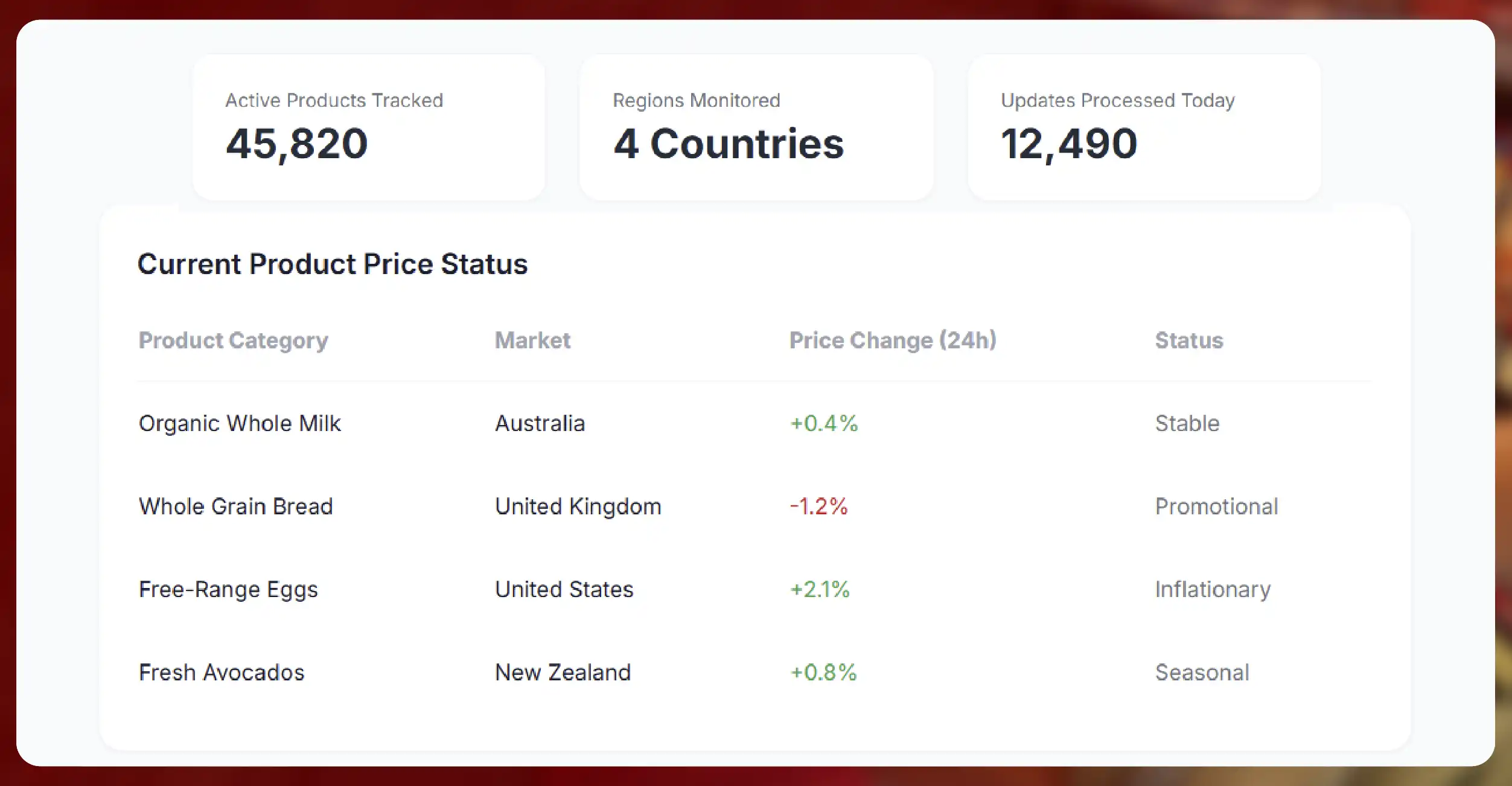
Modern grocery retailers update prices multiple times each day due to supplier costs, local competition, seasonal demand, inventory levels, and promotional campaigns. Monitoring these changes manually has become nearly impossible because thousands of products are constantly changing.
Automated grocery data extraction enables organizations to monitor supermarkets across Australia, New Zealand, the United Kingdom, and the United States without human intervention. Continuous monitoring provides historical price records that help businesses understand inflation, promotional cycles, product demand, and competitive positioning.
Instead of relying on occasional market surveys, businesses receive continuously updated pricing intelligence that improves forecasting, procurement, pricing optimization, and market analysis.
Information Available Through Grocery Apps
Today's grocery applications provide much more than product prices. Businesses can collect comprehensive datasets containing product names, brands, descriptions, categories, package sizes, nutritional information, prices, promotional discounts, loyalty pricing, stock availability, seller details, product ratings, customer reviews, product images, delivery fees, timestamps, and location-specific pricing.
Historical pricing information enables organizations to evaluate seasonal pricing trends, promotional frequency, category performance, inflation rates, and consumer purchasing behavior over extended periods.
Businesses increasingly depend on multi-country grocery pricing intelligence to compare identical products across international markets while understanding regional pricing strategies and competitive positioning.
Understanding Regional Grocery Markets
Australia has one of the world's most competitive grocery sectors where supermarkets frequently launch promotional campaigns, loyalty discounts, and category-based offers. Monitoring these activities helps businesses understand pricing behavior and promotional effectiveness.
New Zealand's expanding digital grocery market creates opportunities to monitor online pricing, inventory availability, regional product assortment, and delivery charges while evaluating retailer competitiveness.
The United Kingdom continues to experience aggressive price competition among leading supermarket chains. Continuous monitoring helps businesses understand promotional timing, discount frequency, and category-specific pricing differences.
The United States grocery market presents regional pricing variations influenced by logistics, supplier agreements, taxes, consumer preferences, and local competition. Businesses can compare thousands of products across multiple states using automated data collection.
Monitoring Grocery Product availability from AU to NZ, UK & US enables organizations to identify inventory shortages, seasonal demand patterns, regional assortment differences, and supply chain performance more efficiently.
Business Applications
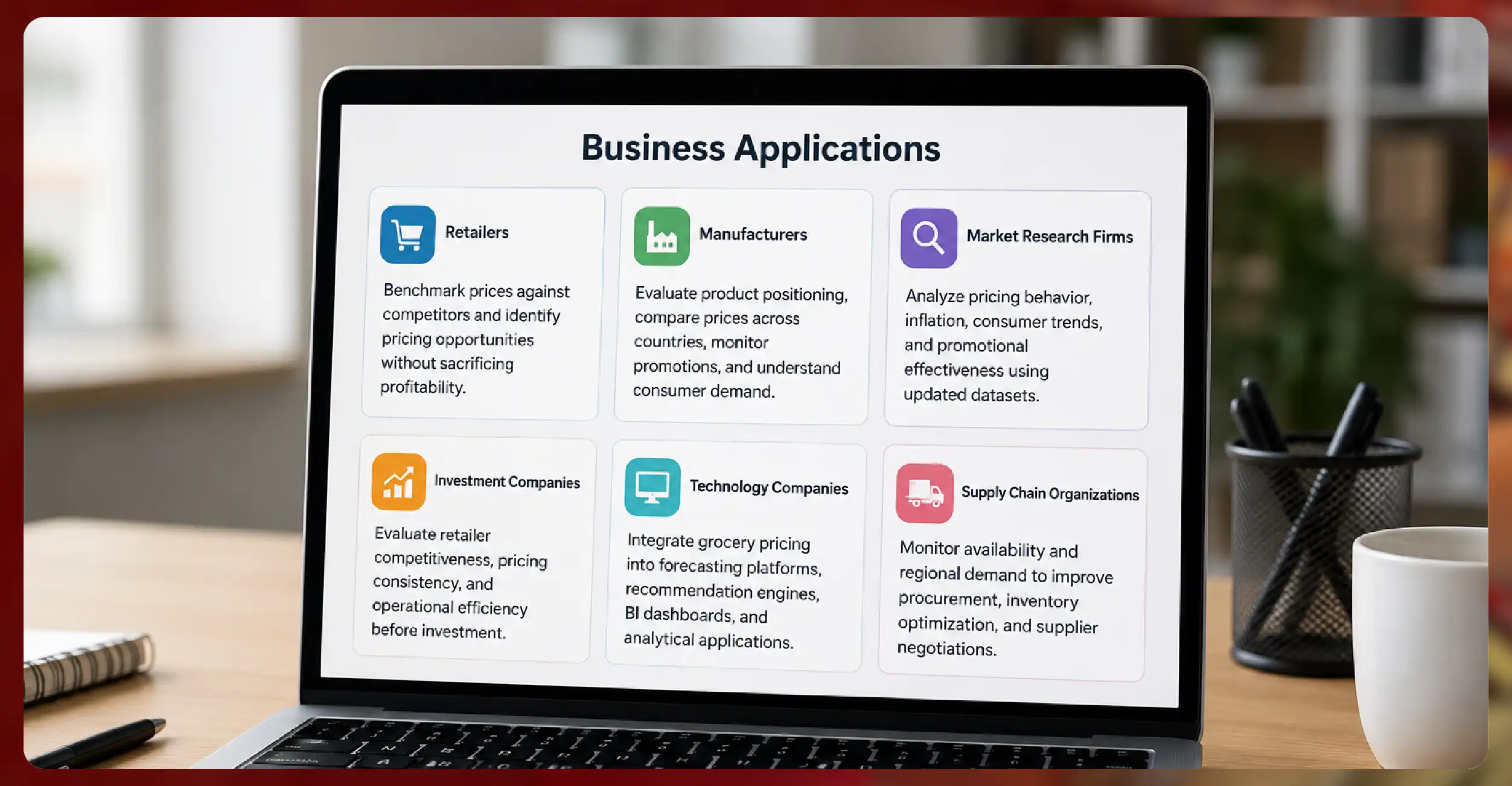
Retailers use grocery intelligence to benchmark their prices against competitors and identify pricing opportunities without sacrificing profitability.
Manufacturers evaluate product positioning, compare retail prices across countries, monitor promotional activity, and understand consumer demand for different product categories.
Market research firms analyze pricing behavior, inflation, consumer purchasing trends, and promotional effectiveness using continuously updated datasets.
Investment companies evaluate retailer competitiveness, pricing consistency, and operational efficiency before making strategic investment decisions.
Technology companies integrate grocery pricing into forecasting platforms, recommendation engines, business intelligence dashboards, and analytical applications.
Supply chain organizations monitor product availability and regional demand to improve procurement planning, inventory optimization, and supplier negotiations.
Automation Improves Data Quality
Manual grocery price collection requires significant time and resources while increasing the possibility of errors and outdated information. Automated extraction systems continuously collect fresh information from multiple grocery applications without interruption.
Automation enables businesses to monitor thousands of products several times each day while maintaining consistent data quality. Historical records generated through automated workflows allow analysts to evaluate pricing movements over weeks, months, and years.
Businesses also benefit from standardized datasets that simplify reporting, visualization, forecasting, and machine learning applications.
Stay Ahead in Luxury Fashion Markets!
Get accurate product, pricing, and competitor insights with our smart data solutions. Connect with us today!
Competitive Benchmarking
Retail pricing changes rapidly in response to promotions, consumer demand, competitor actions, and inventory fluctuations. Businesses require continuous visibility into market movements to remain competitive.
Automated competitor grocery price tracking enables organizations to monitor competitor pricing strategies, promotional campaigns, product launches, discount frequency, and category performance across multiple retailers simultaneously.
With access to real-time competitive intelligence, businesses can optimize pricing decisions, improve promotional planning, and strengthen market positioning.
API Integration and Enterprise Analytics
Many enterprises integrate grocery pricing directly into pricing engines, ERP platforms, reporting systems, business intelligence dashboards, and machine learning applications.
Organizations can Extract grocery pricing API information wherever supported, allowing structured integration into existing enterprise workflows while reducing manual processing and improving reporting efficiency.
Combined with automated extraction technologies, API integration delivers highly scalable grocery intelligence suitable for large retail organizations operating across multiple countries.
Benefits of Grocery Price Intelligence
Organizations adopting grocery price intelligence gain numerous operational and strategic advantages. Retailers improve pricing decisions through continuous competitor monitoring while manufacturers better understand market positioning across regions.
Procurement teams negotiate supplier contracts using verified pricing information. Financial analysts monitor retail inflation and category-specific pricing behavior. Consumer brands optimize product launches using competitive intelligence gathered from international grocery markets.
Comprehensive Price Monitoring Services provide organizations with continuous visibility into retail pricing movements, helping improve forecasting accuracy, promotional planning, inventory optimization, and competitive decision-making.
Ready to transform global grocery data into actionable insights? Contact iWeb Data Scraping today for customized, real-time grocery price intelligence solutions tailored to your business needs.
Future of International Grocery Intelligence
Artificial intelligence and predictive analytics continue transforming grocery pricing intelligence into highly sophisticated forecasting platforms. Modern analytical systems no longer simply collect prices—they identify promotional patterns, forecast demand fluctuations, estimate inventory shortages, and recommend optimal pricing strategies.
Cross-country grocery intelligence will continue growing as retailers expand digital operations and consumers increasingly compare prices online before purchasing. Organizations investing in automated grocery intelligence today position themselves for stronger competitiveness, better operational planning, and improved profitability.
How iWeb Data Scraping Can Help You?
Customized Data Collection
Our specialists develop tailored extraction solutions based on your target retailers, countries, product categories, scheduling preferences, and delivery formats. This ensures businesses receive highly relevant datasets that align with operational objectives and analytical requirements.
Automated Real-Time Monitoring
We build automated monitoring systems that continuously collect updated pricing, promotions, inventory levels, and catalog information. Frequent updates provide organizations with reliable market intelligence that supports faster decision-making and more effective pricing strategies.
High-Quality Structured Data
Every dataset undergoes extensive validation to ensure completeness, consistency, and accuracy. Clean structured information reduces manual processing, improves reporting efficiency, and enables organizations to perform reliable analytics across international grocery markets.
Scalable Enterprise Solutions
Whether monitoring thousands or millions of products, our infrastructure scales according to business requirements. Organizations benefit from dependable automation, secure delivery pipelines, flexible scheduling, and enterprise-grade support throughout every project.
Actionable Business Intelligence
Beyond raw information, we deliver organized datasets that support forecasting, pricing optimization, market research, procurement planning, competitive benchmarking, and strategic decision-making across rapidly changing retail environments.
Conclusion
The future of grocery retail depends on timely, accurate, and scalable market intelligence. Businesses leveraging automated grocery data gain a competitive advantage through faster pricing decisions, improved forecasting, enhanced inventory planning, and stronger market visibility. Modern Web Scraping API Services enable organizations to collect large-scale retail information efficiently while comprehensive Grocery and Supermarket Store Datasets provide valuable insights into international pricing, promotions, and consumer behavior. A reliable Grocery & Supermarket Data Extraction Service transforms raw grocery application data into structured business intelligence that helps retailers, manufacturers, analysts, and technology companies make smarter strategic decisions across Australia, New Zealand, the United Kingdom, and the United States.
Experience top-notch web scraping service and mobile app scraping solutions with iWeb Data Scraping. Our skilled team excels in extracting various data sets, including retail store locations and beyond. Connect with us today to learn how our customized services can address your unique project needs, delivering the highest efficiency and dependability for all your data requirements.