

Introduction
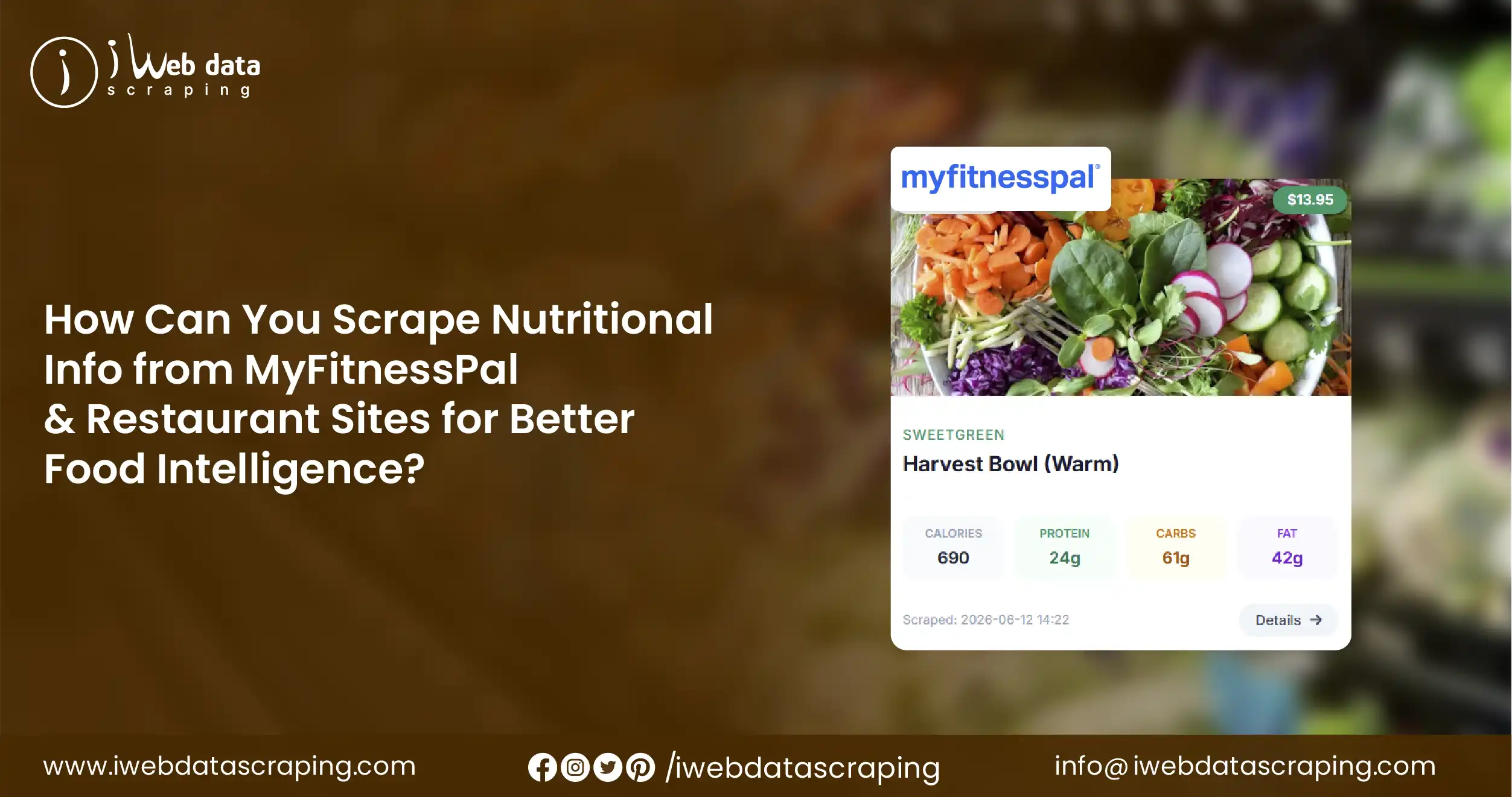
Food choices are becoming increasingly data-driven. Consumers want to know how many calories they are consuming, how much protein a meal provides, whether a dish contains excessive sodium, and which restaurant offers healthier alternatives. At the same time, fitness applications, nutrition platforms, restaurants, food delivery companies, researchers, and market intelligence firms need structured nutritional information to build better products and make informed decisions. This growing demand makes the need to Scrape Nutritional Info from MyFitnessPal & Restaurant Sites an important approach for transforming scattered online food information into organized, usable datasets.
A comprehensive MyFitnessPal nutritional data Extraction process can help businesses collect food names, serving sizes, calorie counts, macronutrients, micronutrients, ingredients, and other nutritional attributes available from relevant sources. When this information is standardized, companies can analyze thousands of food records much faster than through manual research.
Similarly, Food calorie and nutritional data collection From Restaurant Sites can provide valuable insights into menu composition, nutritional positioning, portion sizes, ingredients, and differences between competing restaurants. When combined with menu prices, ratings, categories, and availability, nutritional information becomes part of a broader restaurant intelligence ecosystem.
The opportunity extends beyond simply counting calories. Structured nutrition datasets can power meal-planning applications, fitness platforms, restaurant comparison tools, health-focused marketplaces, research projects, recommendation engines, and competitive intelligence dashboards.
Why Nutritional Information Matters?
Nutrition has become a significant factor in purchasing and dining decisions. People following fitness programs may prioritize protein, while consumers managing their food intake may compare calories, sugar, carbohydrates, sodium, or fat before ordering.
For businesses, manually checking nutritional information across hundreds or thousands of food and restaurant pages can quickly become inefficient. Websites may present information through tables, product pages, downloadable nutrition guides, interactive menus, or dynamically generated content. Data may also be presented using different measurement units and naming conventions.
Automated extraction provides a way to bring these fragmented details into one structured dataset. Once collected, nutritional attributes can be cleaned, standardized, validated, and analyzed according to specific business requirements.
For example, an analytics company could compare the average calories of burgers across restaurant chains, evaluate protein levels in meal bowls, identify low-sugar beverages, or analyze sodium levels across different cuisine categories.
What Nutritional Data Can Be Collected?
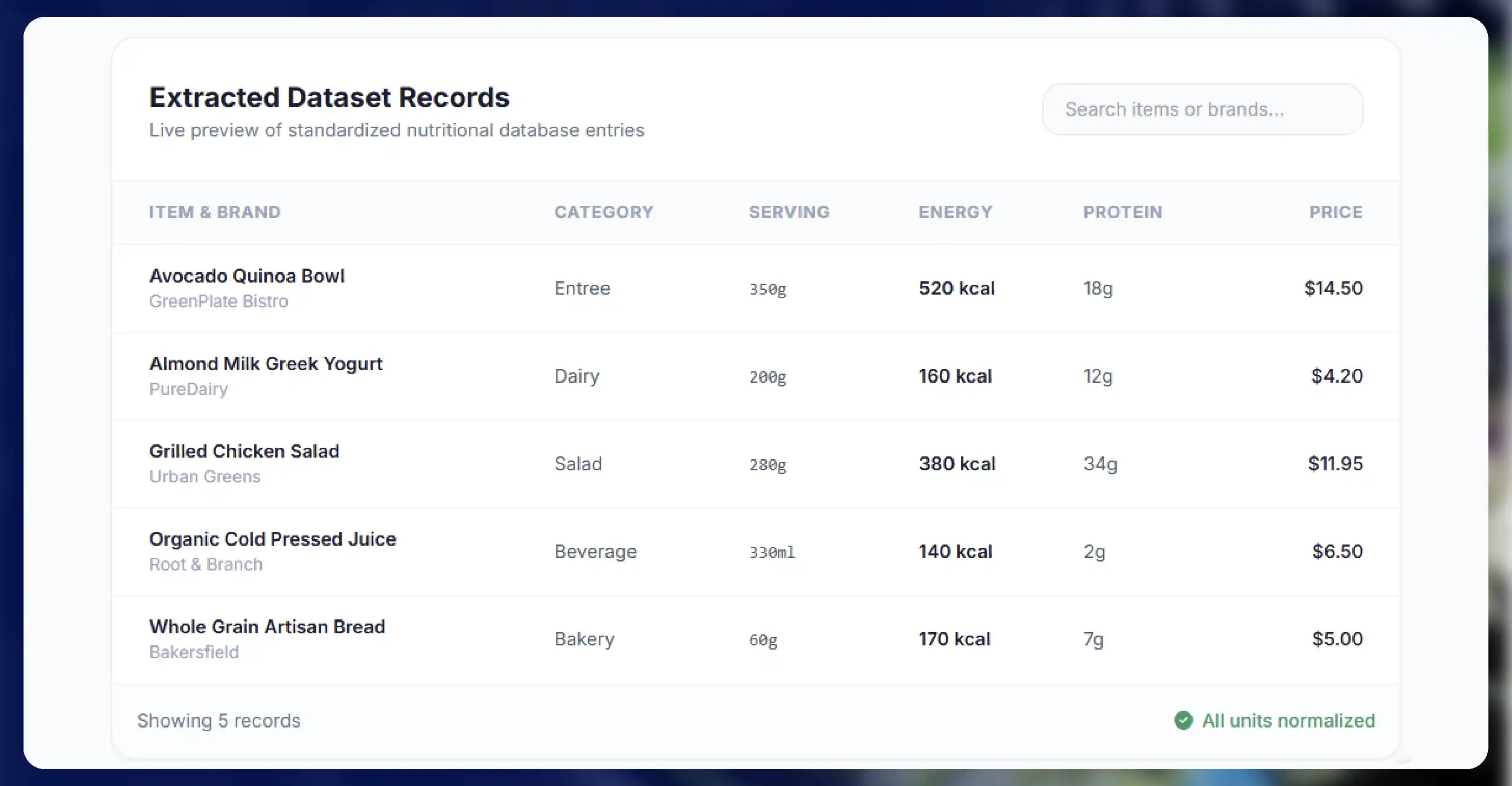
A well-designed extraction project can collect many nutritional attributes depending on what each source publicly provides. Basic fields may include food name, brand, restaurant, menu category, serving size, calories, protein, carbohydrates, total fat, saturated fat, trans fat, cholesterol, sodium, fiber, sugar, and added sugar.
More detailed sources may provide vitamins, minerals, ingredients, allergens, dietary labels, preparation information, and nutritional percentages.
Restaurant datasets can also contain menu prices, discounted prices, item descriptions, location information, availability, cuisine type, meal category, and source URLs.
The important part is not merely collecting these fields but organizing them consistently. One source may describe energy as calories, another as kcal, and another through a nutritional table. Serving sizes may appear in grams, ounces, pieces, cups, bowls, or custom portions.
Normalization converts these variations into comparable data points, allowing businesses to perform accurate analysis across different sources.
Collecting Data From Food Databases
Large food databases contain enormous quantities of information that can be difficult to research manually. Automated extraction workflows can identify relevant food records, collect available nutritional fields, and transform them into structured formats.
A typical workflow starts by defining the required fields. For example, a nutrition application may require calories, protein, carbohydrates, fats, sugar, sodium, serving size, and ingredients, while a market research company may additionally require brand and category information.
The extraction process can then discover relevant pages and capture the required information. Depending on website architecture and permitted access methods, workflows may use HTML parsing, structured page information, browser automation, APIs, or other technical approaches.
After collection, the data is cleaned and standardized. Duplicate entries are removed, inconsistent units are normalized, missing values are identified, and numerical fields are validated.
This process creates a dataset that can be integrated into analytics platforms, databases, dashboards, applications, or research environments.
Restaurant Menu And Nutrition Intelligence
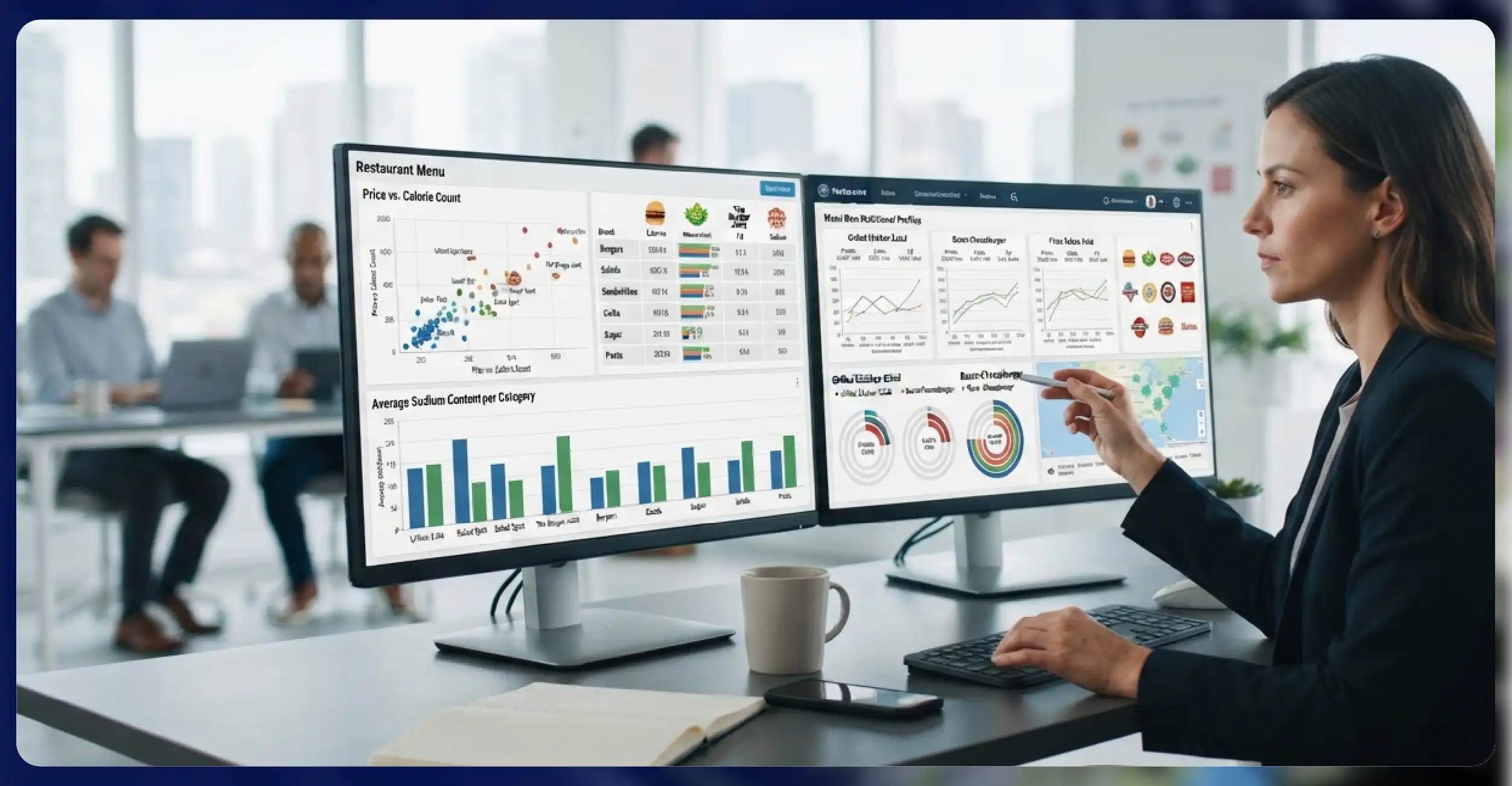
Restaurant websites are especially valuable because they connect nutritional information with actual menu offerings. Instead of analyzing nutrition data in isolation, businesses can understand how nutritional values relate to food categories, prices, descriptions, and customer-facing positioning.
For example, MyFitnessPal food nutrition analytics can become more valuable when food records are connected with restaurant-level information. Analysts can identify popular meal categories, compare nutritional profiles, and evaluate how different brands position their menus.
Likewise, Restaurant nutritional information extraction can help organizations gather information from restaurant menu pages, nutrition guides, and other publicly available sources. This can support competitive benchmarking across multiple brands and geographic markets.
A restaurant intelligence platform could compare calories, protein, carbohydrates, fat, sugar, and sodium across similar dishes. It could also identify which brands provide the most detailed nutrition information and which menu categories have the widest nutritional variation.
Businesses can then use these insights to understand market positioning and identify potential opportunities.
Combining Menu And Nutritional Information
Nutrition becomes considerably more useful when connected with other restaurant attributes. For example, Scrape restaurant menu and nutrition data to create datasets containing menu names, descriptions, prices, categories, calories, serving sizes, ingredients, ratings, and availability.
This combined information can answer questions that nutritional data alone cannot address.
A meal-planning platform might identify high-protein dishes within a particular budget. A restaurant analytics company could compare calories against prices. A delivery platform could introduce nutritional filters that allow users to discover meals based on specific dietary preferences.
Researchers could analyze whether healthier menu options are generally more expensive or determine which cuisine categories offer the greatest selection of lower-calorie dishes.
The combination of multiple data dimensions creates significantly stronger analytical value.
Data Cleaning And Standardization
Raw web data is rarely ready for immediate analysis. Nutritional information may contain inconsistent spellings, duplicated products, different units, missing values, formatting errors, or descriptions mixed with numerical attributes.
Data cleaning addresses these challenges before the dataset reaches its final destination.
For instance, serving sizes can be standardized into consistent measurement units. Calorie values can be stored numerically instead of as text. Restaurant names can be normalized to reduce duplicate records. Menu categories can be mapped into standardized classifications.
Validation rules can also identify unusual values. If one item contains an unexpectedly high or low calorie count compared with similar products, the record can be flagged for additional verification.
This quality-control stage is critical because inaccurate nutritional information can produce misleading analytics and poor recommendations.
Competitive Benchmarking Opportunities
Nutritional datasets can provide a new dimension of competitive intelligence for restaurant businesses.
Instead of comparing competitors only by prices, ratings, or menu size, companies can evaluate nutritional positioning. They can calculate average calories by category, compare protein levels across competing dishes, analyze sodium concentrations, and identify emerging nutritional trends.
For example, a restaurant brand may discover that competitors are rapidly introducing high-protein meals. Another business may identify growing demand for lower-calorie desserts or reduced-sugar beverages.
Historical data makes these insights even more useful. By maintaining periodic snapshots, businesses can observe how nutritional profiles change over time.
A change in calories could indicate recipe reformulation, portion-size changes, ingredient substitutions, or new preparation methods. Tracking such changes provides a deeper understanding of evolving restaurant strategies.
Applications Across Food Technology
Nutritional datasets can support a wide range of applications. Fitness platforms can improve food discovery, meal-planning services can recommend meals according to nutritional requirements, and consumer applications can help users compare restaurant dishes.
Food delivery businesses can combine nutritional attributes with menus, prices, delivery availability, ratings, and promotions to create more informative discovery experiences.
Food Delivery Data Scraping Services can support this broader approach by helping businesses build structured datasets containing restaurant and menu information alongside nutritional attributes where publicly available.
Market researchers can use these datasets to study dietary trends, restaurant positioning, pricing strategies, and product innovation across cities and countries.
Investors can also analyze menu changes and nutritional trends as indicators of evolving consumer preferences.
Building A Scalable Data Pipeline
A scalable extraction pipeline begins with clear data requirements. Businesses should determine which sources, geographic areas, restaurant categories, nutritional fields, and update frequencies are necessary.
Source discovery is followed by automated page collection and information extraction. The collected records then pass through cleaning, normalization, validation, deduplication, and classification stages.
Recurring extraction is particularly useful for restaurant data because menus are constantly changing. New products may be launched, seasonal dishes may disappear, prices may change, and nutritional information may be updated.
A scheduled workflow can capture these changes and maintain historical records. Change detection can identify when a nutritional value or serving size has been modified.
The final dataset can be delivered through structured files, databases, cloud storage, APIs, or other formats suitable for the organization's technology environment.
Managing Dynamic Restaurant Websites
Many restaurant websites use dynamic interfaces where menu details are loaded after the initial page request. Nutrition information may appear through interactive panels, expandable sections, downloadable documents, or embedded data.
A robust extraction architecture needs to account for these variations. Different sources may require different extraction strategies, while monitoring systems can identify layout changes that affect data collection.
Scalability is equally important. Collecting nutritional information from ten restaurants is fundamentally different from monitoring thousands of restaurants across multiple markets.
Large-scale projects may require parallel processing, scheduling, proxy infrastructure, error handling, duplicate detection, monitoring, and automated quality checks.
The objective is to create a dependable data pipeline rather than a one-time collection exercise.
Turning Nutrition Data Into Business Intelligence
The real value of nutritional extraction emerges when the collected information becomes part of a larger analytical system.
Businesses can combine nutrition with menu prices to calculate value-oriented nutritional comparisons. They can combine nutrition with customer ratings to determine whether certain healthy options perform well. They can combine nutrition with location data to identify geographic differences in menu composition.
AI-powered applications can use structured datasets to recommend meals based on calorie limits, protein requirements, cuisine preferences, budgets, or other user-selected factors.
Restaurant operators can use competitive benchmarks to identify gaps in their menus. Food delivery platforms can improve discovery. Researchers can study changes in food composition over time.
Thus, nutritional data becomes more than a collection of individual facts. It becomes an intelligence layer that supports strategic and consumer-facing decisions.
How iWeb Data Scraping Can Help You?
Customized Nutritional Collection
iWeb Data Scraping can collect required nutritional fields, restaurant information, menu attributes, serving sizes, ingredients, calories, and other available data according to specific business requirements.
Structured Data Delivery
Collected information can be cleaned, standardized, deduplicated, and organized into structured datasets, making nutritional records easier to analyze, integrate, visualize, and use across business applications.
Large-Scale Restaurant Coverage
Businesses can monitor nutritional information across numerous restaurant brands, menu categories, locations, and food sources, creating broader datasets for competitive research and market intelligence.
Recurring Data Monitoring
Scheduled extraction can help identify menu additions, removals, nutritional changes, serving-size updates, and other modifications, keeping datasets refreshed without relying entirely on repetitive manual research.
Analytics-Ready Information
iWeb Data Scraping can deliver structured nutritional datasets suitable for dashboards, recommendation engines, research platforms, databases, applications, pricing analysis, and broader restaurant intelligence initiatives.
Conclusion
Nutritional information is becoming an increasingly important part of the digital food ecosystem. Calories, protein, carbohydrates, fats, sugar, sodium, ingredients, allergens, and serving sizes can help consumers make informed choices while providing businesses with valuable market intelligence.
For companies building comprehensive restaurant intelligence platforms, Food Delivery App Menu Datasets can be enriched with nutritional attributes to create deeper insights into menus, products, pricing, availability, and consumer-facing food choices.
Organizations that need continuously updated information can also use Web Scraping API Services to integrate structured food and restaurant information into applications, dashboards, analytics platforms, and automated workflows.
At a larger scale, professional Web Scraping Services can help businesses collect, clean, standardize, validate, and maintain nutritional datasets across multiple sources and markets.
The future of food intelligence is not simply about knowing how many calories a dish contains. It is about connecting nutrition with pricing, menus, availability, customer preferences, restaurant competition, and market trends. When properly structured and maintained, nutritional data can become a powerful foundation for smarter food technology and better business decisions.
FAQs
Depending on the source, nutritional datasets can include calories, serving sizes, protein, carbohydrates, fats, sugar, sodium, fiber, ingredients, allergens, vitamins, minerals, and nutritional percentages.
Yes. Nutritional information can be combined with menu prices, categories, descriptions, ratings, availability, promotions, and restaurant locations to create comprehensive competitive intelligence datasets.
The appropriate frequency depends on business requirements. Weekly or monthly monitoring may work for research, while frequently changing menus may require daily or more frequent updates.
Yes. Structured nutrition datasets can support applications that recommend meals based on calories, protein, carbohydrates, dietary preferences, serving sizes, budgets, cuisine types, and other selected criteria.
Cleaning removes duplicates, standardizes units, resolves inconsistent naming, validates numerical values, and identifies missing information, helping businesses create reliable datasets suitable for analysis and applications.