
58.6K+
TOTAL UAE PRODUCT & MENU RECORDS PROCESSED

Scrape UAE Brand Used Talabat, Noonfood & Lulu APIs for Pricing, Products, Availability, Locations, and Competitive Retail Intelligence.
This case study presents a real-world enterprise scenario where a UAE-focused retail intelligence organization wanted to build a unified data layer from leading food delivery, grocery, and hypermarket ecosystems. The objective was to monitor product availability, pricing, locations, menu information, promotions, and SKU-level changes across rapidly evolving quick-commerce environments.
The organization used method to Scrape UAE Brand Used Talabat, Noonfood & Lulu API capabilities to consolidate fragmented retail and food-delivery information into structured datasets that could support competitive intelligence, pricing analytics, assortment monitoring, location intelligence, and FMCG market research.
It is designed for:
A major requirement was the ability to Extract Talabat, Noonfood & Lulu pricing data at scale while maintaining product-level consistency across different platforms, categories, locations, and time periods.
The client wanted to move beyond occasional manual checks. Its objective was to establish a continuous intelligence framework capable of identifying pricing changes, unavailable SKUs, new products, promotional movements, and geographic differences across the UAE retail landscape.
UAE quick-commerce has created a highly dynamic retail environment where prices, inventory, promotions, menus, and delivery availability can change throughout the day. For FMCG brands and retailers, monitoring these changes manually creates significant gaps in competitive visibility.
The client therefore implemented a structured data intelligence framework designed to Scrape UAE Q-commerce product and pricing data across major food-delivery and hypermarket ecosystems. The system collected product names, brands, categories, pack sizes, prices, discounted prices, availability indicators, store information, location details, and other relevant retail attributes.
The project also enabled teams to Extract UAE Q-commerce data API for FMCG brands, giving brand managers a structured view of how products appeared across different digital channels. Instead of analyzing isolated platform snapshots, analysts could compare product positioning and price movements through normalized datasets.
The resulting intelligence layer supported price benchmarking, assortment monitoring, promotional analysis, competitive research, and regional availability tracking. Data was organized into standardized records so that the same or similar products could be compared despite differences in naming conventions, pack sizes, category structures, and presentation formats.
The system continuously processed large volumes of retail and food-delivery information. Automated validation reduced duplicate records and improved consistency between historical and current observations.
For FMCG companies, the resulting intelligence helped answer critical questions: Which products are discounted? Where are prices changing? Which SKUs are unavailable? Which categories are expanding? Which locations show the greatest price differences? Which brands receive stronger promotional visibility?
The client operated in a highly competitive UAE retail ecosystem where product prices and availability varied according to platform, location, category, store, promotion, and delivery conditions.
One of the first challenges was obtaining consistent Grocery price comparison across Talabat, Noonfood & Lulu. Similar products could appear under different names, pack-size descriptions, promotional structures, and category classifications. Manual comparisons therefore required substantial effort and could easily produce inaccurate conclusions.
The second challenge involved maintaining reliable UAE grocery SKU and availability data Scraping across a large assortment. Product availability could change frequently, making periodic manual collection insufficient for understanding inventory patterns.
Another major requirement was obtaining structured information from food-delivery ecosystems. The organization needed Talabat Food Data Extraction Services to monitor restaurant menus, food categories, item prices, promotions, availability, and location-level information alongside grocery intelligence.
By implementing a structured extraction and normalization framework, the client replaced fragmented manual monitoring with an automated intelligence pipeline covering grocery products, FMCG SKUs, restaurant menus, prices, promotions, locations, and availability.
| Dimension | Manual Tracking | Client Data Intelligence System |
|---|---|---|
| Data collection | Periodic manual browsing | Automated multi-platform data ingestion |
| Platform coverage | Limited number of stores and categories | Expanded coverage across multiple UAE commerce ecosystems |
| Price monitoring | Occasional spreadsheet updates | Continuous structured price observations |
| SKU tracking | Manual product searches | Standardized SKU-level records |
| Availability | Checked manually | Structured availability indicators |
| Product matching | Human comparison | Normalized product and brand attributes |
| Promotion tracking | Manually recorded offers | Regular price and promotional price separation |
| Location intelligence | Limited geographic visibility | Location and store-level datasets |
| Historical analysis | Difficult to maintain | Time-series comparison across records |
| Reporting | Spreadsheet-based | Dashboard-ready structured datasets |
| Trend detection | Reactive | Faster identification of emerging movements |
| Scalability | Low to moderate | High-volume processing architecture |
| Data consistency | Variable | Standardized schemas and validation |
| Decision speed | Delayed | Faster competitive and pricing decisions |
The transformation allowed the client to treat digital commerce data as an ongoing intelligence stream rather than a collection of isolated snapshots.
The brand in focus is a UAE-oriented retail intelligence organization supporting FMCG, grocery, food-tech, and digital commerce businesses with market visibility and competitive analytics.
Its monitoring requirements expanded rapidly as more brands, products, stores, restaurants, and delivery locations entered the digital marketplace. The organization needed to understand not only what products were listed but also how those products were priced, promoted, positioned, and distributed across different areas.
Its existing workflow depended heavily on manual checks and disconnected spreadsheets. Analysts had to search individual platforms, record product information, compare prices, validate availability, and consolidate observations before producing a report.
This process created three major limitations: low monitoring frequency, inconsistent data structures, and delayed insights.
The organization therefore shifted toward an automated data intelligence architecture. The new system was designed to capture commerce information continuously, normalize product and restaurant records, identify changes, and deliver structured outputs for downstream analytics.
We delivered an end-to-end data intelligence solution designed to collect, normalize, validate, and organize information across food delivery, grocery, FMCG, and hypermarket environments.
The architecture was built around a standardized schema covering product identifiers, brand names, categories, descriptions, pack sizes, regular prices, discounted prices, promotions, availability, store information, locations, timestamps, and other relevant attributes.
For restaurant and food-delivery intelligence, the system incorporated Talabat Food Delivery App Dataset capabilities to organize restaurant names, cuisine categories, menu items, prices, promotional information, locations, and availability indicators into structured records.
The solution also integrated noonfood Food Data Extraction Services to support restaurant and food-delivery data monitoring. This created a more comprehensive view of menu pricing, food categories, restaurant availability, and geographic coverage.
For hypermarket intelligence, the framework supported the ability to Scrape Lulu Hypermarket locations in the UAE, enabling location-level analysis of stores and associated product availability.
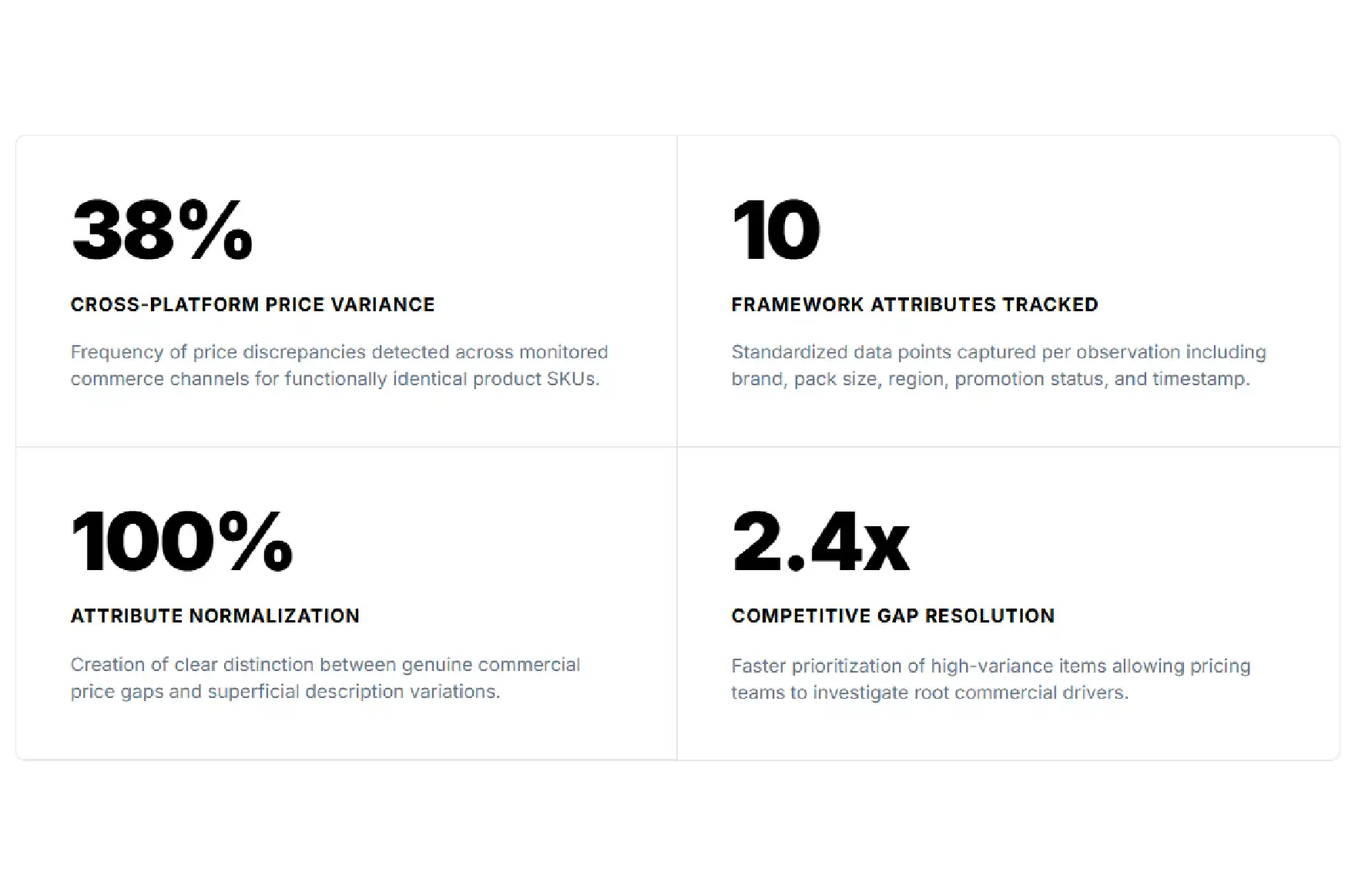
The first major finding was that product prices frequently differed across monitored commerce environments. These differences could result from platform-specific promotions, retailer strategies, store-level conditions, pack-size variations, or temporary discounts.
The structured dataset allowed analysts to compare comparable products using normalized brand, product, and pack-size attributes.
This created a clearer distinction between genuine price differences and apparent differences caused by inconsistent product descriptions.
The client could therefore identify products with unusually high price variance and investigate the underlying commercial reasons.
A recurring comparison framework was created around:
This information supported pricing teams in identifying competitive gaps and prioritizing products requiring further investigation.
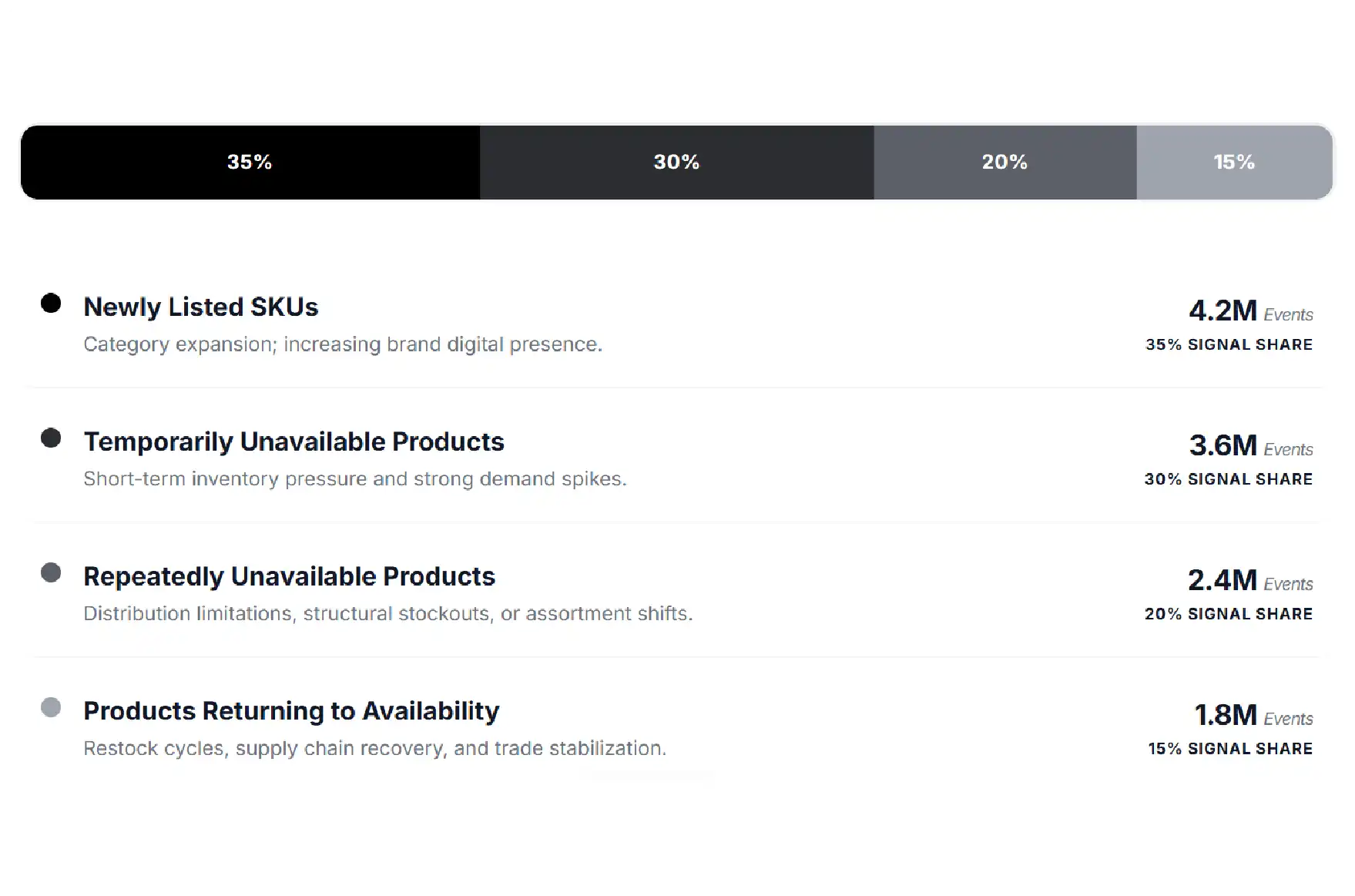
Availability was initially treated as a basic inventory field. However, once historical records were available, the client discovered that availability changes could reveal meaningful market signals.
Repeated unavailability across specific locations could indicate inventory pressure, strong demand, distribution limitations, or assortment changes.
Similarly, newly available products could indicate category expansion or a brand's increasing digital presence.
The client therefore developed availability monitoring around four primary signals:
This approach transformed SKU availability from a simple operational field into a competitive intelligence indicator.
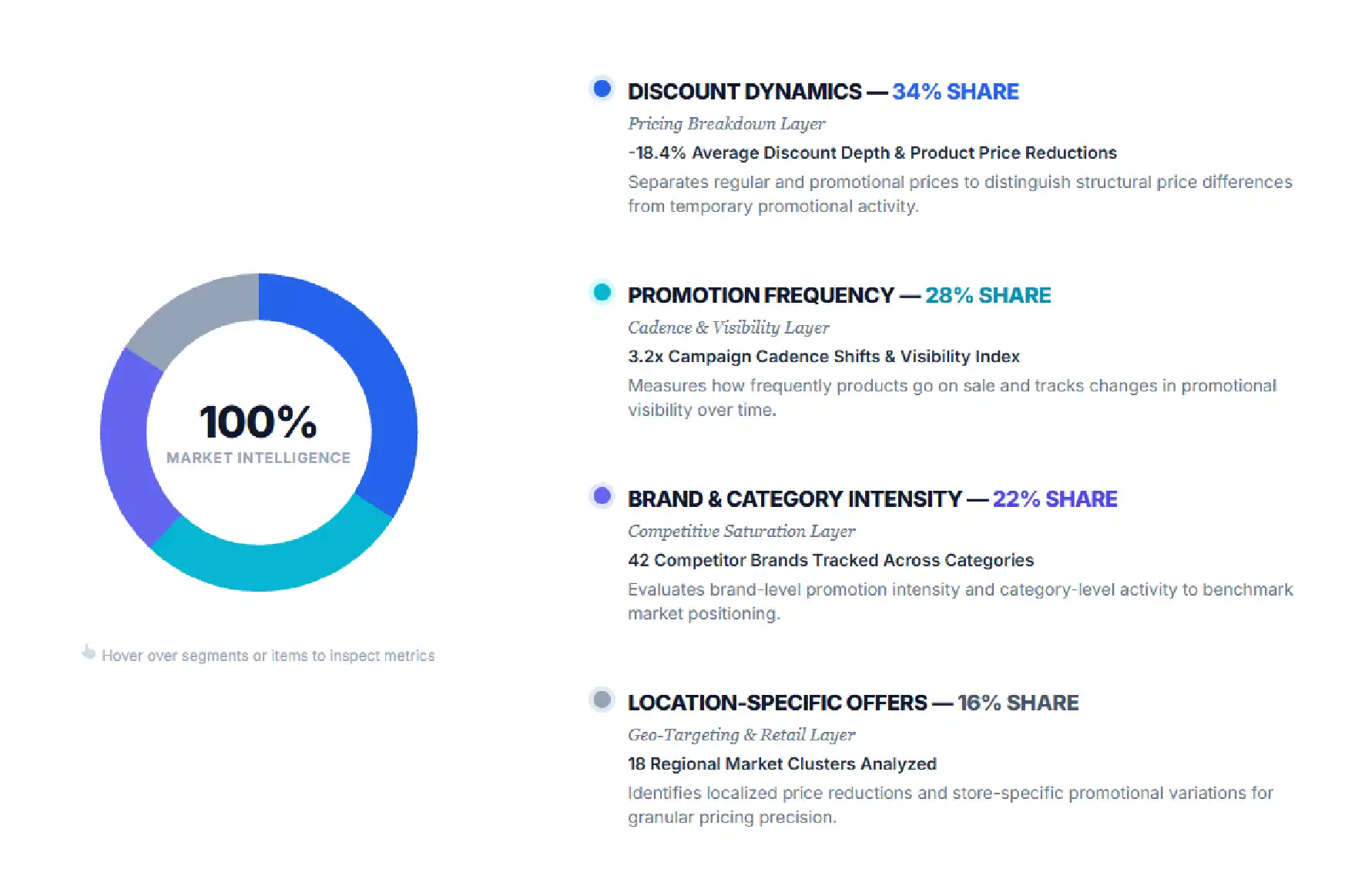
Promotions represented another significant source of insight.
A simple price comparison could incorrectly classify a discounted product as permanently cheaper. By separating regular and promotional prices, the client could distinguish structural price differences from temporary promotional activity.
Analysts could examine:
The resulting intelligence supported more accurate competitive pricing analysis.
For FMCG manufacturers, this was particularly valuable because it provided a broader view of how products were being positioned at the consumer-facing level.
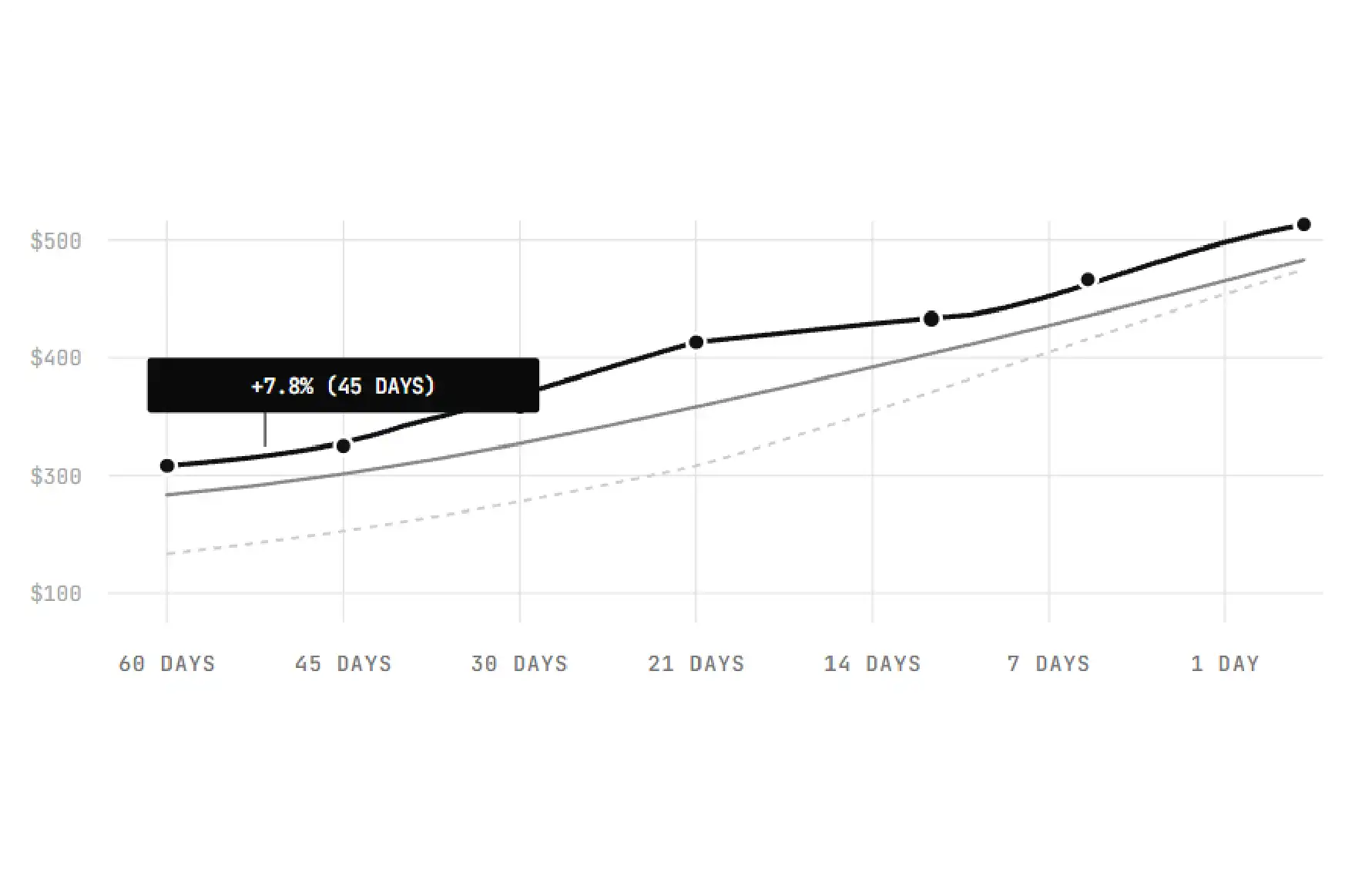
The UAE market contains geographically distributed retail and delivery operations. Product availability and pricing can therefore vary by store and delivery location.
The client's structured location dataset made it possible to compare:
| Location Type | Products Tracked | Avg. Price Variation | Availability Signal | Primary Insight |
|---|---|---|---|---|
| Dubai | 18,420 | 8.1% | High | Strong assortment depth |
| Abu Dhabi | 14,860 | 7.4% | High | Competitive pricing |
| Sharjah | 9,740 | 6.8% | Medium | Growing digital assortment |
| Ajman | 6,280 | 7.1% | Medium | Selective category coverage |
| Al Ain | 5,920 | 6.3% | Medium | Regional availability variation |
| Ras Al Khaimah | 3,380 | 5.9% | Moderate | Smaller monitored assortment |
| Fujairah | 2,940 | 5.6% | Moderate | Location-specific availability |
These observations helped the client identify areas where product coverage, pricing, and availability behaved differently.
Location-level monitoring also supported store expansion analysis and helped stakeholders understand where digital assortment was strongest.
A representative dataset snapshot was created to demonstrate how structured UAE commerce intelligence could be analyzed across products and locations.
| Brand | Product | Category | Pack Size | Regular Price AED | Sale Price AED | Availability | Location | Platform |
|---|---|---|---|---|---|---|---|---|
| Kellogg's | Corn Flakes | Grocery | 500g | 19.95 | 16.95 | Available | Dubai | Grocery |
| Al Rawabi | Full Cream Milk | Dairy | 1L | 7.50 | 6.95 | Available | Abu Dhabi | Grocery |
| Lay's | Classic Potato Chips | Snacks | 150g | 8.25 | 7.25 | Available | Sharjah | Q-Commerce |
| Almarai | Orange Juice | Beverages | 1L | 12.50 | 10.95 | Limited | Dubai | Grocery |
| Ariel | Laundry Detergent | Household | 2.5L | 29.90 | 26.90 | Available | Abu Dhabi | Grocery |
| Cadbury | Dairy Milk Chocolate Bar | Confectionery | 100g | 6.95 | 5.95 | Available | Ajman | Q-Commerce |
| Al Ain | Cooking Oil | Staples | 1.5L | 18.75 | 17.50 | Available | Dubai | Grocery |
| Masafi | Bottled Water | Beverages | 1.5L | 2.50 | 2.25 | Available | Sharjah | Grocery |
The dataset structure enabled stakeholders to compare products across platforms while retaining location, availability, pricing, and promotional context.
The project also revealed that grocery and food-delivery intelligence could be analyzed together to understand broader digital consumer behavior.
Restaurant menus provided additional information about cuisine demand, item pricing, promotional positioning, and geographic availability.
Menu-level records could be organized around:
| Data Field | Example Intelligence |
|---|---|
| Restaurant | Restaurant identity |
| Cuisine | Cuisine classification |
| Menu Item | Individual food product |
| Category | Starters, mains, beverages, desserts |
| Regular Price | Standard listed price |
| Sale Price | Promotional price |
| Availability | Item-level availability |
| Location | Delivery market |
| Promotion | Discount or offer |
| Timestamp | Historical tracking point |
Combining restaurant and grocery information helped the client create a wider view of the UAE digital food ecosystem.
After implementing the structured data intelligence framework, the client achieved measurable improvements in pricing visibility, assortment monitoring, location intelligence, and operational efficiency.
Our approach focuses on converting fragmented digital commerce information into structured intelligence that organizations can use across pricing, marketing, competitive research, retail strategy, and business analytics.
The solution supports multi-platform data consolidation, enabling different commerce datasets to be organized into consistent structures. This removes the need for analysts to work with disconnected spreadsheets and manually reconcile information from separate sources.
It also improves price intelligence, allowing organizations to compare regular prices, promotional prices, product pack sizes, and location-level differences across monitored environments.
The architecture supports SKU-level monitoring, helping businesses identify product introductions, assortment changes, availability fluctuations, and category expansion.
Another major advantage is historical data availability. Once records are timestamped and standardized, organizations can analyze pricing trends, promotional frequency, availability patterns, and competitive movements over time.
The framework also supports location intelligence, which is particularly important for UAE commerce because digital assortment and availability can differ by market.
"We were looking for a scalable way to understand how grocery, FMCG, and food-delivery information was changing across the UAE market. The data intelligence solution gave our team a much clearer view of pricing, availability, promotions, products, and locations.
Previously, analysts spent considerable time checking platforms individually and maintaining spreadsheets. The structured datasets significantly reduced that effort and gave our commercial teams faster access to useful market signals.
The ability to compare products, identify availability changes, and analyze location-level patterns has strengthened our competitive intelligence process. The solution has also created a strong foundation for future dashboards and predictive analytics."
— Director of Retail Intelligence
The final outcome was a scalable UAE commerce intelligence framework capable of transforming fragmented grocery, FMCG, food-delivery, product, pricing, availability, and location information into structured datasets.
The client achieved stronger visibility into product-level pricing and assortment movements while reducing dependency on manual monitoring.
Historical records allowed analysts to understand how prices changed over time rather than relying on individual observations. Promotional information could be separated from regular pricing, improving competitive benchmarking accuracy.
Location-level datasets provided additional visibility into how assortment and availability varied across UAE markets.
The implementation of a Talabat Grocery Delivery Data Scraper further strengthened the client's ability to monitor grocery product information, pricing, availability, and assortment changes across delivery-oriented retail environments.
A structured UAE commerce dataset can include product names, brands, categories, descriptions, pack sizes, prices, discounted prices, promotions, availability, store information, locations, restaurant details, menu items, and timestamps.
Prices can differ across platforms because of promotions, retailer strategies, location-specific conditions, pack sizes, and temporary discounts. Structured comparison helps businesses identify genuine competitive price differences more efficiently.
Yes. Availability indicators can be structured at SKU, store, category, and location levels. Historical records can then be used to identify recurring stock-outs, new listings, and changing assortment patterns.
Yes. Restaurant menus, food categories, grocery products, pricing, promotions, and locations can be normalized into related datasets. This enables broader analysis of the UAE digital food and retail ecosystem.
Yes. Structured datasets can be prepared for dashboard environments and analytical systems. Businesses can visualize price movements, product availability, promotional activity, location differences, and competitive trends.
Fields marked * are required. Everything else just helps us scope faster — skip what you don't know yet.