
48.6K+
COMMERCIAL VEHICLE PARTS RECORDS PROCESSED

Scrape UAE Commercial Vehicle Parts Pricing Data for Real-Time Market Intelligence, Supplier Tracking, Competitive Analysis, and Procurement Optimization
This case study is based on a real-world automotive intelligence scenario where an enterprise data and analytics team implemented an automated framework to Scrape UAE Commercial Vehicle Parts Pricing Data and convert fragmented automotive listings into structured pricing intelligence for commercial vehicle manufacturers, distributors, fleet operators, aftermarket businesses, and procurement teams.
It is designed for:
The project also supports organizations looking to Scrape truck spare parts prices in the UAE across multiple commercial vehicle categories, product specifications, locations, and supplier sources.
The client's core challenge was straightforward: UAE commercial vehicle parts data was available across multiple digital sources, but pricing information was fragmented, inconsistent, frequently updated, and difficult to compare at scale. The organization required a centralized intelligence layer capable of capturing part names, specifications, prices, brands, suppliers, availability, locations, and related commercial vehicle information continuously.
A recent enterprise case study explored how automotive intelligence teams transformed fragmented UAE commercial vehicle parts information into structured pricing intelligence through automated data collection, normalization, validation, and monitoring workflows.
The initiative incorporated Daimler Truck parts data scraping to organize commercial vehicle component information across relevant product categories and supplier ecosystems. Data engineers collected product names, part descriptions, prices, specifications, availability indicators, supplier information, and location attributes from multiple online sources.
The project also established a structured UAE truck parts price benchmarking framework that allowed analysts to compare pricing movements across suppliers, product categories, vehicle segments, and geographic markets.
The resulting pipeline continuously processed automotive listings and converted unstructured information into standardized datasets. Duplicate records were removed, inconsistent product names were normalized, pricing formats were standardized, and product attributes were mapped into structured fields.
The intelligence system enabled procurement teams to identify pricing differences, monitor supplier movements, understand product availability, and evaluate changing aftermarket conditions. Commercial teams could also examine historical price movements and identify categories experiencing greater volatility.
Dashboards presented pricing trends, supplier comparisons, location-level differences, and availability signals in a simplified format. This helped stakeholders reduce manual research and improve the speed of pricing analysis.
The client operated in a highly fragmented commercial vehicle parts market where product information was distributed across dealer websites, automotive marketplaces, distributor catalogs, supplier pages, and other digital sources. Collecting comparable pricing information manually required substantial time and repeated research.
One major challenge involved tracking Daimler Truck MEA commercial vehicle data across multiple product categories and supplier sources. Product descriptions differed considerably between websites, making it difficult to identify matching components and compare prices consistently.
Another major issue was the lack of centralized Truck and commercial vehicle parts data extraction, which limited the organization's ability to maintain a unified view of product pricing, specifications, availability, supplier information, and market coverage.
The client also required scalable Automotive data scraping capabilities because commercial vehicle parts listings changed frequently. Manual collection could not reliably capture price updates, new products, discontinued listings, or changes in availability.
Additional challenges included:
By implementing an automated commercial vehicle pricing intelligence framework, the client replaced fragmented manual monitoring with a structured pipeline capable of continuously collecting, processing, standardizing, and analyzing commercial vehicle parts information across UAE sources.
| Dimension | Manual Parts Tracking | Client Data Scraping System |
|---|---|---|
| Data collection | Individual supplier and dealer browsing | Automated multi-source data ingestion |
| Pricing updates | Periodic manual checks | Continuous scheduled monitoring |
| Product matching | Manual identification | Standardized product and attribute mapping |
| Data structure | Spreadsheets and unorganized records | Structured datasets with normalized fields |
| Supplier comparison | Time-consuming manual comparison | Automated price benchmarking |
| Location analysis | Limited geographic visibility | Location-level pricing intelligence |
| Availability tracking | Inconsistent updates | Automated availability monitoring |
| Historical analysis | Limited historical records | Continuously maintained pricing history |
| Reporting speed | Hours or days | Rapid dashboard and dataset updates |
| Scalability | Limited by analyst capacity | Scalable across thousands of parts |
The brand in focus is a commercial vehicle intelligence and automotive analytics organization operating across the UAE aftermarket ecosystem. Its business environment includes manufacturers, authorized dealers, independent distributors, fleet operators, parts suppliers, and commercial vehicle service providers.
The organization required detailed visibility into commercial vehicle parts pricing because procurement decisions depend heavily on current market conditions. Differences in supplier pricing, product specifications, availability, and location can influence purchasing decisions and operating costs.
As its market coverage expanded, the organization encountered increasing volumes of digital product information. Individual suppliers presented products using different naming structures, descriptions, measurements, and pricing formats. Without automated normalization, it became difficult to determine whether similar listings represented identical or comparable parts.
The organization therefore adopted a structured automotive intelligence framework capable of monitoring product information across multiple sources. The objective was to create a reliable pricing database that could support procurement analysis, supplier benchmarking, market research, and commercial planning.
The system also provided a foundation for historical analysis. Instead of viewing individual prices in isolation, analysts could compare pricing changes over time, identify recurring movements, and examine market-level differences.
This transformation allowed the organization to move from reactive information gathering toward continuous automotive market intelligence.
We delivered an end-to-end automotive intelligence solution that transformed fragmented commercial vehicle parts listings into structured pricing datasets using automated extraction, normalization, validation, and analytical workflows.
The system used a scalable scraping API architecture to collect product information from multiple digital sources while maintaining consistent field structures across incoming records.
Data captured included product name, part category, vehicle compatibility, manufacturer, supplier, price, currency, availability, location, product URL, specification attributes, and collection timestamp.
A normalization layer standardized product names, units, currencies, supplier identifiers, and category labels. This reduced duplication and enabled more accurate comparison between similar commercial vehicle components.
The solution also implemented Managed web scraping workflows to support continuous monitoring, source management, extraction scheduling, error handling, and dataset maintenance across expanding automotive sources.
A dedicated Location intelligence layer connected parts listings with UAE market locations, allowing analysts to compare pricing and availability across major commercial hubs and supplier markets.
The system further applied automated validation rules to identify incomplete records, duplicate listings, abnormal prices, missing attributes, and inconsistent product descriptions. Records passing validation were transferred into structured databases for analytics and reporting.
Historical snapshots were retained to support price-change analysis. This allowed the client to identify increases, decreases, stable pricing periods, and recurring pricing patterns across product categories.
Dashboards were then connected to the processed datasets, enabling procurement and commercial teams to view pricing comparisons, supplier movements, product availability, and market-level differences through simplified analytical interfaces.
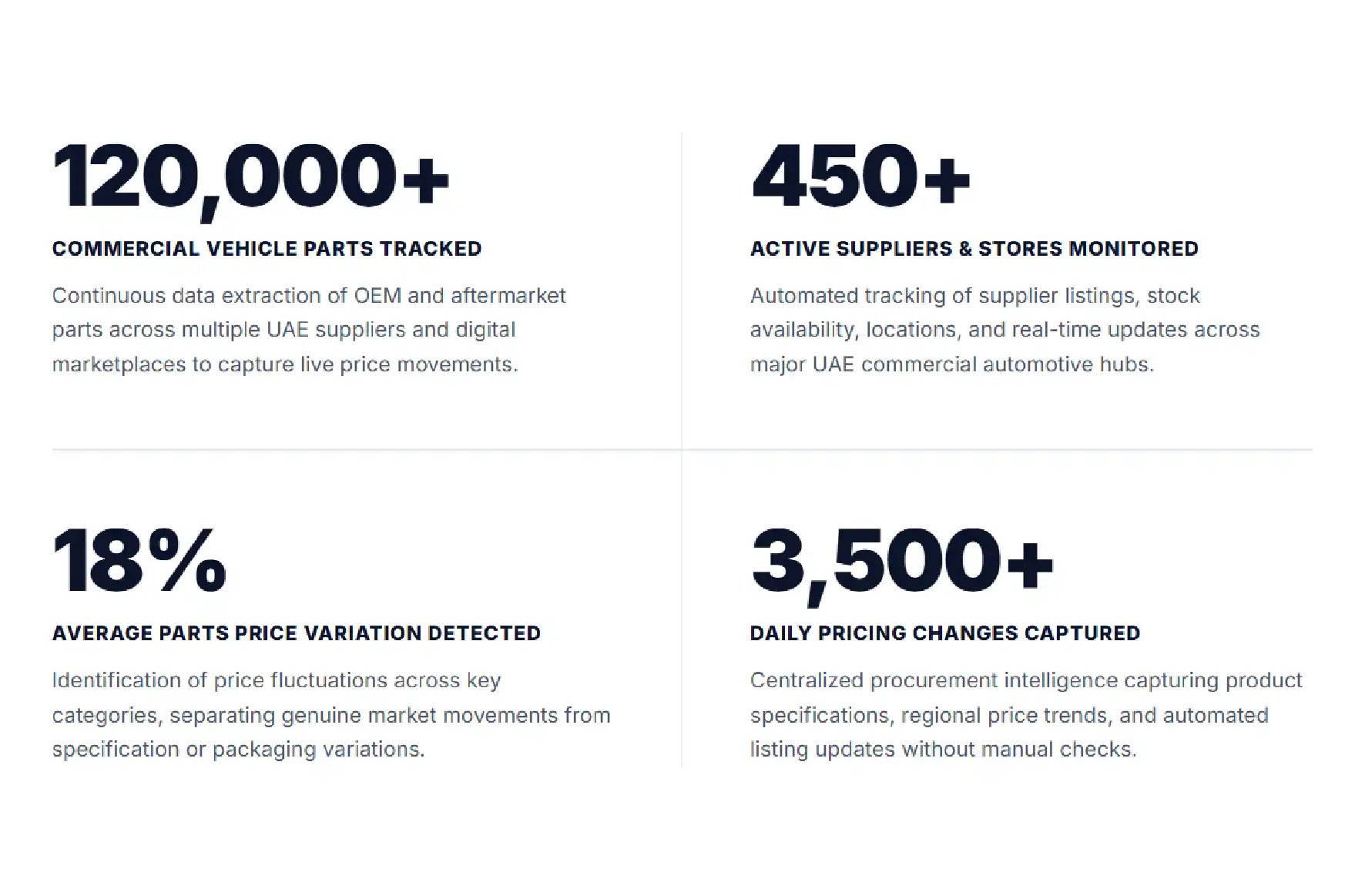
The implementation of continuous data extraction provided the client with improved visibility into commercial vehicle parts prices across multiple UAE sources.
Previously, analysts depended on manual supplier checks to identify current prices. The automated system continuously collected new and updated listings, reducing the time required to identify pricing changes.
The platform captured product-level pricing together with supplier, location, specification, and availability information. This allowed stakeholders to distinguish genuine price movements from differences caused by product specifications or packaging variations.
The resulting dataset supported more consistent procurement research and provided a centralized reference point for commercial vehicle parts pricing.
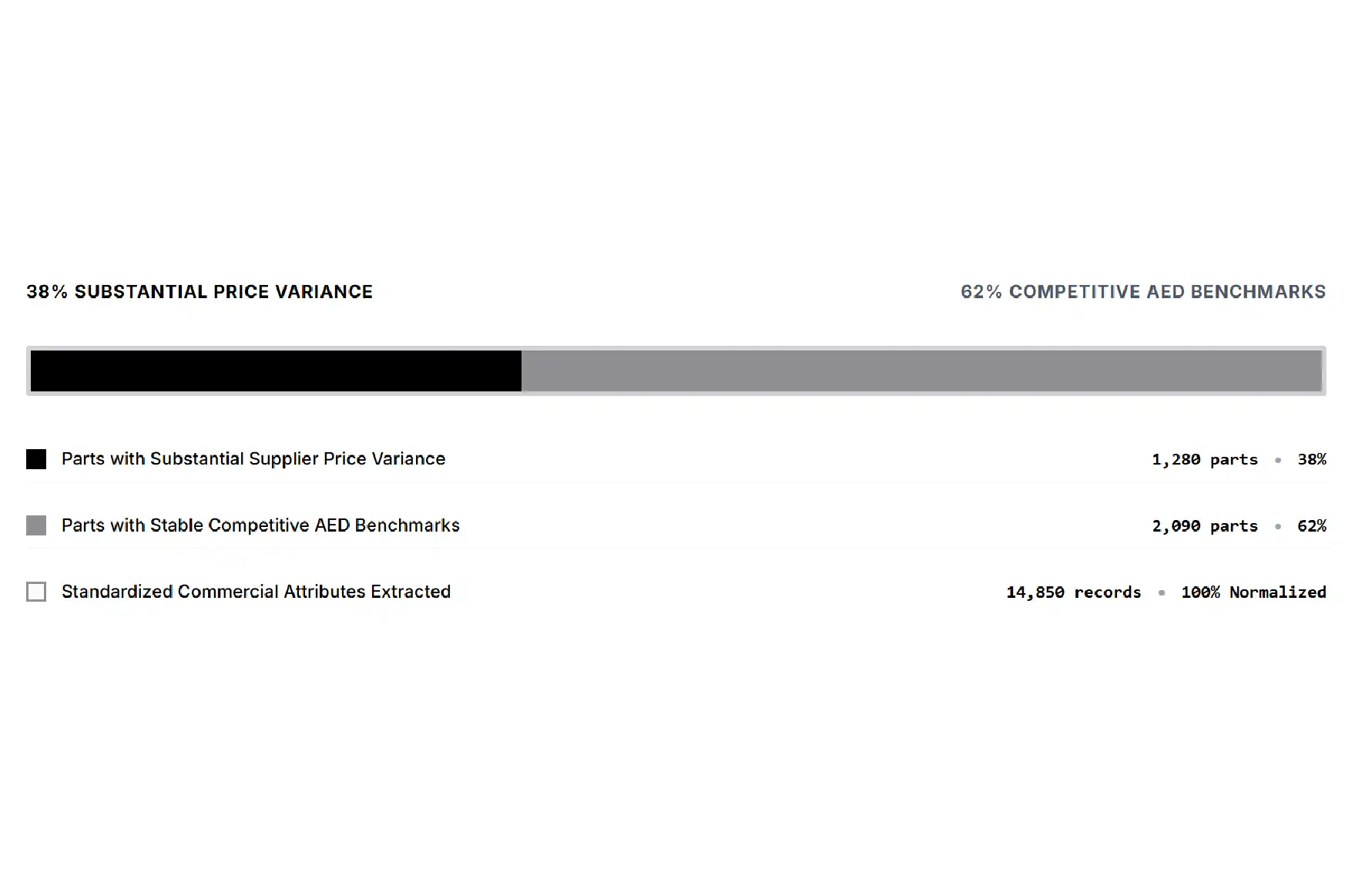
The structured dataset enabled the organization to compare equivalent or closely matched commercial vehicle parts across different suppliers.
Pricing records were normalized into consistent AED-based fields, while product attributes were retained for comparison. This helped analysts understand minimum, maximum, median, and average prices across selected parts.
Supplier-level comparisons also highlighted areas where pricing differences were substantial. Procurement teams could investigate these differences further by considering product quality, availability, brand, delivery conditions, and supplier positioning.
The system therefore transformed isolated product prices into comparative market intelligence.
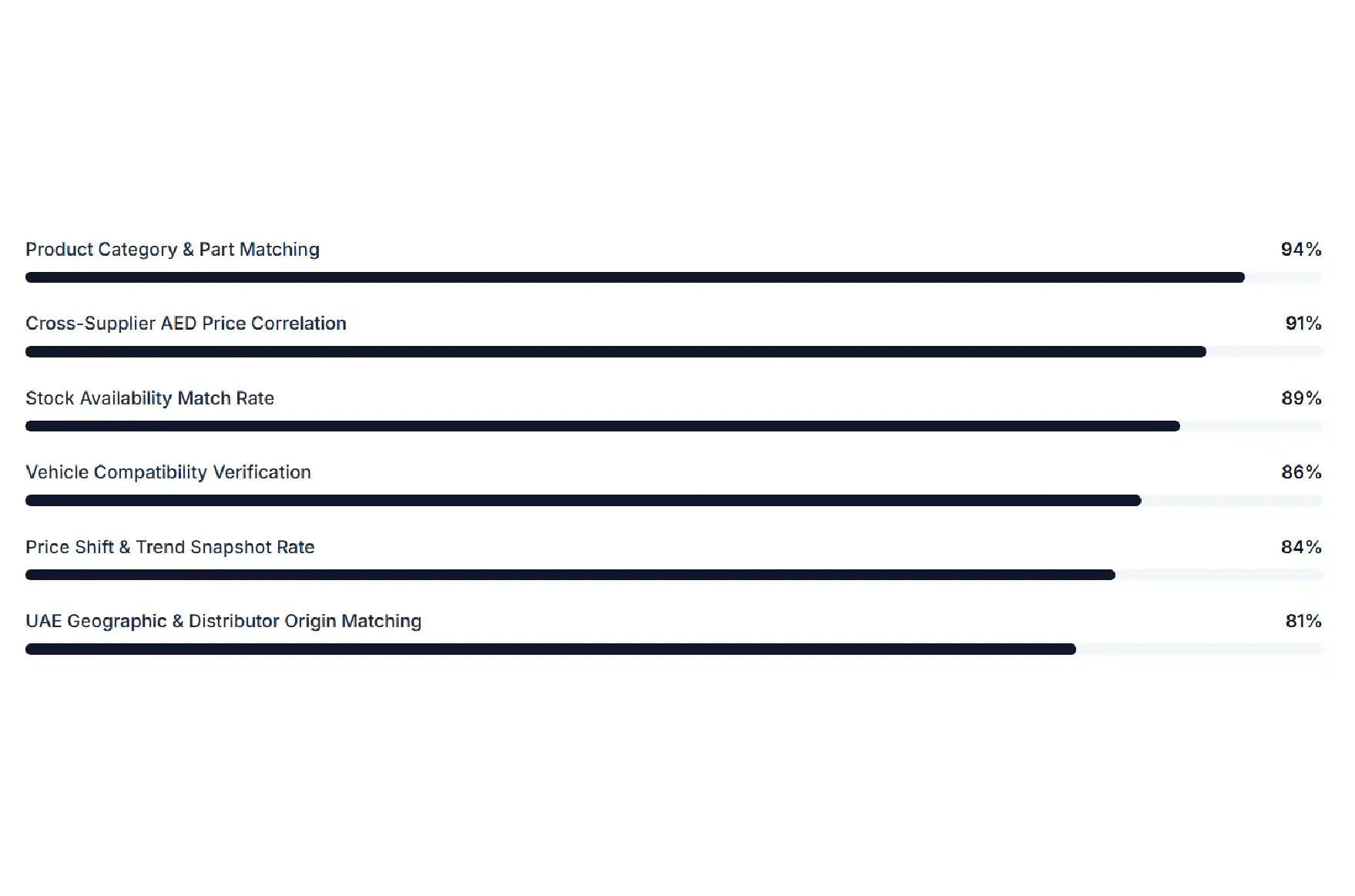
The platform captured pricing and availability together, allowing analysts to understand how market conditions affected commercial vehicle parts procurement.
A part with a low listed price could have limited availability, while another supplier could offer a higher price with immediate availability. Combining these attributes created a more complete view of the purchasing environment.
| Metric | Insight Captured | Business Impact |
|---|---|---|
| Part Price | Current AED listing price | Supplier price comparison |
| Price Change | Movement from previous snapshot | Early identification of pricing shifts |
| Availability | In-stock or unavailable status | Procurement planning |
| Supplier | Source and distributor identity | Vendor comparison |
| Location | UAE market or supplier location | Geographic pricing analysis |
| Product Category | Brake, engine, filter, transmission, or body parts | Category-level benchmarking |
| Vehicle Compatibility | Supported truck or commercial vehicle | More accurate product matching |
The structured mapping also reduced the risk of comparing unrelated products and improved the reliability of downstream pricing analysis.
The automated system enabled continuous monitoring across multiple UAE automotive markets and commercial vehicle parts categories.
Instead of relying on individual analysts to review supplier websites, the platform processed large numbers of records automatically. This increased market coverage while reducing repetitive manual work.
The framework could also be expanded as new suppliers, marketplaces, distributors, product categories, or commercial vehicle segments entered the monitoring scope.
This scalability provided the organization with a long-term foundation for automotive market intelligence and aftermarket pricing analysis.
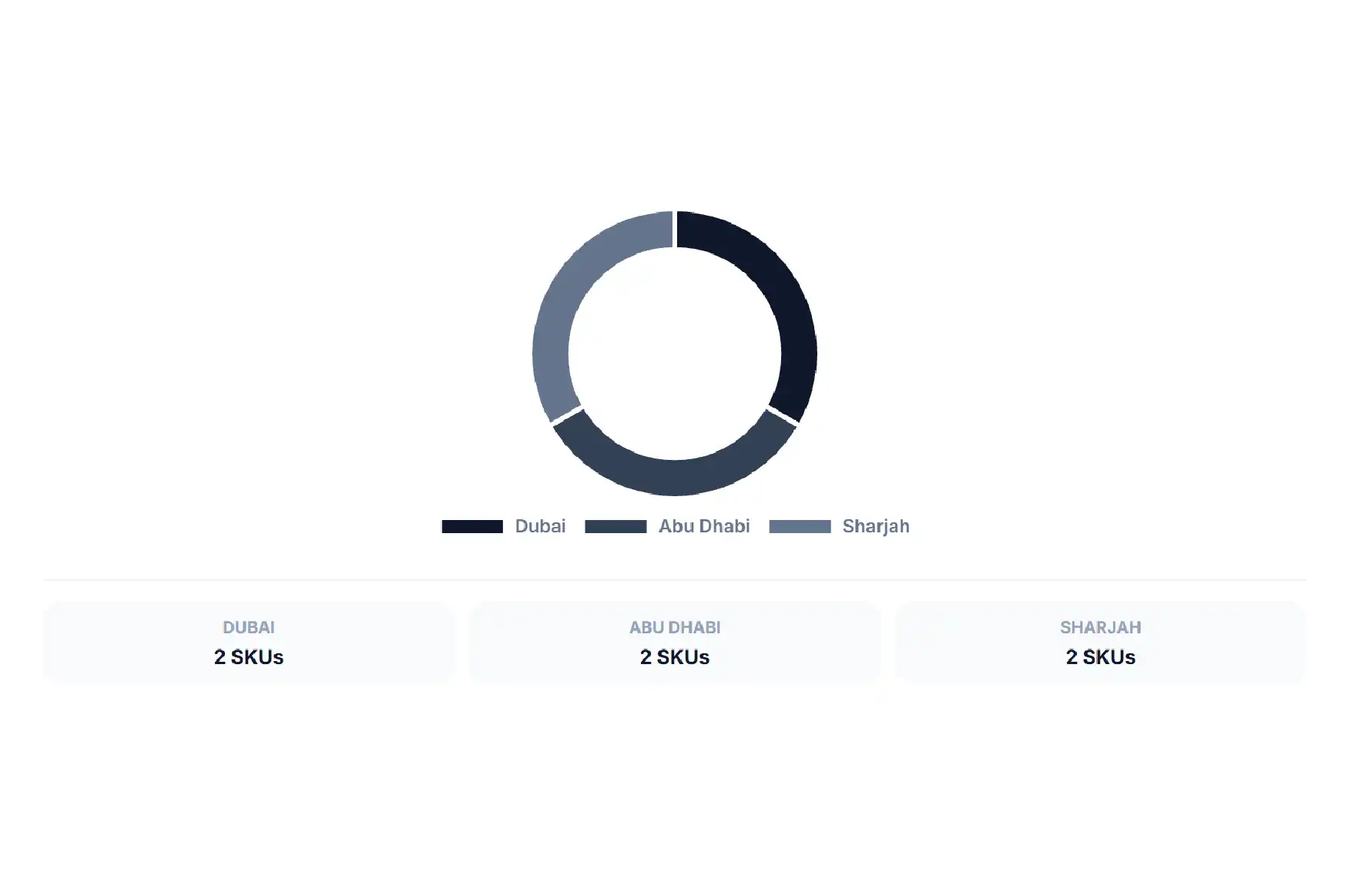
The dataset snapshot demonstrates how commercial vehicle parts pricing information can be structured across different suppliers and product categories. It combines pricing, availability, supplier, vehicle compatibility, and location information to support market benchmarking.
| Part Name | Vehicle Segment | Supplier | Price (AED) | Availability | Location |
|---|---|---|---|---|---|
| Brake Pad Set | Heavy Truck | Daimler Truck & Bus Middle East | 685 | In Stock | Dubai |
| Oil Filter | Commercial Truck | Al-Futtaim Motors | 145 | In Stock | Abu Dhabi |
| Air Filter | Heavy Truck | ZF Middle East | 210 | Limited | Sharjah |
| Clutch Plate | Commercial Vehicle | Bosch Middle East | 1,280 | In Stock | Dubai |
| Brake Disc | Heavy Truck | MAN Truck & Bus Middle East | 920 | In Stock | Abu Dhabi |
| Fuel Filter | Commercial Truck | Scania Middle East | 175 | In Stock | Sharjah |
The sample illustrates how pricing records can be transformed into structured intelligence. Analysts can compare supplier prices, identify availability differences, evaluate location-level variation, and monitor individual product categories over time.
After implementing structured commercial vehicle parts pricing intelligence, the client achieved improvements in pricing visibility, supplier comparison, market monitoring, and procurement analysis.
Our approach enables businesses to consolidate commercial vehicle parts information from multiple digital sources into a unified structured dataset. This reduces fragmentation and creates a consistent analytical foundation for procurement, supplier benchmarking, market research, and commercial decision-making.
The solution supports continuous data monitoring by capturing changing prices, availability conditions, product listings, supplier information, and market signals at scheduled intervals. This helps organizations maintain current visibility without depending entirely on manual research.
Data quality is supported through automated validation, deduplication, normalization, and field-level checks. Product attributes are standardized so analysts can compare similar parts more consistently across different suppliers and digital sources.
The architecture is also scalable, allowing businesses to expand monitoring coverage as product catalogs, supplier networks, vehicle categories, and geographic markets increase. New data sources can be incorporated into the framework while maintaining standardized output structures.
Another important capability is historical intelligence. Instead of maintaining only the latest price, the system can preserve recurring observations and create a historical record of market movements. This supports price trend analysis, supplier evaluation, procurement planning, and category-level research.
The resulting datasets can also be integrated with dashboards, APIs, databases, spreadsheets, and business intelligence environments. This provides flexibility for organizations with different analytical workflows.
Overall, the approach converts fragmented automotive information into structured, searchable, comparable, and continuously updated intelligence that supports faster commercial analysis.
We are highly satisfied with the commercial vehicle pricing intelligence solution delivered by the team. The system transformed fragmented supplier information into a structured and usable dataset that significantly improved our visibility into parts pricing and availability.
The automated monitoring process reduced the amount of manual research required by our team and provided faster access to current market information. We were particularly impressed with the consistency of the product data, supplier information, and pricing records.
The dashboards and structured datasets have made it easier for our procurement and commercial teams to compare suppliers, identify pricing movements, and understand market differences across UAE locations.
The solution has provided a reliable foundation for ongoing automotive intelligence and has improved the speed and consistency of our market analysis.
—Head of Commercial Intelligence
The final outcome of the project was a scalable commercial vehicle parts pricing intelligence system designed to continuously collect, standardize, validate, and analyze automotive market data across UAE sources.
The client gained improved visibility into commercial vehicle parts prices, supplier activity, product availability, vehicle compatibility, and location-level market differences. Automated data processing reduced repetitive research and created a centralized foundation for ongoing pricing analysis.
The structured system supported more efficient supplier benchmarking by bringing comparable product records into a common analytical format. Procurement teams could evaluate current pricing while also examining historical changes and availability patterns.
The platform also created a foundation for future automotive intelligence applications. Additional suppliers, product categories, vehicle segments, and geographic markets can be incorporated as monitoring requirements expand.
Continuous data processing improved the timeliness of intelligence, while validation and normalization processes strengthened dataset consistency.
The project demonstrated how structured automotive data collection can transform fragmented commercial vehicle parts information into actionable pricing intelligence.
Overall, the organization gained a scalable data foundation for procurement research, supplier analysis, market benchmarking, historical pricing intelligence, and future automotive analytics initiatives.
The solution can monitor multiple categories, including brake components, filters, engine parts, clutch components, transmission parts, suspension components, electrical parts, body components, and other truck and commercial vehicle aftermarket products.
Yes. Monitoring schedules can be configured according to business requirements. The system can capture recurring product updates, pricing changes, availability information, supplier movements, and other relevant attributes for ongoing market intelligence.
Product names, specifications, categories, compatibility information, supplier identifiers, and other attributes can be standardized during processing. These normalized fields help analysts identify comparable products and reduce inconsistencies during price benchmarking.
Yes. Supplier names, market locations, product URLs, collection timestamps, availability indicators, and other relevant fields can be incorporated into the structured dataset. This supports supplier-level and geographic pricing analysis.
Yes. The architecture is designed to support expanding data volumes and additional sources. New suppliers, marketplaces, distributors, product categories, and commercial vehicle segments can be incorporated into the monitoring framework as requirements grow.
Our advanced automotive data scraping and analytics solutions help transform fragmented parts listings into structured pricing intelligence, enabling faster supplier comparisons, better procurement visibility, continuous market monitoring, and scalable commercial vehicle analytics.
Start a projectFields marked * are required. Everything else just helps us scope faster — skip what you don't know yet.