
47.8K+
TOTAL SHOPEE TAIWAN SKU RECORDS MONITORED

Shopee Taiwan SKU Monitoring to Prevent Unauthorized Discounting and Strengthen Marketplace Pricing Compliance for WitsPer.
This case study presents a real-world marketplace intelligence scenario in which WitsPer strengthened its brand-protection and pricing-compliance operations through continuous SKU-level monitoring across Shopee Taiwan. The initiative focused on identifying price deviations, unauthorized seller discounts, promotional inconsistencies, and marketplace-level pricing changes before they could negatively affect brand positioning or channel relationships.
WitsPer's core requirement was to create a dependable monitoring layer that could continuously identify unusual price reductions across individual products and sellers. Instead of relying on manual marketplace checks, the business needed structured information about product names, SKU identifiers, seller names, listed prices, promotional prices, discount percentages, inventory status, ratings, and timestamps.
The initiative therefore combined Shopee Taiwan SKU Monitoring with automated product intelligence to provide a consolidated view of marketplace pricing activity.
The project also focused on Shopee Taiwan SKU price monitoring for WitsPer, helping the organization compare observed seller prices against approved pricing thresholds and identify potential violations faster.
It is designed for:
WitsPer operates in an environment where marketplace prices can change rapidly because sellers frequently introduce promotions, vouchers, flash discounts, bundle offers, and limited-time campaigns. These changes can create significant challenges for brands attempting to maintain consistent pricing across authorized digital channels.
The project explored how WitsPer could monitor unauthorized discounts on Shopee Taiwan through an automated SKU-level marketplace intelligence framework that continuously captured pricing changes across relevant listings.
Instead of checking individual product pages manually, the system collected structured product and seller information at scheduled intervals. This enabled WitsPer to compare current marketplace prices against approved pricing benchmarks and historical observations.
A major component of the solution involved SKU-level price tracking for marketplace compliance, allowing the organization to understand exactly which products experienced pricing deviations, which sellers initiated those changes, and how deep the discount became.
The monitoring framework captured original prices, current selling prices, promotional prices, discount percentages, seller information, product URLs, SKU identifiers, stock availability, timestamps, and other relevant marketplace attributes.
The project ultimately transformed fragmented Shopee Taiwan marketplace observations into a continuously updated pricing intelligence environment. WitsPer gained greater visibility into SKU-level price behavior, seller-level discount activity, and marketplace compliance patterns while significantly reducing dependence on manual monitoring.
WitsPer faced several operational difficulties while attempting to maintain consistent pricing visibility across Shopee Taiwan. Marketplace listings could change throughout the day, while sellers could introduce promotions or price reductions without immediately becoming visible through conventional reporting workflows.
1. Unauthorized Discount Identification
The organization needed a dependable way to detect unauthorized seller discounts on Shopee without manually reviewing thousands of product listings. Price changes could occur between monitoring cycles, making occasional checks insufficient for identifying short-lived promotions or sudden seller-level deviations.
2. Fragmented SKU Information
Product information was distributed across numerous marketplace listings, sellers, categories, and product variations. WitsPer required a scalable way to Scrape Shopee Taiwan SKU Data API information into a standardized structure so that product-level comparisons could be performed consistently across monitored listings.
3. Limited Taiwan Marketplace Data Access
Traditional manual collection made it difficult to maintain historical records of changing product prices. The organization needed a Shopee Product Data Scraping API for Taiwan to systematically capture product information, pricing signals, seller details, and promotional changes at regular intervals.
4. Rapid Price Volatility
Marketplace sellers could change prices frequently around campaigns, festivals, flash sales, vouchers, and inventory movements. This created a requirement for automated monitoring capable of identifying sudden price changes rather than depending exclusively on periodic manual audits.
5. Difficulty Linking Sellers With Specific SKUs
Another challenge involved connecting each pricing event with the correct SKU, seller, and product variation. Without consistent identifiers, teams could struggle to determine whether two price observations represented the same product or different variants.
The client also struggled to answer several operational questions:
By implementing an automated marketplace intelligence framework, WitsPer moved away from fragmented manual checks and toward a structured SKU-monitoring pipeline capable of continuously capturing product, seller, pricing, promotional, and availability signals across Shopee Taiwan.
| Dimension | Manual Shopee Tracking | WitsPer Data Monitoring System |
|---|---|---|
| Data collection | Individual product-page checks | Automated multi-SKU collection |
| Monitoring frequency | Periodic manual reviews | Scheduled and continuous monitoring |
| SKU identification | Manual product matching | Standardized SKU and product identifiers |
| Price tracking | Spreadsheet-based snapshots | Timestamped historical price records |
| Discount detection | Manual comparison | Automated threshold-based detection |
| Seller tracking | Manually recorded seller names | Structured seller-level records |
| Historical visibility | Limited or inconsistent | Centralized historical pricing database |
| Compliance review | Reactive investigation | Proactive anomaly identification |
| Reporting | Manually prepared spreadsheets | Automated analytical dashboards |
| Scalability | Limited by team capacity | Designed for large SKU volumes |
| Alerting | Dependent on manual discovery | Automated exception-based workflows |
| Data consistency | Vulnerable to human errors | Normalized and validated datasets |
The structured approach provided WitsPer with a more systematic framework for understanding marketplace pricing behavior. Each record could be associated with a product, SKU, seller, price, discount, timestamp, and monitoring status.
WitsPer operates in the digital commerce intelligence environment, where accurate marketplace information is essential for understanding product availability, seller behavior, pricing consistency, and promotional activity.
As marketplace ecosystems expanded, WitsPer required greater visibility into the way individual sellers presented and priced products. Shopee Taiwan represented an important source of marketplace activity, with multiple sellers offering similar or identical products under different pricing conditions.
The challenge was not simply to observe prices but to understand price movement at the SKU level.
A product could appear compliant during one observation and experience a substantial discount later in the day. Similarly, a seller could introduce a temporary promotional price that disappeared before a traditional manual review was completed.
This made continuous data collection essential.
We developed an automated marketplace intelligence solution that captured product-level and seller-level information from Shopee Taiwan and transformed it into structured pricing datasets.
The solution used Shopee.tw Product Data Scraping Services to collect product names, SKU identifiers, seller information, listed prices, promotional prices, discount percentages, ratings, stock signals, product URLs, and timestamps.
A Managed web scraping framework handled scheduled collection, monitoring workflows, validation, duplicate control, and data normalization so that WitsPer could maintain a consistent historical dataset.
The architecture also incorporated a scalable scraping API layer that allowed structured product information to flow into downstream analytics and compliance systems.
A typical normalized record contained:
After collection, the raw records passed through several processing stages.
SKU Normalization: Marketplace product titles were standardized so that different naming formats could be mapped to the same internal product.
For example, variations in capitalization, pack-size notation, punctuation, and promotional wording were normalized to reduce duplicate records.
Seller Normalization: Seller names and identifiers were standardized to ensure that pricing observations were consistently associated with the correct marketplace participant.
Price Classification: The system categorized products into states such as within range, review, or exception, depending on the observed price relative to configured thresholds.
Duplicate Removal: Repeated records generated during overlapping collection cycles were identified and handled using product, seller, marketplace, and timestamp combinations.
Historical Storage: Each observation was timestamped, enabling the client to calculate price variance and discount frequency over time.
Alert Prioritization: The analytics layer identified high-priority situations, including high-value SKUs showing repeated pricing exceptions across multiple sellers.
The final dataset was connected to dashboards where analysts could filter information by marketplace, seller, SKU, category, and time period.
The first major finding was that continuous SKU-level monitoring provided substantially greater visibility than periodic manual checks.
WitsPer could observe individual products across multiple monitoring cycles and compare their current pricing with historical records. This made it easier to identify whether a price reduction was isolated, recurring, or part of a broader marketplace movement.
The monitoring system also helped distinguish between changes occurring across multiple sellers and changes associated with a specific seller.
This distinction was important because a broad marketplace promotion could produce similar price movements across several sellers, while an isolated reduction could require a different type of compliance review.
Timestamped records provided additional context. Analysts could identify when a discount appeared, how long it remained active, and whether the product returned to its previous price.
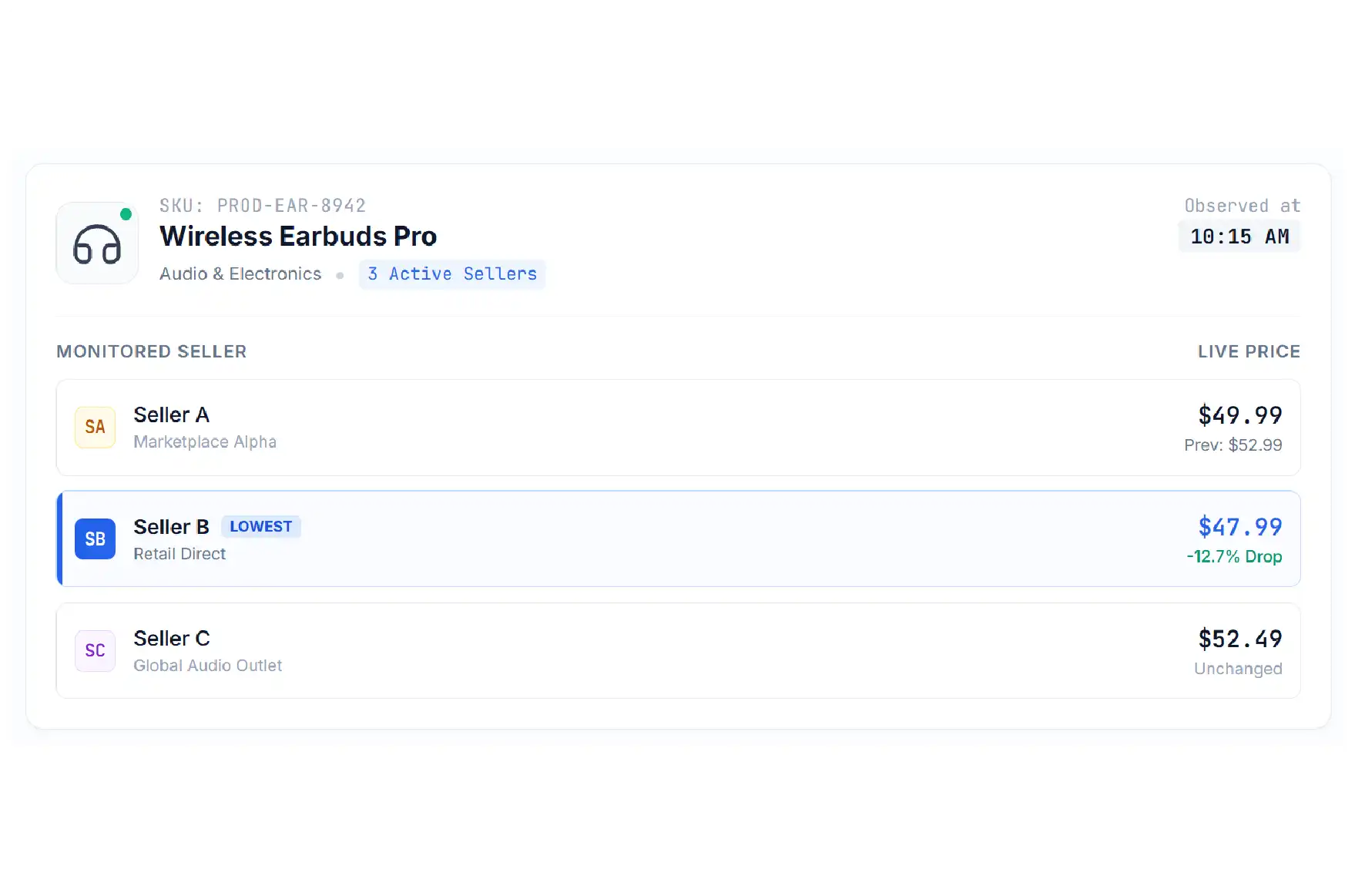
The second finding involved faster identification of unusual discount activity.
Automated comparison rules continuously examined observed prices against configured reference values. When a product moved beyond a predefined pricing threshold, the system classified the observation as a potential exception.
This did not automatically establish that a seller had violated a commercial agreement. Instead, it provided a structured signal for the compliance team to investigate further.
The approach enabled WitsPer to prioritize high-impact exceptions rather than reviewing every marketplace listing manually.
Listings with larger price deviations, repeated reductions, or unusual seller behavior could receive greater analytical attention.
This helped transform compliance monitoring from a broad manual exercise into a more focused exception-management process.
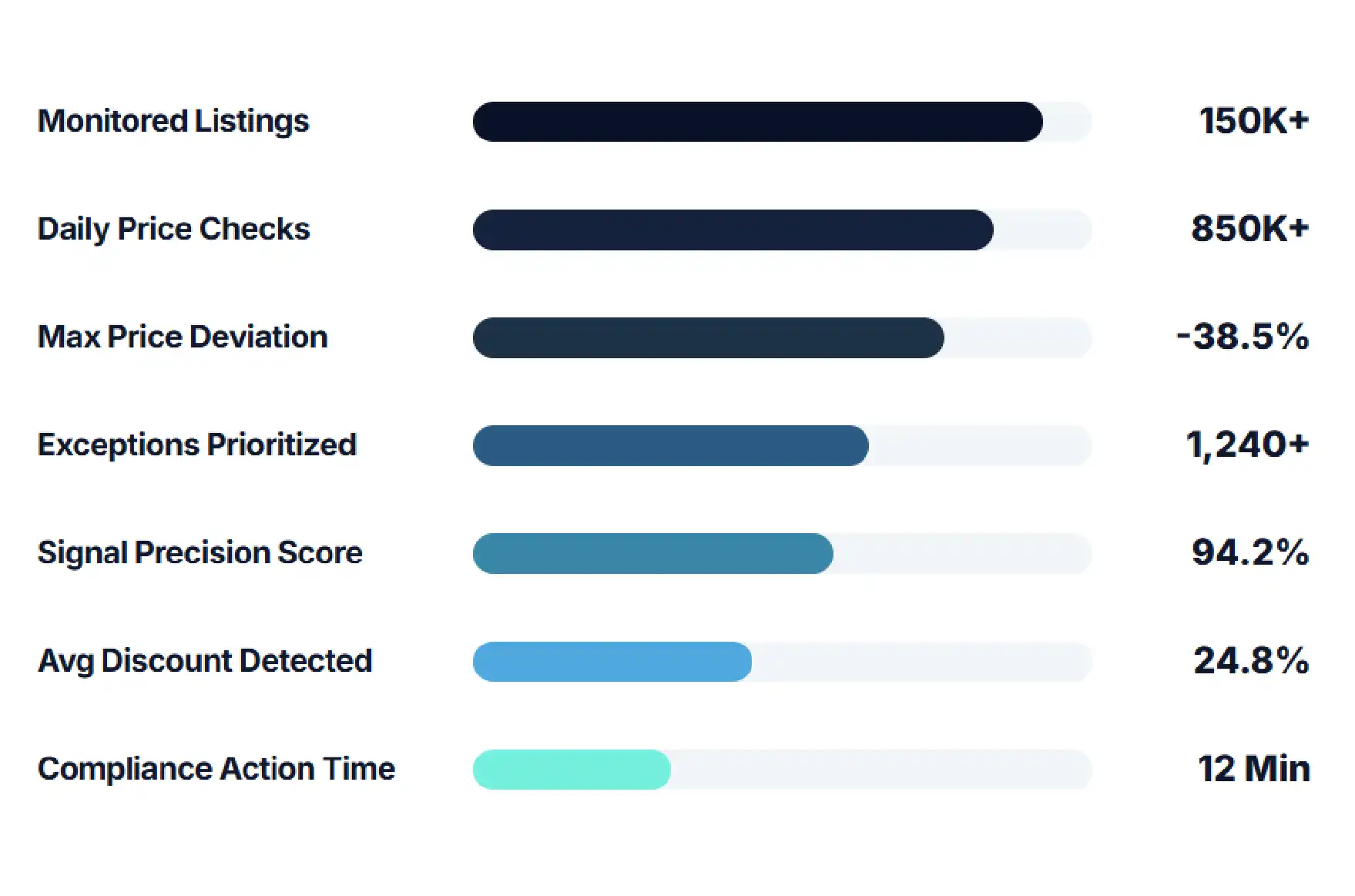
The third finding was that seller-level data created additional visibility beyond product-level pricing.
By connecting sellers with individual SKUs and historical pricing observations, WitsPer could examine which marketplace participants were associated with repeated price changes.
This enabled the organization to build seller-level profiles based on observed marketplace activity.
For example, analysts could examine average discount depth, frequency of price changes, number of monitored SKUs affected, and duration of promotional pricing.
Such metrics provided a more comprehensive view of marketplace behavior and helped teams determine where additional review might be required.
| Metric | Insight Captured | Business Impact |
|---|---|---|
| SKU Price Variance | Difference between reference and observed price | Identification of pricing exceptions |
| Discount Depth | Percentage reduction from listed price | Prioritization of significant discounts |
| Seller Frequency | Number of pricing changes by seller | Identification of recurring seller activity |
| Price Duration | Length of time a discount remained active | Separation of temporary and persistent changes |
| SKU Coverage | Number of monitored products | Measurement of monitoring scope |
| Compliance Exceptions | Listings crossing configured thresholds | Faster review prioritization |
| Historical Price | Previous recorded SKU prices | Context for current pricing |
| Seller-SKU Relationship | Products associated with each seller | Seller-level compliance analysis |
| Monitoring Frequency | Number of observations collected | Improved visibility into price volatility |
| Availability Status | In-stock/out-of-stock signals | Contextual interpretation of pricing events |
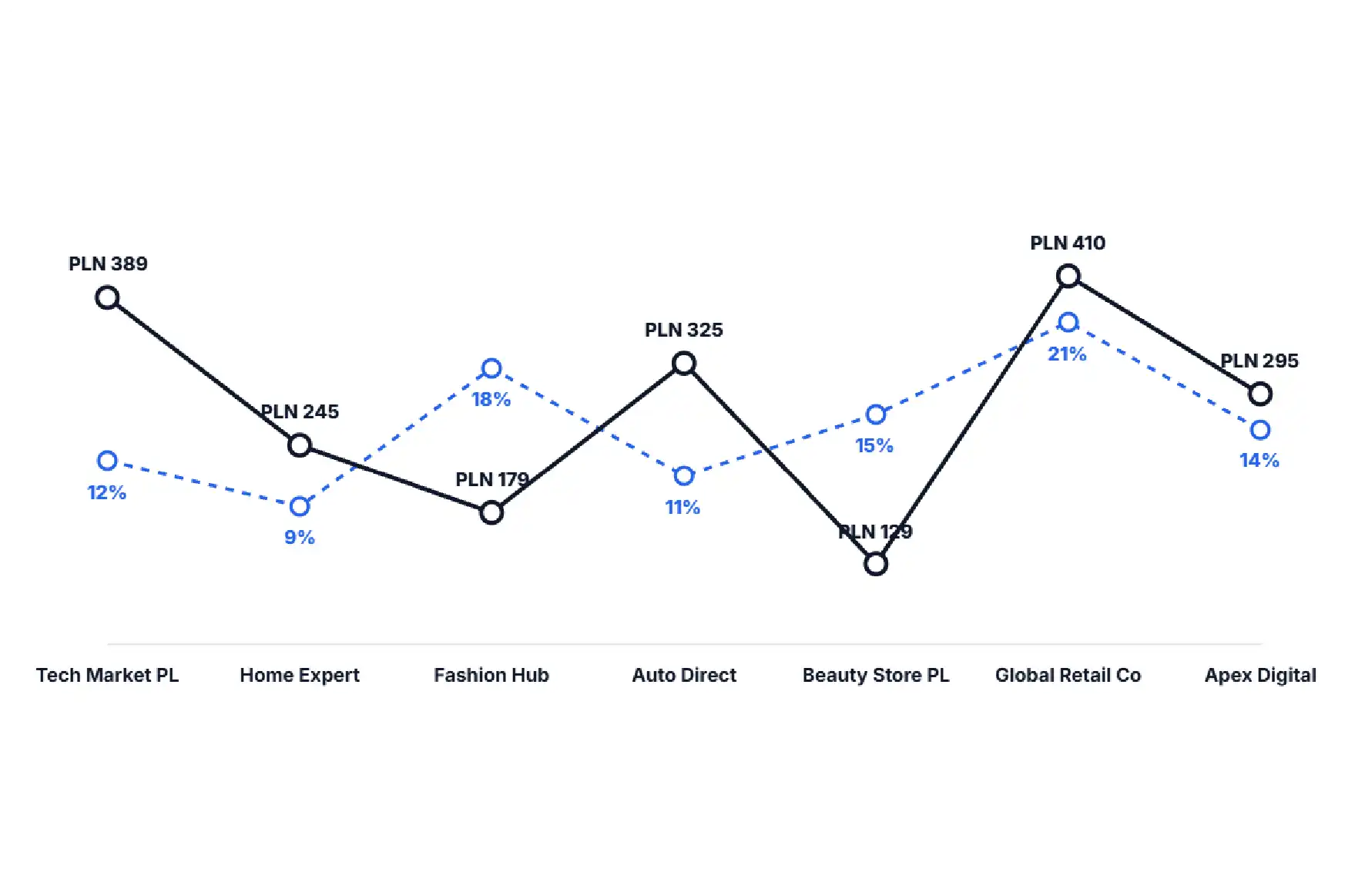
Historical data became one of the most valuable components of the monitoring framework.
Without historical observations, teams could see only the current marketplace price. With historical records, WitsPer could examine how the price evolved.
For example, an SKU that changed from NT$2,999 to NT$2,499 could be compared with its previous observations. Analysts could determine whether the product had frequently fluctuated around the same range or whether the reduction represented an unusual event.
Historical records also helped identify repeated promotional cycles.
This created a more comprehensive compliance environment in which pricing events could be reviewed in context rather than treated as isolated snapshots.
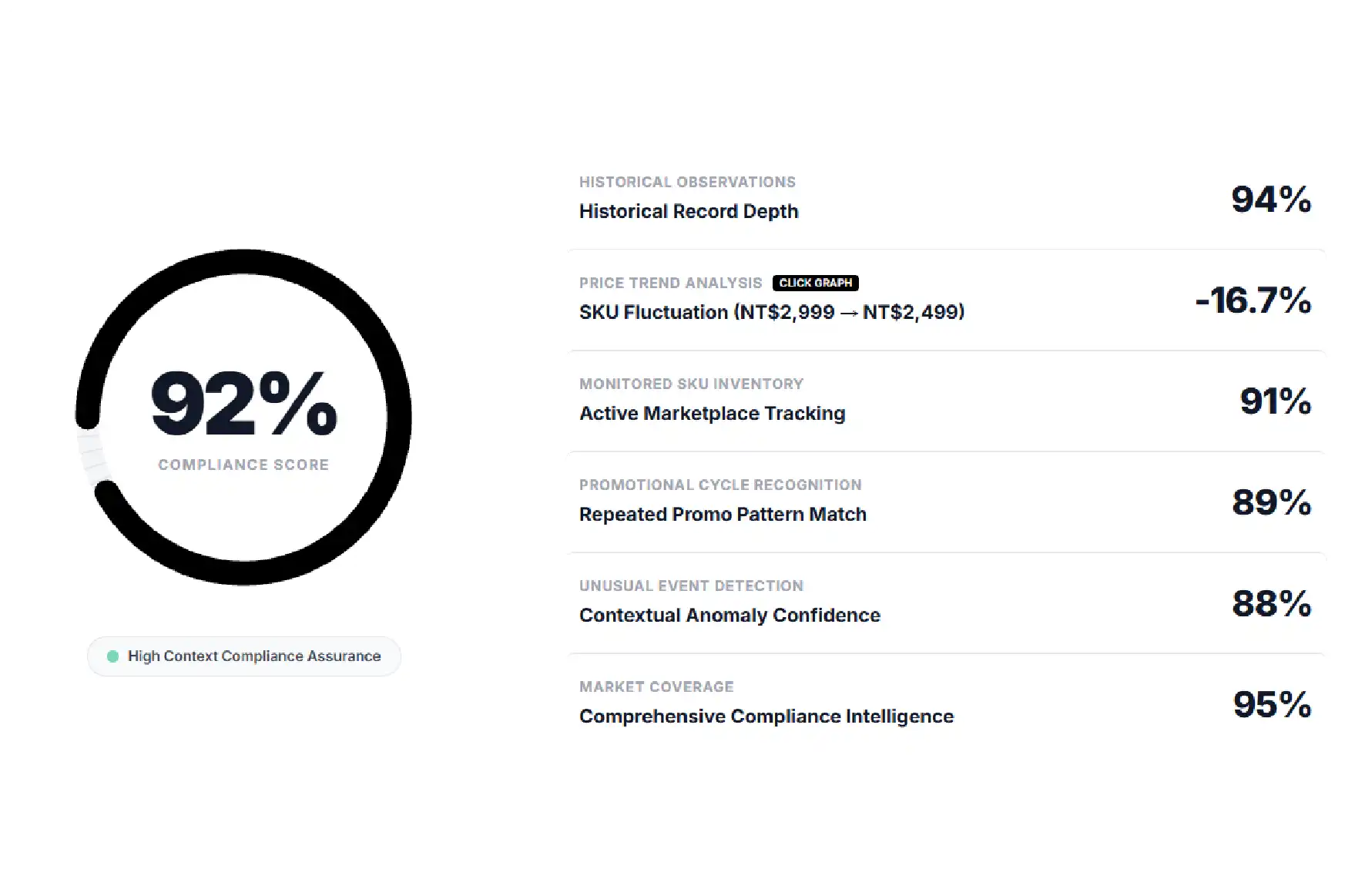
The following dataset snapshot demonstrates how the monitoring framework could organize SKU-level information across selected Shopee Taiwan listings. The data structure combines product, seller, price, discount, and compliance signals into a single analytical view.
| SKU | Product Category | Seller Type | Listed Price | Current Price | Discount | Seller Status | Compliance Signal |
|---|---|---|---|---|---|---|---|
| TW-SKU-1001 | Electronics | Authorized | NT$3,999 | NT$3,799 | 5.0% | Verified | Within Range |
| TW-SKU-1002 | Beauty | Authorized | NT$1,599 | NT$1,399 | 12.5% | Verified | Review |
| TW-SKU-1003 | Home Appliances | Marketplace Seller | NT$4,899 | NT$3,999 | 18.4% | Monitored | Exception |
| TW-SKU-1004 | Personal Care | Authorized | NT$899 | NT$849 | 5.6% | Verified | Within Range |
| TW-SKU-1005 | Electronics | Marketplace Seller | NT$6,999 | NT$5,599 | 20.0% | Monitored | Exception |
| TW-SKU-1006 | Household | Authorized | NT$1,299 | NT$1,249 | 3.8% | Verified | Within Range |
| TW-SKU-1007 | Sports | Marketplace Seller | NT$2,499 | NT$2,099 | 16.0% | Monitored | Review |
| TW-SKU-1008 | Beauty | Authorized | NT$2,199 | NT$2,049 | 6.8% | Verified | Within Range |
The dataset allowed WitsPer to analyze price changes at both SKU and seller levels. A compliance signal represented an analytical flag requiring review rather than a definitive conclusion about a seller's contractual status.
After implementing the structured Shopee Taiwan monitoring framework, WitsPer achieved measurable improvements in marketplace visibility, pricing analysis, and compliance workflow efficiency.
Our approach enabled WitsPer to establish a centralized marketplace intelligence environment where product, SKU, seller, pricing, discount, and historical information could be collected and analyzed through a unified framework.
The solution reduced fragmentation by bringing marketplace observations into standardized datasets. Instead of maintaining separate spreadsheets for individual product groups, the organization could analyze pricing activity through consistent data structures.
The architecture also supported continuous marketplace monitoring. Automated collection allowed the system to capture pricing changes at predefined intervals, helping teams maintain visibility into fast-moving marketplace conditions.
Data quality was another important component. Product records were normalized, duplicate observations were controlled, and pricing fields were standardized to improve analytical consistency.
The system also supported scalable monitoring. As WitsPer expanded the number of SKUs and sellers under observation, the architecture could accommodate additional records without requiring the same increase in manual effort.
Another advantage was historical intelligence. Timestamped records created a growing database of marketplace observations that could be used to examine pricing patterns over weeks and months.
"We needed stronger visibility into SKU-level marketplace pricing and seller activity across Shopee Taiwan. The solution provided a structured and reliable way to monitor product prices, identify unusual discount patterns, and maintain historical records. The automated workflow significantly reduced our manual monitoring workload while improving the speed at which our teams could review pricing exceptions. The combination of accurate data extraction, seller-level visibility, and reporting capabilities has strengthened our marketplace compliance processes and given us greater confidence in our pricing intelligence operations."
— Head of E-commerce Intelligence
The final outcome was a scalable marketplace monitoring system that transformed Shopee Taiwan product observations into structured SKU-level pricing intelligence.
WitsPer gained continuous visibility into product prices, promotional discounts, seller activity, and historical price movements. Instead of relying on occasional manual checks, the organization could monitor a broader product universe through automated collection and structured analysis.
The system also established a consistent method for identifying potential pricing exceptions. When an observed price moved beyond configured thresholds, the relevant SKU and seller information could be surfaced for review.
The implementation of automated marketplace extraction infrastructure improved data consistency and reduced the operational burden associated with repetitive marketplace monitoring.
Historical datasets provided another important advantage. WitsPer could analyze pricing changes over time, helping teams distinguish isolated events from recurring patterns.
The solution also created a foundation for future marketplace intelligence initiatives. Additional marketplaces, product categories, sellers, pricing rules, and analytical metrics could be incorporated into the same framework as business requirements expanded.
Overall, the project enabled WitsPer to shift from manual marketplace observation toward a structured, scalable, and data-driven approach to pricing compliance.
The company could now answer critical operational questions faster:
This shift from periodic reporting to continuous pricing intelligence strengthened the organization's ability to manage the rapidly evolving Shopee Taiwan marketplace environment.
Most importantly, the project demonstrated that marketplace pricing compliance is not simply a monitoring metric. In a competitive e-commerce environment, price consistency is part of the brand experience and directly influences channel relationships and customer trust.
Shopee Taiwan SKU monitoring involves continuously tracking individual product SKUs on the Shopee Taiwan marketplace to capture changes in prices, discounts, sellers, availability, and other product-level attributes. It enables brands and e-commerce teams to maintain structured visibility into marketplace activity and compare current observations with historical pricing information.
SKU monitoring can compare observed marketplace prices against predefined pricing thresholds or reference values. When a product falls outside an expected range, the system can generate a compliance signal for further investigation. The signal itself does not establish a contractual violation. It helps teams identify listings that require review.
Yes. A structured monitoring architecture can associate multiple sellers with the same product or SKU and record individual prices, discounts, availability, and timestamps. This allows teams to compare seller-level pricing behavior and identify repeated or unusual pricing patterns.
Yes. Timestamped observations can be stored in historical datasets, allowing teams to analyze price movements over time. Historical records can help identify recurring discounts, temporary promotions, persistent price changes, and other marketplace pricing patterns.
The architecture can be designed to support expanding numbers of products, SKUs, sellers, categories, and monitoring intervals. Structured collection, validation, normalization, and automated processing allow marketplace intelligence programs to scale without requiring the same level of manual monitoring effort.
iWeb Data Scraping can help transform marketplace product information into structured pricing intelligence, enabling brands to monitor SKU-level changes, analyze seller behavior, identify potential discount exceptions, maintain historical price records, and support faster marketplace compliance reviews at scale.
Start a projectFields marked * are required. Everything else just helps us scope faster — skip what you don't know yet.