
28.6K+
RERA PROJECT RECORDS PROCESSED

Tracking New Housing Projects Across India Using RERA Data for Builder Intelligence, Market Analysis, Project Discovery, and Investment Decisions.
This case study is based on a real-world enterprise scenario where a real estate intelligence team uses regulatory housing project data to identify new developments, monitor builders, analyze project pipelines, and create structured property intelligence across India's rapidly expanding residential market.
It is designed for:
The primary objective was Tracking New Housing Projects Across India Using RERA Data, enabling the client to systematically identify newly registered residential projects, analyze promoter activity, and monitor development patterns across multiple Indian markets.
The project also required the ability to Extract RERA project and builder data across India, transforming fragmented regulatory information into a consistent, searchable, and analysis-ready dataset.
India's residential real estate market generates substantial regulatory information through state-level RERA portals. However, project details are distributed across different state systems, formats, registration structures, and search interfaces, making nationwide monitoring difficult through manual research.
The client wanted reliable builder and promoter data extraction from RERA records to understand developer portfolios, project registrations, locations, timelines, and project-level activity across different states.
The implementation focused on New Housing project data Scraping using RERA, capturing critical information such as project name, registration number, promoter name, project address, project type, proposed completion date, registration date, units, and project status wherever available.
Automated extraction pipelines collected information from multiple RERA ecosystems and normalized records into a unified structure. Data validation routines helped identify duplicate projects, inconsistent developer names, incomplete fields, and formatting differences between state portals.
The resulting dataset allowed analysts to compare project activity across states, identify active builders, map development clusters, and monitor new housing supply more efficiently. Dashboards and structured exports further enabled investment teams, researchers, and property businesses to convert regulatory data into actionable market intelligence.
The client needed nationwide visibility into India's residential project pipeline but faced major difficulties because RERA information is distributed across multiple state-specific portals. Each portal follows different layouts, search mechanisms, naming conventions, and data structures, making consistent data collection challenging.
A major requirement was State-wise RERA housing project data Scraping, allowing analysts to compare project registrations and builder activity across individual states while maintaining consistent fields and standardized records.
The client also required a reliable RERA project data extraction API to provide structured project information to internal applications, dashboards, research systems, and downstream analytics workflows without depending on repetitive manual searches.
Another challenge was maintaining comprehensive Real estate data scraping workflows capable of processing large volumes of project records while handling different portal structures, pagination systems, document formats, and data availability patterns.
The organization also faced the following challenges:
The client therefore required an automated and scalable solution capable of continuously collecting, validating, standardizing, and organizing RERA housing project information.
By replacing fragmented portal-by-portal research with an automated RERA intelligence pipeline, the client gained a standardized framework for monitoring housing projects, builders, promoters, registration activity, locations, and development timelines across multiple Indian markets.
| Dimension | Manual RERA Research | Client Data Scraping System |
|---|---|---|
| Data collection | Individual state portal searches | Automated multi-state data ingestion |
| Project discovery | Dependent on manual searches | Systematic project-level extraction |
| Builder monitoring | Separate research for each developer | Centralized promoter and builder datasets |
| Data structure | Different formats across portals | Standardized fields and normalized records |
| Location analysis | Manual address interpretation | Structured geographic information |
| Update frequency | Periodic manual checking | Scheduled automated updates |
| Duplicate handling | Manual identification | Automated deduplication and validation |
| Market comparison | Time-consuming spreadsheet work | Cross-state analytical datasets |
| Historical tracking | Difficult to maintain | Structured historical records |
| Scalability | Limited by analyst capacity | Designed for large-scale processing |
The brand in focus is a real estate intelligence organization serving businesses that require accurate and continuously updated information about India's residential development landscape.
Its research operations covered multiple states and cities, with analysts monitoring registered housing projects, developers, promoters, project locations, construction timelines, and registration activity. As the volume of available RERA information increased, conventional research methods became increasingly inefficient.
The organization needed a centralized data layer capable of transforming state-level regulatory information into standardized real estate intelligence.
Its goal was not simply to collect project records but to understand where new housing developments were emerging, which builders were expanding, which markets were experiencing higher project activity, and how residential supply was distributed geographically.
We developed an end-to-end data extraction framework designed to collect, clean, validate, standardize, and organize housing project information from multiple RERA ecosystems.
The solution created structured Real-estate datasets containing project-level and promoter-level information in a consistent format. Key fields included project name, RERA registration number, promoter name, project type, registration date, proposed completion date, project status, address, units, and other available regulatory attributes.
The architecture incorporated Location intelligence to convert raw project addresses into meaningful geographic datasets. This enabled the client to analyze project concentration by state, city, district, locality, and development cluster.
The extraction system used automated navigation, parsing, pagination handling, data validation, duplicate detection, and normalization processes to accommodate differences between state RERA portals.
The workflow included:
The implementation provided the client with a centralized view of housing project registrations across multiple Indian states. Instead of manually visiting individual RERA portals, analysts could access standardized project records from a consolidated dataset.
This improved the ability to identify new project registrations, monitor development activity, and compare residential construction pipelines between major markets.
The centralized system also made it easier to identify markets where project registrations were increasing and areas where development activity remained relatively limited.
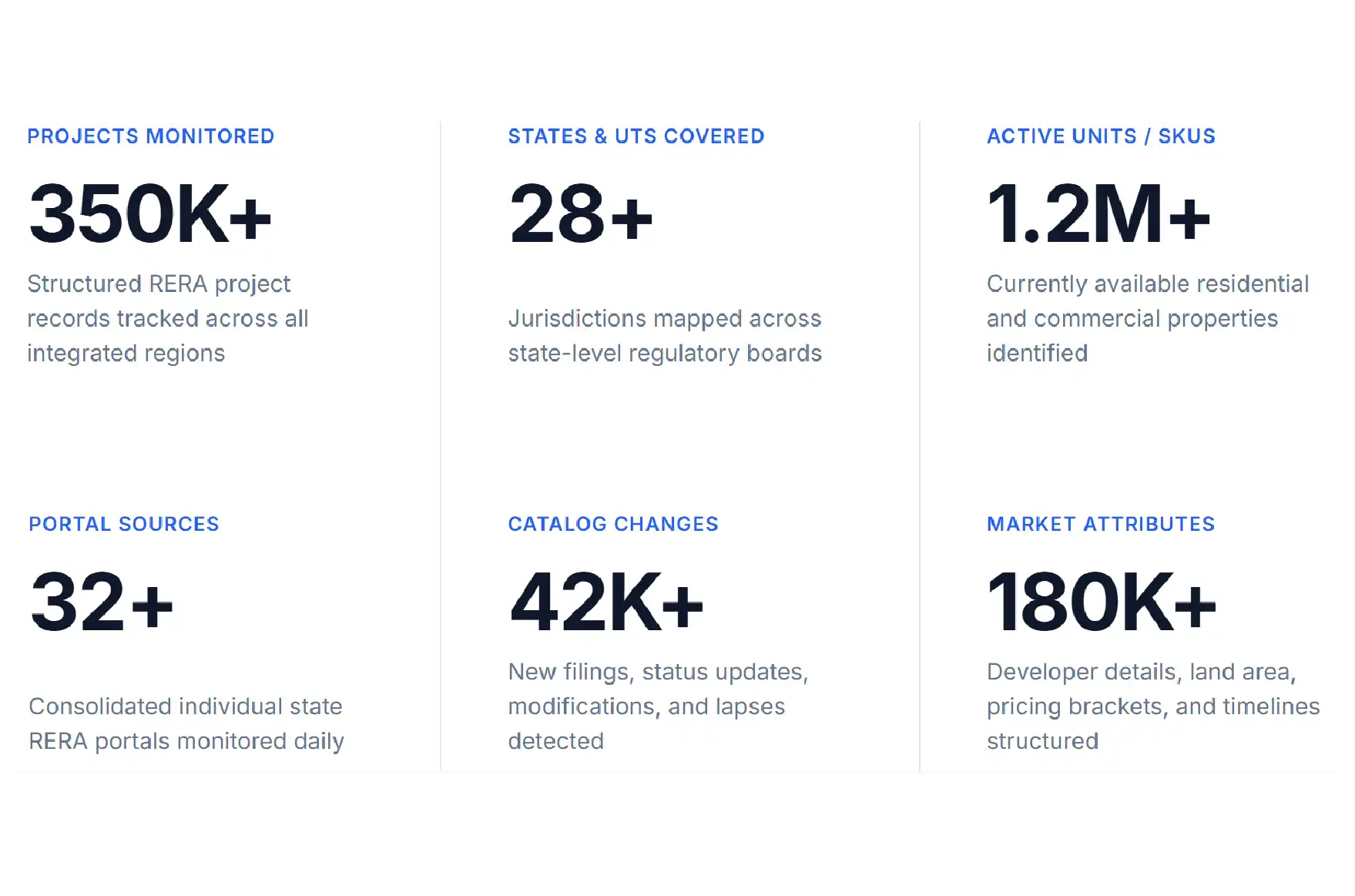
Structured promoter-level extraction enabled the client to analyze developer activity across different markets.
By standardizing builder names and connecting individual projects to their respective promoters, the organization could identify developers with expanding portfolios, compare project activity, and evaluate geographic expansion patterns.
This created a more reliable foundation for builder benchmarking, competitive research, supplier targeting, and investment analysis.
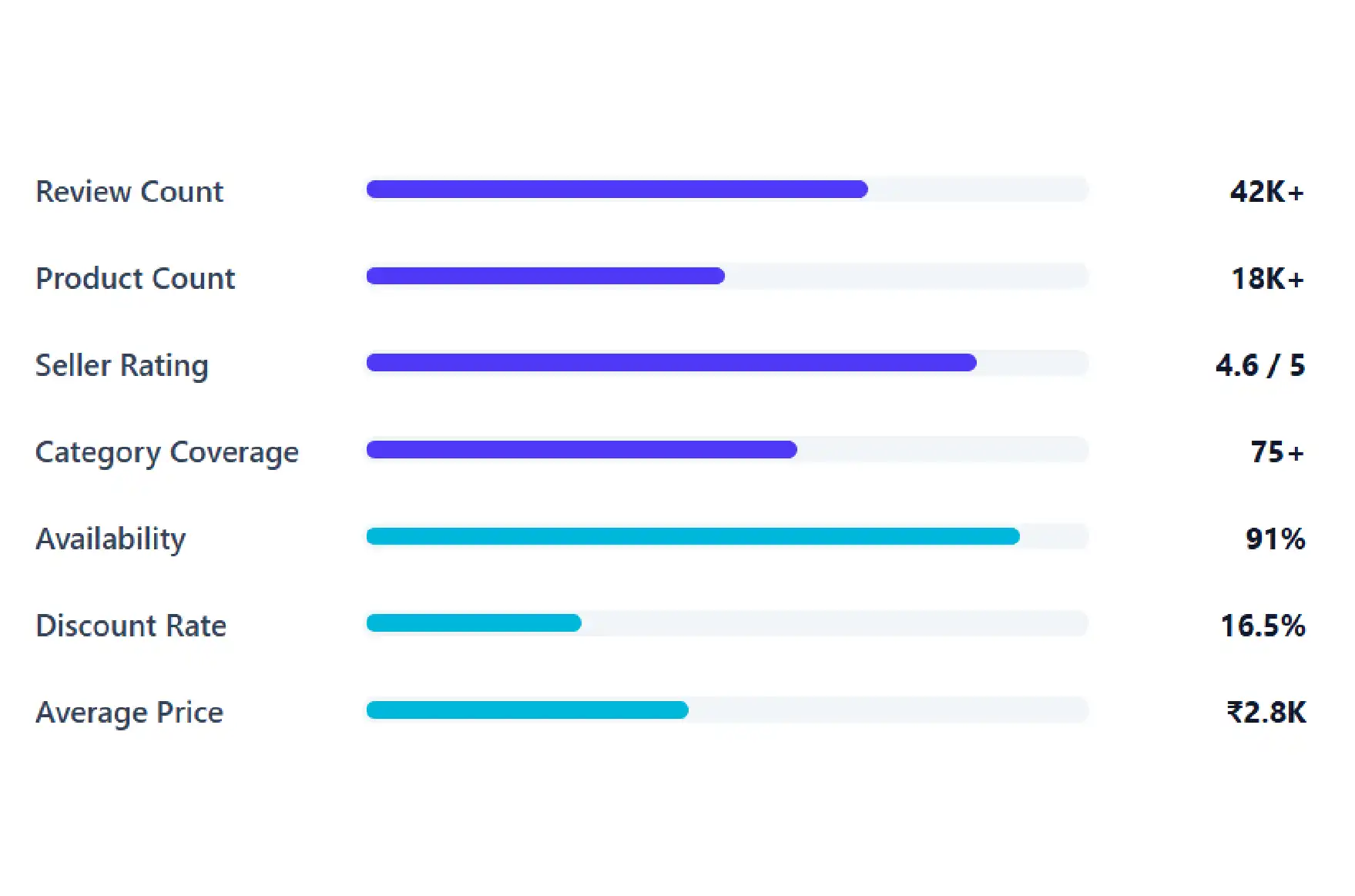
The integration of geographic attributes transformed project addresses into actionable market intelligence.
| Metric | Insight Captured | Business Impact |
|---|---|---|
| State | Project registrations by state | Comparison of regional development activity |
| City | New projects by urban market | Identification of high-growth cities |
| District | Local concentration of developments | Detection of emerging development zones |
| Locality | Project clustering | Micro-market opportunity identification |
| Promoter Location | Builder activity by geography | Developer expansion analysis |
| Project Status | Active, completed, or other available status | Housing pipeline monitoring |
The client could therefore move beyond basic project listings and understand how new housing developments were distributed geographically.
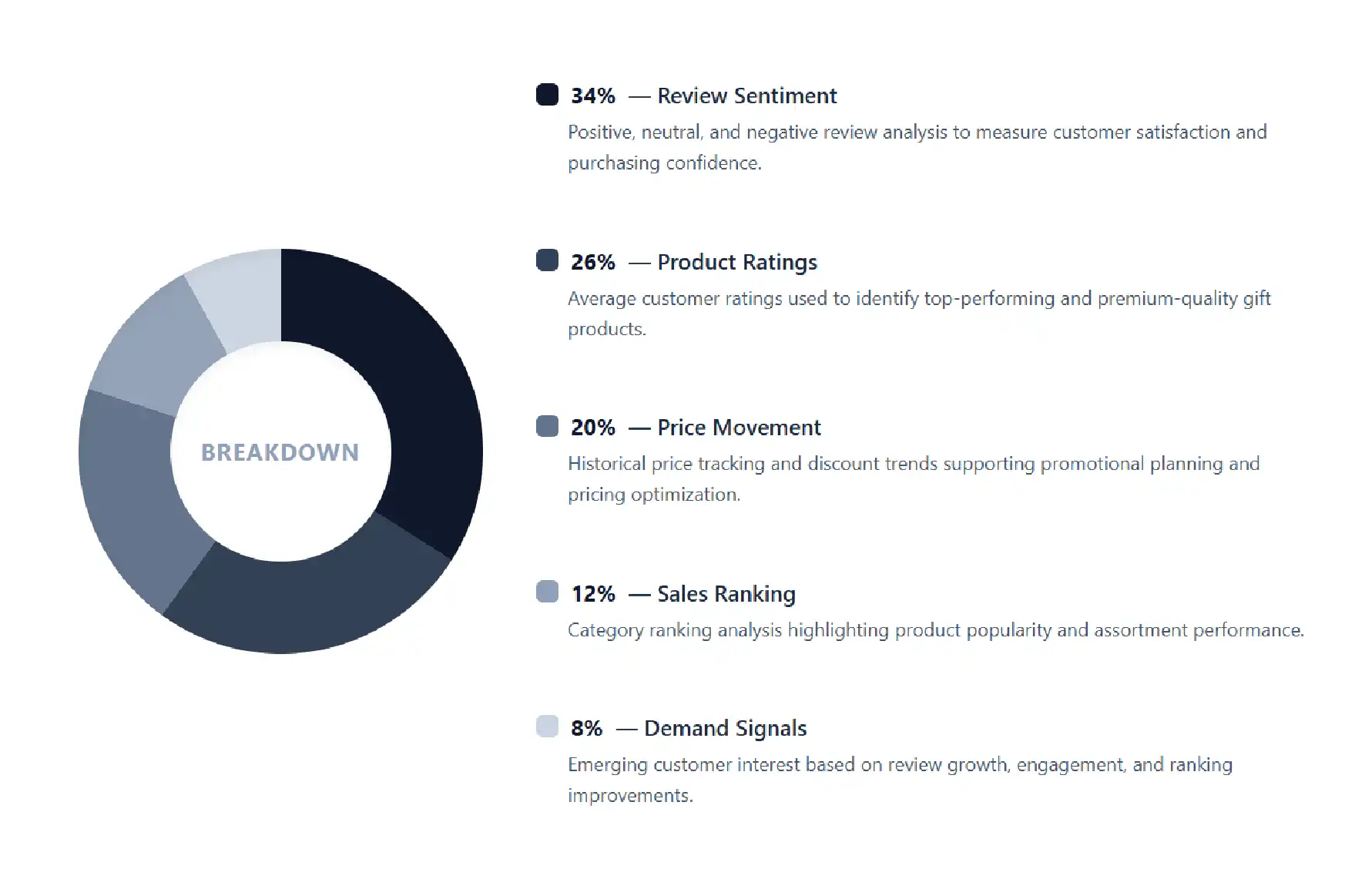
The structured dataset allowed analysts to compare project registrations over time and identify locations experiencing increased residential development.
Markets showing growing numbers of new registrations could be prioritized for deeper research, investment analysis, construction-material sales, property marketplace expansion, and competitive intelligence.
The ability to combine project registration data with geographic and promoter information also helped reveal development clusters that were difficult to identify through isolated portal searches.
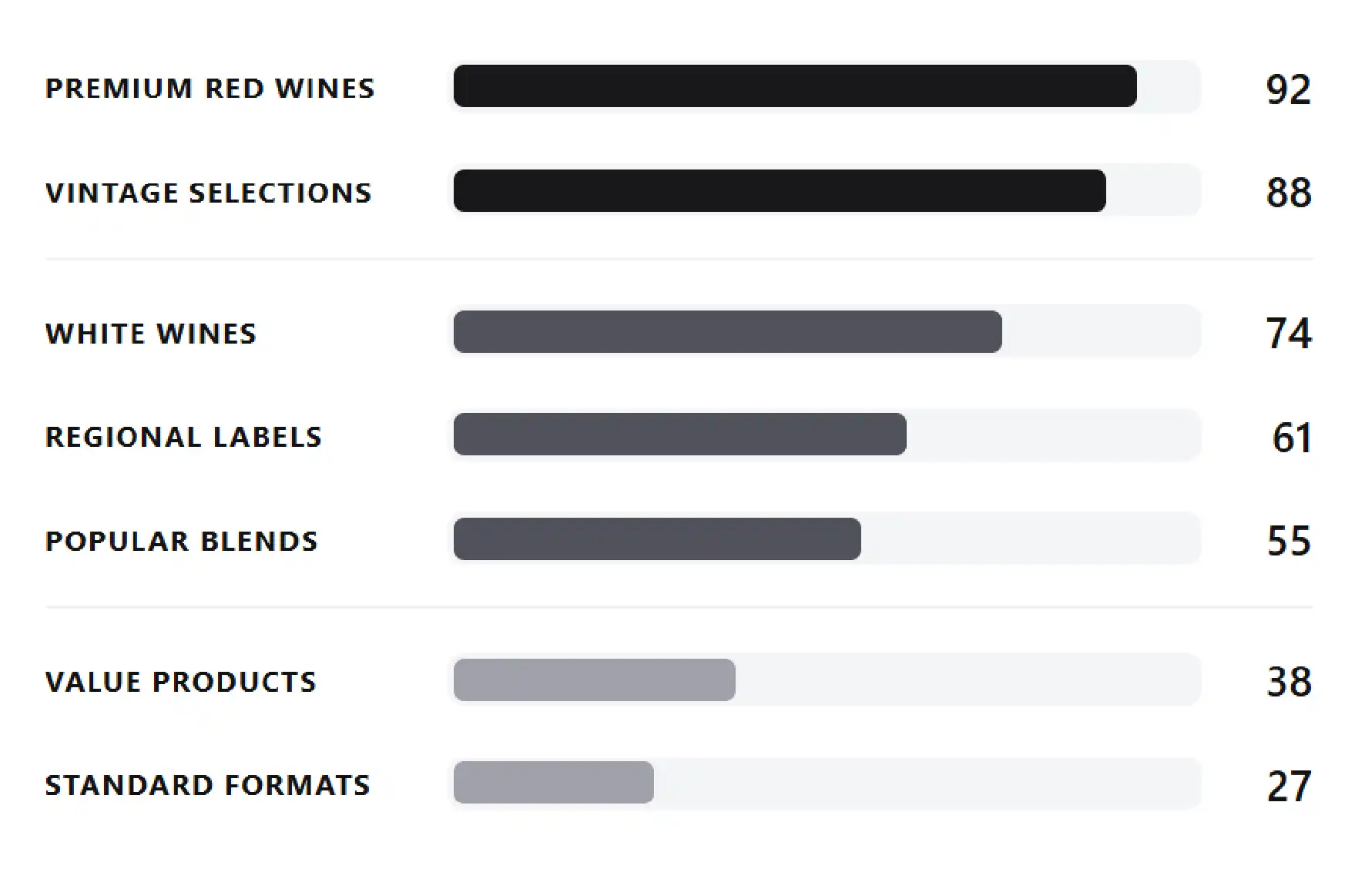
The automated pipeline provided a scalable framework for continuously monitoring housing project information.
Rather than treating RERA research as a one-time data collection exercise, the client established an ongoing intelligence workflow capable of identifying new records and tracking changes in available project information.
This supported recurring market reports, builder intelligence dashboards, project discovery systems, and data-driven real estate research.
The following dataset snapshot illustrates how structured RERA information can be organized for housing market intelligence. It combines project, promoter, location, registration, status, and development information into a standardized format.
| Project Name | State | City | Promoter / Builder | RERA Registration | Project Status | Registration Date |
|---|---|---|---|---|---|---|
| Green Valley Residency | Maharashtra | Pune | ABC Developers | P521000XXXX | Ongoing | 2026-02-14 |
| Sunrise Heights | Karnataka | Bengaluru | Urban Homes Pvt. Ltd. | PRM/KA/RERA/XXXX | New Registration | 2026-03-09 |
| Riverfront Enclave | Uttar Pradesh | Lucknow | Prime Habitat Group | UPRERAPRJXXXX | Ongoing | 2026-01-28 |
| Metro Gardens | Telangana | Hyderabad | Skyline Infra | PXXXXXX | New Registration | 2026-04-17 |
| Palm Residency | Gujarat | Ahmedabad | Horizon Buildtech | PR/GJ/XXXX | Ongoing | 2026-02-21 |
After implementing the structured RERA data intelligence system, the client achieved significant improvements in project discovery, builder monitoring, geographic analysis, and real estate research efficiency.
Our approach transforms fragmented regulatory information into structured, analysis-ready datasets that can support real estate research, investment intelligence, competitive monitoring, and property-market analytics.
The solution reduces manual research by automating repetitive data collection tasks across multiple RERA environments. This enables analysts to focus more time on interpreting market trends rather than searching for individual project records.
Data standardization also improves consistency by bringing project names, promoter information, registration numbers, locations, statuses, and dates into a common structure. This makes cross-state comparison substantially easier.
Automated validation and deduplication processes help maintain higher-quality datasets by identifying duplicate records, inconsistent values, missing information, and formatting variations.
The system also supports geographic analysis by converting raw project addresses into structured location attributes, allowing businesses to understand housing development patterns at state, city, district, and locality levels.
Finally, scalable architecture allows the solution to accommodate expanding datasets and additional state portals while maintaining a consistent workflow for extraction, processing, validation, and delivery.
We are extremely pleased with the RERA intelligence solution delivered by the team. Previously, our analysts spent considerable time searching different state portals and manually consolidating project information. The new system has transformed that workflow by providing structured project and builder data in a centralized format. It has improved our research speed, geographic analysis, and understanding of developer activity across India. The quality of the datasets and consistency of the output have significantly strengthened our market intelligence capabilities and allowed our teams to make faster, more confident decisions.
— Director of Real Estate Intelligence
The final outcome was a scalable RERA data intelligence platform that transformed fragmented regulatory records into structured housing market intelligence.
Implementation of Web Scraping API Services enabled continuous access to standardized project and builder information, supporting internal dashboards, research platforms, databases, and analytical applications.
The solution improved project discovery, builder monitoring, geographic analysis, and market comparison while significantly reducing dependence on manual research.
The deployment of Managed web scraping further provided an operational framework for maintaining extraction workflows, handling source changes, validating datasets, and supporting recurring data delivery requirements.
As a result, the client gained a centralized view of housing development activity across multiple Indian markets. Analysts could identify new project registrations faster, evaluate builder portfolios, compare state-level activity, and uncover emerging residential clusters.
The structured infrastructure also created a foundation for future applications such as housing supply forecasting, builder benchmarking, project discovery platforms, investment research, construction opportunity mapping, and real estate competitive intelligence.
Overall, the project delivered a reliable and scalable foundation for converting RERA records into actionable real estate intelligence and supporting faster, evidence-based decisions across India's housing market.
Depending on portal availability, datasets can include project names, RERA registration numbers, promoter or builder names, project addresses, registration dates, project status, completion timelines, project types, unit information, and other publicly available project attributes.
Yes. A structured extraction framework can be designed to monitor multiple state-level RERA portals and normalize the collected information into a unified dataset for nationwide analysis.
RERA data can support new-project discovery, builder intelligence, competitive research, market expansion analysis, investment research, housing supply monitoring, and geographic identification of emerging residential markets.
Yes. Structured datasets can be integrated into APIs, databases, dashboards, cloud environments, spreadsheets, or other systems depending on the client's technical and business requirements.
Update frequency can be configured according to the use case, including scheduled daily, weekly, or periodic extraction. The appropriate frequency depends on source availability, business requirements, and the type of project intelligence being monitored.
Partner with iWeb Data Scraping to extract, structure, and analyze RERA project data at scale.
Start a projectFields marked * are required. Everything else just helps us scope faster — skip what you don't know yet.