
48.6K+
UCC FILING RECORDS PROCESSED

UCC Data Scraper Enabled a US Alternative Lender to Automate Filing Checks, Strengthen Risk Assessment, and Accelerate Credit Decisions.
This case study explores an enterprise lending scenario in which a US-based alternative lending organization partnered with a data intelligence provider to automate the collection, extraction, validation, and analysis of Uniform Commercial Code (UCC) filing records. The initiative focused on transforming fragmented public filing information into structured financial intelligence that could support faster borrower evaluations, collateral verification, lien discovery, and credit risk assessment.
The project demonstrates how a UCC data scraper can help financial institutions collect relevant public filing information from multiple Secretary of State databases, standardize records, and integrate essential secured transaction details into their lending workflows.
It is designed for:
The client wanted a centralized solution to collect UCC filing data across relevant US jurisdictions without depending on repetitive manual searches. Its objective was to improve underwriting efficiency, reduce information gaps, and establish a more reliable process for identifying existing secured interests before extending business credit.
A US-based alternative lending organization approached iWeb Data Intelligence to address operational challenges associated with collecting and analyzing UCC records across multiple state filing systems. Its underwriting department depended heavily on manual searches, individual state portals, spreadsheets, and fragmented public records to investigate existing business liens and secured financing arrangements.
The organization needed a centralized intelligence system that could collect filing information, organize debtor and secured-party details, and make relevant records accessible during credit evaluations.
iWeb implemented an automated extraction framework that supported UCC lien data extraction from selected Secretary of State filing portals and other relevant public record sources. The system captured available filing information, including debtor names, secured-party details, filing numbers, filing dates, collateral descriptions, filing statuses, and jurisdiction-specific identifiers.
The extracted information was cleaned, normalized, and organized into structured datasets. Matching procedures helped identify potential duplicate records and connect related filings with borrower entities using available business identifiers and name variations.
The platform also consolidated secured lending data into an accessible intelligence layer, enabling credit analysts to review existing secured interests alongside borrower application information.
Automated workflows reduced the time spent navigating individual filing systems and compiling records. Analysts could review relevant filing histories through centralized dashboards rather than repeatedly switching between multiple state databases.
The client operated in the competitive US alternative lending market, where underwriting teams frequently evaluate businesses that may have existing loans, equipment financing arrangements, receivables-based facilities, and other secured obligations.
However, identifying these financial relationships through public filing records was a time-consuming process. Different state jurisdictions maintained their own filing portals, search interfaces, record formats, and access procedures.
The client encountered several operational challenges that affected credit evaluation speed and information consistency.
1. Fragmented State Filing Systems
The underwriting team had to access multiple Secretary of State websites to investigate borrowers operating across different states. Each portal presented different search options, filing formats, and record structures, making consolidated research difficult.
2. Time-Consuming Filing Verification
Reviewing UCC-1 filings data required analysts to search individual records, inspect filing documents, and manually capture relevant debtor, secured-party, and collateral information. This extended the time required to complete borrower due diligence.
3. Limited Visibility into Existing Financial Obligations
The absence of centralized filing intelligence made it difficult to identify potentially overlapping secured interests and financing arrangements. Analysts needed a more consistent method of reviewing existing filings before evaluating new lending opportunities.
4. Inconsistent Data Formats
Different jurisdictions supplied records in different formats, including searchable portal entries, downloadable documents, and structured or semi-structured information. This created inconsistencies when combining borrower information into internal credit assessment systems.
5. Difficulty Identifying Related Business Records
Borrower names could appear with abbreviations, punctuation differences, historical business names, or other variations. Identifying potentially related records required additional investigation and careful entity matching.
The client also struggled to answer several operational questions:
By implementing an automated UCC data collection framework, the client replaced fragmented research activities with a centralized filing intelligence process.
The solution was designed to collect information from selected public filing sources, standardize records, and make relevant information available through structured datasets and analytical dashboards.
| Dimension | Manual UCC Research | Automated Data Scraping System |
|---|---|---|
| Data collection | Individual state portal searches | Automated collection from selected filing sources |
| Research speed | Dependent on analyst availability | Scheduled and automated extraction |
| Data formatting | Different formats and spreadsheets | Standardized and normalized records |
| Debtor identification | Manual name-based investigation | Entity matching using available identifiers |
| Filing verification | Individual document inspection | Structured status and record validation |
| Historical analysis | Manual comparison of previous records | Consolidated filing history |
| Monitoring | Periodic manual checks | Configurable monitoring workflows |
| Reporting | Manually prepared summaries | Centralized dashboards and structured exports |
| Scalability | Limited by analyst capacity | Expandable across supported jurisdictions |
| Data integration | Repetitive data entry | API-enabled delivery and system integration |
The automated system did not replace legal review or establish lien priority independently. Instead, it provided a more efficient method of discovering, organizing, and reviewing public filing information.
The brand in focus is a US-based alternative lending organization specializing in commercial financing for small and medium-sized businesses. Its lending portfolio includes working capital facilities, business expansion loans, equipment financing, and other commercial funding products.
Unlike traditional banking institutions that may rely on extensive financial histories and established borrower relationships, alternative lenders frequently evaluate businesses with varying operating histories, financing structures, and documentation profiles.
This makes efficient business verification and collateral-related due diligence particularly important.
The organization processes applications from companies operating across multiple US states. Consequently, its underwriting department needs access to relevant public records that help establish borrower identity, identify existing secured parties, and understand the potential implications of previously filed financing statements.
Before implementation, its research process involved navigating different filing portals, downloading available documents, recording information manually, and transferring findings into internal credit assessment systems.
The growing application pipeline made this approach increasingly difficult to sustain.
iWeb delivered an end-to-end data intelligence solution designed to collect, process, validate, and organize UCC filing information from selected public filing systems across relevant US jurisdictions.
The implementation combined automated extraction, document processing, data normalization, entity matching, and analytical reporting.
1. Multi-Jurisdiction Data Collection
The first stage involved identifying relevant state filing portals and determining the available search and retrieval methods. Automated workflows were configured to collect accessible public records according to jurisdiction-specific requirements and permitted access methods.
The extraction framework captured available filing information while accommodating differences in portal structures and record presentation.
2. Filing Information Extraction
The system collected relevant information from filing records and available documents, including:
3. Data Cleaning and Standardization
Extracted information was processed through automated cleaning procedures. The system standardized names, dates, filing identifiers, and other available fields.
Duplicate detection procedures helped identify repeated records, while validation checks highlighted missing information and inconsistencies for additional review.
4. Entity Resolution and Record Matching
The solution used available business identifiers, debtor names, and other relevant attributes to associate potentially related filing records.
Name normalization helped identify variations in business names. However, potential matches were treated as candidates requiring verification rather than automatically assumed to represent the same legal entity.
The solution incorporated Web Scraping API Services to support automated information delivery, helping reduce repetitive manual transfers and improving accessibility across operational teams.
A typical normalized record contained:
After collection, the raw records passed through several processing stages.
Debtor Normalization: Debtor names and identifiers were standardized so that equivalent records could be mapped consistently across jurisdictions.
For example, variations in business naming, abbreviations, and punctuation were normalized to reduce duplicate records.
Secured-Party Normalization: Secured-party names and identifiers were standardized to ensure that related records could be analyzed consistently across filing systems.
Filing Classification: The system categorized observations into states such as active, amended, continued, or terminated, depending on the data returned during collection.
Duplicate Removal: Repeated records generated during overlapping collection cycles were identified and handled using filing ID, debtor, and timestamp combinations.
Historical Storage: Each observation was timestamped, enabling the client to calculate filing changes and status movements over time.
Alert Prioritization: The analytics layer identified high-priority situations, including borrowers showing multiple secured filings or recent amendment activity across jurisdictions.
The final dataset was connected to dashboards where analysts could filter information by debtor, secured party, state, filing type, and time period.
The centralized extraction framework enabled underwriting teams to access relevant filing records from multiple supported jurisdictions through a unified system.
Previously, analysts had to navigate separate filing portals and manually consolidate information. The new workflow provided a more consistent view of available debtor and secured-party relationships.
This improved the initial borrower investigation process and helped identify potentially relevant existing secured interests before proceeding with further credit evaluation.
The system also preserved source references, allowing analysts to revisit original records whenever additional verification was required.
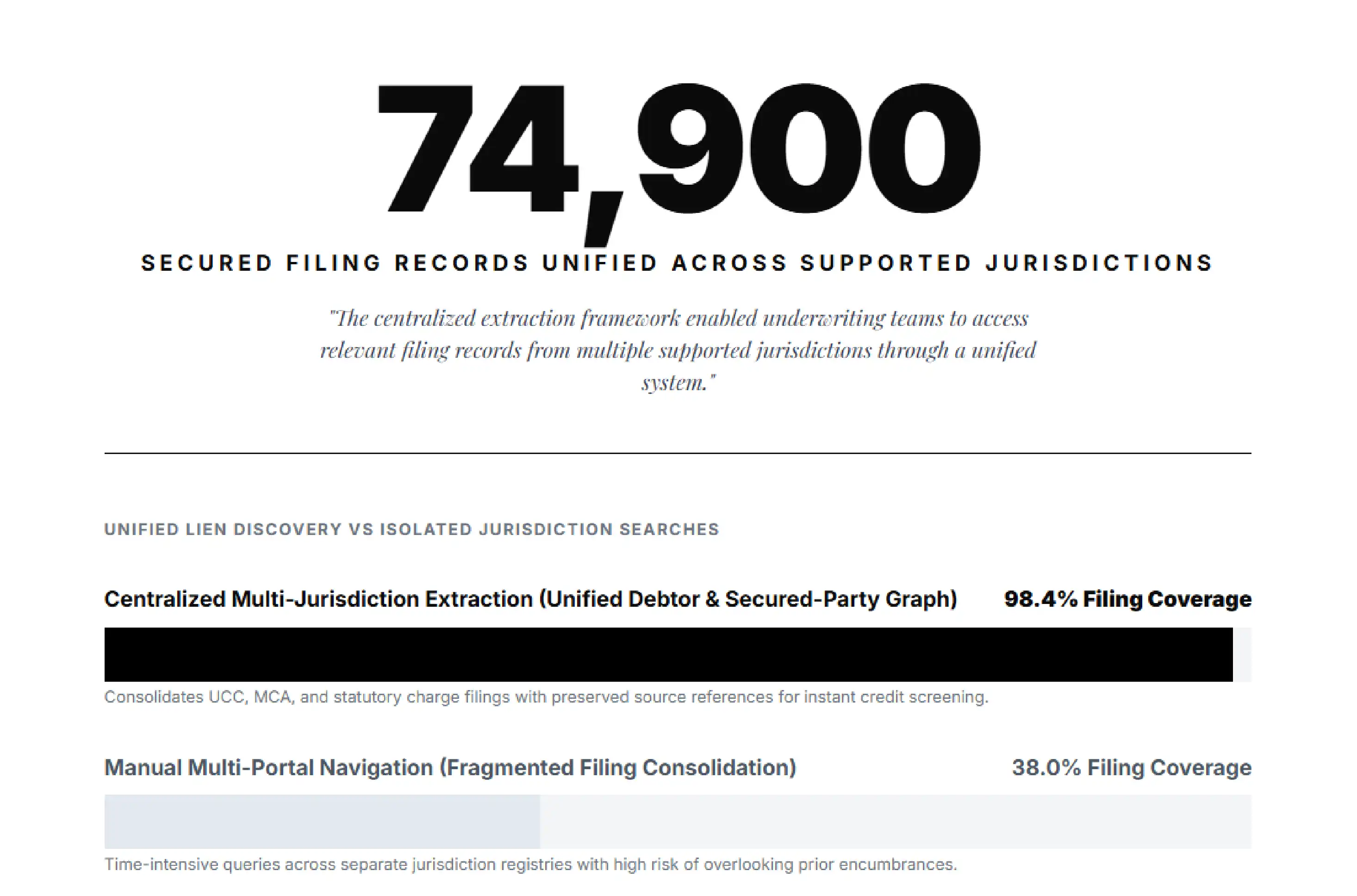
The extraction pipeline enabled analysts to identify filing records associated with borrowers and review the available secured-party information.
By consolidating filing histories, the platform helped highlight situations involving multiple secured parties, amendments, or other filing events that might require additional investigation.
This was particularly useful for asset-based lending and working capital financing, where understanding existing security interests can influence collateral assessment and transaction structuring.
The system provided information for further review rather than independently determining lien priority or legal enforceability.
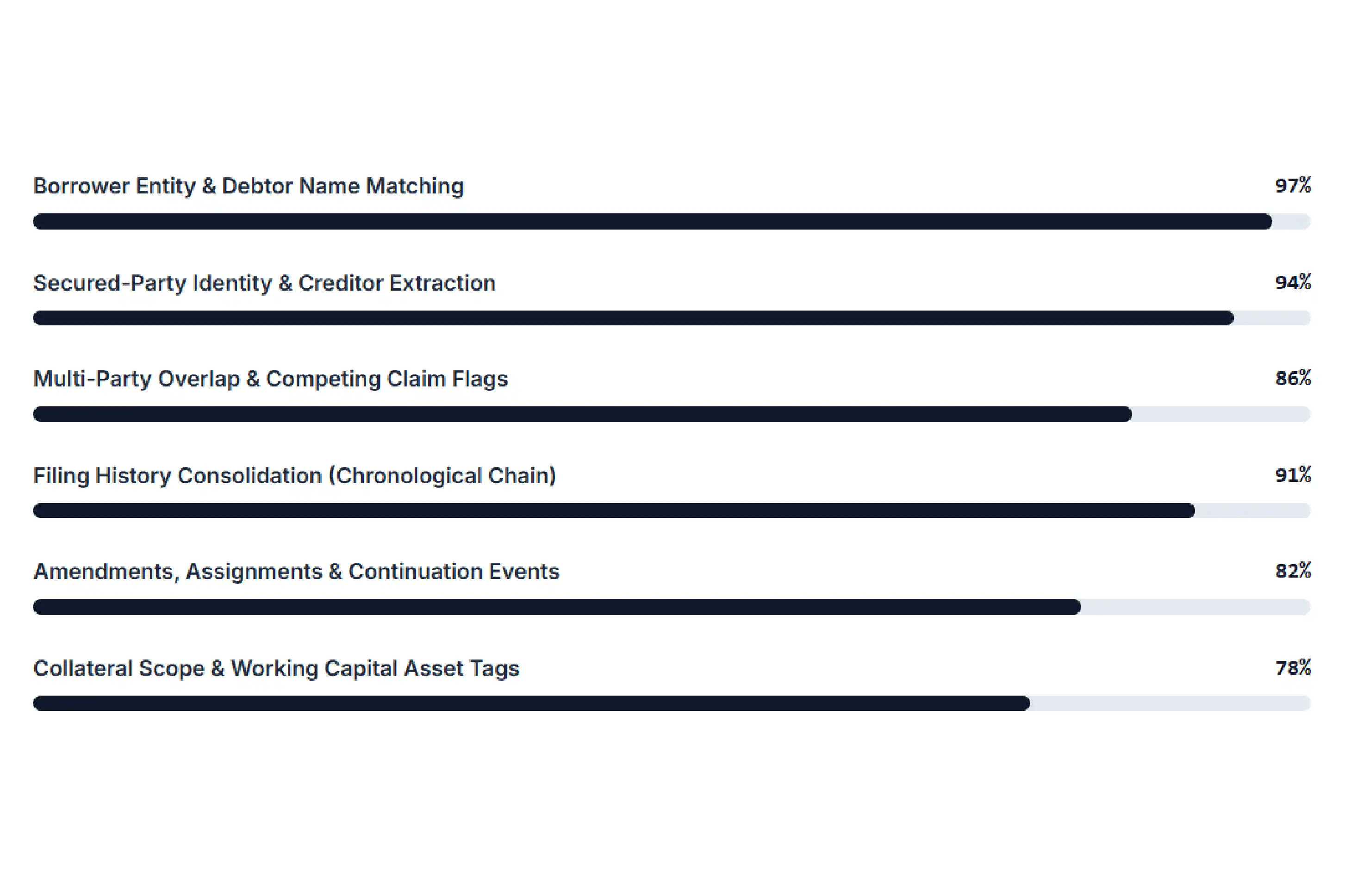
The entity matching framework helped connect potentially related records using business names, available identifiers, and filing references.
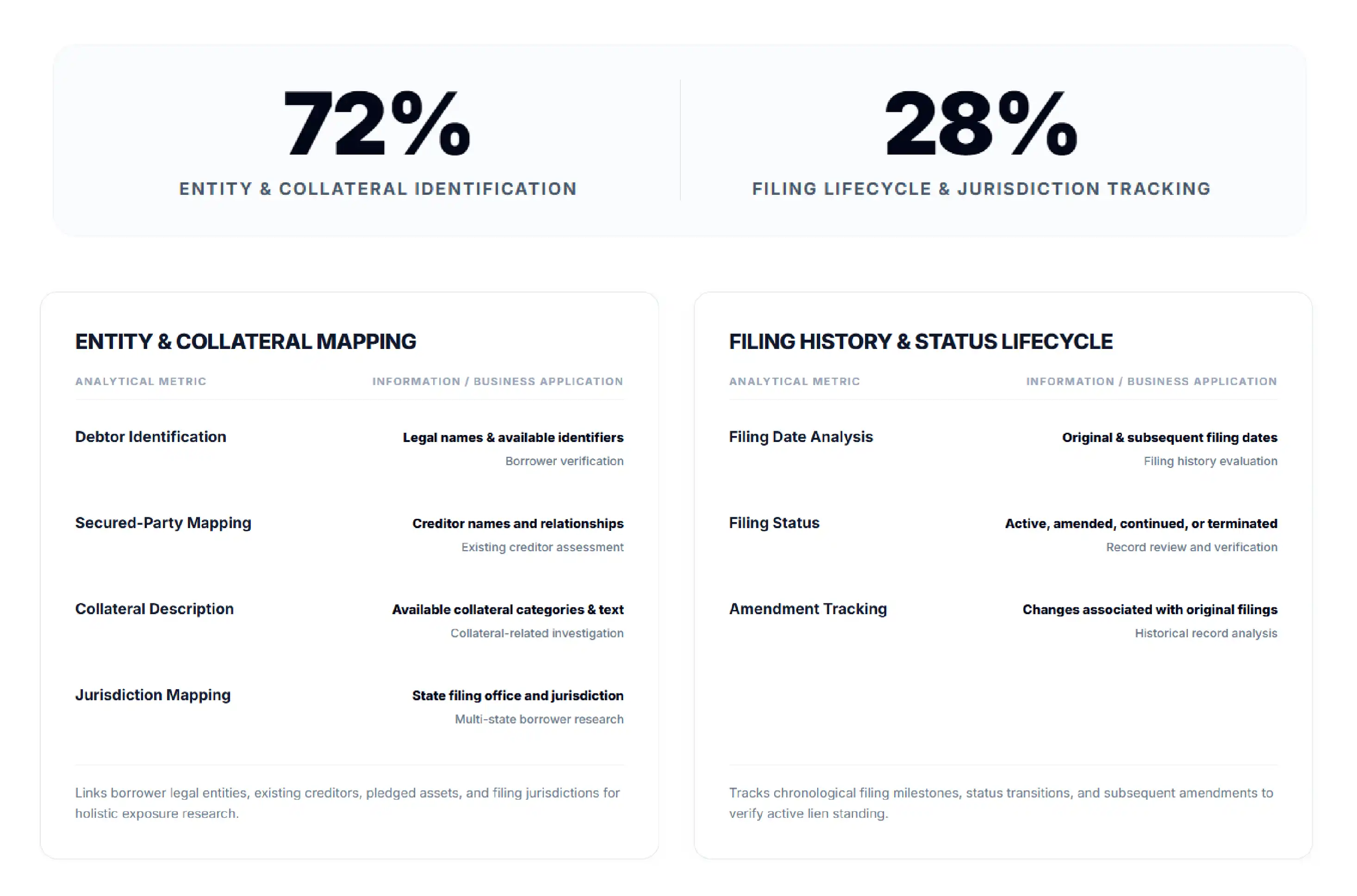
| Analytical Metric | Information Captured | Business Application |
|---|---|---|
| Debtor Identification | Legal names and available identifiers | Borrower verification |
| Secured-Party Mapping | Creditor names and relationships | Existing creditor assessment |
| Filing Date Analysis | Original and subsequent filing dates | Filing history evaluation |
| Collateral Description | Available collateral categories and text | Collateral-related investigation |
| Filing Status | Active, amended, continued, or terminated indicators where available | Record review and verification |
| Jurisdiction Mapping | State filing office and jurisdiction | Multi-state borrower research |
| Amendment Tracking | Changes associated with original filings | Historical record analysis |
These structured attributes helped the lending team conduct more consistent preliminary investigations.
The following illustrative dataset demonstrates how the extracted information was organized for the client's underwriting and financial intelligence teams. The records represent sample business entities and filing scenarios rather than verified borrower transactions.
| Debtor Name | State | Filing ID | Secured Party | Filing Type | Collateral Description | Status |
|---|---|---|---|---|---|---|
| Apex Manufacturing LLC | Texas | TX-2026-18452 | Summit Capital | UCC-1 | Equipment and inventory | Active indicator |
| BluePeak Logistics Inc. | Florida | FL-2026-28731 | Commercial Finance Group | UCC-1 | Accounts receivable | Active indicator |
| NorthStar Retail LLC | California | CA-2026-39146 | Harbor Lending | UCC-3 | Inventory and proceeds | Amendment |
| GreenField Supplies Inc. | New York | NY-2026-42618 | Metro Business Credit | UCC-1 | Business assets | Active indicator |
| PrimeTech Solutions LLC | Illinois | IL-2026-51873 | Enterprise Funding | UCC-3 | Equipment and receivables | Termination |
The value of this dataset was not limited to individual records.
The real advantage came from accumulating observations over time.
With thousands of records collected repeatedly, analysts could calculate filing trends, identify recurring secured-party patterns, compare jurisdictions, and connect debtor-level availability with lending decisions.
Following implementation, the client established a more efficient process for collecting and reviewing public UCC filing information.
The automated framework reduced repetitive research activities and improved the availability of relevant records during underwriting.
The following illustrative project performance indicators demonstrate the intended operational outcomes of the engagement. They are scenario-based measurements for this case study and should not be interpreted as independently audited financial results.
Overall, the solution strengthened the client's underwriting research infrastructure and established a scalable foundation for more efficient commercial lending operations.
iWeb Data Intelligence provides structured data extraction and analytics solutions that help financial institutions convert fragmented public information into reliable business intelligence.
Our approach focuses on five important capabilities.
1. Centralized Data Collection
We consolidate information from multiple relevant public filing sources into a unified dataset. This reduces fragmented research activities and provides underwriting teams with a more consistent view of available filing information across supported jurisdictions.
2. Automated Data Extraction
Our automated pipelines collect relevant filing details, including debtor names, secured-party information, filing dates, collateral descriptions, and available status indicators. This reduces repetitive manual searches and supports efficient information retrieval.
3. Data Validation and Standardization
We implement data cleaning, normalization, duplicate identification, and validation procedures to improve consistency. These processes help identify incomplete records and potential matching errors before information reaches analytical systems.
4. Scalable Intelligence Infrastructure
Our solutions support growing data requirements through configurable extraction workflows, structured storage, and API-enabled delivery. This allows financial institutions to expand coverage across additional jurisdictions and increase monitoring frequency as operational requirements evolve.
"The data intelligence solution delivered by iWeb has significantly improved how our underwriting teams access and review public UCC filing information. Previously, our analysts spent considerable time navigating different state filing portals and manually organizing records before they could begin their assessment. The automated extraction framework has made this process considerably more efficient. We now have structured access to debtor details, secured-party information, filing histories, and collateral descriptions through a centralized reporting environment. The improvement in data accessibility and processing consistency has strengthened our borrower research capabilities and reduced repetitive operational work. The team's technical understanding, implementation approach, and commitment to data quality have been valuable throughout the engagement. We now have a scalable foundation for improving our credit research workflows and supporting more informed lending decisions."
— Head of Credit Operations
The project successfully established a centralized UCC filing intelligence framework for a US-based alternative lending organization. By replacing fragmented manual research with automated extraction and structured data processing, the client improved its ability to collect, organize, and analyze relevant public filing records.
The implementation of the UCC data scraper enabled continuous and scalable collection of available filing information from selected state jurisdictions. Structured datasets provided greater visibility into debtor identities, secured-party relationships, filing histories, collateral descriptions, and relevant filing events.
The solution also established a foundation for incorporating automated RERA data for lending analytics into broader financial intelligence workflows where relevant jurisdictional datasets are available, extending the potential application of structured public-record intelligence beyond UCC filing analysis.
Overall, the engagement demonstrated how automated public-record intelligence can improve commercial lending research, strengthen operational efficiency, and create a more informed foundation for credit decision-making.
The company could now answer critical operational questions faster:
This shift from periodic reporting to continuous filing intelligence strengthened the organization's ability to manage the rapidly evolving commercial lending environment.
Most importantly, the project demonstrated that public-record visibility is not simply a documentation metric. In a competitive lending environment, filing intelligence is part of the risk assessment process and directly influences the opportunity to make informed credit decisions.
UCC data scraping involves collecting publicly accessible Uniform Commercial Code filing information from relevant state filing systems and converting it into structured datasets. Alternative lenders use this information to investigate borrowers, identify potentially existing secured interests, and support commercial credit due diligence.
Depending on jurisdiction and source availability, extraction can capture debtor names, secured-party details, filing numbers, filing dates, collateral descriptions, amendments, continuations, assignments, termination information, and available filing status indicators. Original documents and source references can also be retained for verification.
Automation reduces the time spent accessing individual filing portals, collecting records, and preparing spreadsheets. Centralized information helps analysts investigate borrower filing histories more efficiently and identify records that may require additional collateral or legal review.
Yes. An automated solution can be configured to collect information from multiple supported state filing systems. However, portal accessibility, search functionality, document availability, fees, and data formats differ by jurisdiction and must be considered during implementation.
No. Extracted filing records provide useful research information but cannot independently establish lien priority, perfection, enforceability, or the validity of a security interest. These matters require appropriate legal analysis, original-document verification, and jurisdiction-specific review.
iWeb Data Intelligence helps alternative lenders transform fragmented public filing records into structured financial intelligence. Our automated data extraction, validation, and monitoring solutions support better borrower research, improved filing visibility, and more efficient underwriting workflows.
Start a projectFields marked * are required. Everything else just helps us scope faster — skip what you don't know yet.