
250K+
INFLUENCER PROFILES PROCESSED

UK Brand Used Bulk Influencer Data Scraping to Transform Creator Discovery, Audience Targeting, Outreach, and Campaign Intelligence Across Platforms.
This case study presents a real-world enterprise scenario in which a UK-based consumer brand transformed influencer discovery and outreach by building a structured creator intelligence database across Instagram, YouTube, and TikTok. Instead of relying on manual searches, agency spreadsheets, social platform recommendations, and fragmented creator databases, the brand implemented a scalable data collection framework to identify relevant creators, evaluate audience characteristics, compare engagement signals, and prioritize outreach opportunities.
The project demonstrates how UK Brand Used Bulk Influencer Data Scraping to create a centralized creator intelligence layer covering thousands of potential influencers across multiple content categories, audience segments, locations, and follower tiers.
It is designed for:
The project also supports businesses that need to Extract Instagram, YouTube & TikTok influencer data at scale to identify creators based on follower count, engagement activity, content category, location, posting frequency, audience signals, and other publicly observable attributes.
The client's primary objective was to replace inefficient creator discovery with a structured, continuously refreshed database that could support faster campaign planning and more targeted influencer outreach.
A UK consumer brand was experiencing rapid growth in influencer marketing but struggled to identify the right creators efficiently. Its marketing team was manually searching Instagram, YouTube, and TikTok, collecting creator information into spreadsheets, checking individual profiles, and repeatedly validating whether influencers were relevant to specific campaigns.
The fragmented process created several problems. Creator discovery required significant employee time, influencer information became outdated quickly, and campaign teams lacked a consistent methodology for comparing creators across platforms.
To solve these challenges, the brand implemented a structured UK influencer data scraping for brand outreach framework designed to collect, normalize, classify, and score publicly available creator information.
The solution created a centralized influencer intelligence database containing profile-level and content-level information from multiple social ecosystems. Instead of evaluating creators individually, the marketing team could filter large creator pools based on categories, location, audience size, engagement indicators, platform activity, content formats, and other campaign requirements.
The project also introduced Bulk creator data extraction for influencer marketing In UK, enabling the brand to move from small-scale influencer searches to systematic creator discovery across a significantly broader market.
Data pipelines continuously collected relevant information, while validation and normalization processes removed duplicate records and standardized fields across platforms.
The client had a growing influencer marketing budget but lacked the infrastructure required to discover and evaluate creators efficiently at scale.
Its existing approach depended heavily on manual platform searches, recommendations, influencer agencies, and spreadsheets. While these methods worked for individual campaigns, they became increasingly inefficient as the number of required creators increased.
One of the biggest problems involved inconsistent influencer discovery. Different marketing team members used different search terms, categories, and selection criteria. As a result, one campaign could identify hundreds of creators while another overlooked potentially valuable niche influencers.
The client needed scalable Instagram influencer Data Scraping to build a structured creator pool containing relevant public profile information, content signals, engagement indicators, and category attributes.
A second challenge was the lack of standardized cross-platform information. A creator could maintain an Instagram profile, YouTube channel, and TikTok account, but the client had no centralized method for connecting these identities and understanding their overall digital presence.
YouTube presented another research challenge because creator information was distributed across channels, videos, descriptions, categories, publishing activity, and engagement signals. The organization required reliable YouTube creator data Extraction to analyze creators beyond subscriber counts and identify content patterns relevant to its campaigns.
TikTok created an additional challenge because of the platform's enormous volume of creators and rapidly changing content environment. Marketing teams needed to Extract TikTok Bulk influencer data: efficiently enough to identify creators within specific niches without spending hours manually reviewing individual profiles.
The client replaced fragmented influencer research with an automated intelligence workflow capable of collecting, standardizing, validating, and categorizing creator information across multiple social platforms.
| Dimension | Manual Influencer Research | Client Data Intelligence System |
|---|---|---|
| Creator discovery | Individual searches across platforms | Automated large-scale creator discovery |
| Platform coverage | Limited to selected profiles | Instagram, YouTube, and TikTok |
| Data collection | Manual spreadsheet entry | Automated structured ingestion |
| Creator filtering | Basic manual filtering | Multi-dimensional creator segmentation |
| Engagement analysis | Occasional manual calculation | Standardized engagement indicators |
| Location targeting | Manually verified | Structured geographic attributes |
| Content categorization | Subjective classification | Rule-based and automated categorization |
| Duplicate detection | Manual | Automated record matching |
| Creator updates | Periodic spreadsheet refresh | Scheduled data refreshes |
| Outreach preparation | Manually assembled lists | Campaign-ready creator segments |
| Scale | Hundreds of creators | Hundreds of thousands of records |
| Decision speed | Days or weeks | Hours or significantly shorter cycles |
The new system allowed campaign teams to move from reactive influencer discovery toward proactive creator intelligence.
Instead of beginning every campaign with an empty spreadsheet, marketers could start with an established creator database and apply campaign-specific filters.
The brand in focus was a rapidly expanding UK consumer business using influencer marketing as a major customer acquisition and brand-awareness channel.
Its campaigns covered multiple product categories and required different types of creators. Some campaigns needed high-reach macro-influencers, while others performed better with highly relevant micro- and mid-tier creators who maintained stronger niche engagement.
As campaign frequency increased, the brand discovered that influencer discovery had become one of the most time-consuming parts of its marketing operation.
Marketing executives needed answers to practical questions:
The lack of structured answers created delays throughout the campaign lifecycle.
The brand therefore decided to establish an influencer intelligence framework that could provide a centralized view of the creator landscape.
The system was designed not only to collect influencer profiles but also to transform creator information into actionable campaign intelligence.
The project began with a detailed definition of the client's creator discovery requirements. Campaign categories, geographic markets, creator tiers, engagement thresholds, platform requirements, and content characteristics were converted into structured data fields.
The team developed a scalable framework incorporating Web Scraping Social Media User Data to organize publicly available creator information into standardized records.
The collection architecture was designed around platform-specific data structures while maintaining a common schema across Instagram, YouTube, and TikTok.
The pipeline collected relevant public information such as:
The solution used Social media scraping workflows to continuously organize creator information and make it available to campaign teams through structured datasets.
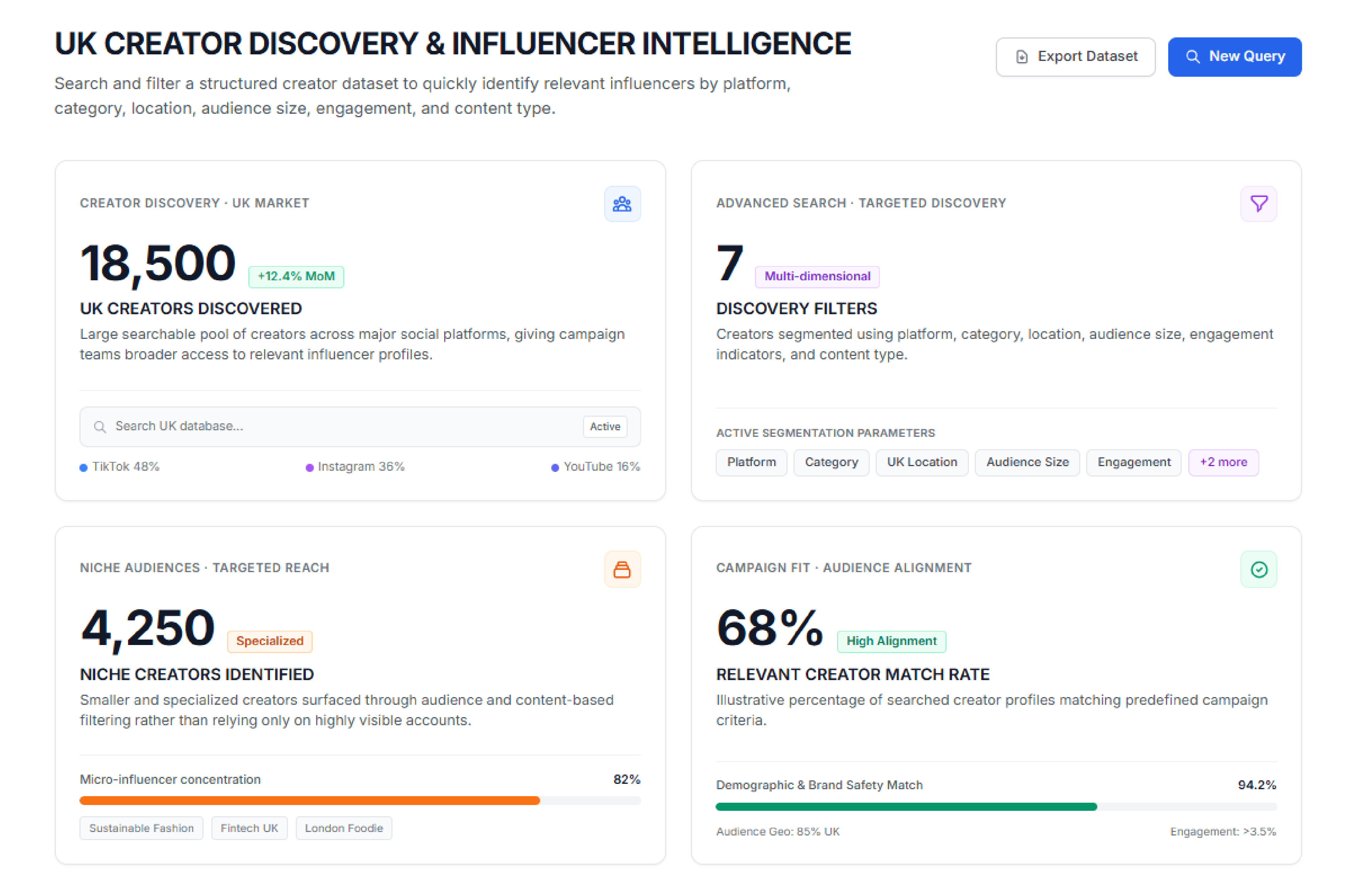
The first major finding was a significant improvement in creator discovery speed.
Previously, marketing executives could spend hours searching individual platforms for suitable influencers. The structured system transformed this process by allowing campaign teams to search large creator datasets using predefined criteria.
A campaign manager could filter creators by platform, category, location, audience size, engagement indicators, and content type.
This reduced the dependency on individual employee knowledge and made creator discovery more consistent.
The brand also gained access to a broader pool of niche creators.
Rather than focusing exclusively on highly visible accounts, marketing teams could identify smaller creators whose audiences aligned more closely with campaign requirements.
This created new opportunities for cost-efficient influencer campaigns.
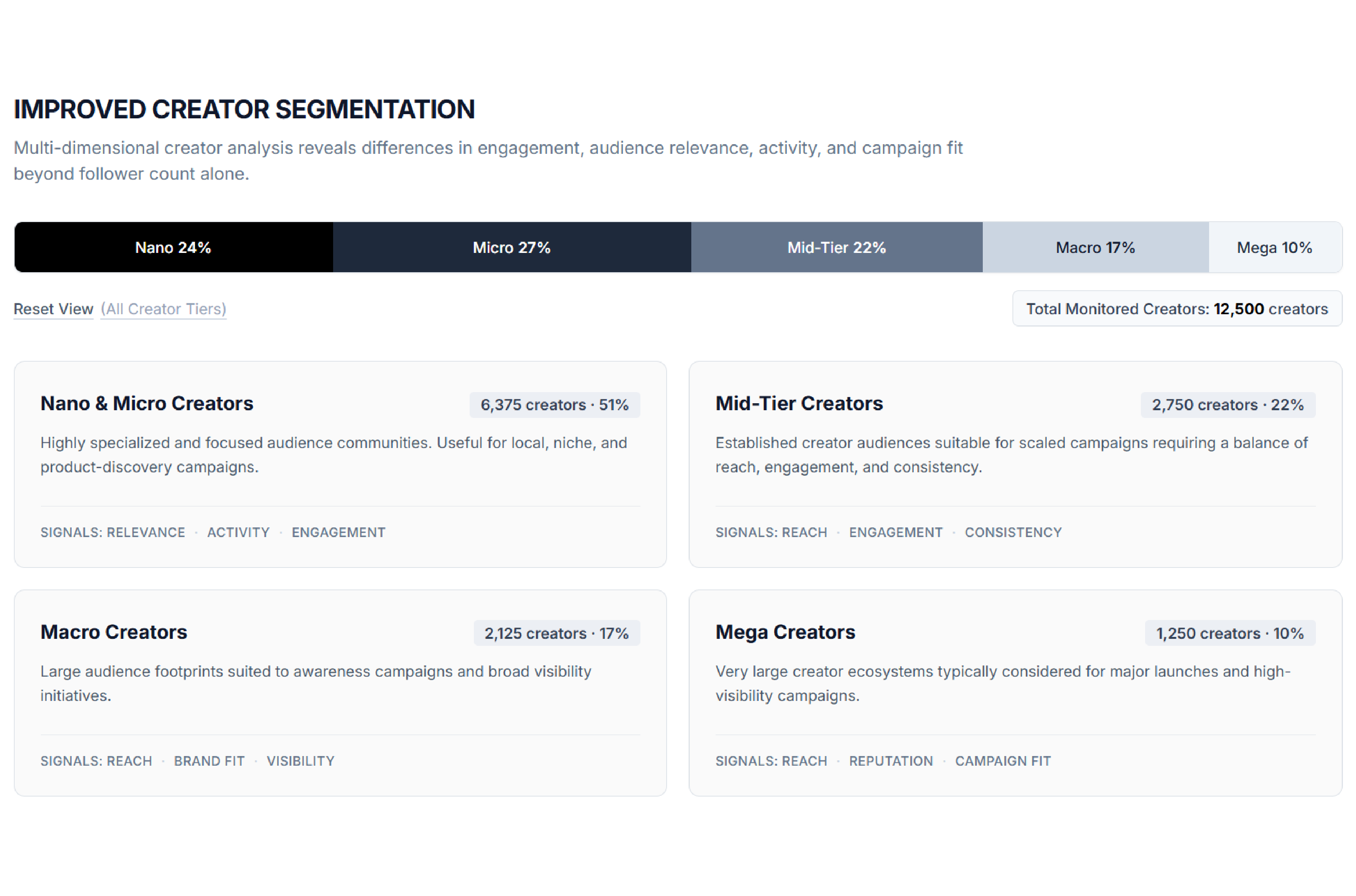
The second finding involved creator segmentation.
The client discovered that influencer performance could vary substantially even among creators with similar follower counts.
For example, two creators with 100,000 followers could have very different levels of content activity, engagement, niche relevance, and audience alignment.
The structured dataset enabled the client to segment creators using multiple dimensions.
| Creator Tier | Typical Profile | Outreach Use Case | Primary Evaluation Signals |
|---|---|---|---|
| Nano | Highly specialized communities | Local and niche campaigns | Relevance, activity, engagement |
| Micro | Focused audience groups | Product discovery | Engagement, category relevance |
| Mid-Tier | Established creator audiences | Scaled campaigns | Reach, engagement, consistency |
| Macro | Large audience footprint | Awareness campaigns | Reach, brand fit, visibility |
| Mega | Very large creator ecosystems | Major launches | Reach, reputation, campaign fit |
This segmentation allowed the marketing team to choose creators according to campaign objectives rather than simply selecting accounts with the highest follower counts.
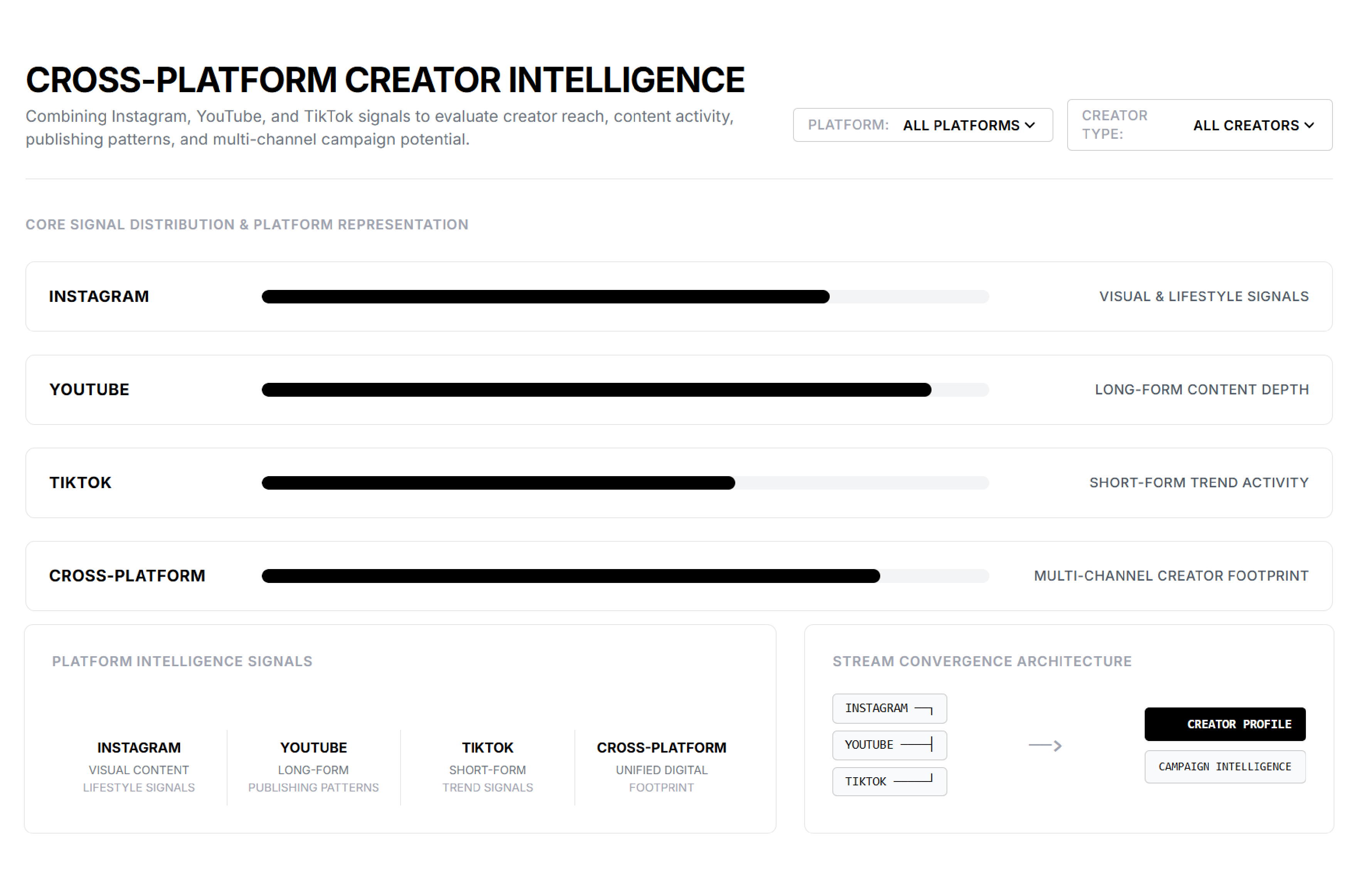
The third finding was the value of combining Instagram, YouTube, and TikTok data.
Each platform provided a different type of creator signal.
Instagram offered strong visual and lifestyle content indicators.
YouTube provided deeper long-form content signals and channel-level publishing patterns.
TikTok offered high-volume short-form content and rapidly changing trend signals.
By bringing these datasets together, the client could evaluate a creator's broader digital footprint.
A creator with a strong Instagram audience and rapidly growing TikTok activity could be prioritized differently from a creator with a large YouTube subscriber base but lower activity elsewhere.
This cross-platform intelligence improved campaign planning and helped the client identify creators capable of supporting multi-channel campaigns.
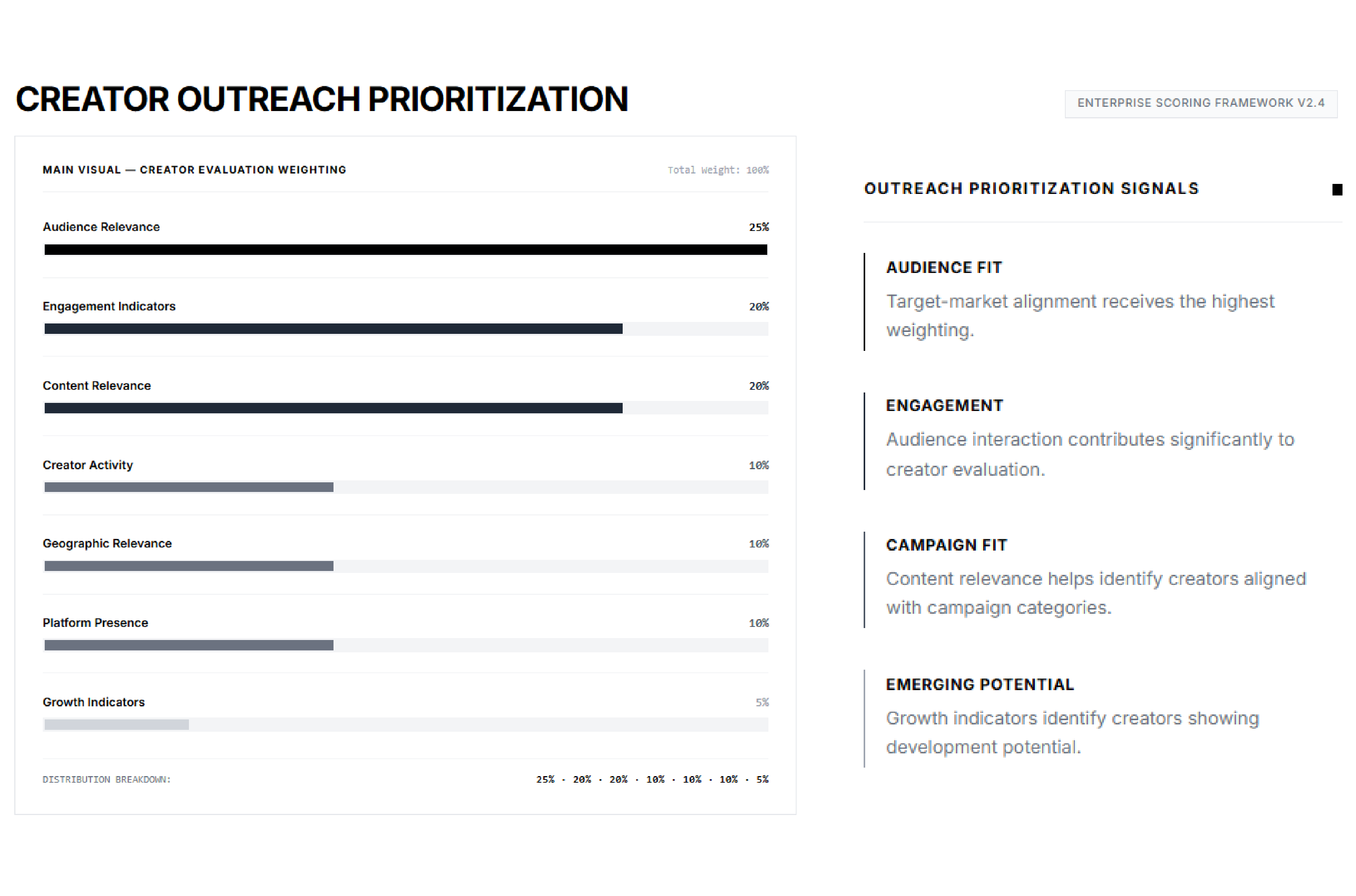
The fourth finding was improved outreach prioritization.
Before implementation, outreach teams frequently worked from large lists without a clear order of priority.
The new system introduced structured creator scoring based on campaign-specific requirements.
A simplified scoring framework included:
| Evaluation Factor | Weight | Purpose |
|---|---|---|
| Audience relevance | 25% | Measures alignment with target market |
| Engagement indicators | 20% | Evaluates audience interaction |
| Content relevance | 20% | Measures category and campaign fit |
| Creator activity | 10% | Evaluates publishing consistency |
| Geographic relevance | 10% | Identifies UK market alignment |
| Platform presence | 10% | Supports multi-channel campaigns |
| Growth indicators | 5% | Identifies emerging creators |
The framework helped marketing teams prioritize high-potential creators before beginning outreach.
This reduced research time and created a more systematic approach to campaign prospecting.
The following sample illustrates how the structured dataset could support influencer discovery and outreach planning.
| Creator | Platform | Category | Followers/Subscribers | Engagement | Location | Content Type | Outreach Priority |
|---|---|---|---|---|---|---|---|
| Sophie Carter | Beauty | 184K | 6.8% | London | Reels | High | |
| Oliver Grant | YouTube | Technology | 326K | 5.9% | Manchester | Reviews | High |
| Amelia Rose | TikTok | Fashion | 241K | 8.7% | Birmingham | Short Video | High |
| Daniel Brooks | Fitness | 96K | 7.4% | Leeds | Reels | Medium | |
| Chloe Martin | TikTok | Food | 128K | 9.1% | Bristol | Short Video | High |
| Ethan Wilson | YouTube | Travel | 212K | 5.6% | Edinburgh | Vlogs | Medium |
| Grace Taylor | Lifestyle | 74K | 8.2% | Glasgow | Reels | Medium | |
| Harry Evans | TikTok | Gaming | 187K | 7.9% | Liverpool | Short Video | High |
| Mia Thompson | YouTube | Parenting | 143K | 6.1% | London | Long Video | Medium |
| Jack Roberts | Menswear | 112K | 6.5% | Nottingham | Reels | Medium |
The dataset can be expanded with additional fields such as creator email availability where publicly provided, brand collaboration indicators, recent post timestamps, content keywords, hashtags, average views, channel activity, and historical campaign relationships.
The implementation generated measurable operational improvements across the client's influencer marketing workflow.
The project's value extended beyond simple data collection.
The core objective was to create a reliable influencer intelligence infrastructure capable of supporting marketing decisions.
The solution unified information from multiple social platforms into a consistent structure, enabling campaign teams to compare creators using common fields.
Automated processing reduced repetitive manual work and helped marketing teams spend more time on outreach strategy rather than data preparation.
The architecture was also designed for scalability. As the client's influencer marketing activity expanded, the system could accommodate additional creator records and new segmentation requirements.
Another advantage was structured historical intelligence.
Rather than losing creator information after each campaign, the organization could maintain a continuously evolving creator database and use previous research to support future campaign planning.
The system also enabled better collaboration between teams.
"We previously spent a considerable amount of time searching across different social platforms and manually building influencer lists for every campaign. The new data intelligence system completely changed that process. We now have a much broader and more structured view of creators across Instagram, YouTube, and TikTok. Our teams can identify relevant influencers faster, segment them according to campaign requirements, and prioritize outreach more effectively. The biggest improvement has been the ability to turn creator discovery into a repeatable, data-driven process rather than a manual research exercise."
— Head of Influencer Marketing
The final outcome was a centralized influencer intelligence system that transformed creator discovery into a scalable marketing data operation.
The client moved from fragmented platform searches and spreadsheet-based research to a structured creator database covering Instagram, YouTube, and TikTok.
The system supported creator discovery, segmentation, cross-platform mapping, engagement analysis, campaign filtering, and outreach prioritization.
By combining structured datasets with automated processing, the brand was able to identify larger pools of relevant creators while reducing the manual workload associated with influencer research.
The platform also enabled the client to Scrape YouTube Channels And Videos Data for deeper creator and content-level analysis, helping campaign managers understand channel activity, content themes, publishing behavior, and audience engagement indicators.
The solution further incorporated TikTok Data Scraping Services to support scalable discovery of short-form creators and identify emerging accounts within specific categories.
The resulting infrastructure gave the brand a more complete view of the UK influencer landscape.
Bulk influencer data helps brands identify large numbers of relevant creators efficiently. Instead of manually searching individual profiles, marketing teams can filter structured creator records based on platform, category, location, audience size, engagement indicators, and content relevance.
A creator intelligence dataset can be designed around platforms such as Instagram, YouTube, and TikTok. The specific fields collected depend on the platform structure, campaign objectives, publicly available information, and applicable platform policies.
Yes. Where publicly available and appropriate, creator datasets can include geographic attributes such as country, city, or regional indicators. This allows brands to build location-specific influencer lists for UK campaigns.
Yes. Creator datasets can be segmented according to follower or subscriber ranges, engagement indicators, content categories, and other campaign requirements. This makes it easier to discover micro- and niche influencers that may be missed during manual searches.
Structured data allows marketing teams to prioritize creators before contacting them. Campaign managers can filter creator records according to relevance, engagement, location, platform activity, content category, and other predefined criteria.
A structured influencer intelligence solution can help brands discover, segment, compare, and prioritize creators across major social platforms. By transforming publicly available social signals into organized datasets, businesses can reduce manual research, improve campaign targeting, expand creator discovery, and build more efficient influencer outreach programs at scale.
Start a projectFields marked * are required. Everything else just helps us scope faster — skip what you don't know yet.