
186.5K+
TOTAL GROCERY PRODUCT RECORDS PROCESSED

UK Grocery Price API Solutions Empower Price-Comparison Apps With Real-Time Supermarket Data, Smarter Insights, And Better Consumer Shopping Decisions.
This case study explores an enterprise scenario in which a UK-based price-comparison application wanted to strengthen its grocery intelligence capabilities by implementing a scalable UK grocery price API to collect, organize, and distribute supermarket product prices through a unified digital platform. The objective was to provide consumers with accurate product comparisons, transparent pricing information, and convenient grocery shopping decisions across multiple retailers.
The project demonstrates how structured UK supermarket price data can help digital comparison platforms transform fragmented retail information into reliable, searchable, and frequently refreshed datasets.
It is designed for:
The client's primary challenge was the fragmented nature of grocery pricing information across different supermarket websites and digital shopping platforms. Product descriptions, package sizes, promotional conditions, and prices were presented in different formats, making direct comparisons difficult.
A growing UK price-comparison application wanted to improve the accuracy and usefulness of its grocery shopping experience. Consumers increasingly expected to compare supermarket prices before purchasing everyday essentials, but the application lacked a consistent source of frequently updated retail information. Its existing collection methods could not efficiently capture pricing changes, promotional offers, product availability, and variations in package sizes across multiple supermarkets.
The client therefore partnered with iWeb Data Intelligence to develop an automated grocery intelligence infrastructure capable of collecting postcode level grocery prices UK across selected retailers and product categories. The solution was designed to capture location-specific pricing information wherever retailer sources exposed relevant regional or delivery-area differences.
The implementation included a structured Tesco Sainsbury's Asda price API integration approach, alongside additional retailer data sources, to consolidate product information into a standardized database. Product titles, brands, categories, package quantities, regular prices, promotional prices, availability, and product identifiers were captured and normalized.
The project also generated reliable UK grocery price comparison app data, enabling the application to present comparable products and calculate differences between supermarket baskets. Automated validation and product-matching procedures helped reduce duplicate listings and improve comparison accuracy.
The client operated a digital grocery comparison application designed to help consumers identify affordable products across leading UK supermarkets. However, maintaining accurate product-level information across different retailers became increasingly difficult as the application expanded its coverage and product catalogue.
Inconsistent Retailer Pricing Information
Different supermarkets displayed product prices, package quantities, and promotional conditions using different structures. This complicated direct comparisons and created inconsistencies in the application's product records. The client needed a standardized weekly grocery price feed UK capable of supporting consistent product-level comparisons across multiple retailers.
Frequent Price Changes and Promotional Updates
Grocery prices changed through temporary offers, loyalty promotions, seasonal discounts, and retailer-specific campaigns. Existing monitoring methods could not capture these changes consistently. The client required continuous grocery data scraping to identify price movements and update application records without depending on repeated manual checks.
Product Matching Across Supermarkets
Equivalent products frequently appeared under different titles, descriptions, or package formats. Comparing a 500-gram product with a 750-gram alternative without quantity normalization could produce misleading results. The client needed accurate product matching and standardized grocery datasets to support meaningful comparisons.
Regional Pricing and Availability Differences
Some grocery products displayed different prices or availability depending on the selected shopping location, delivery postcode, or fulfilment method. The application needed to distinguish national pricing information from location-specific records and avoid presenting misleading comparisons to consumers.
To overcome these challenges, the client required an automated grocery intelligence framework capable of continuous collection, product matching, regional classification, and structured API delivery.
By adopting an automated grocery intelligence framework, the client replaced fragmented manual monitoring with a structured data pipeline that continuously collected, validated, standardized, and distributed supermarket product information.
The new infrastructure enabled the application to compare grocery products across multiple retailers while improving data freshness, product matching, and operational scalability.
| Dimension | Manual Grocery Price Tracking | Client's Structured API System |
|---|---|---|
| Data collection | Individual supermarket website checks | Automated collection across multiple retailer sources |
| Price updates | Periodic manual observations | Scheduled and frequent data refreshes |
| Product matching | Manual title-based comparisons | Normalized product identifiers, brands, and package quantities |
| Regional pricing | Limited postcode-specific visibility | Location-aware records wherever source data permits |
| Promotions | Occasional discount identification | Structured regular-price and promotional-price tracking |
| Data organization | Separate spreadsheets and records | Centralized, standardized grocery database |
| Historical analysis | Limited historical observations | Timestamped price records and historical comparisons |
| Data delivery | Manual file preparation | Structured API-based application delivery |
| Scalability | Increasing manual effort with catalogue growth | Expandable collection and processing infrastructure |
| Reporting | Basic price comparison | Product, retailer, category, and basket-level intelligence |
This transition established a more dependable foundation for consumer-facing grocery comparisons and retailer-level pricing analysis.
The brand in focus is a growing UK-based digital grocery comparison application focused on helping consumers make informed purchasing decisions. Its platform enables shoppers to explore everyday grocery products, compare supermarket prices, identify promotional opportunities, and understand differences in shopping basket costs.
As consumer demand for convenient and affordable grocery shopping increased, the application wanted to expand its product coverage and improve the reliability of its comparison experience. However, collecting information from multiple supermarket sources introduced challenges involving product identification, regional pricing, package-size variations, and frequent promotional changes.
The organization recognized that accurate comparisons required more than collecting individual product prices. It needed a dependable information infrastructure capable of connecting equivalent products, identifying meaningful price differences, and maintaining historical observations.
To achieve this objective, the client adopted a structured grocery intelligence solution developed by iWeb Data Intelligence. The system brought together automated data collection, product normalization, validation, and API-based distribution.
The resulting framework helped the brand improve its grocery comparison capabilities while establishing a scalable foundation for additional supermarket coverage, product categories, and advanced consumer shopping features.
iWeb Data Intelligence delivered an end-to-end grocery data collection and distribution solution designed specifically for the client's price-comparison application. The approach combined automated extraction, data cleaning, product matching, regional classification, and structured API delivery.
Source Identification and Field Mapping
The first stage involved identifying relevant supermarket sources and determining the product information required by the application. These fields included product names, brands, categories, package sizes, regular prices, promotional prices, availability, product identifiers, and source timestamps.
Automated Data Extraction
The second stage focused on automated data extraction. Source-specific collection pipelines gathered product information from accessible retailer pages and digital catalogues. Collection schedules were configured according to source availability, update frequency, and business requirements.
Standardization and Product Matching
The third stage involved standardization. Product descriptions, units, quantities, and price fields were normalized to create consistent records. Equivalent products were matched using available identifiers, brand information, product descriptions, and package specifications. We also implemented Grocery Price Intelligence Solutions to organize price movements, identify promotional patterns, and support historical analysis across supermarket categories.
Validation and Quality Checks
The data processing framework included validation rules to detect missing prices, duplicate listings, inconsistent quantities, and unusual price changes. Records that failed validation were flagged for additional examination rather than automatically being treated as reliable comparisons.
API Integration and Delivery
The fourth stage involved API integration. Validated information was organized into structured responses that the client's application could retrieve through defined endpoints. This allowed the development team to integrate grocery records into product search, retailer comparison, and shopping basket functionality.
Finally, monitoring dashboards provided operational visibility into collection performance, source coverage, processing accuracy, and update frequency. This helped the client maintain a dependable data pipeline as its grocery catalogue expanded.
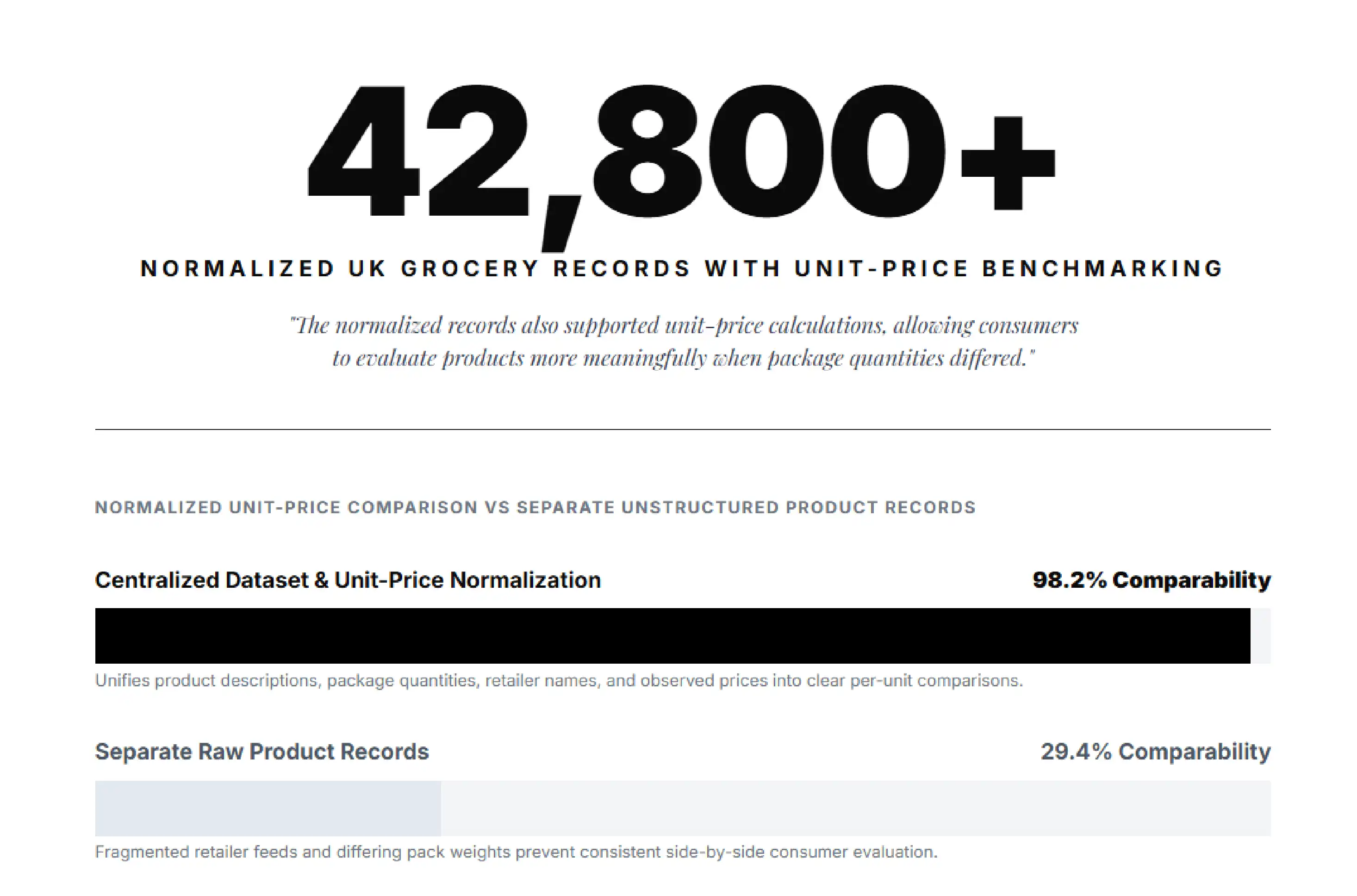
The implementation provided the client with a centralized view of grocery prices across selected UK supermarket sources. Previously, the application relied on separate product records that were difficult to compare consistently.
The structured dataset brought together product descriptions, package quantities, retailer names, and observed prices. This enabled the application to identify differences between equivalent products and display clearer comparisons.
The normalized records also supported unit-price calculations, allowing consumers to evaluate products more meaningfully when package quantities differed.
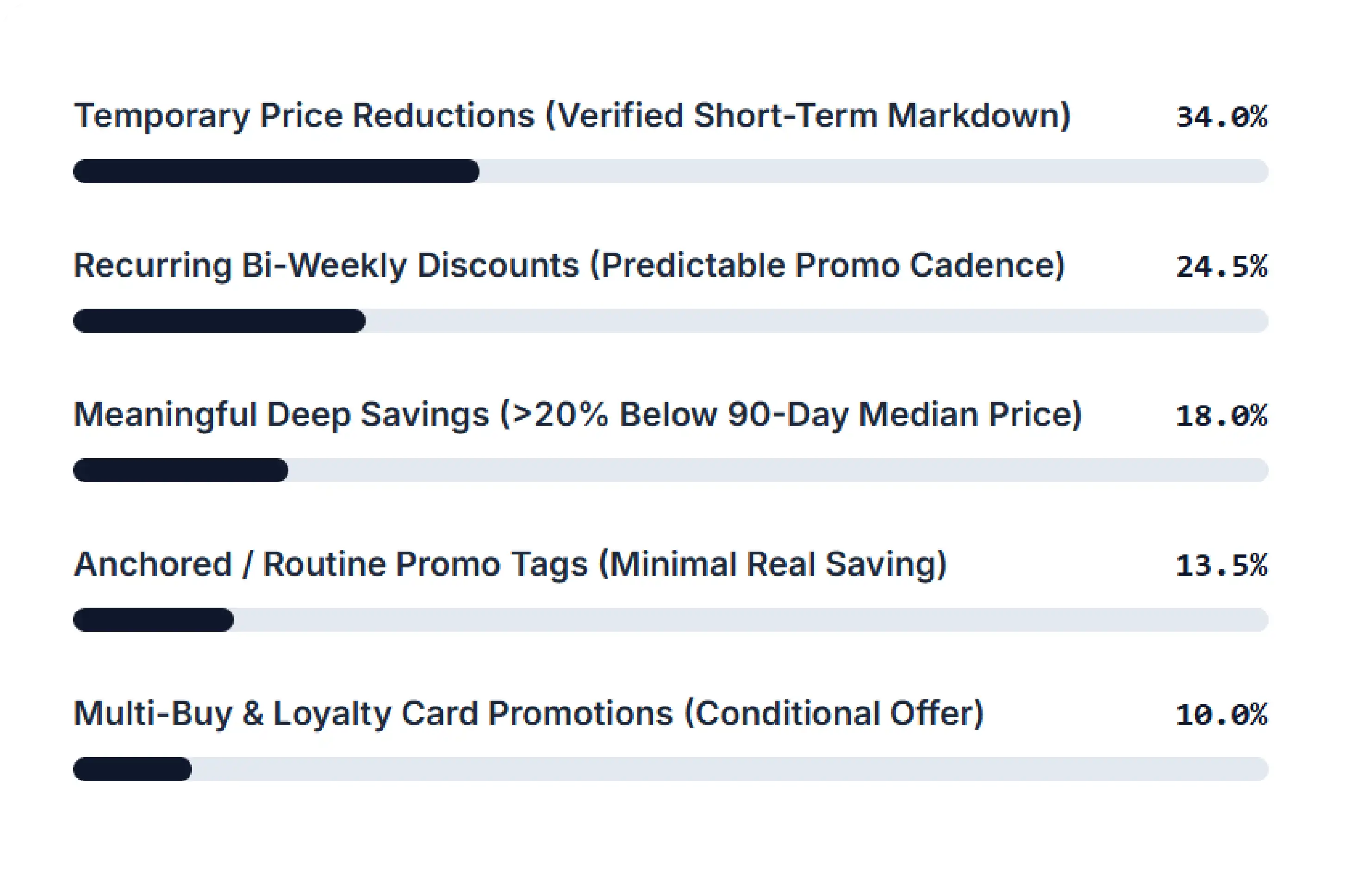
Automated monitoring improved the client's ability to distinguish standard prices from promotional offers. The system captured available discount information and associated it with the relevant product and retailer.
This helped the application identify products with temporary price reductions and compare promotional prices against other available supermarket listings.
Historical price observations also provided additional context for identifying recurring discounts and understanding whether a promotion represented a meaningful saving.
Product matching was an important component of the project because different retailers frequently used different product titles and descriptions.
The solution standardized brand names, package sizes, measurement units, and product categories. Available product identifiers were used to improve matching confidence, while ambiguous records were flagged for review.
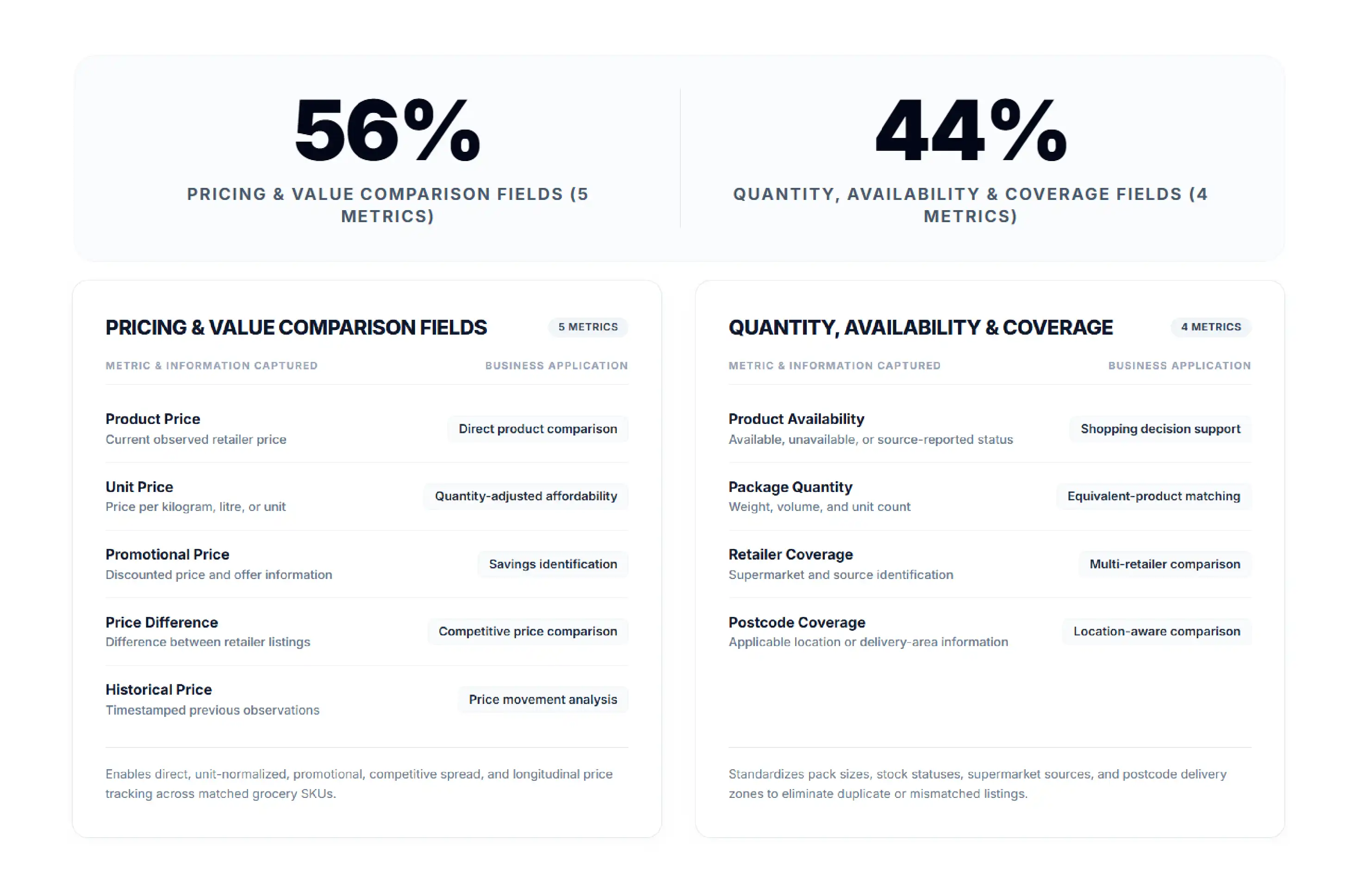
This process helped reduce duplicate product entries and supported more accurate comparisons between equivalent grocery items. Key analytical fields included product price, unit price, promotional price, price difference, product availability, package quantity, retailer coverage, historical price, and postcode coverage.
The following illustrative dataset demonstrates how product-level grocery information can be organized for a UK price-comparison application. It includes selected supermarket examples, product descriptions, package quantities, observed prices, and unit-price calculations.
Prices are representative sample values created to demonstrate the proposed data structure. They are not verified live supermarket quotations or claims about current retailer pricing.
| Retailer | Product Name | Category | Pack Size | Sample Price (£) | Unit Price (£/kg or litre) | Availability |
|---|---|---|---|---|---|---|
| Tesco | Semi-Skimmed Milk | Dairy | 2 Litres | 1.55 | 0.78/L | Available |
| Sainsbury's | Semi-Skimmed Milk | Dairy | 2 Litres | 1.60 | 0.80/L | Available |
| Asda | Semi-Skimmed Milk | Dairy | 2 Litres | 1.50 | 0.75/L | Available |
| Morrisons | Semi-Skimmed Milk | Dairy | 2 Litres | 1.58 | 0.79/L | Available |
| Tesco | White Bread | Bakery | 800g | 1.25 | 1.56/kg | Available |
| Sainsbury's | White Bread | Bakery | 800g | 1.30 | 1.63/kg | Available |
| Asda | White Bread | Bakery | 800g | 1.20 | 1.50/kg | Available |
| Morrisons | White Bread | Bakery | 800g | 1.28 | 1.60/kg | Available |
| Tesco | Bananas | Fresh Produce | 1kg | 1.10 | 1.10/kg | Available |
| Sainsbury's | Bananas | Fresh Produce | 1kg | 1.15 | 1.15/kg | Available |
| Asda | Bananas | Fresh Produce | 1kg | 1.05 | 1.05/kg | Available |
| Morrisons | Bananas | Fresh Produce | 1kg | 1.12 | 1.12/kg | Available |
| Tesco | Long Grain Rice | Pantry | 1kg | 1.65 | 1.65/kg | Available |
| Sainsbury's | Long Grain Rice | Pantry | 1kg | 1.75 | 1.75/kg | Available |
| Asda | Long Grain Rice | Pantry | 1kg | 1.60 | 1.60/kg | Available |
| Morrisons | Long Grain Rice | Pantry | 1kg | 1.70 | 1.70/kg | Available |
Note: Sample figures are illustrative and do not represent verified live supermarket quotations or claims about current retailer pricing.
The structured dataset enables the application to compare retailers, product names, categories, pack sizes, sample prices, unit prices, and availability across multiple UK supermarket sources.
Following the implementation of the structured grocery data collection and API infrastructure, the client achieved improvements in product visibility, pricing consistency, data delivery, and application readiness.
The following illustrative project outcomes demonstrate the value generated through the implementation:
iWeb Data Intelligence provides structured data collection and processing solutions that help businesses transform fragmented online information into reliable business intelligence. For grocery price-comparison applications, this means collecting product information from multiple supermarket sources and organizing it into consistent records that can support application development and analytical operations.
Automated Data Collection
Our approach emphasizes automated data collection, allowing businesses to monitor product prices, promotional information, availability, and catalogue changes without depending entirely on manual research. Scheduled extraction processes help maintain regular updates according to the requirements of individual retailers and business use cases.
Data Standardization
Another important advantage is data standardization. Grocery information often contains inconsistent product titles, package descriptions, measurement units, and pricing formats. Our processing framework normalizes these fields, helping businesses create comparable records and reduce inconsistencies across multiple sources.
Data Validation and Reliability
We also prioritize data validation and reliability. Automated checks identify duplicate listings, missing values, unusual price movements, and incomplete product attributes. These procedures help maintain a consistent data foundation for comparison applications, reporting systems, and advanced analytics.
"We wanted to build a reliable grocery price-comparison experience that would help consumers make better shopping decisions. However, collecting consistent product information from multiple supermarkets was becoming increasingly challenging. iWeb Data Intelligence helped us establish a structured data collection and API delivery framework that significantly improved our product visibility and operational efficiency. The standardized records, product matching procedures, and automated updates helped us improve the consistency of our comparisons. We also gained better visibility into promotional changes, product availability, and retailer-level pricing differences. The team's technical approach and understanding of grocery data requirements made the implementation valuable for our application development plans. We now have a more scalable data foundation that supports our existing comparison features and future product expansion."
— Product and Technology Director
The project delivered a structured and scalable grocery price intelligence infrastructure that transformed fragmented supermarket information into standardized, application-ready datasets. The client gained a more reliable foundation for comparing products, identifying promotional opportunities, and supporting consumer shopping decisions across selected UK retailers.
Implementation of web scraping API capabilities enabled automated collection of grocery product information from accessible retailer sources. The solution supported structured extraction of product names, brands, categories, package sizes, regular prices, promotional prices, availability, and relevant location attributes.
The API integration framework also improved the distribution of validated information to the client's comparison application. Standardized records supported product search, retailer filtering, unit-price calculations, and shopping basket comparisons.
The project further strengthened price and promotion monitoring by creating a framework for tracking observed price changes, discount information, and historical product records. This helped the application provide more useful comparisons and supported the development of additional grocery intelligence features.
A UK grocery price API is a structured data delivery interface that provides product-level supermarket information, including product names, prices, brands, categories, package sizes, promotional details, and availability. It helps comparison applications integrate grocery information into their platforms and support consumer price discovery.
Depending on source accessibility and project requirements, data can be collected from retailers such as Tesco, Sainsbury's, Asda, Morrisons, Aldi, Lidl, Waitrose, and other grocery providers. Available information may include product details, observed prices, promotional offers, package quantities, and availability.
Yes, location-specific monitoring can be implemented wherever retailer sources expose postcode-dependent prices or delivery-area information. The solution can organize available location attributes with product records to support more relevant regional comparisons and avoid combining incompatible pricing observations.
Product matching identifies equivalent grocery items across different supermarkets using product identifiers, brand names, descriptions, categories, and package quantities. Standardization and unit-price calculations help applications compare products more accurately and reduce misleading comparisons caused by differences in packaging or product variants.
Yes. Timestamped product observations can be maintained to create historical price records. These records help businesses analyze price movements, identify recurring promotional patterns, compare retailer pricing strategies, and develop additional consumer features such as price alerts and historical price comparisons.
iWeb Data Intelligence helps businesses collect, standardize, validate, and integrate supermarket product information through scalable data extraction and API solutions. Transform fragmented grocery pricing information into structured intelligence that supports better product comparisons, improved promotional visibility, and more informed consumer shopping decisions.
Start a projectFields marked * are required. Everything else just helps us scope faster — skip what you don't know yet.