

Introduction
The U.S. grocery industry has become increasingly competitive as consumers seek better prices, personalized offers, and convenient shopping experiences. Mobile applications that compare grocery prices across major retailers have emerged as valuable tools for both shoppers and businesses. By leveraging US App Compared Grocery Prices Across Walmart, Kroger & Publix, organizations can create intelligent price comparison platforms that empower consumers to make informed purchasing decisions. These solutions rely on technologies that Scrape Walmart, Kroger & Publix grocery Pricing data to provide accurate, up-to-date product pricing, while US supermarket market intelligence helps businesses understand competitive pricing strategies, regional demand, promotional trends, and customer preferences.
The Growing Demand for Grocery Price Comparison Apps
Consumers no longer want to visit multiple stores or browse several retailer websites before completing their grocery shopping. They expect instant access to price comparisons that help them identify the most affordable retailer for every item on their shopping list.
This shift has encouraged retailers, startups, and technology companies to develop grocery comparison applications capable of aggregating prices from multiple supermarket chains. These platforms simplify shopping by presenting current prices, discounts, product availability, and promotional offers in a single interface.
Businesses also benefit from these applications because they gain continuous visibility into market pricing and consumer purchasing trends, allowing them to adjust strategies more efficiently.
Why Walmart, Kroger, and Publix Are Ideal for Comparison?
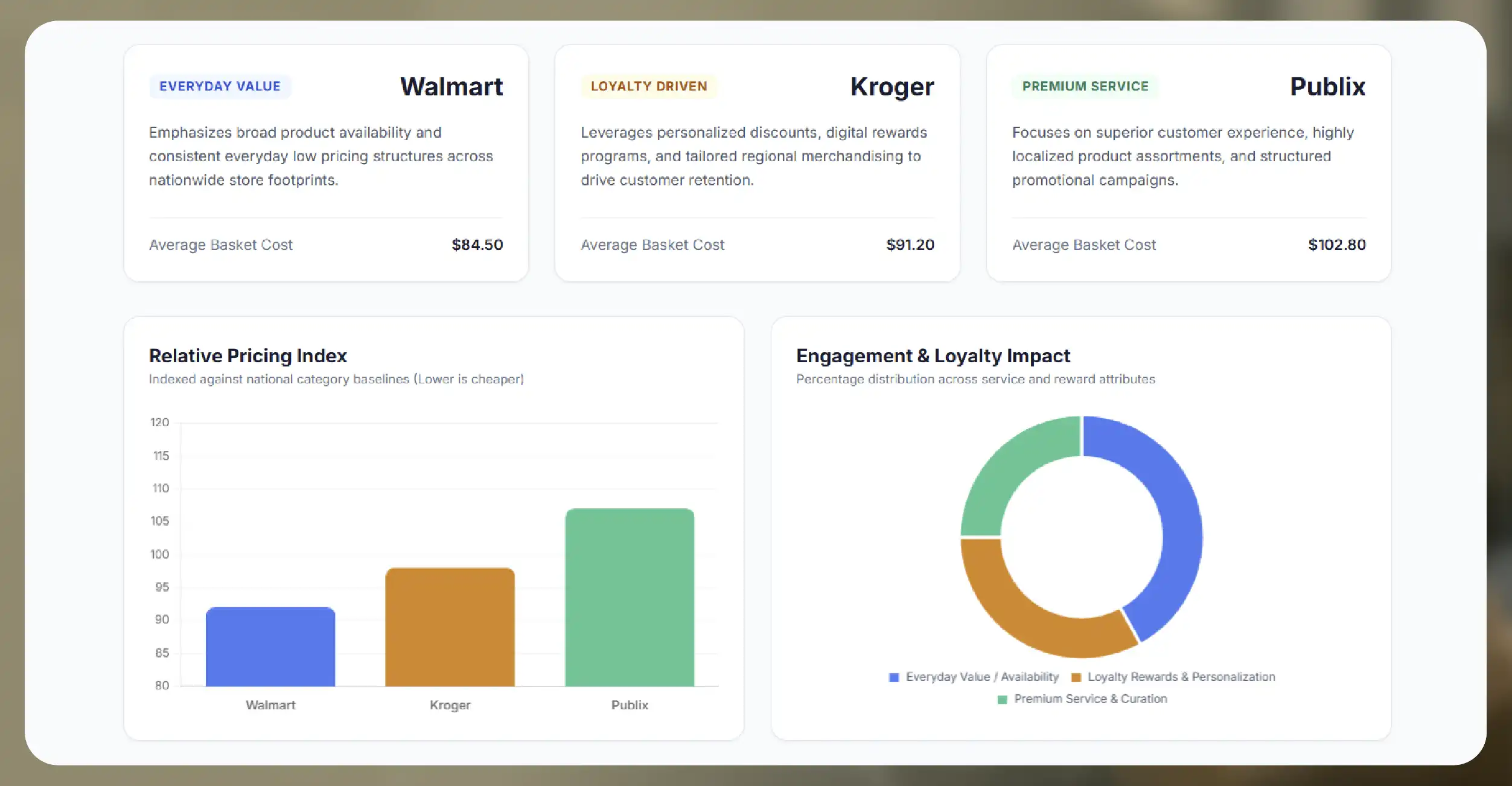
These three supermarket chains represent different pricing models within the American grocery landscape.
Walmart is recognized for its everyday low pricing strategy and nationwide product availability.
Kroger focuses heavily on loyalty rewards, personalized discounts, and regional merchandising strategies.
Publix serves customers through premium service, localized assortments, and carefully planned promotional campaigns throughout the southeastern United States.
Comparing these retailers provides a balanced understanding of grocery pricing across different retail business models while offering shoppers broader purchasing options.
Essential Grocery Data Used for Price Comparison
An effective grocery comparison platform depends on collecting structured product information from multiple retailers.
Typical datasets include product names, SKU numbers, UPC codes, brands, package sizes, unit measurements, categories, regular prices, discounted prices, promotional offers, loyalty discounts, inventory availability, delivery options, pickup availability, nutritional information, product descriptions, customer ratings, product images, retailer locations, timestamps, and historical pricing records.
When standardized properly, these datasets enable accurate product matching between retailers.
How Grocery Comparison Platforms Operate?
The process begins with automated data collection from multiple supermarket websites and applications.
After gathering information, advanced algorithms clean, organize, and normalize product data by matching identical products despite differences in naming conventions or packaging descriptions.
The system compares regular pricing, promotional discounts, digital coupons, loyalty rewards, unit pricing, delivery charges, pickup fees, and bundle offers before displaying the lowest available price to shoppers.
Real-time updates ensure customers always receive current pricing information before making purchasing decisions.
Benefits for Modern Consumers
Price comparison applications provide significant value by helping shoppers reduce grocery expenses without sacrificing convenience.
Instead of manually checking prices at multiple stores, consumers receive immediate access to the most affordable shopping options available.
Additional benefits include improved budget planning, promotion alerts, digital shopping lists, personalized recommendations, historical price tracking, regional price comparisons, and simplified meal planning.
These capabilities encourage smarter purchasing decisions while increasing customer satisfaction.
Business Advantages of Grocery Price Intelligence
Retailers, manufacturers, distributors, and market research firms all benefit from continuous grocery pricing intelligence.
Accurate pricing data supports competitive benchmarking, promotion analysis, inventory planning, assortment optimization, demand forecasting, dynamic pricing strategies, category management, private-label performance evaluation, customer behavior analysis, and digital shelf monitoring.
Organizations can identify emerging market trends much faster than relying solely on manual research methods.
Understanding Regional Grocery Pricing
Grocery prices often vary significantly between cities, states, and neighborhoods.
Transportation expenses, supplier agreements, warehouse locations, seasonal demand, regional competition, labor costs, and local purchasing behavior all contribute to pricing differences.
Continuous monitoring enables businesses to understand how these variables affect pricing across different markets and develop more effective regional strategies.
Retail analysts increasingly rely on Walmart price monitoring to identify pricing trends, promotional timing, and category-level pricing movements that influence competitors throughout the U.S. grocery market.
Monitoring Competitor Pricing More Effectively
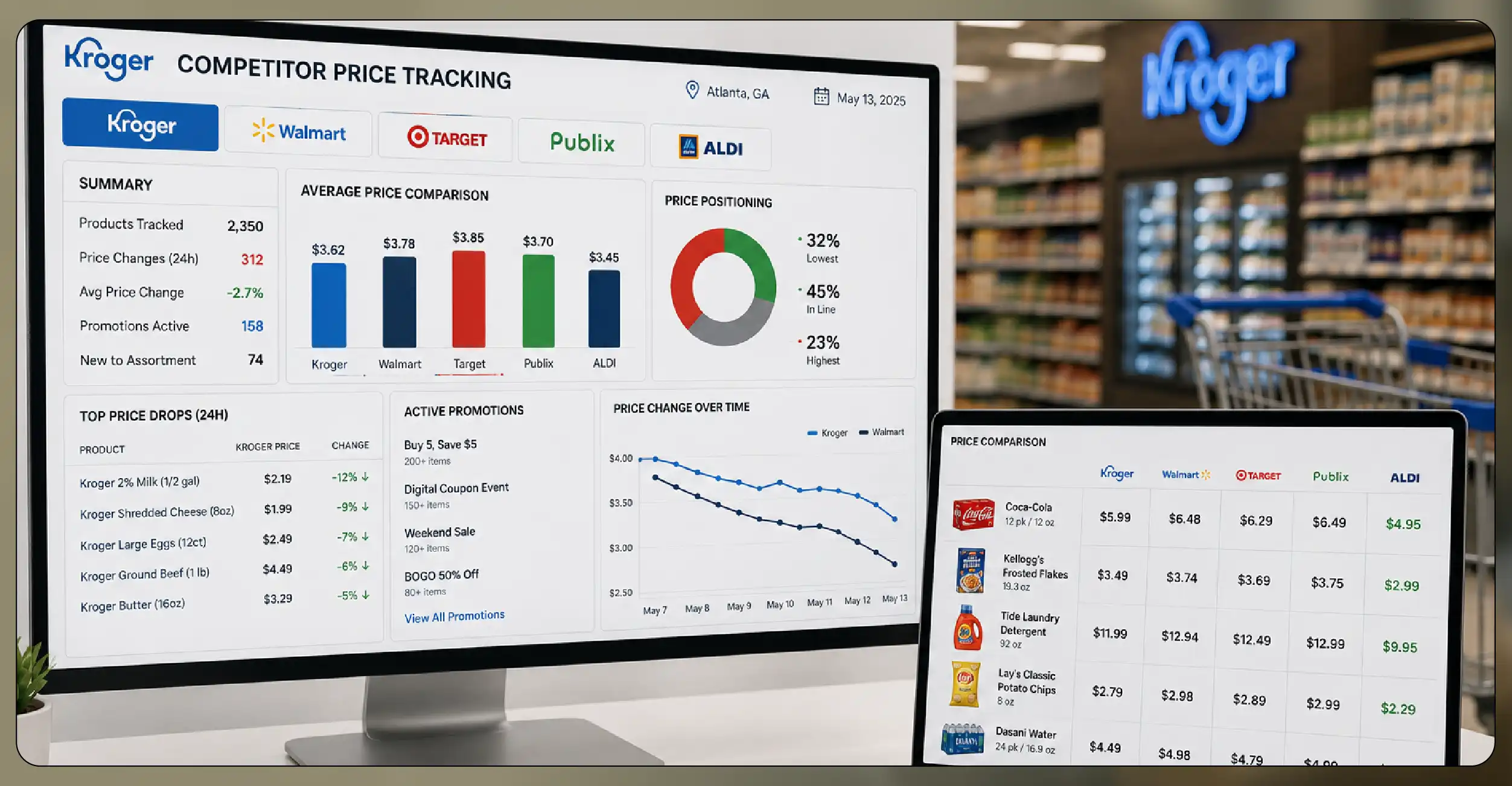
Successful retailers continuously observe competitors to remain competitive in rapidly changing markets.
Regular analysis of grocery pricing reveals how discounts evolve, when promotions begin, which products experience the greatest price fluctuations, and how customer demand affects pricing decisions.
Businesses also gain insight into seasonal campaigns, holiday promotions, private-label strategies, and product assortment changes.
Many organizations improve their competitive analysis through Kroger price tracking in US, enabling them to evaluate loyalty pricing, digital coupons, regional promotions, and personalized discount strategies more effectively.
Improving Market Intelligence Through Retail Data
High-quality retail data provides far more than simple product prices.
Organizations can analyze assortment expansion, discontinued products, promotional frequency, inventory changes, customer preferences, and category growth patterns.
These insights support strategic planning while reducing uncertainty in competitive markets.
Companies seeking regional retail intelligence frequently invest in Publix grocery data scraping to understand localized pricing strategies, premium product positioning, and changing consumer purchasing patterns across southeastern markets.
The Role of Artificial Intelligence in Grocery Analytics
Artificial intelligence has dramatically improved grocery comparison technology.
Machine learning models automatically recognize equivalent products even when retailers use different naming conventions.
For example, one retailer may list "Organic Whole Milk One Gallon" while another displays "128 oz Organic Whole Milk." AI algorithms identify both listings as identical products and calculate accurate unit price comparisons.
This technology significantly improves comparison accuracy while reducing manual intervention.
Transforming Retail Data into Actionable Intelligence
Modern grocery analytics platforms combine historical pricing with live market information to generate predictive insights.
Businesses can identify pricing opportunities before competitors react, evaluate promotional performance, forecast seasonal demand, and optimize inventory planning using continuously updated datasets.
Organizations increasingly depend on supermarket competitor price intelligence In USA to strengthen pricing decisions, benchmark promotional effectiveness, and improve competitive positioning across thousands of grocery products.
Real-Time Data Integration for Modern Applications
Today's mobile applications require fresh information delivered with minimal delay.
Businesses integrate automated retail datasets into shopping applications, analytics dashboards, recommendation engines, business intelligence systems, and forecasting platforms.
Many organizations Extract real-time US grocery market data API to provide continuously updated grocery prices, product availability, and promotional information directly within their applications.
This approach enhances user experience while ensuring accurate decision-making.
The Importance of Standardized Grocery Datasets
Raw grocery data often contains inconsistent naming conventions, varying package sizes, duplicate products, and different measurement units.
Data standardization resolves these issues by matching brands, normalizing weights, converting units, mapping categories, validating product identifiers, and removing duplicate records.
Businesses benefit from cleaner datasets that support more accurate pricing analysis and improved reporting.
Reliable Kroger Grocery Datasets allow retailers, brands, and analytics companies to evaluate pricing trends, promotional campaigns, product assortment, and regional demand with greater confidence.
Similarly, comprehensive Publix Grocery Datasets provide valuable insights into premium grocery pricing, localized assortments, inventory changes, and seasonal promotional strategies that help businesses strengthen regional market analysis.
Meanwhile, detailed Walmart Grocery Datasets enable organizations to monitor nationwide pricing movements, product availability, assortment expansion, customer demand, and competitive positioning across thousands of grocery categories.
How iWeb Data Scraping Can Help You?
Comprehensive Retail Data Collection
Our specialists collect structured grocery information from multiple retailers, delivering accurate datasets containing pricing, promotions, inventory status, product specifications, and category insights that support informed business decisions and long-term market analysis.
Real-Time Price Monitoring
Our automated systems capture pricing changes throughout the day, helping businesses respond quickly to competitor activities, promotional campaigns, seasonal demand, and changing customer purchasing behavior across diverse grocery categories.
Clean and Standardized Data
We normalize product names, brands, package sizes, categories, and identifiers while removing duplicate records, enabling highly accurate comparisons across multiple supermarket platforms for consistent reporting and reliable analytics.
Flexible Integration Solutions
Our data delivery supports APIs, dashboards, cloud platforms, enterprise systems, analytics software, and custom reporting tools, allowing businesses to integrate grocery intelligence seamlessly into existing operational workflows.
Scalable Enterprise Intelligence
Whether monitoring thousands or millions of grocery products, our scalable infrastructure delivers reliable updates, historical pricing, customized reporting, and enterprise-ready datasets designed to support business growth and competitive intelligence.
Conclusion
As grocery competition continues to evolve, businesses require accurate, timely, and comprehensive retail intelligence to remain competitive. Advanced grocery comparison platforms provide shoppers with better purchasing decisions while enabling organizations to strengthen pricing strategies, monitor competitors, and forecast market trends.
Our Web Scraping API Services empower organizations with automated, scalable, and real-time retail intelligence for smarter decision-making. Combined with comprehensive Grocery and Supermarket Store Datasets, businesses gain structured information that supports pricing optimization, demand forecasting, and competitive benchmarking. Our Grocery & Supermarket Data Extraction Services transform complex grocery information into actionable insights, helping retailers, brands, and technology companies succeed in today's dynamic U.S. grocery market.
FAQs
They help consumers compare prices across multiple supermarkets instantly, reducing shopping costs while saving time and improving purchasing decisions.
They typically contain product names, brands, SKUs, UPCs, prices, promotions, inventory status, categories, package sizes, product images, ratings, and availability.
Real-time or multiple daily updates are ideal for capturing pricing changes, promotional campaigns, inventory fluctuations, and seasonal trends accurately.
Retailers, CPG brands, pricing analysts, market research firms, e-commerce platforms, grocery comparison apps, and technology companies all benefit from accurate grocery data.
Automated data collection ensures timely, accurate, and scalable pricing intelligence, enabling businesses to monitor competitors, optimize pricing strategies, and make data-driven decisions efficiently.