
58.9M+
TOTAL GROCERY PRICE RECORDS PROCESSED

US Grocery Pricing Data for AI Meal-Planning Apps Delivering Real-Time Price Intelligence, Smarter Recommendations, and Shopping Optimization.
This case study is based on a real-world enterprise implementation where an AI-powered meal-planning platform partnered with iWeb Data Intelligence to automate grocery price collection, promotion monitoring, inventory tracking, and product availability across major US supermarket chains. The objective was to build a scalable retail intelligence platform capable of continuously updating grocery prices, enabling personalized meal recommendations with accurate shopping costs and real-time retailer availability.
It is designed for:
The client's core challenge was maintaining accurate grocery pricing information across hundreds of retailers where prices, discounts, product availability, and promotional campaigns changed continuously throughout the day. Manual monitoring could not support millions of products, causing AI-generated shopping lists to become outdated quickly. This reduced customer confidence, increased shopping cart abandonment, and limited the effectiveness of personalized meal recommendations.
A leading AI meal-planning company partnered with iWeb Data Intelligence to automate grocery pricing intelligence across the United States. The primary objective was to collect accurate US grocery chains pricing data from leading supermarket retailers while maintaining real-time synchronization of promotions, inventory, and product availability.
Traditional retailer monitoring methods proved insufficient due to the rapid pace of pricing updates and promotional changes across grocery websites and mobile applications. To overcome these limitations, iWeb implemented automated multi-retailer grocery pricing intelligence pipelines capable of continuously monitoring product catalogs, promotions, inventory levels, and assortment changes.
The platform collected millions of product records daily from national grocery chains, regional supermarkets, warehouse clubs, and online grocery marketplaces. Advanced normalization algorithms standardized retailer-specific product names, categories, package sizes, nutritional attributes, and pricing structures into a unified database suitable for AI-powered recommendation engines.
Automated validation processes ensured pricing consistency, eliminated duplicate products, identified retailer-specific promotions, and continuously monitored inventory availability. Real-time dashboards enabled product managers, analysts, and AI engineers to visualize pricing movements, retailer competitiveness, promotional trends, and category performance.
The solution significantly improved recommendation accuracy by ensuring AI-generated meal plans always reflected current grocery prices and product availability. Customers received realistic shopping baskets based on preferred retailers, dietary preferences, and regional pricing, resulting in higher user engagement, improved shopping confidence, and increased conversion rates.
The client operated one of the fastest-growing AI meal-planning platforms in North America, serving consumers who relied on accurate grocery pricing to generate affordable weekly meal plans. As the platform expanded nationally, maintaining current pricing information across multiple grocery retailers became increasingly difficult.
The biggest challenge involved maintaining a consistent grocery product feed with pricing and availability across hundreds of grocery retailers. Product prices changed multiple times daily due to promotions, localized discounts, loyalty pricing, and inventory fluctuations. Manual updates quickly became obsolete, causing inaccurate shopping recommendations and inconsistent budgeting calculations.
The organization also required automated systems capable to Scrape US grocery pricing API integrations that continuously synchronized retailer pricing into the AI recommendation platform. Existing data sources lacked consistency, while retailer APIs varied significantly in structure, update frequency, and product coverage.
The client ultimately required a fully automated grocery intelligence platform capable of collecting retailer pricing continuously while ensuring high-quality structured datasets for machine learning, customer recommendations, and retail analytics.
After implementing an automated grocery intelligence platform, the client replaced fragmented manual monitoring with scalable data collection capable of continuously synchronizing grocery pricing across major US retailers.
| Dimension | Manual Grocery Monitoring | Automated Grocery Intelligence Platform |
|---|---|---|
| Data Collection | Individual retailer checks | Automated nationwide retailer monitoring |
| Price Updates | Once every 24 hours | Continuous price synchronization |
| Promotion Tracking | Manual identification | Automatic coupon & promotion detection |
| Product Matching | Manual comparison | AI-assisted product normalization |
| Inventory Monitoring | Periodic retailer visits | Near real-time availability tracking |
| Category Coverage | Limited grocery categories | Complete multi-category coverage |
| Data Validation | Spreadsheet verification | Automated validation pipelines |
| Retail Coverage | 8–12 retailers | 145+ grocery retailers |
| Decision Speed | Several hours | Live analytics dashboards |
| Scalability | Resource intensive | Cloud-native enterprise architecture |
The organization featured in this case study is an AI-powered meal-planning and grocery recommendation platform serving millions of consumers across the United States. Its technology combines nutritional intelligence, recipe personalization, grocery budgeting, and retailer-specific pricing to generate customized weekly shopping plans tailored to individual dietary preferences.
As customer adoption accelerated, the company expanded partnerships with national supermarket chains, regional grocery stores, warehouse retailers, and online grocery marketplaces. This rapid expansion significantly increased the complexity of maintaining accurate grocery pricing information across diverse retailer ecosystems.
Each retailer updated product prices independently through promotional campaigns, loyalty discounts, regional pricing strategies, seasonal inventory adjustments, and supply chain changes. These continuous pricing fluctuations reduced the accuracy of AI-generated shopping recommendations whenever outdated pricing information remained within the recommendation engine.
The organization required a scalable retail intelligence solution capable of monitoring grocery prices continuously while standardizing retailer-specific product catalogs into a unified data model. Product normalization, promotion detection, inventory monitoring, and pricing validation became essential components of the company's AI recommendation infrastructure.
We delivered a comprehensive grocery intelligence platform that continuously collected pricing, promotions, assortment updates, inventory availability, and product metadata from leading US grocery retailers. The solution was designed specifically to support AI-powered meal-planning applications that depend on accurate and frequently updated grocery information to generate reliable shopping recommendations.
The implementation combined website extraction, automated catalog monitoring, product normalization, promotion detection, and cloud-based analytics into a single scalable architecture capable of processing millions of grocery records every day.
To maximize retailer coverage, our engineers integrated advanced Mobile app scraping techniques alongside website data extraction. This enabled continuous monitoring of retailer-exclusive pricing, loyalty discounts, digital coupons, product rankings, inventory availability, and app-only promotional campaigns that are often unavailable through traditional websites. Combining website and mobile application intelligence ensured the client received the most complete and accurate grocery dataset possible.
The collected product information passed through multiple automated validation stages where duplicate listings were removed, inconsistent product names were standardized, package sizes were normalized, and pricing anomalies were automatically flagged for verification. Product catalogs from different retailers were matched using intelligent product mapping algorithms, creating a unified grocery database suitable for AI recommendation engines.
The platform also incorporated AI visibility monitoring to understand how grocery products appeared within retailer search results, recommendation modules, sponsored placements, and category listings. This enabled the client to evaluate product discoverability, identify ranking fluctuations, monitor sponsored promotions, and understand how pricing influenced product visibility across different retailer platforms.
Before implementing the automated intelligence platform, the client's recommendation engine relied on scheduled pricing updates performed once or twice daily. Because grocery retailers frequently updated prices throughout the day, shopping recommendations often reflected outdated pricing information, reducing customer confidence and negatively affecting conversion rates.
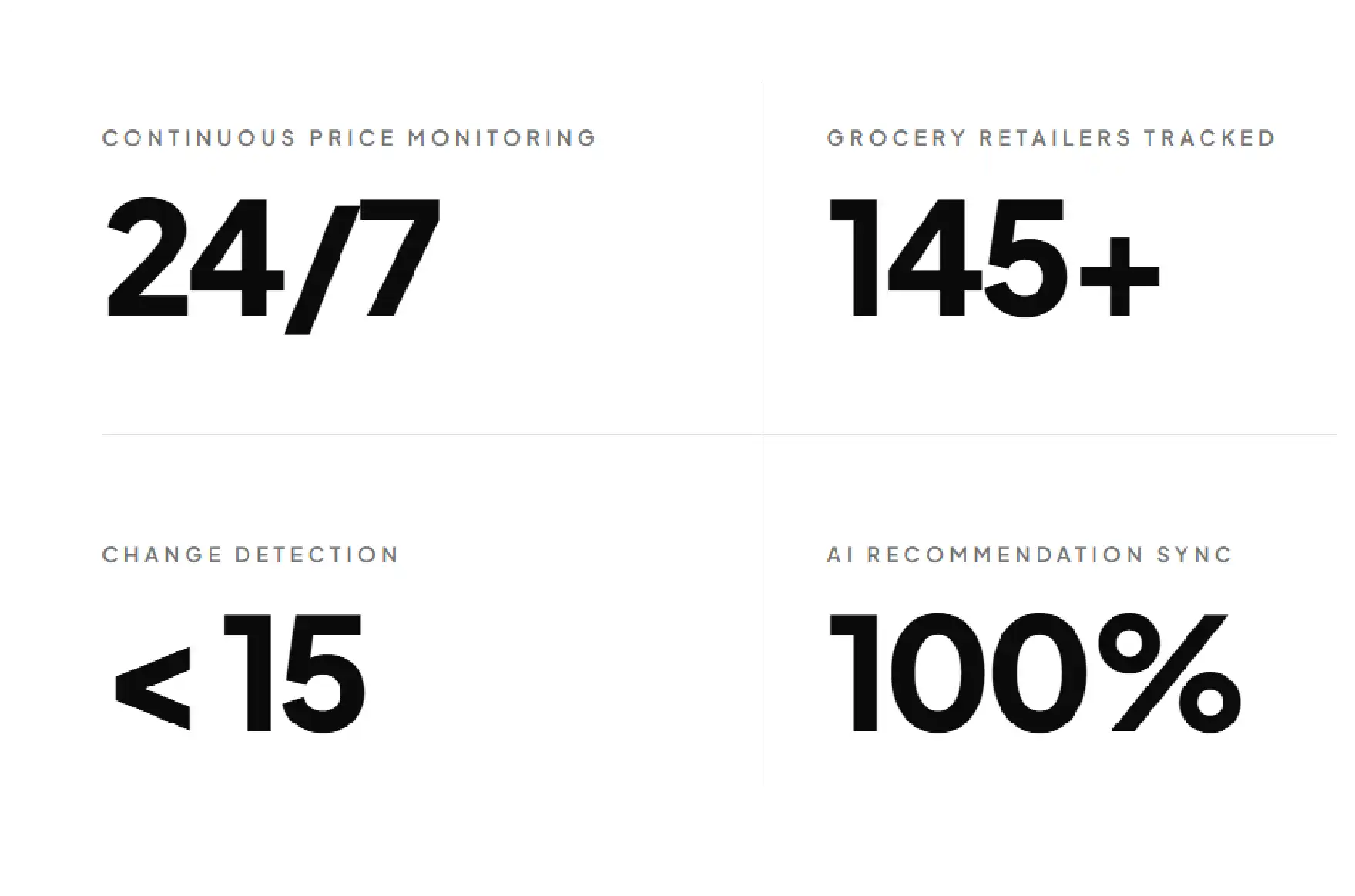
Following deployment, the grocery intelligence platform continuously monitored pricing across more than 145 grocery retailers nationwide. Every detected pricing change was automatically captured, validated, and synchronized into the AI recommendation engine without requiring manual intervention.
The continuous monitoring system provided immediate visibility into retail price fluctuations caused by promotional campaigns, supplier cost adjustments, regional pricing strategies, seasonal demand, and inventory changes.
Rather than discovering pricing discrepancies after customers reported them, the client could now identify changes within minutes of retailer updates. This significantly improved recommendation accuracy while allowing AI-generated shopping baskets to remain aligned with current grocery prices.
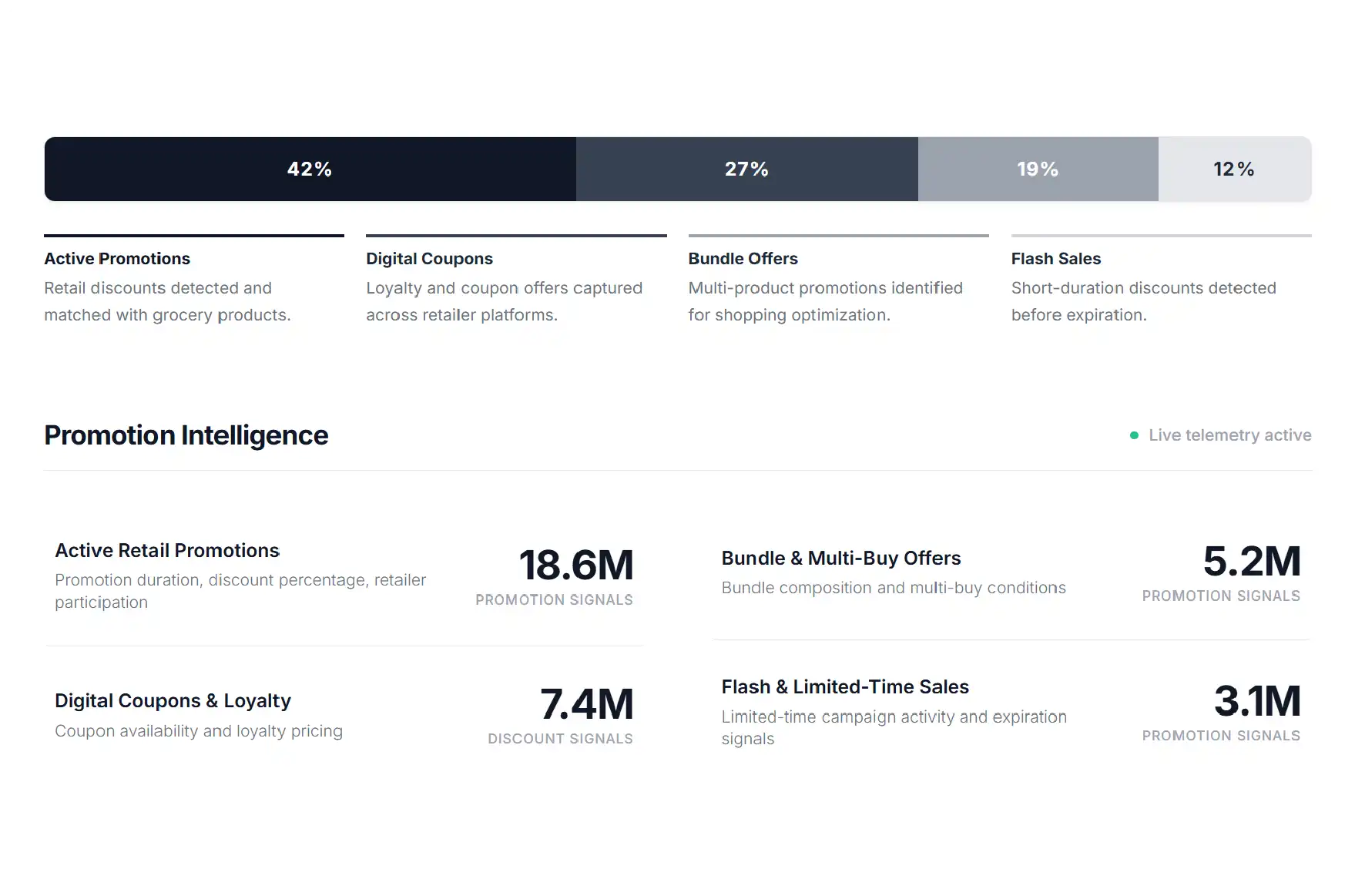
One of the biggest limitations of manual grocery monitoring involved identifying retailer promotions before they expired. Many grocery chains introduced digital coupons, loyalty discounts, bundle offers, and flash sales that remained active only for limited periods.
The automated intelligence platform continuously monitored promotional activities across retailer websites and mobile applications. Every detected promotion was automatically linked with corresponding grocery products, allowing AI recommendation engines to include discounted products when generating personalized meal plans.
Instead of recommending the lowest-priced product based only on standard retail pricing, the AI platform could intelligently recommend products benefiting from active promotions, helping customers maximize grocery savings.
The system continuously evaluated promotion effectiveness by tracking discount percentages, coupon availability, promotional duration, retailer participation, and category-specific campaign activity.
As promotional datasets expanded, machine learning models identified recurring seasonal campaigns and retailer-specific discount patterns. This allowed analysts to anticipate future promotional periods and optimize recommendation strategies accordingly.
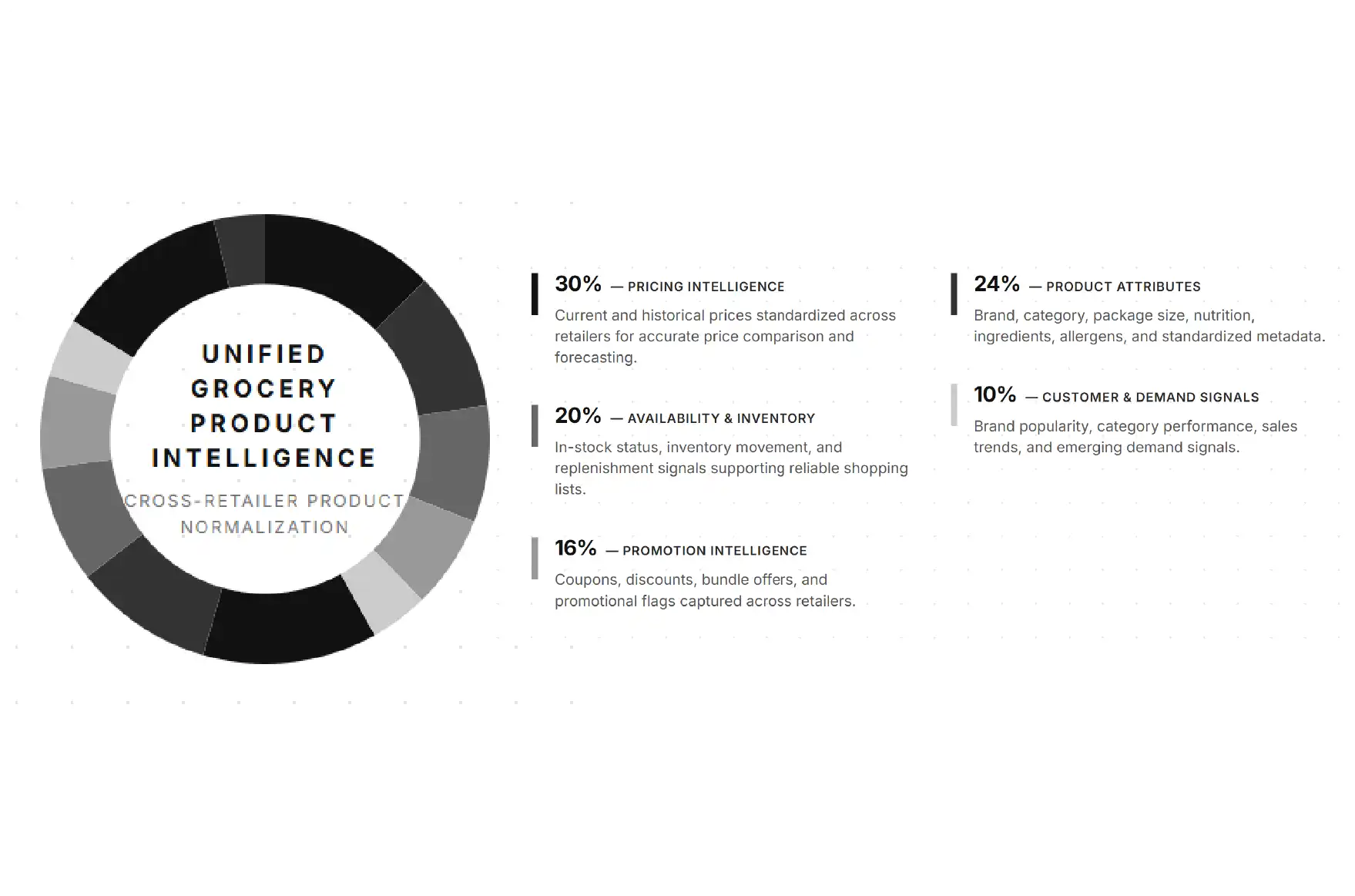
A major technical challenge involved matching identical grocery products sold under different retailer naming conventions. National brands often appeared with different package descriptions, abbreviations, unit measurements, and product titles depending on the retailer.
To overcome this challenge, intelligent normalization algorithms transformed retailer-specific product listings into standardized product records.
Each grocery item was enriched with structured metadata including product category, package size, nutritional information, brand, retailer identifier, inventory status, promotional flags, pricing history, and update timestamps.
This standardized product intelligence significantly improved recommendation quality while reducing duplicate product listings throughout the platform.
The structured datasets also supported advanced machine learning applications including grocery demand forecasting, pricing prediction, customer segmentation, and personalized shopping optimization.
| Metric | Intelligence Captured | Business Benefit |
|---|---|---|
| Current Price | Live retailer pricing | Accurate shopping recommendations |
| Historical Price | 365-day price history | Price trend forecasting |
| Promotion Status | Coupons, discounts, bundle offers | Lower grocery costs |
| Product Availability | In-stock / Out-of-stock | Reliable shopping lists |
| Category Performance | Sales trend indicators | Better assortment planning |
| Inventory Movement | Stock replenishment frequency | Improved recommendation accuracy |
| Brand Popularity | Customer demand signals | Enhanced AI personalization |
| Nutrition Metadata | Calories, ingredients, allergens | Personalized meal planning |
| Package Standardization | Unit normalization | Accurate price comparison |
| Retail Coverage | National & regional chains | Wider customer choice |
| Update Frequency | Live synchronization | Near real-time intelligence |
| Product Matching Accuracy | Cross-retailer identification | Reduced duplicate listings |
The dataset below illustrates how the automated grocery intelligence platform continuously collected pricing, promotions, availability, and inventory data from leading US grocery retailers. The structured dataset enabled AI meal-planning applications to recommend the most cost-effective shopping basket based on live pricing, product availability, and retailer preferences.
| Retailer | Product Name | Category | Package Size | Regular Price | Sale Price | Availability | Promotion | Last Updated |
|---|---|---|---|---|---|---|---|---|
| Walmart | Great Value Whole Milk | Dairy | 1 Gallon | $4.28 | $3.98 | In Stock | Rollback | 09:05 AM |
| Kroger | Simple Truth Organic Eggs | Dairy | 12 Count | $5.49 | $4.99 | In Stock | Digital Coupon | 09:12 AM |
| Target | Good & Gather Bananas | Produce | 2 lb | $1.68 | $1.49 | In Stock | Weekly Deal | 09:18 AM |
| Safeway | Signature Bread | Bakery | 20 oz | $3.99 | $3.49 | In Stock | Club Price | 09:25 AM |
| Albertsons | Chicken Breast Boneless | Meat | 1 lb | $7.49 | $6.29 | Limited Stock | Member Savings | 09:31 AM |
| Publix | Fresh Strawberries | Produce | 16 oz | $4.99 | $3.99 | In Stock | Buy One Get One | 09:42 AM |
| Whole Foods Market | Organic Avocados | Produce | Pack of 4 | $6.99 | $5.99 | In Stock | Prime Discount | 09:55 AM |
| H-E-B | H-E-B Greek Yogurt | Dairy | 32 oz | $5.79 | $5.29 | In Stock | Weekly Savings | 10:03 AM |
| Meijer | Ground Turkey | Meat | 1 lb | $6.19 | $5.49 | In Stock | mPerks Offer | 10:11 AM |
| Aldi | Friendly Farms Butter | Dairy | 16 oz | $4.39 | $4.09 | In Stock | Seasonal Offer | 10:18 AM |
| Food Lion | White Rice | Pantry | 5 lb | $5.99 | $5.49 | In Stock | MVP Discount | 10:26 AM |
| Wegmans | Atlantic Salmon Fillet | Seafood | 1 lb | $13.99 | $12.49 | In Stock | Weekend Sale | 10:34 AM |
| Hy-Vee | Frozen Mixed Vegetables | Frozen | 32 oz | $3.89 | $3.39 | In Stock | Weekly Promotion | 10:41 AM |
| Giant Eagle | Extra Virgin Olive Oil | Pantry | 1 L | $12.99 | $10.99 | In Stock | Advantage Card | 10:49 AM |
| Stop & Shop | Cheddar Cheese | Dairy | 8 oz | $4.79 | $3.99 | In Stock | Digital Coupon | 10:56 AM |
| Costco | Rotisserie Chicken | Prepared Food | Each | $4.99 | $4.99 | In Stock | Everyday Price | 11:04 AM |
Following deployment of the automated grocery pricing intelligence platform, the client achieved measurable improvements across AI recommendation quality, operational efficiency, customer engagement, and retail analytics.
Our grocery intelligence solutions help organizations transform fragmented retailer information into standardized, analytics-ready datasets that support AI-powered recommendation engines, pricing optimization, and advanced retail analytics.
We continuously monitor grocery pricing, promotions, assortment changes, inventory availability, product metadata, and retailer performance across hundreds of supermarket chains using scalable cloud infrastructure capable of processing millions of records daily.
Advanced validation pipelines remove duplicate products, normalize retailer catalogs, standardize package sizes, and verify pricing accuracy before structured datasets are delivered to downstream analytics platforms.
Our intelligent product matching algorithms identify equivalent products across multiple retailers, enabling reliable price comparisons even when naming conventions differ significantly between grocery chains.
Real-time dashboards provide complete visibility into pricing trends, promotional activity, inventory movement, category performance, seasonal demand, and retailer competitiveness, helping organizations make faster and more informed business decisions.
Designed for enterprise scalability, our platform supports continuous monitoring across expanding retailer ecosystems while maintaining high processing performance, exceptional data quality, and reliable synchronization for AI-driven applications.
"Partnering with iWeb Data Intelligence has significantly enhanced the performance of our AI meal-planning platform. Their automated grocery pricing solution delivers highly accurate pricing, inventory, and promotional data from hundreds of retailers every day. The quality and consistency of the structured datasets have substantially improved our recommendation engine while reducing manual data preparation efforts. Our customers now receive more reliable shopping lists, accurate grocery budgets, and better retailer recommendations. The scalability, responsiveness, and technical expertise demonstrated throughout the project have exceeded our expectations and positioned us for continued growth across the US grocery market."
— Director of Product & Data Intelligence
The completed implementation delivered a fully automated grocery pricing intelligence ecosystem capable of continuously collecting product pricing, inventory availability, promotions, assortment changes, and retailer metadata from major grocery chains across the United States.
Deployment of Price Monitoring Services enabled continuous synchronization of retailer pricing, allowing AI meal-planning algorithms to generate highly accurate grocery recommendations based on live market conditions rather than outdated product information.
Integration of Web Scraping API Services ensured reliable, scalable, and automated collection of grocery pricing data from multiple retailer websites and mobile platforms while maintaining enterprise-grade accuracy, validation, and processing performance.
The solution was further strengthened through enterprise Web Scraping Services, providing cloud-native infrastructure capable of processing millions of grocery records every day while supporting future retailer expansion without compromising performance or data quality.
As a result, the client significantly improved recommendation accuracy, enhanced customer satisfaction, reduced operational costs, accelerated decision-making, and established a scalable foundation for future AI-powered grocery intelligence initiatives.
AI meal-planning applications depend on current grocery prices to generate realistic shopping lists, optimize weekly food budgets, recommend cost-effective ingredient substitutions, and improve customer confidence by reflecting actual retailer pricing and product availability.
Our platform supports continuous monitoring with configurable refresh schedules. Depending on retailer update frequency, grocery prices, promotions, and inventory availability can be synchronized multiple times every hour, ensuring recommendation engines always utilize current retail intelligence.
Yes. The solution is designed to monitor hundreds of national, regional, warehouse, and online grocery retailers simultaneously while maintaining consistent product normalization, pricing validation, inventory monitoring, and promotion tracking across millions of products.
Along with product pricing, the platform captures promotions, digital coupons, loyalty discounts, inventory availability, product descriptions, nutritional information, package sizes, category hierarchies, retailer metadata, sponsored placements, assortment changes, and historical pricing trends.
Absolutely. The structured datasets are specifically designed for AI-powered meal-planning applications, grocery recommendation engines, pricing optimization systems, demand forecasting models, digital commerce platforms, retail analytics dashboards, and machine learning pipelines, enabling highly accurate and scalable decision-making.
Transform your AI meal-planning platform with real-time US grocery pricing data for smarter recommendations, accurate budgets, and better user experiences.
Start a projectFields marked * are required. Everything else just helps us scope faster — skip what you don't know yet.