

Introduction
The United States pharmacy industry continues to evolve as healthcare delivery, digital transformation, consumer expectations, and retail expansion reshape the competitive landscape. National pharmacy chains, regional providers, supermarkets, and independent pharmacies are competing to deliver convenient healthcare services while expanding prescription fulfillment, vaccination programs, telehealth integration, and wellness offerings. Businesses, healthcare researchers, pharmaceutical companies, insurers, and investors increasingly rely on accurate market intelligence to understand changing competitive dynamics.
The demand for US Pharmacy Market Analysis of Giants, Growth & Geography has increased significantly because organizations need deeper insights into pharmacy networks, pricing strategies, geographic expansion, customer accessibility, and retail healthcare services. Modern analytics supported by US pharmacy Market data scraping enables organizations to monitor thousands of pharmacy locations in real time while identifying emerging opportunities across different regions. Likewise, comprehensive US pharmacy industry analysis provides decision-makers with valuable intelligence regarding market concentration, regional demand, competitive positioning, and healthcare accessibility.
Understanding the Modern US Pharmacy Landscape
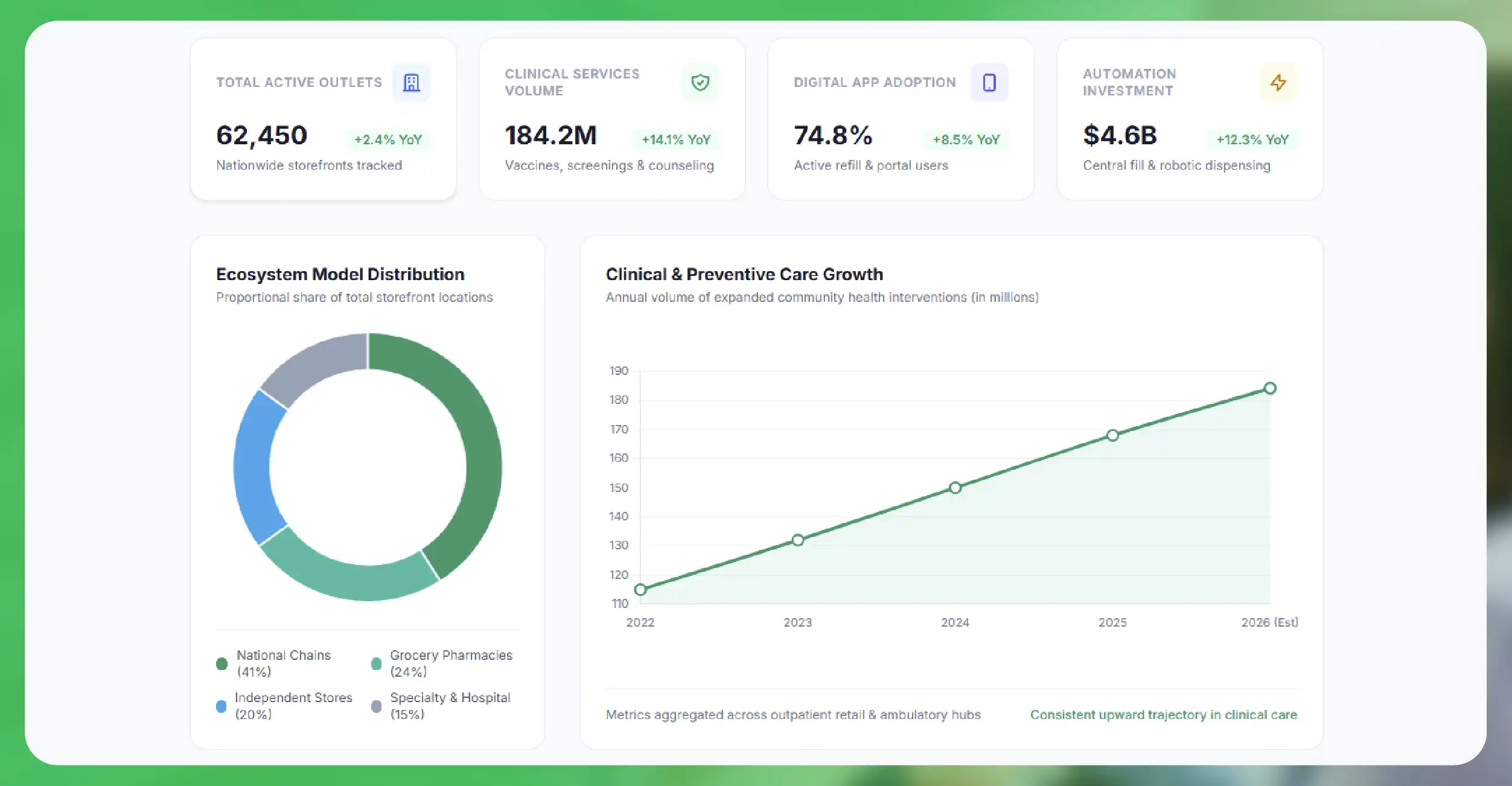
The US pharmacy ecosystem consists of multiple business models serving millions of customers every day. Large pharmacy chains operate nationwide with thousands of locations, while grocery-based pharmacies, hospital pharmacies, specialty pharmacies, and independent drug stores continue serving local communities.
Today's pharmacies have evolved far beyond prescription dispensing. They now provide preventive healthcare services, chronic disease management, immunizations, health screenings, medication counseling, and digital prescription management. Many locations also function as neighborhood healthcare centers, making them essential components of the American healthcare system.
As healthcare costs continue rising, pharmacy chains invest heavily in automation, customer experience, digital applications, and personalized healthcare services. These developments create enormous amounts of publicly available market data that organizations can analyze for strategic planning.
Market Giants Driving Industry Competition
Several national pharmacy retailers dominate the US market through extensive store networks, integrated healthcare services, and digital healthcare platforms. Their competitive advantages include nationwide coverage, supply chain efficiency, customer loyalty programs, insurance partnerships, and advanced pharmacy technologies.
Large pharmacy companies continuously evaluate new store locations, optimize inventory management, improve prescription fulfillment speed, and expand healthcare offerings. Meanwhile, regional pharmacy chains compete by focusing on community engagement, personalized customer service, and localized healthcare solutions.
Independent pharmacies remain important by offering specialized medication management, customized patient care, and niche healthcare services that larger chains may not provide.
This competitive diversity creates a highly dynamic marketplace requiring continuous monitoring and analysis.
Growth Factors Reshaping the Pharmacy Industry
Several macroeconomic and healthcare trends continue fueling expansion across the pharmacy sector.
An aging population significantly increases prescription medication demand while creating opportunities for chronic disease management programs. Growing healthcare awareness encourages preventive care, resulting in higher demand for vaccinations, wellness consultations, and diagnostic services.
Digital healthcare adoption has accelerated online prescription refills, mobile applications, medication reminders, virtual consultations, and integrated patient management systems. These technological advancements improve operational efficiency while generating valuable digital datasets for competitive analysis.
Insurance coverage changes, government healthcare initiatives, and pharmaceutical innovation also influence pharmacy growth patterns across different states and metropolitan areas.
Geographic Distribution Creates Competitive Advantages
Location strategy remains one of the strongest competitive differentiators in the pharmacy industry. Population density, healthcare accessibility, demographics, income levels, transportation infrastructure, and physician availability all influence pharmacy performance.
Organizations increasingly use Pharmacy geographic Data Extraction to understand pharmacy density, regional competition, underserved healthcare markets, and expansion opportunities.
Geographic intelligence enables businesses to identify:
- High-demand pharmacy corridors
- Rural healthcare accessibility gaps
- Urban pharmacy saturation
- Emerging suburban markets
- Population-driven expansion opportunities
- Competitive overlap among major chains
Location analytics also supports healthcare policy planning by identifying communities requiring improved pharmaceutical access.
Importance of Retail Healthcare Intelligence

Retail pharmacies have become comprehensive healthcare destinations rather than simple medication providers. Customers increasingly visit pharmacies for vaccinations, diagnostic testing, wellness products, nutritional supplements, beauty products, and healthcare consultations.
Organizations that Scrape US healthcare retail Data gain visibility into service availability, product assortment, pricing changes, promotional campaigns, healthcare offerings, and customer engagement strategies.
Retail healthcare intelligence supports pharmaceutical manufacturers, healthcare technology providers, insurers, distributors, and consulting firms seeking actionable market insights.
Competitive Benchmarking Across Pharmacy Networks
Competitive benchmarking has become essential for organizations operating within healthcare retail markets.
Businesses compare pharmacy chains based on:
- Store coverage
- Prescription services
- Healthcare programs
- Digital capabilities
- Vaccination availability
- Operating hours
- Customer reviews
- Delivery options
- Insurance acceptance
- Pricing strategies
Analyzing these variables enables companies to evaluate competitive positioning while identifying market gaps that create new business opportunities.
Role of Data Scraping in Pharmacy Market Intelligence
Traditional market research often becomes outdated quickly because pharmacy networks constantly evolve. New store openings, relocations, healthcare partnerships, service expansions, and pricing adjustments occur throughout the year.
Automated data collection enables continuous monitoring of publicly available information from pharmacy websites, store locators, healthcare directories, and retail platforms.
This information supports:
- Market share estimation
- Store expansion monitoring
- Healthcare accessibility research
- Regional competitive analysis
- Consumer behavior studies
- Healthcare investment decisions
- Business expansion planning
- Digital transformation assessments
Real-time data collection provides organizations with significantly greater visibility than periodic manual research.
Geographic Expansion and Store Network Analysis
Organizations increasingly seek to Track pharmacy chains across the United States to understand expansion strategies adopted by leading pharmacy retailers.
Location intelligence reveals patterns such as:
- Rapid suburban expansion
- Urban market consolidation
- Healthcare desert development
- Regional competitive clustering
- Population-based store placement
- State-by-state growth differences
- Healthcare service availability
- Infrastructure investments
Network analysis also helps logistics companies optimize pharmaceutical distribution routes while supporting healthcare planners in improving medication accessibility.
Key Metrics Used in Pharmacy Market Analysis
Successful pharmacy intelligence projects analyze multiple business indicators simultaneously rather than focusing only on store counts.
Important metrics include prescription volume estimates, healthcare services offered, customer ratings, operating schedules, vaccination availability, insurance partnerships, geographic coverage, nearby healthcare providers, product categories, promotional activity, and demographic characteristics.
Combining these datasets creates a comprehensive understanding of competitive positioning and regional healthcare dynamics.
Applications Across Multiple Industries
Pharmacy market intelligence serves a wide range of industries beyond retail pharmacy itself.
- Pharmaceutical manufacturers monitor distribution coverage and retail presence.
- Healthcare providers evaluate patient accessibility.
- Insurance companies assess pharmacy network adequacy.
- Investors identify expansion opportunities.
- Commercial real estate firms analyze site selection.
- Government agencies monitor healthcare accessibility.
- Academic researchers study healthcare infrastructure.
- Technology companies develop healthcare analytics platforms.
- Consulting firms deliver market assessments for strategic decision-making.
The growing availability of structured pharmacy information makes data-driven decision-making increasingly accurate.
Challenges in Pharmacy Market Research
The pharmacy market changes rapidly due to mergers, acquisitions, healthcare regulations, reimbursement policies, and evolving consumer expectations.
Organizations often struggle with fragmented information spread across multiple public sources.
Maintaining current datasets requires automated collection, validation, normalization, and continuous updates to ensure consistency across thousands of pharmacy locations.
Accurate geographic mapping, duplicate removal, address standardization, and service categorization remain essential for producing reliable market intelligence.
How iWeb Data Scraping Can Help You?
Comprehensive Pharmacy Location Intelligence
Our data scraping solutions collect publicly available pharmacy location information, operating details, healthcare services, and geographic coverage, enabling organizations to build reliable datasets for market research, expansion planning, competitive benchmarking, and healthcare accessibility analysis.
Real-Time Market Monitoring
We continuously monitor pharmacy websites and publicly available sources to identify store openings, closures, service updates, pricing changes, and operational developments, ensuring businesses always work with fresh, actionable, and reliable market intelligence.
Customized Data Delivery
Our solutions provide structured datasets in multiple formats tailored to business requirements, allowing seamless integration with business intelligence platforms, analytics systems, CRM software, GIS mapping tools, and internal reporting environments.
Geographic Market Analysis
Our specialized location analytics help organizations understand pharmacy distribution, regional competition, healthcare accessibility, demographic alignment, market saturation, and expansion opportunities using advanced geographic intelligence for informed strategic planning and investment decisions.
Scalable Enterprise Data Solutions
Whether monitoring hundreds or thousands of pharmacy locations, our scalable scraping infrastructure delivers consistent, high-quality datasets while supporting enterprise-level analytics, competitive intelligence, forecasting models, and long-term healthcare market research initiatives.
Conclusion
As healthcare delivery continues evolving, pharmacy market intelligence becomes increasingly valuable for organizations seeking competitive advantages. Comprehensive analytics help businesses understand market leaders, regional expansion, healthcare accessibility, and changing consumer expectations. The future of Pharmacy Market Growth Trends in US will depend on digital healthcare innovation, demographic changes, and expanding retail healthcare ecosystems. Advanced Pharmaceutical and Medical Data Scraping enables organizations to transform publicly available information into strategic insights that support smarter decisions, while Web Scraping API Services ensure scalable, automated, and reliable access to continuously updated pharmacy market data for long-term business growth.
Frequently Asked Questions
US pharmacy market analysis involves studying pharmacy chains, store locations, healthcare services, market share, geographic distribution, pricing trends, and competitive strategies to understand the structure and performance of the pharmacy industry.
Pharmacy data scraping automates the collection of publicly available information such as pharmacy locations, operating hours, available services, customer reviews, and store networks, providing organizations with timely market intelligence.
Pharmaceutical companies, healthcare providers, insurers, investors, consulting firms, logistics providers, technology companies, researchers, and government agencies all use pharmacy market intelligence for planning and decision-making.
Organizations can collect publicly available information including store addresses, contact details, operating hours, healthcare services, vaccination availability, pharmacy categories, customer ratings, geographic coordinates, and location updates.
Geographic analysis identifies underserved regions, competitive clusters, expansion opportunities, healthcare accessibility gaps, and demographic trends, helping businesses optimize store placement, investment strategies, and regional market planning.