
186.4K+
STORE-LEVEL PRODUCT PRICE RECORDS PROCESSED

Store-Level Grocery Price API for US Grocery Savings Apps Through Real-Time Retail Pricing, Product Comparisons, and Consumer Savings Intelligence.
This case study presents an enterprise scenario in which a US-based grocery savings application partnered with iWeb Data Intelligence to implement a store-level grocery price API for collecting, processing, and delivering accurate grocery pricing information across multiple supermarket locations. The project demonstrates how structured US grocery price data can help digital platforms improve price transparency, strengthen shopping recommendations, and provide consumers with reliable information before they visit physical grocery stores.
It is designed for:
The client's primary objective was to eliminate the gap between online grocery information and actual in-store shopping prices. Consumers frequently encountered different prices for identical products across stores, even within the same city. The application wanted to address this problem by offering location-specific grocery prices that shoppers could compare before making purchasing decisions.
A growing US grocery savings application wanted to improve how consumers discovered affordable grocery products across nearby supermarkets. The company required a scalable grocery UPC lookup API to identify identical products across retailers using standardized product identifiers, packaging information, and brand attributes.
The project incorporated structured grocery promotions data to help shoppers identify discounts, special offers, and retailer-specific savings opportunities. Additionally, access to reliable in-store shelf price data enabled the application to display location-specific product prices rather than depending entirely on generalized online listings or outdated promotional information.
iWeb Data Intelligence developed an automated data collection and integration framework covering supermarket catalogs, store-level product information, promotional listings, and geographic identifiers. The solution consolidated product records from multiple retail sources and standardized them into a common database structure.
The system connected UPC and GTIN identifiers with product names, brands, pack sizes, categories, regular prices, promotional prices, and retailer locations. This enabled the application to recognize equivalent grocery products across different supermarkets and present meaningful price comparisons.
The client faced several difficulties while building a reliable grocery savings platform. Although supermarket websites and applications provided product catalogs and promotional information, these sources did not consistently offer the exact store-level pricing information required for accurate comparisons.
Inconsistent Retail Pricing Across Store Locations
The same grocery product could have different prices across supermarket branches, cities, and regional markets. The client struggled to identify these variations consistently. Generalized pricing information could mislead shoppers when actual shelf prices differed from displayed online prices.
Fragmented Product Identification
Different retailers frequently used varying product titles, descriptions, category structures, and packaging terminology. The client needed to connect identical products across multiple catalogs. Without reliable matching, comparison results could include incorrect pack sizes or similar but different products.
Limited Visibility into Grocery Promotions
The application required timely information about discounts, multibuy offers, loyalty promotions, and temporary price reductions. However, inconsistent promotional formats made it difficult to compare savings opportunities across retailers and locations.
Challenges Integrating Third-Party Grocery Sources
The client explored grocery deals app data to understand competitor pricing experiences and promotional coverage. However, integrating fragmented information into one consistent database required additional normalization, validation, and location mapping. The client also evaluated Instacart data scraping and Walmart data scraping to understand available grocery listings, but needed to distinguish online listings from location-specific retail prices.
To overcome these challenges, the client required an automated grocery pricing intelligence pipeline capable of multi-retailer collection, UPC-based matching, store-level mapping, and structured API delivery.
By implementing an automated grocery pricing intelligence pipeline, the client replaced fragmented product monitoring with a centralized system that continuously collected, standardized, validated, and distributed grocery price information.
| Dimension | Manual Price Tracking | Client's Grocery Price API |
|---|---|---|
| Price collection | Individual retailer checks | Automated multi-retailer collection |
| Store coverage | Limited supermarket branches | 1,250+ monitored locations |
| Product matching | Manual name-based comparison | UPC and GTIN-based matching |
| Price accuracy | Inconsistent manual verification | Automated validation and anomaly detection |
| Promotional tracking | Periodic offer checking | Structured promotional data collection |
| Geographic coverage | Limited city-level visibility | Multi-state location mapping |
| Data refresh | Irregular manual updates | Scheduled refresh cycles |
| Integration | Separate spreadsheets and databases | Centralized API delivery |
| Historical analysis | Limited price records | Time-stamped historical datasets |
| Scalability | Dependent on manual resources | Expandable data infrastructure |
The structured approach helped the application move beyond basic product comparisons. It created a consistent foundation for understanding how grocery prices differed by retailer, store location, product size, and promotional period.
The brand in focus is a US-based digital grocery savings application designed to help consumers make informed purchasing decisions. Its primary offering revolves around helping shoppers discover affordable grocery products, compare prices between nearby supermarkets, and identify opportunities to reduce household food expenses.
The application operates within a competitive grocery technology environment where price transparency, product availability, and convenience influence consumer engagement. Shoppers increasingly expect digital platforms to provide useful information before they travel to a store or complete a grocery purchase.
However, delivering dependable store-level comparisons requires more than collecting product prices from supermarket websites. The application must understand which products are identical, where individual stores are located, whether promotional offers are applicable, and when prices were last verified.
The brand recognized that incomplete or outdated information could negatively affect consumer trust. A shopper who visits a supermarket expecting a particular price but encounters a different shelf price may lose confidence in the application.
To overcome this limitation, the organization invested in a structured grocery intelligence framework. Its objective was to develop a unified information layer connecting retailer catalogs, product identifiers, geographic store information, and pricing records.
This transformation enabled the brand to strengthen its grocery comparison capabilities while preparing its technology infrastructure for additional retailers, markets, and advanced consumer savings features.
iWeb Data Intelligence designed an end-to-end grocery data collection and API integration solution that converted fragmented retail information into standardized, location-specific pricing records.
Retailer and Location Identification
The first stage involved identifying relevant grocery retailers, product categories, store locations, and available pricing information. Data collection processes were configured around publicly accessible retailer information and permitted data sources, subject to applicable access restrictions and usage requirements.
Product Identification and Matching
The second stage focused on product identification. UPC and GTIN references were used to connect equivalent products across different supermarket catalogs. Brand names, package sizes, quantities, descriptions, and category attributes provided additional matching signals.
Store-Level Price Mapping
The third stage involved store-level price mapping. Each collected price record was associated with its respective retailer, store identifier, geographic location, and collection timestamp. This helped distinguish prices across nearby branches and different regional markets.
Promotional Intelligence
The fourth stage involved promotional intelligence. Regular prices, discounted prices, offer descriptions, promotional validity periods, and applicable conditions were organized into consistent fields. This allowed the application to communicate savings opportunities more clearly.
Data Cleaning, Validation and API Delivery
Data cleaning and validation formed an important part of the complete process. Duplicate records were removed, inconsistent product descriptions were standardized, and unusual price movements were flagged for additional verification. Finally, the structured information was delivered through an API layer that supported application integration, location-based queries, product searches, and scheduled updates.
The implementation provided visibility into pricing variations across supermarket branches and geographic markets. Products that appeared similarly priced at a national level sometimes showed considerable differences between individual locations.
By connecting prices with store identifiers, the application could distinguish regional pricing patterns and offer more relevant comparisons.
This capability helped the client understand how geography influenced grocery affordability. It also supported location-based recommendations that considered the actual shopping destinations selected by consumers rather than relying on generalized retailer averages.

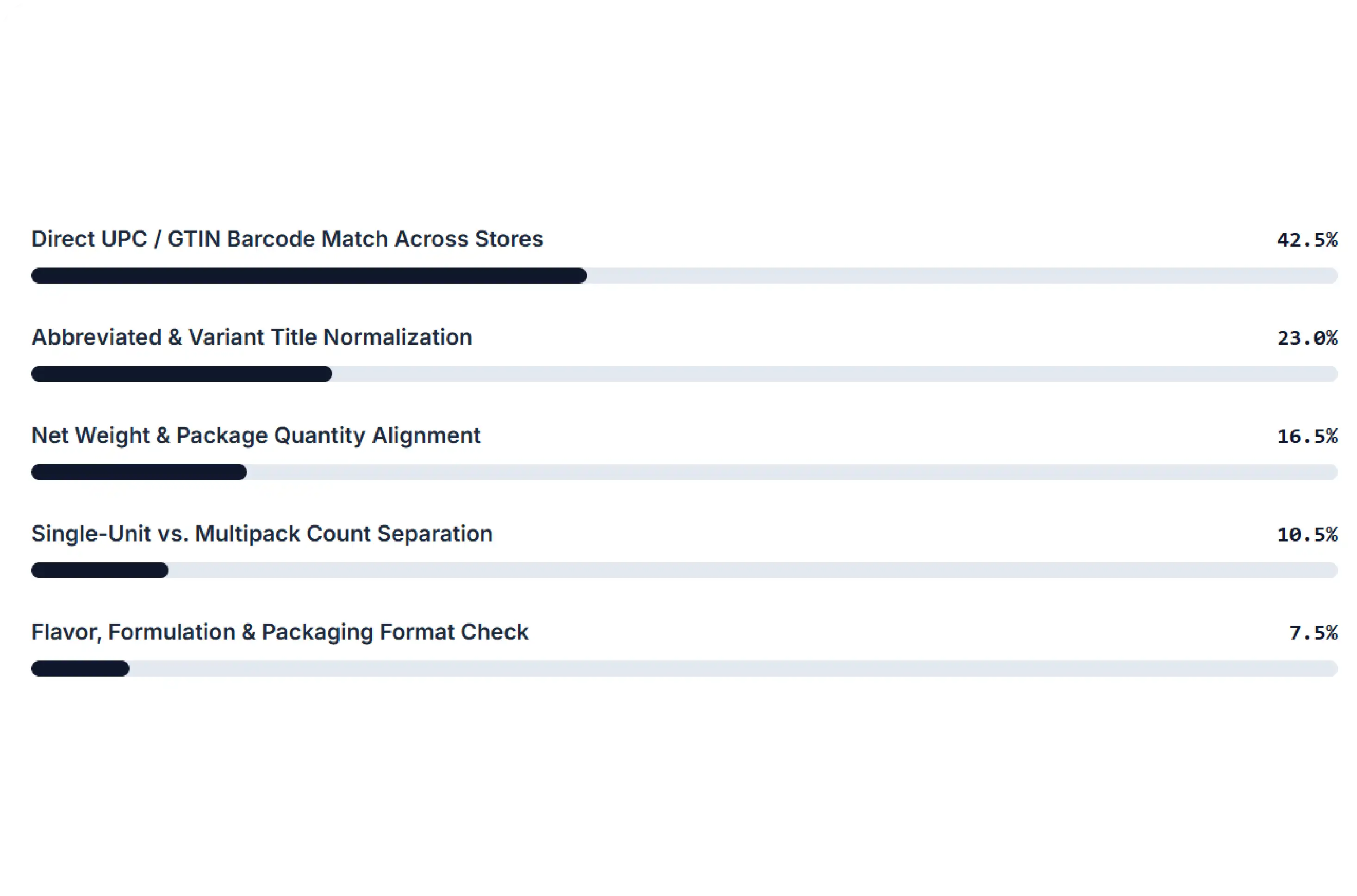
Product identification was one of the most important components of the project. Different supermarket websites frequently displayed identical products using different titles, abbreviations, and descriptive formats.
The matching framework used UPC and GTIN identifiers alongside brand, quantity, and packaging information to connect equivalent listings.
This reduced incorrect comparisons involving different package sizes, product variants, or multipacks. It also helped the application provide shoppers with more meaningful comparisons between identical grocery products.
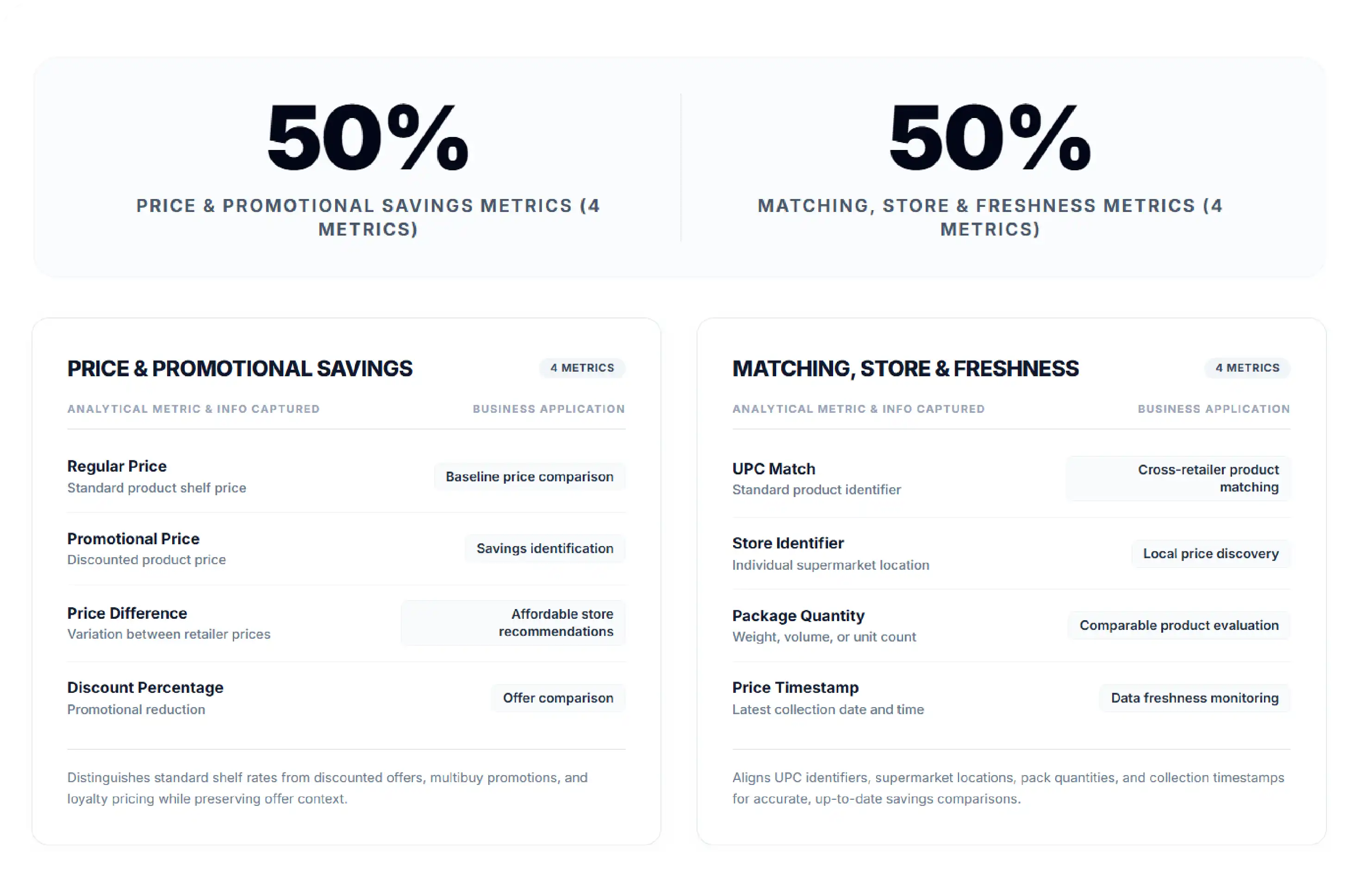
The integration of promotional information allowed the application to identify opportunities beyond standard shelf-price comparisons.
Retailer discounts, temporary offers, multibuy promotions, and loyalty-based pricing could be organized into structured records. This provided a more comprehensive view of the savings available at participating supermarkets.
The system also helped distinguish regular prices from promotional prices, reducing the risk of presenting discounted prices without relevant offer conditions. Key analytical metrics included regular price, promotional price, UPC match, store identifier, price difference, discount percentage, package quantity, and price timestamp.
The client required more than a snapshot of current grocery prices. Historical records were important for understanding whether an advertised discount represented a meaningful price reduction.
The system maintained timestamped price observations that enabled the application to examine changes across different collection periods.
This helped identify recurring promotional patterns, temporary price increases, and products experiencing frequent price fluctuations. Historical analysis also provided a foundation for future features such as price alerts, grocery budget planning, and recommendations based on previously observed pricing trends.
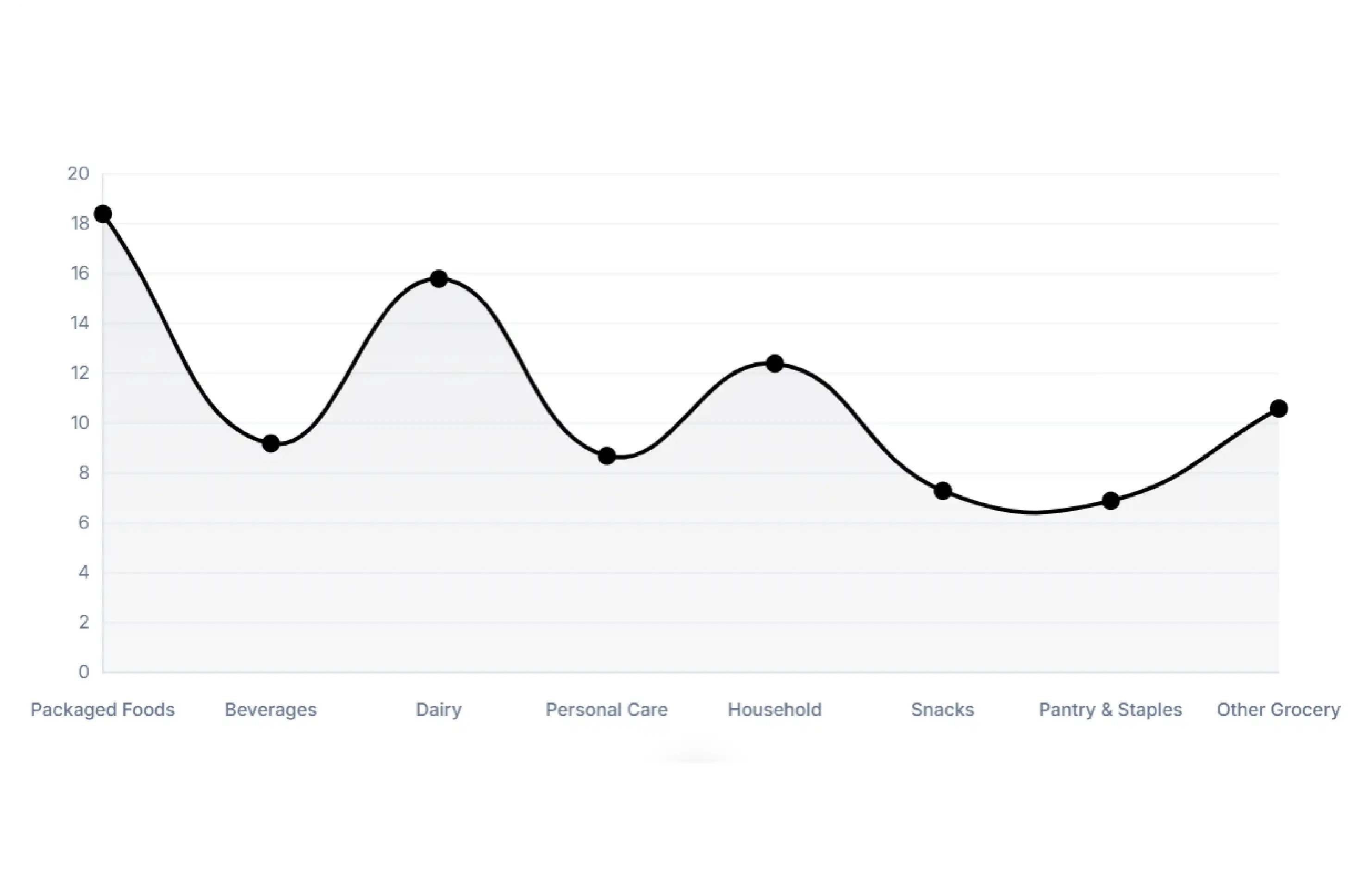
The sample records represent different grocery categories and supermarket locations. They demonstrate how the application can identify equivalent products and compare prices across participating retailers.
| UPC | Product Name | Retailer | Store Location | Regular Price | Offer Price |
|---|---|---|---|---|---|
| 012345678901 | Whole Milk 1 Gallon | Walmart | Dallas, TX | $3.89 | $3.49 |
| 012345678918 | Large Eggs 12 Count | Kroger | Houston, TX | $3.79 | $2.99 |
| 012345678925 | White Bread 20 oz | Target | Austin, TX | $2.79 | $2.49 |
| 012345678932 | Bananas 1 lb | Walmart | Phoenix, AZ | $0.69 | $0.59 |
| 012345678949 | Greek Yogurt 32 oz | Kroger | Atlanta, GA | $5.49 | $4.79 |
| 012345678956 | Long Grain Rice 5 lb | Safeway | Denver, CO | $6.49 | $5.99 |
| 012345678963 | Cheddar Cheese 8 oz | Target | Chicago, IL | $3.99 | $3.49 |
| 012345678970 | Orange Juice 52 oz | Walmart | Miami, FL | $4.29 | $3.79 |
| 012345678987 | Peanut Butter 16 oz | Kroger | Nashville, TN | $3.49 | $2.99 |
| 012345678994 | Pasta 16 oz | Safeway | Seattle, WA | $1.99 | $1.69 |
Note: Sample figures are illustrative and do not represent verified live supermarket prices or actual store-level offers.
The structured dataset enables the application to compare UPCs, product names, retailers, store locations, regular prices, and offer prices across participating grocery locations.
Following the implementation of the structured grocery pricing infrastructure, the client established a more reliable foundation for location-specific grocery comparisons, promotional discovery, and consumer savings recommendations.
The project delivered improvements across data management, pricing visibility, and application functionality.
iWeb Data Intelligence provides structured retail data collection and integration capabilities that help businesses transform fragmented grocery information into actionable intelligence.
Unified Grocery Information
We consolidate product catalogs, store-level pricing, promotions, and location information into standardized datasets. This creates a consistent foundation for grocery comparison applications and retail intelligence platforms.
Product Matching and Standardization
Our data processing methodologies connect product identifiers with descriptions, brands, package sizes, and categories. This supports more accurate product comparisons across multiple grocery retailers.
Location-Based Pricing Intelligence
We organize grocery pricing information around individual store locations, helping applications deliver geographically relevant comparisons rather than depending entirely on generalized retailer prices.
Flexible API Integration
Our API infrastructure supports structured data delivery through consistent formats, making it easier for businesses to integrate grocery intelligence into existing applications, dashboards, and analytical systems.
Scalable Data Management
Our solutions are designed to accommodate expanding retailer coverage, growing product catalogs, and increasing data volumes while maintaining organized and validated records.
Reliable Data Validation
Automated cleaning, duplicate detection, identifier matching, and anomaly checks help improve dataset consistency and identify records that require additional verification.
"We wanted to create a grocery savings application that offered consumers more than basic supermarket price comparisons. Our biggest requirement was obtaining accurate product information connected to individual store locations. The iWeb Data Intelligence team helped us establish a structured pricing infrastructure that brought together product identifiers, store information, regular prices, and promotional records. Their approach improved our ability to compare grocery products across different retail locations and provided a reliable foundation for our application features. The API integration also made it easier for our technology team to access organized information without managing multiple disconnected datasets. We particularly appreciated the emphasis on product matching, location mapping, and data validation. The solution has strengthened our grocery comparison capabilities and helped us move toward a more transparent and consumer-focused shopping experience."
— Product and Technology Head
The project delivered a structured grocery pricing intelligence infrastructure that enabled the client's US grocery savings application to move from fragmented retail information toward standardized, location-specific product comparisons.
Implementation of grocery data scraping capabilities helped consolidate product catalogs, UPC references, regular prices, promotional information, and store-level identifiers into a centralized dataset. The resulting information provided the application with a more consistent foundation for comparing grocery prices across participating retailers and geographic markets.
The integration of a web scraping API established a flexible mechanism for collecting and distributing structured retail information through application-ready endpoints. Automated processing, product matching, data cleaning, and validation helped improve the reliability of the pricing intelligence pipeline.
The solution also created opportunities for additional consumer-focused features, including grocery price alerts, shopping-list optimization, promotional recommendations, historical price comparisons, and location-based savings discovery.
A store-level grocery price API provides structured product pricing information associated with individual supermarket locations. It enables applications to retrieve grocery prices, compare retailers, identify promotional offers, and deliver location-specific shopping insights to consumers.
UPC matching helps identify identical products across different supermarket catalogs. By connecting standardized product identifiers with brand names, package quantities, and product descriptions, applications can reduce incorrect comparisons and provide more reliable pricing information.
Yes. A structured data collection infrastructure can consolidate available grocery information from multiple participating retailers and permitted public sources. Coverage depends on source accessibility, retailer policies, geographic availability, and data collection requirements.
Update frequency depends on retailer source availability, pricing changes, collection permissions, and business requirements. Scheduled refreshes can be configured at suitable intervals, while timestamps and validation processes help users understand the freshness of collected information.
Yes. The data infrastructure can organize available promotional information, including regular prices, discounted prices, multibuy offers, discount percentages, and promotional validity periods. Offer conditions should also be retained wherever available.
iWeb Data Intelligence helps businesses collect, standardize, and integrate grocery product prices, UPC information, promotional offers, and store-level retail datasets. Transform fragmented grocery information into actionable pricing intelligence and deliver more transparent shopping experiences to consumers.
Start a projectFields marked * are required. Everything else just helps us scope faster — skip what you don't know yet.