
52.4K+
PRODUCT LISTINGS MONITORED

Price Monitoring USA Enabled a Consumer Electronics Brand to Track Competitors and Optimize Daily Pricing Strategies Across Major Retail Marketplaces.
This case study explores how a consumer electronics brand operating in the competitive United States retail market implemented an automated intelligence framework to monitor product prices across leading e-commerce platforms. By leveraging price monitoring USA, the organization transformed fragmented competitor pricing information into structured intelligence that supported pricing decisions, promotional planning, and competitive positioning.
It is designed for:
The client's primary requirement was to establish consistent visibility into competitor prices across Amazon, Walmart, and Target. Previously, pricing information was collected manually, making it difficult to identify changes quickly or compare identical electronics products across different sellers. The organization wanted a centralized system that could capture product-level information, identify pricing differences, and deliver actionable insights through daily reports and dashboards.
A consumer electronics brand operating across the United States wanted to strengthen its competitive pricing strategy through continuous marketplace intelligence. The organization sold products across multiple categories, including televisions, headphones, laptops, smart home devices, speakers, gaming accessories, and mobile accessories. However, competitor pricing changed frequently across marketplaces, creating challenges for maintaining consistent product positioning.
The business needed a reliable approach to track competitor prices across Amazon, Walmart, and Target without depending on time-consuming manual research. Its existing process involved checking individual product pages, recording prices in spreadsheets, and comparing promotional offers periodically. This approach frequently overlooked short-term discounts, seller-specific changes, and variations in product configurations.
To address these limitations, the company implemented an automated Amazon Walmart Target price tracking framework that collected product listings, prices, discounts, seller information, availability, and promotional details. The system matched comparable products across platforms using product identifiers, brand names, model numbers, and specifications.
The solution processed more than 52,400 product listings and created a centralized dataset for daily competitor benchmarking. Automated validation and normalization improved consistency, while historical records enabled analysts to identify price movements and promotional patterns.
The client operated in a highly competitive retail environment where electronics prices frequently changed because of seasonal promotions, marketplace competition, seller strategies, inventory conditions, and changing consumer demand. Its existing monitoring process could not provide sufficiently comprehensive US retail price monitoring across all relevant product categories and retail channels.
Fragmented Competitor Pricing Information
Product prices were available across multiple marketplaces, but the information was scattered across individual listings. Analysts struggled to consolidate prices, discounts, seller details, and product specifications into a consistent comparison framework.
Delayed Identification of Price Changes
The existing process depended on manual checking and periodic spreadsheet updates. Without automated daily price tracking, the business frequently discovered competitor price changes after promotional opportunities had already passed.
Product Matching Difficulties
Identical electronics products appeared under different titles, descriptions, and listing formats. Variations in model numbers, storage capacity, colors, bundle configurations, and product specifications created difficulties when comparing equivalent products across marketplaces.
Limited Promotional Visibility
The client lacked a centralized understanding of list prices, selling prices, coupon discounts, promotional offers, and marketplace-specific deals. This restricted its ability to evaluate competitor promotional intensity and identify effective pricing opportunities.
Inconsistent Historical Price Records
The organization did not maintain a reliable historical record of competitor pricing movements. Consequently, analysts found it difficult to distinguish temporary discounts from long-term pricing changes or evaluate recurring promotional patterns.
By adopting an automated marketplace intelligence framework, the client replaced fragmented manual monitoring with a structured competitor pricing system. The solution continuously collected relevant information from Amazon, Walmart, and Target, normalized product records, and maintained historical price information for comparison.
| Dimension | Manual Price Monitoring | Automated Client System |
|---|---|---|
| Data collection | Individual product-page checking | Automated marketplace data extraction |
| Monitoring frequency | Periodic manual updates | Scheduled daily collection |
| Price comparison | Spreadsheet-based calculations | Centralized product-level benchmarking |
| Product matching | Manual title comparisons | Identifier and specification-based matching |
| Discount tracking | Occasional promotional checks | Regular discount and offer monitoring |
| Seller visibility | Limited seller information | Structured seller-level records |
| Historical analysis | Inconsistent spreadsheet history | Centralized historical price database |
| Reporting | Manually prepared reports | Automated analytical dashboards |
| Scalability | Limited product coverage | Scalable multi-category monitoring |
| Decision support | Delayed competitor insights | Faster pricing and promotional intelligence |
The structured approach improved consistency and allowed the client to evaluate competitors using comparable product-level fields across major US retail platforms.
The brand in focus is an established consumer electronics organization operating within the competitive United States retail ecosystem. Its product portfolio includes several high-demand electronics categories, such as televisions, laptops, wireless headphones, smartwatches, gaming accessories, Bluetooth speakers, home entertainment equipment, and smart home products.
The company distributes its products through different retail channels, including online marketplaces and established retail chains. Its commercial strategy depends on maintaining competitive prices while protecting profit margins and ensuring consistent brand positioning across platforms.
However, the increasing complexity of online retail pricing created significant operational challenges. Similar products were frequently listed by multiple sellers, promotional offers changed throughout the week, and product availability differed across marketplaces. These variations made it difficult to understand the actual competitive landscape using conventional monitoring methods.
We delivered an end-to-end marketplace intelligence solution designed to collect, organize, validate, and analyze consumer electronics pricing information across Amazon, Walmart, and Target.
The implementation followed a structured data collection and processing methodology.
Marketplace Identification and Product Discovery
The first stage involved identifying relevant electronics categories and competitor product listings across all three marketplaces. Products were organized into categories such as televisions, computers, audio equipment, gaming devices, accessories, and smart home technology.
Automated Product Data Extraction
The extraction pipeline collected relevant product information, including product titles, brand names, model numbers, product identifiers, listed prices, discounted prices, seller details, ratings, review counts, and availability indicators.
Product Matching and Normalization
Products were matched using identifiers such as UPC, GTIN, manufacturer part numbers, model numbers, and relevant specifications wherever available. Matching rules helped distinguish identical products from similar-looking but technically different listings.
Price and Discount Validation
The collected information underwent validation to identify missing values, inconsistent pricing formats, duplicate listings, and unusual price movements. Promotional prices were recorded separately from regular listed prices whenever the source provided sufficient information.
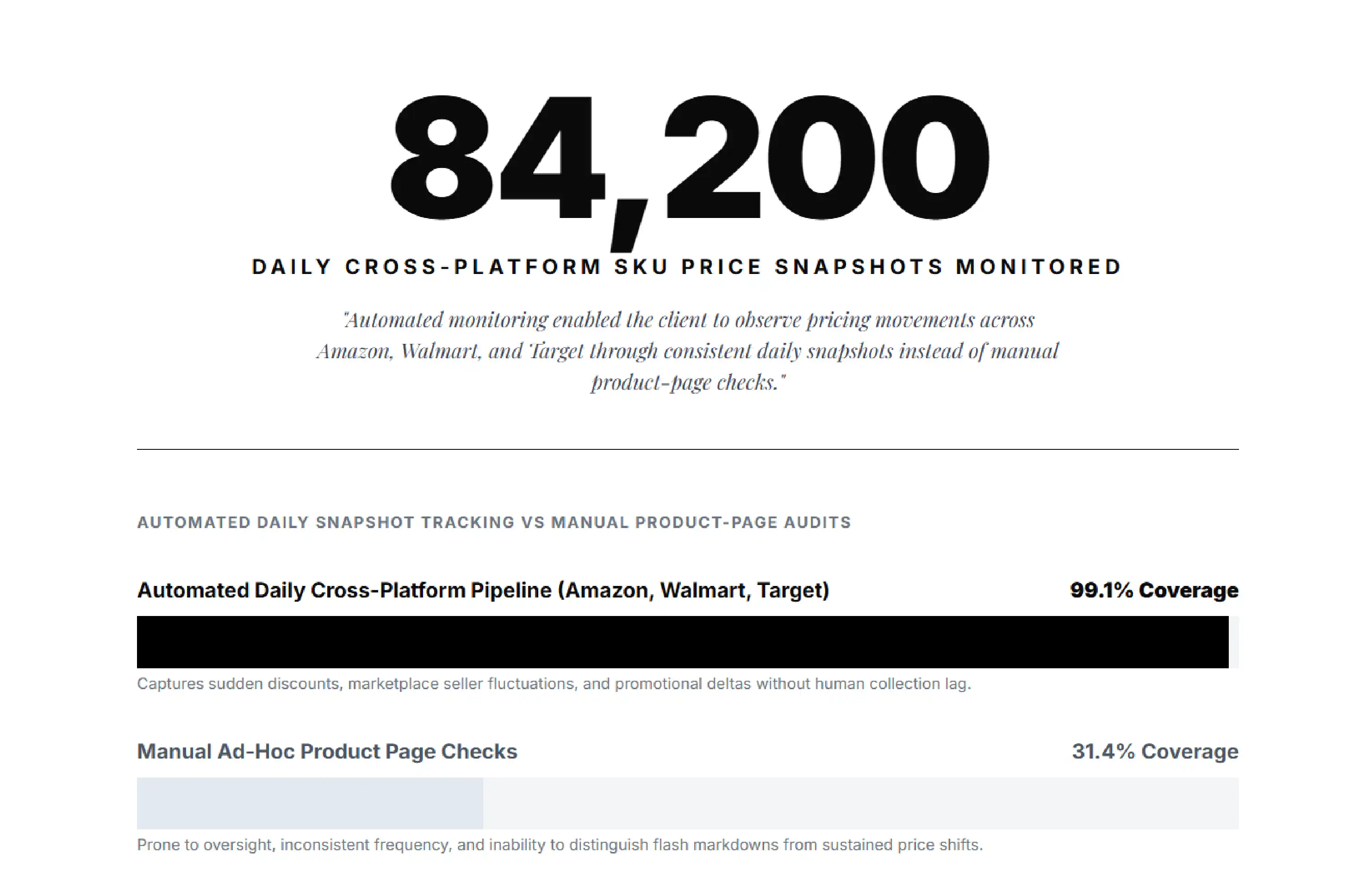
Automated monitoring enabled the client to observe pricing movements across Amazon, Walmart, and Target through consistent daily snapshots. Instead of depending on manual product-page checks, analysts could compare current prices against previous records and identify meaningful changes.
The system highlighted products experiencing sudden discounts, increases in selling prices, and differences between marketplace offers. This information helped the pricing team understand where competitors were becoming more aggressive and which products required closer attention.
It also improved the organization's ability to distinguish temporary promotional activity from sustained price adjustments, supporting more informed pricing decisions.
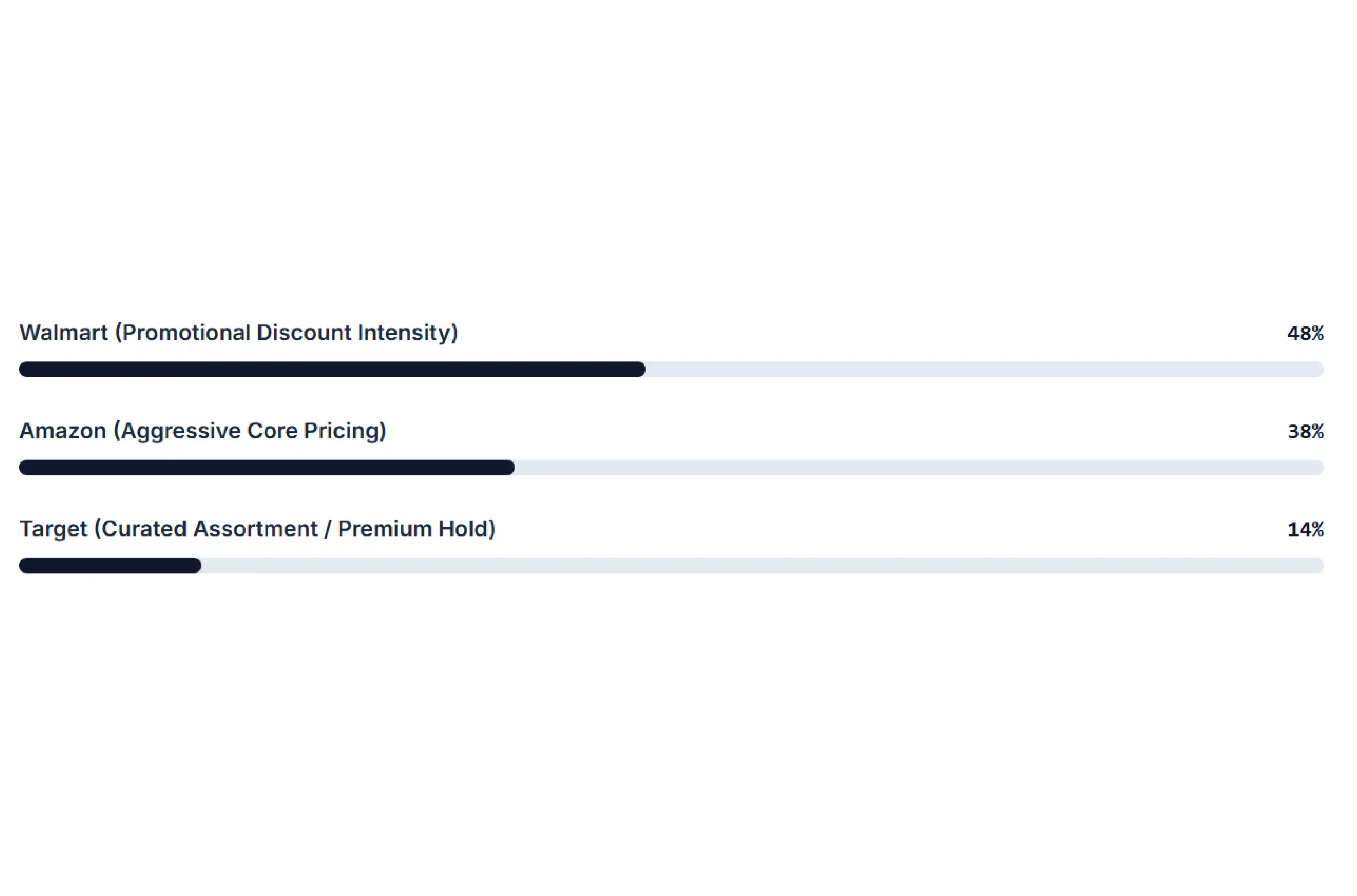
The analysis revealed that identical electronics products could carry different selling prices across the three marketplaces. Differences were influenced by promotional campaigns, seller participation, fulfillment arrangements, availability, and marketplace-specific pricing strategies.
The client could identify products where Amazon offered the lowest observed price, Walmart provided a stronger promotional discount, or Target maintained a comparatively higher selling price.
These comparisons helped the brand understand channel-level positioning and determine where its own pricing strategy required adjustment.
| Product Category | Amazon Price | Walmart Price | Target Price | Lowest Observed |
|---|---|---|---|---|
| 55-inch Smart TV | $428 | $449 | $469 | Amazon |
| Wireless Headphones | $89 | $84 | $99 | Walmart |
| Bluetooth Speaker | $119 | $109 | $129 | Walmart |
| Gaming Headset | $74 | $79 | $69 | Target |
| Smartwatch | $179 | $169 | $189 | Walmart |
| Laptop | $699 | $729 | $749 | Amazon |
| Streaming Device | $39 | $35 | $39 | Walmart |
| Smart Home Camera | $59 | $64 | $69 | Amazon |
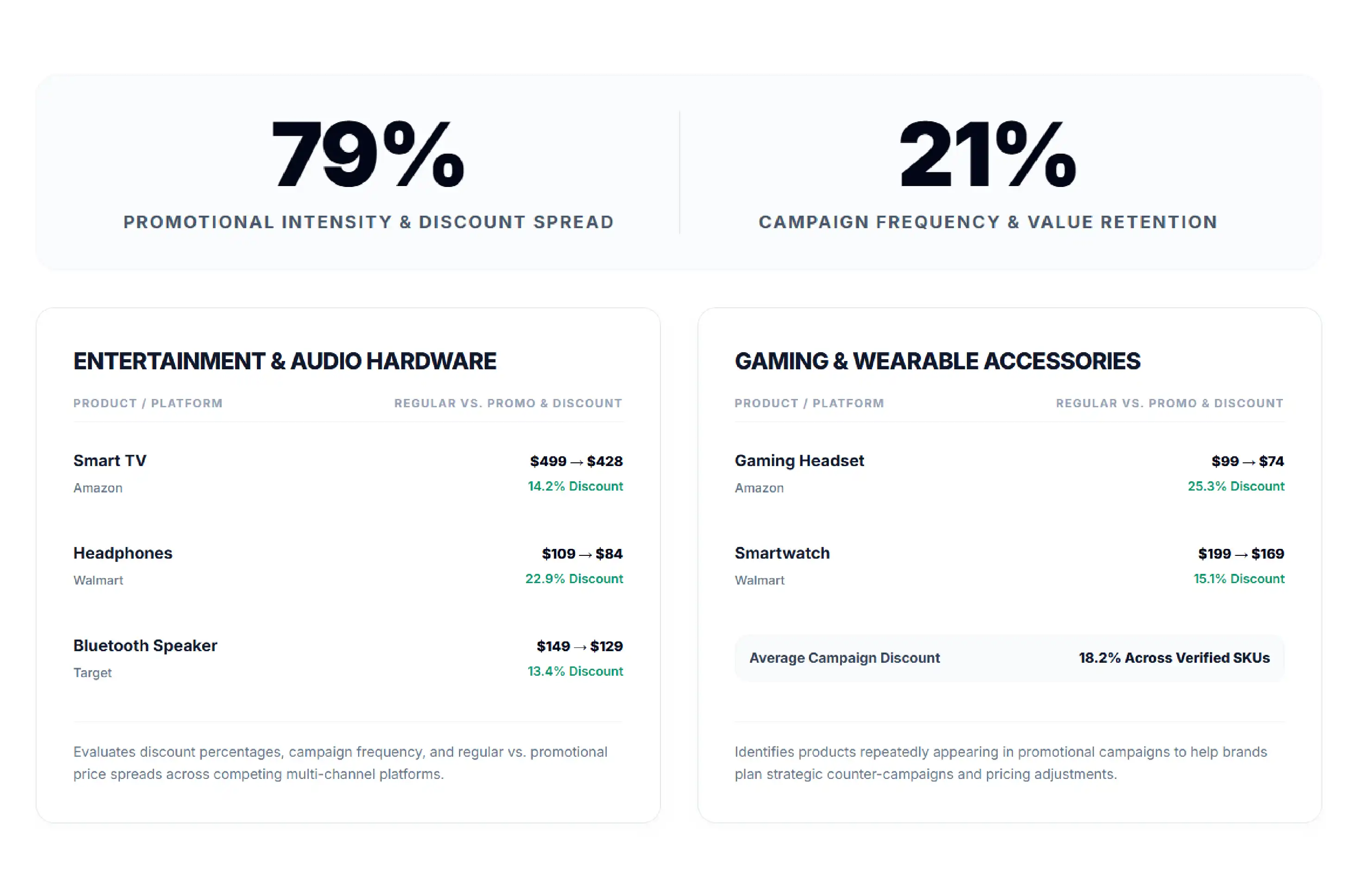
The monitoring framework enabled the organization to compare regular listed prices against promotional selling prices. This distinction was important because a low displayed price did not always represent a permanent reduction in product value.
Analysts evaluated discount percentages, promotional frequency, and price changes across comparable products. The system also helped identify products that repeatedly appeared in discount campaigns.
These insights allowed the brand to understand competitor promotional intensity and plan its own campaigns more strategically.
| Product | Platform | Regular Price | Promotional Price | Discount |
|---|---|---|---|---|
| Smart TV | Amazon | $499 | $428 | 14.2% |
| Headphones | Walmart | $109 | $84 | 22.9% |
| Bluetooth Speaker | Target | $149 | $129 | 13.4% |
| Gaming Headset | Amazon | $99 | $74 | 25.3% |
| Smartwatch | Walmart | $199 | $169 | 15.1% |
The following sample demonstrates how the collected information was structured for analytical use. Each record combines product identification, marketplace details, pricing information, seller information, and availability indicators.
| Product Name | Platform | Model | Price | Discount | Availability |
|---|---|---|---|---|---|
| Smart TV 55-inch | Amazon | TV55-A1 | $428 | 14% | In Stock |
| Smart TV 55-inch | Walmart | TV55-A1 | $449 | 10% | In Stock |
| Smart TV 55-inch | Target | TV55-A1 | $469 | 6% | In Stock |
| Wireless Headphones | Amazon | WH-200 | $89 | 18% | In Stock |
| Wireless Headphones | Walmart | WH-200 | $84 | 23% | In Stock |
| Wireless Headphones | Target | WH-200 | $99 | 9% | Limited |
| Bluetooth Speaker | Amazon | BS-120 | $119 | 15% | In Stock |
| Bluetooth Speaker | Walmart | BS-120 | $109 | 22% | In Stock |
| Bluetooth Speaker | Target | BS-120 | $129 | 13% | In Stock |
All sample product names, model identifiers, prices, and availability records are illustrative.
The dataset can be expanded with additional attributes, including product URLs, UPCs, seller names, shipping charges, ratings, review counts, fulfillment types, coupon details, collection timestamps, and historical price records.
This structure makes it easier for the client to conduct product-level comparisons, identify pricing gaps, and build category-specific intelligence reports.
After implementing the automated marketplace monitoring framework, the client established a more efficient approach to competitor benchmarking and pricing intelligence. The following illustrative project outcomes demonstrate how the solution can be presented in terms of operational and analytical improvements.
These improvements helped the organization establish a repeatable pricing intelligence process and improve collaboration between merchandising, marketing, product management, and revenue teams.
iWeb Data Scraping provides a structured approach to collecting and analyzing large volumes of marketplace information. For consumer electronics brands, the solution supports competitor benchmarking by consolidating product-level prices, discounts, seller information, and availability details from multiple online retail sources.
Unified Data Collection
Its automated extraction capabilities reduce dependency on repetitive manual research and provide consistent datasets for daily monitoring. Businesses can compare equivalent products across marketplaces, identify price differences, and understand promotional movements through normalized records.
Data Quality and Standardization
The solution also emphasizes data quality through validation, duplicate identification, and standardized product attributes. This is particularly valuable for electronics categories where model numbers, configurations, and technical specifications influence accurate product matching.
Historical Tracking and Dashboards
Historical data management enables businesses to evaluate pricing changes over time, recognize recurring discount patterns, and understand competitor strategies. Integrated dashboards further simplify reporting by presenting important marketplace indicators in accessible formats.
Scalable Coverage
With scalable infrastructure and flexible delivery formats, iWeb helps organizations expand monitoring coverage across additional retailers, product categories, and geographic markets. The resulting intelligence supports better pricing decisions, stronger competitive positioning, and more efficient retail operations.
"We were looking for a dependable solution that could help us understand competitor pricing across major US retail marketplaces. The iWeb team developed a structured monitoring system that significantly improved our visibility into product prices, discounts, and availability. Earlier, our analysts spent considerable time manually checking individual listings and preparing comparison spreadsheets. The automated solution simplified this process and provided consistent daily information through centralized dashboards. We particularly appreciated the product matching and historical pricing capabilities, which helped us understand competitor movements more effectively. The solution has improved our reporting efficiency, supported faster pricing decisions, and strengthened our overall marketplace intelligence capabilities."
— Head of E-commerce and Pricing Strategy
The project delivered a centralized and scalable marketplace intelligence framework that transformed fragmented competitor pricing information into structured business insights. Through automated price monitoring USA, the consumer electronics brand gained improved visibility into product prices, promotional activities, seller information, and availability across Amazon, Walmart, and Target.
The system established a consistent daily monitoring process, enabling the organization to compare equivalent products, identify pricing gaps, and evaluate marketplace-specific promotional strategies. Historical snapshots further supported pricing trend analysis and helped analysts understand how competitor prices evolved over time.
The structured output also created opportunities to develop category-specific intelligence resources, including a Walmart product dataset containing product identifiers, pricing attributes, discounts, seller details, and availability information.
Furthermore, the architecture can support broader retail intelligence initiatives, including an US grocery price inflation tracker, by extending similar data collection and analytical methodologies to grocery products and additional retail categories.
Price monitoring involves collecting and analyzing product prices across competing retail platforms. It helps electronics brands understand competitor pricing, compare discounts, identify pricing gaps, and make informed decisions about their own product positioning.
The monitoring framework covers Amazon, Walmart, and Target. It can also be extended to other relevant retailers and e-commerce marketplaces depending on business requirements, product availability, and permitted data access.
Relevant information includes product names, model numbers, identifiers, listed prices, promotional prices, discounts, seller details, ratings, review counts, availability indicators, and product URLs, subject to source accessibility.
Daily tracking helps businesses identify price movements, monitor promotional changes, compare competing offers, and maintain historical pricing records. It improves market visibility and supports timely pricing and merchandising decisions.
Yes. iWeb can develop customized dashboards based on business requirements, including marketplace comparisons, product-level price benchmarking, discount analysis, historical price movements, and seller-level monitoring.
iWeb Data Intelligence helps consumer electronics brands transform marketplace information into structured pricing intelligence through automated data extraction, product matching, historical tracking, and customized analytics. Build better visibility across Amazon, Walmart, and Target to support smarter pricing decisions and stronger competitive positioning.
Start a projectFields marked * are required. Everything else just helps us scope faster — skip what you don't know yet.