


Introduction
The resale fashion economy is becoming increasingly data-driven as shoppers compare brands, conditions, sizes, styles, and prices before purchasing pre-owned products. The Vinted Product & Pricing Dataset 2026 can help businesses, researchers, retailers, and fashion analysts understand how secondhand products are listed, positioned, and priced across a rapidly changing marketplace.
Businesses increasingly Scrape Vinted product and pricing data to analyze product availability, seller behavior, brand-level pricing, product conditions, category trends, and competitive positioning. Vinted allows users to list items with descriptions, photos, brands, conditions, sizes, and prices, creating a rich source of marketplace intelligence. Its catalog includes fashion as well as footwear, accessories, homeware, electronics, toys, and other categories.
For fashion businesses, Vinted product data scraping for brands can reveal how products perform in the resale ecosystem compared with their original retail positioning. This information can support pricing strategy, assortment planning, resale-market analysis, product lifecycle research, and brand perception studies.
Why Vinted Product Data Matters in 2026?
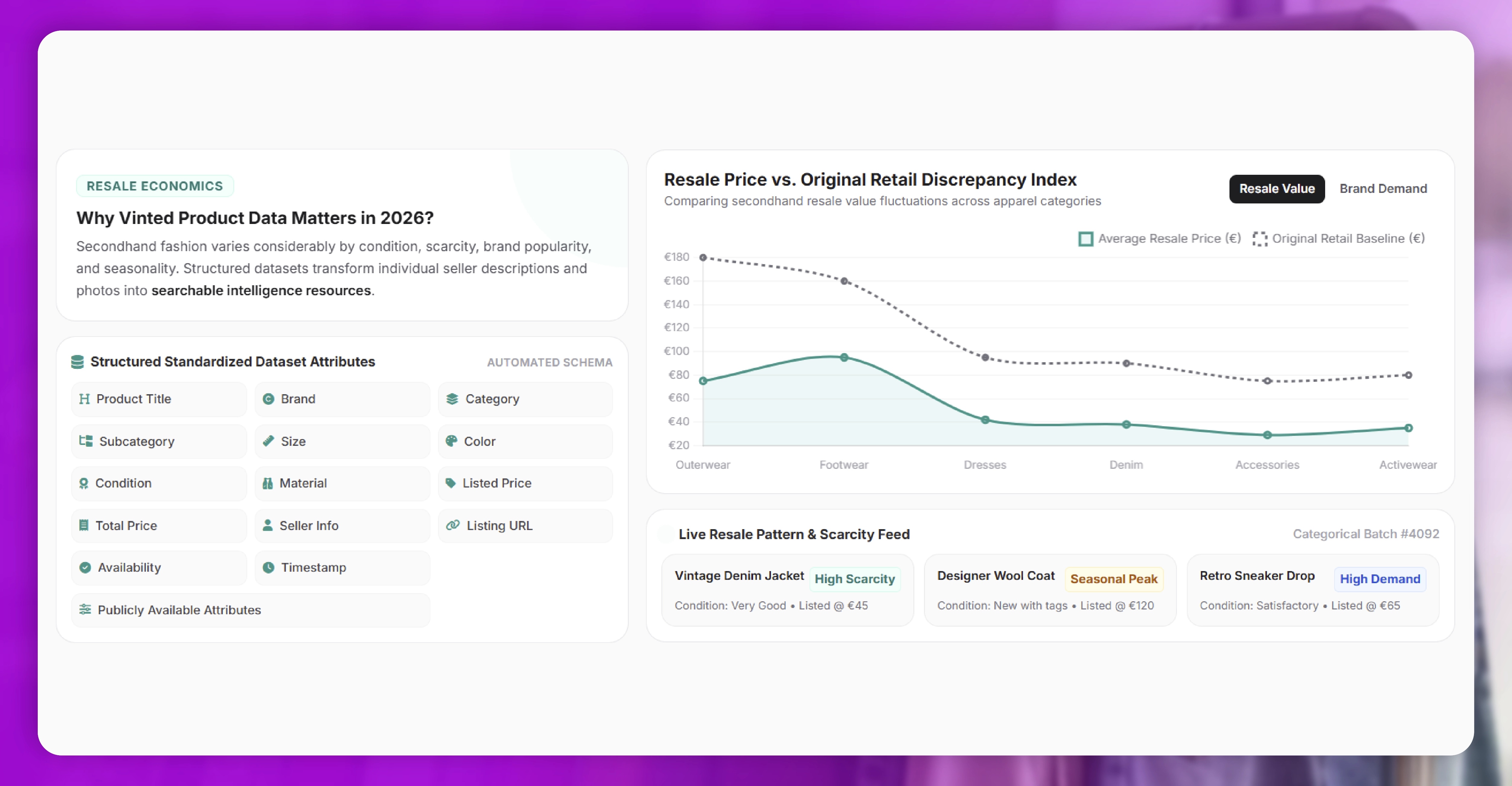
The secondhand fashion market is fundamentally different from conventional retail. New products generally have standardized prices, while resale listings can vary considerably depending on condition, age, demand, scarcity, seller behavior, brand popularity, and seasonality.
Vinted's marketplace structure makes these differences particularly valuable for data analysis. Sellers create individual listings, choose prices, provide descriptions, select conditions, and upload photographs. Buyers can search and compare available products before making purchasing decisions.
A structured dataset can transform these individual listings into a searchable intelligence resource. Instead of reviewing thousands of product pages manually, analysts can examine large collections of standardized records and identify patterns across categories and brands.
A typical dataset may contain product title, brand, category, subcategory, size, color, condition, material, listed price, displayed total price, seller information where legally appropriate, listing URL, availability status, timestamp, and other publicly available attributes.
What Can a Vinted Product & Pricing Dataset Include?
A comprehensive dataset can be designed around the specific requirements of a business or research project.
Product-level information can include titles, descriptions, brands, categories, product types, sizes, colors, materials, condition grades, images, listing dates, and availability indicators.
Pricing information can include listed item price, applicable buyer charges, shipping information, price changes, promotional activity, and historical observations. Vinted states that buyers pay shipping, while the platform displays applicable charges during the purchasing process.
Condition is another important variable. A pre-owned product marked as "very good" should not necessarily be compared directly with the same product marked as "satisfactory." Segmenting prices by condition allows analysts to create more meaningful benchmarks.
Brand information can also support deeper research. A dataset can group listings by brand, category, price range, condition, and other available attributes to determine which brands maintain stronger resale values.
Vinted Pricing Dataset for Market Research
A Vinted pricing dataset for market researchers can provide a practical foundation for understanding secondhand consumer behavior.
Researchers can analyze median prices, price distributions, brand premiums, category-level differences, and variations between new-with-tags and used products. They can also examine how pricing differs between entry-level and premium brands.
For example, researchers studying resale value could compare the listed prices of similar jackets across multiple brands while controlling for condition, size, and product type. This makes it easier to identify whether a brand commands a consistent resale premium.
Time-series collection can add another layer of intelligence. By capturing the same product categories at regular intervals, analysts can observe pricing movements, listing volumes, product availability, and seasonal changes.
Fashion Product Data Scraping Service particularly useful for understanding fashion cycles. Winter coats, boots, knitwear, summer dresses, swimwear, and festival clothing may demonstrate different availability and pricing patterns throughout the year.
Understanding Vinted Secondhand Fashion Pricing
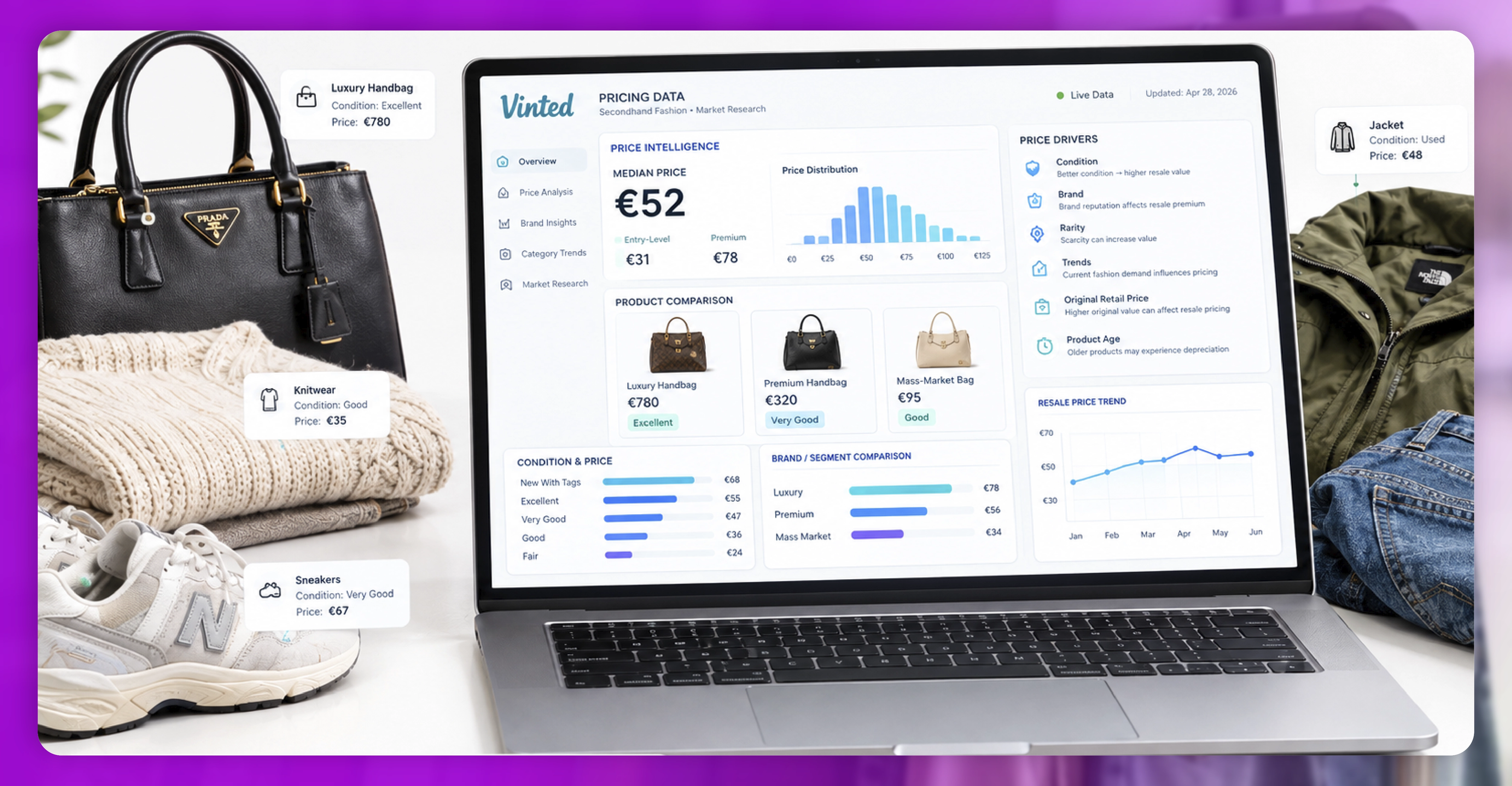
The Vinted secondhand fashion pricing data 2026 landscape can provide insights into how consumers value products after their initial retail purchase.
Unlike traditional retail pricing, resale pricing reflects multiple variables simultaneously. Condition, brand reputation, rarity, current fashion trends, original retail price, product age, and seller expectations can all influence the listed amount.
A structured dataset allows analysts to separate these variables.
For instance, a luxury handbag listed at a higher price may reflect brand value, condition, scarcity, or authenticity-related considerations. Meanwhile, a mass-market garment may have a substantially lower resale price even when it is in excellent condition.
Such comparisons help businesses understand depreciation and residual value across different fashion segments.
Vinted also requires sellers to accurately represent an item's quality and appearance, including defects or alterations, which makes condition-related fields particularly relevant when developing analytical models.
Brand Competitive Intelligence Through Vinted Data
Fashion brands can use marketplace intelligence to understand what happens to their products after the primary retail transaction.
A brand may discover that certain products retain stronger resale values than others. It could identify which categories have high resale visibility, which product styles appear frequently, and which products attract higher secondhand prices.
This information can influence future product development and merchandising decisions.
For example, if a particular jacket style consistently maintains stronger resale prices than comparable products, the brand may investigate its materials, design, popularity, or scarcity.
Resale data can also help brands understand consumer demand beyond their own websites and retail stores.
Vinted Price Monitoring for Fashion Brands
Vinted price monitoring for fashion brands can turn marketplace observations into ongoing competitive intelligence.
Instead of collecting data only once, businesses can schedule recurring collection and monitor changes over time. This can help identify price reductions, newly appearing listings, changing availability, and shifting market activity.
Price monitoring can also support resale benchmarking. Brands can track selected products or comparable products across categories and evaluate how their perceived value changes over time.
Another benefit is anomaly detection. A sudden increase or decrease in listings for a particular product may indicate changing consumer interest, seasonal effects, or market activity.
Scrape Fashion Retailer Products and Pricing Data to make these observations easier to manage than manual searches.
Key Use Cases for the Dataset
The dataset can support several business applications.
Competitive benchmarking: Compare secondhand pricing between brands, product categories, conditions, and product types.
Market research: Identify consumer preferences, pricing patterns, popular brands, and changing resale behavior.
Trend analysis: Track emerging styles, colors, categories, and brands gaining visibility in the secondhand market.
Resale valuation: Estimate potential residual value by analyzing comparable products and historical observations.
Pricing strategy: Use marketplace benchmarks to understand how retail products may be valued after entering the resale ecosystem.
Product lifecycle analysis: Study how prices change as products become older or move through different stages of consumer ownership.
Building a High-Quality Vinted Dataset
Creating useful marketplace data requires more than collecting product names and prices.
Data should be normalized so that similar products can be compared consistently. Brand names, categories, sizes, currencies, condition labels, and product types may need standardization.
Duplicate listings should also be identified where possible. A product appearing repeatedly should not automatically be treated as independent demand.
Timestamping is essential for historical research. Without collection dates, researchers cannot accurately distinguish current prices from previous observations.
Data validation is equally important. Missing fields, incorrect categories, inconsistent prices, unavailable listings, and duplicate records can affect analytical results.
A robust pipeline therefore combines automated collection, parsing, validation, normalization, deduplication, storage, and scheduled refreshes.
Compliance and Responsible Data Collection
Responsible marketplace data collection should respect applicable laws, platform terms, access restrictions, privacy requirements, and intellectual property considerations.
Vinted's terms explain that it operates the marketplace while sellers list goods in its catalog, and its catalog rules define requirements surrounding listings, prohibited content, commercial activity, and product information.
Businesses should therefore define their collection requirements carefully and avoid collecting unnecessary personal information. The focus should remain on relevant product and marketplace attributes required for legitimate analytical purposes.
How iWeb Data Scraping Can Help You?
Scalable Product Collection
iWeb Data Scraping can collect structured Vinted product information across selected categories, brands, conditions, and markets, helping businesses create scalable datasets without relying on repetitive manual research.
Pricing Intelligence
Automated collection can capture product prices and relevant marketplace attributes at scheduled intervals, enabling analysts to identify pricing movements, competitive gaps, discounts, and secondhand valuation patterns.
Brand-Level Monitoring
Businesses can monitor selected brands, product categories, and comparable listings to understand marketplace positioning, resale visibility, pricing behavior, and changing consumer interest across secondhand fashion segments.
Customized Data Delivery
iWeb Data Scraping can organize collected information according to business requirements, supporting customized fields, standardized formats, recurring updates, historical datasets, and analytics-ready outputs for research teams.
Market Research Support
Structured marketplace datasets can help researchers evaluate category trends, brand performance, pricing differences, product availability, and resale-market behavior while reducing the time required for large-scale manual analysis.
Conclusion
The Vinted marketplace provides valuable signals about secondhand fashion demand, product availability, brand strength, condition-based pricing, and resale value. A well-structured Vinted Product & Pricing Dataset 2026 can turn these marketplace observations into actionable business intelligence.
For fashion brands, retailers, researchers, investors, and marketplace analysts, regularly updated product and pricing information can support benchmarking, competitive analysis, trend forecasting, and resale-market research.
As secondhand commerce continues developing, organizations that combine historical marketplace data with automated analytics can better understand how products perform beyond their initial retail lifecycle.
Businesses looking to build scalable marketplace intelligence can explore Web Scraping API Services for automated and structured data collection. They can also leverage E-commerce Data Extraction Services to collect broader product, pricing, availability, and competitive information across digital marketplaces.
For businesses studying customer feedback alongside pricing and product information, an Ecommerce Product Ratings and Review Dataset can further strengthen marketplace research by connecting product attributes with customer sentiment and performance indicators.
FAQs
It is a structured collection of marketplace information such as product titles, brands, categories, conditions, sizes, prices, availability, and other relevant listing attributes collected for analytical purposes.
Vinted data can help brands understand secondhand pricing, resale visibility, product demand, competitive positioning, and how different products retain value after their original retail sale.
Depending on the collection scope, analysts can study listed item prices, price changes, shipping information, buyer-facing charges, category-level price differences, condition-based pricing, and brand-level resale benchmarks.
Yes. A recurring collection strategy can capture marketplace observations at defined intervals, allowing businesses to create historical datasets and monitor changes in pricing, availability, and product activity.
Fashion brands, retailers, resale businesses, market researchers, investment teams, pricing analysts, e-commerce companies, and data intelligence firms can use structured Vinted data for research and competitive analysis.